
Wire-to-Board Connector Market Report Scope & Overview:
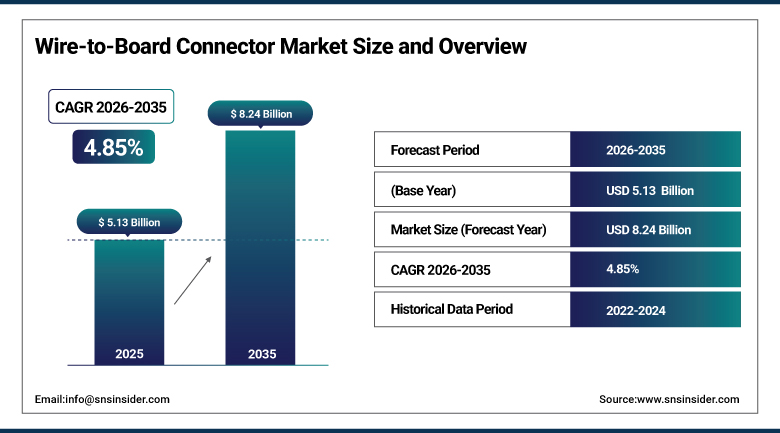
The Wire-to-Board Connector Market was valued at USD 5.13 Billion in 2025 and is expected to reach USD 8.24 Billion by 2035, growing at a CAGR of 4.85% from 2026-2035.
The Wire-to-Board Connector Market is expanding as every electronic system adds more modules, sensors and power stages that need dependable wire terminations. Vehicle electrification and driver assistance are raising connector counts per car. Industrial robots and automation cells require compact power and signal links. Data centers and telecom equipment add demand for dense board-level interconnects. Consumer devices keep shrinking so pitches are getting finer. Manufacturers are launching hybrid power and signal housings and higher current ratings. Asia Pacific anchors production while North America and Europe lead automotive and industrial design wins. These shifts support steady growth through 2035. Standardization efforts also ease supplier switching.
⮞In May 2026, the International Energy Agency reported in its Global EV Outlook that electric car sales exceeded 20 million in 2025, about one quarter of new cars sold. The surge adds demand for wire-to-board connectors in battery management, charging and control electronics.
To Get more information Wire-to-Board Connector Market - Request Free Sample Report
Wire-to-Board Connector Market Trends
-
Hybrid housings that combine power and signal contacts are cutting connector counts and routing area in robots and vehicles.
-
Modular cartridge-based connectors aligned to automotive standards are supporting zonal and software-defined vehicle architectures.
-
High-voltage and high-current wire-to-board designs are entering electric vehicle power electronics.
-
Fine-pitch and surface-mount compatible housings are advancing with device miniaturization.
-
Data center expansion and factory automation are creating new demand for dense and rugged board-level connections.
U.S. Wire-to-Board Connector Market Outlook
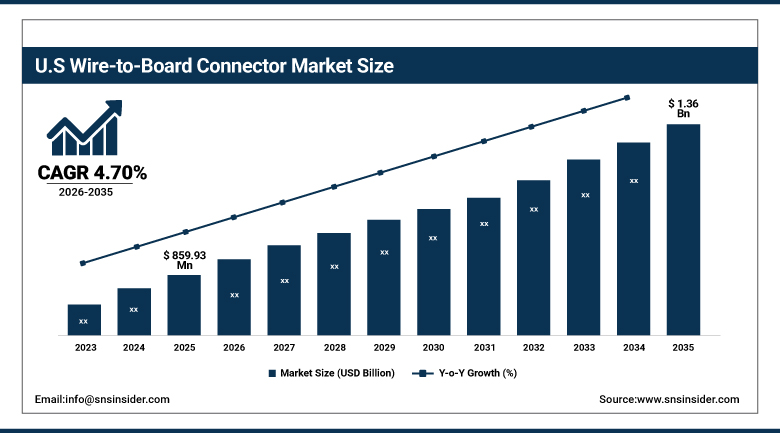
The U.S. Wire-to-Board Connector Market was valued at USD 859.93 Million in 2025 and is expected to reach USD 1.36 Billion by 2035, growing at a CAGR of 4.70% from 2026-2035.
The U.S. Wire-to-Board Connector Market is anchored by automotive electrification, aerospace and defense programs, data center construction and a large industrial equipment base. Federal safety rules are adding advanced driver assistance modules to nearly every new light vehicle. Hyperscale data centers are expanding power and server hardware that depend on board-level connections. Medical device makers need small reliable interconnects for diagnostic and wearable equipment. Reshoring of electronics assembly is gradually shifting demand toward local supply chains. Distributors and design engineers value connector families with broad catalogs and fast sample access. These conditions support steady growth in the U.S. through 2035.
⮞In April 2024, the National Highway Traffic Safety Administration finalized FMVSS 127, which requires automatic emergency braking including pedestrian detection on nearly all light vehicles with a compliance date of September 2029. The mandate adds sensor and control modules that rely on wire-to-board connectors.
Wire-to-Board Connector Market Segment Analysis
-
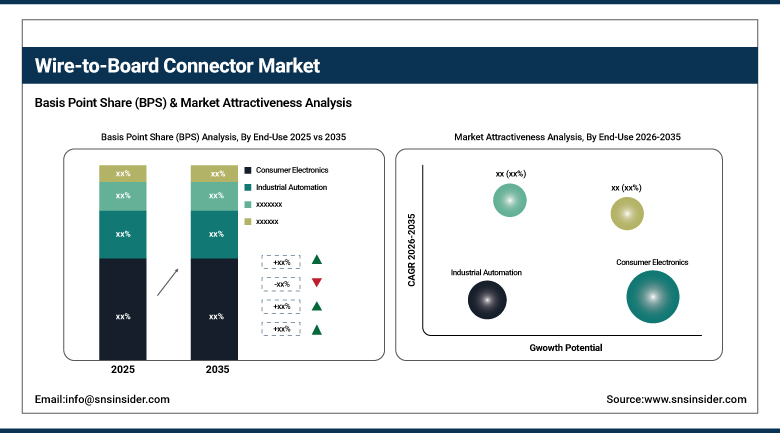
By End-Use, the Consumer Electronics segment dominated the Wire-to-Board Connector Market with approximately 35.03% share in 2025, while the Medical Devices segment is the fastest growing with a CAGR of approximately 7.63%.
-
By Pitch, the Up to 2 mm segment dominated the Wire-to-Board Connector Market with approximately 48.98% share in 2025, while the 2.1 mm to 4 mm segment is the fastest growing with a CAGR of approximately 5.10%.
-
By Mounting Type, the Surface-Mount segment dominated the Wire-to-Board Connector Market with approximately 58.63% share in 2025, while the Through-Hole segment is the fastest growing with a CAGR of approximately 5.00%.
-
By Current Rating, the 1.1 A to 3 A segment dominated the Wire-to-Board Connector Market with approximately 42.53% share in 2025, while the Above 6 A segment is the fastest growing with a CAGR of approximately 6.43%.
By End-Use, Consumer Electronics Dominates the Wire-to-Board Connector Market and Medical Devices Grows Fastest
Consumer electronics lead because smartphone accessories, televisions, appliances, laptops, wearables and smart home devices all use internal wire terminations for batteries, speakers, displays and sensors. High unit volumes make this the largest consumption base. Designers favor compact crimp and poke-in connectors that speed automated and manual assembly. Short product cycles keep design activity high and encourage continuous introduction of thinner housings. Cost pressure is intense so standardized families with broad second-source availability prevail. Appliance makers add further volume through control boards and motor drives.
Medical devices are growing fastest as diagnostic equipment, infusion pumps, patient monitors and wearable sensors multiply. These products require small low-profile connectors that withstand sterilization, vibration and repeated handling. Regulatory expectations for traceability and reliability favor established suppliers with documented materials. Home care and remote monitoring devices increase demand for compact battery and sensor links. Miniaturization of portable imaging and diagnostic equipment pushes pitches below 1 mm. Rising healthcare investment in emerging economies adds further volume. Biocompatible housings and low-outgassing plastics further support adoption.
⮞In 2025, China produced 266.975 million air conditioners according to the National Bureau of Statistics communique issued in February 2026. Output on this scale sustains steady demand for connectors in control boards, fans and compressors.
By Pitch, Up to 2 mm Dominates the Wire-to-Board Connector Market and 2.1 mm to 4 mm Grows Fastest
Fine pitch connectors up to 2 mm dominate because device makers are shrinking boards while adding functions. These housings pack more circuits into a small footprint and support low-profile enclosures in phones, wearables, cameras and medical monitors. Surface-mount compatibility and automated crimping keep assembly costs manageable. Families at 1.0, 1.25, 1.5 and 2.0 mm have mature supply chains and many second sources. Designers use them for signal, sensor and low-current power links where space is the main constraint. Tooling availability further reinforces their position.
Mid-pitch connectors from 2.1 mm to 4 mm are growing faster as power electronics demand higher currents without moving to large industrial terminals. Housings in this range carry battery, motor, LED driver and fan circuits in appliances, robots and vehicles. Wider spacing eases wire gauge handling and supports locking features that withstand vibration. Hybrid designs that combine power and signal contacts are appearing in this band. Automotive and industrial buyers favor them for a balance of density and ruggedness. Wider spacing also eases hand assembly in low-volume builds.
⮞In September 2026 , the International Federation of Robotics reported that the global operational stock of industrial robots rose 9% to a record 5 million units in 2025. Each robot contains multiple drives and sensors that use compact board-level wire connections.
By Mounting Type, Surface-Mount Dominates the Wire-to-Board Connector Market and Through-Hole Grows Fastest
Surface-mount terminations lead because they suit automated assembly lines and thin product designs. Reflow-compatible housings and tape-and-reel packaging allow high placement speed and consistent quality. Smaller footprints free board space for other components. Manufacturers add retention features and standoffs to improve mechanical strength. Consumer, telecom and industrial electronics lean on this approach to control assembly cost. The preference also aligns with the push for lighter and thinner devices across end markets. Low profile heights allow stacking of boards in compact enclosures and wearable products.
Through-hole connectors are growing faster in applications that value mechanical strength under vibration, high current and repeated mating. Power conversion, motor control, automotive modules and industrial equipment still rely on soldered pins for solid anchoring. Press-fit and selective soldering methods ease adoption on mixed-technology boards. Higher power ratings and thicker wire gauges make through-hole retention attractive as electrification spreads. Suppliers offer locking and polarized housings that reduce field failures. Demand strengthens where reliability outweighs space savings. Repairability and field replacement also favor this mounting type in industrial service settings.
⮞In September 2025 , LightingEurope stated that EU RoHS mercury exemptions for certain compact fluorescent and T9 lamps expired on 24 February 2025. The shift toward LED lighting increases the number of driver and light engine boards that use board-mounted wire connections.
By Current Rating, 1.1 A to 3 A Dominates the Wire-to-Board Connector Market and Above 6 A Grows Fastest
Connectors rated at 1.1 A to 3 A lead because they cover the widest range of signal, sensor and low-power functions in modern electronics. Fans, displays, small motors, LED strips and communication modules all fall within this window. Standard crimp housings in this band offer a balance between size, cost and contact reliability. Large production runs reduce unit costs and keep sourcing simple for buyers. Designers often reuse proven families across product generations. Compatibility with common 22 to 28 AWG wire keeps assembly straightforward.
Connectors above 6 A are growing fastest as power density rises in electric vehicles, industrial drives, servers and energy storage. Higher current terminals with larger contacts and thicker insulation allow compact power links directly on boards. Vendors now offer wire-to-board designs that carry tens of amperes while keeping manageable footprints. Thermal management, low contact resistance and secure locking are decisive qualities. Hybrid housings add signal contacts alongside power ones to simplify harnesses. Demand is strongest in battery management, onboard charging and motor control applications.
Regional Analysis
|
Region |
Major Country |
Share within Region, 2025 (%) |
|---|---|---|
|
Asia Pacific |
China |
44.58% |
|
Europe |
Germany |
31.20% |
|
North America |
United States |
91.30% |
|
Latin America |
Mexico |
29.18% |
|
Middle East & Africa |
South Africa |
34.17% |
Asia Pacific Wire-to-Board Connector Market Insights
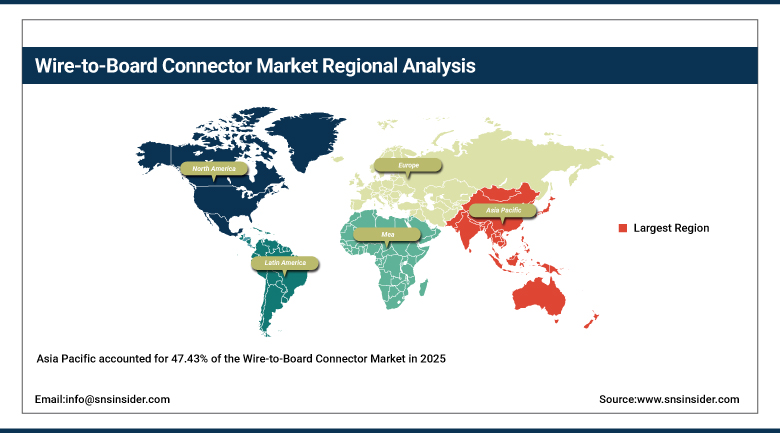
Asia Pacific accounted for 47.43% of the Wire-to-Board Connector Market in 2025, which made it the largest region. China dominates regional production of consumer electronics, appliances, vehicles and industrial robots and also supports a deep local connector industry. Japan hosts leading connector makers with strong positions in automotive and compact electronics. South Korea and Taiwan add demand from displays, semiconductors and devices. India is scaling electronics manufacturing and vehicle output. Southeast Asia is gaining assembly volume as companies diversify production.
Short supply chains give regional buyers fast access to housings, terminals and crimp tooling. Electric vehicle production creates sustained demand for high-current and high-voltage designs. Smartphone, wearable and smart home assembly requires fine-pitch connectors in very large volumes. Robotics and factory automation investments extend demand into industrial power and signal links. Local suppliers compete aggressively on price while global brands focus on automotive and high-reliability applications. Government incentives for electronics manufacturing in India and Vietnam add new capacity. Contract manufacturers in the region also standardize on a limited set of connector families to simplify procurement.
⮞In January 2026, the China Association of Automobile Manufacturers reported that China's new energy vehicle output reached 16.626 million units in 2025. Output at this scale sustains demand for high-current connectors in battery and charging systems.
Get Customized Report as per Your Business Requirement - Enquiry Now
Europe Wire-to-Board Connector Market Insights
Europe holds the second-largest share, supported by strong automotive, industrial automation and medical technology sectors. Germany is the regional leader with its vehicle makers, machine builders and connector manufacturers. France, Italy, the United Kingdom and Central European countries add production of vehicles, appliances and rail equipment. European regulations on safety and chemicals encourage suppliers to document materials and qualification. Local connector brands emphasize modular and industrial families that serve harsh environments. Electrification programs among carmakers keep design activity high. Rail and aerospace programs add further qualified volume.
Industrial automation and robotics integrators demand compact modular connectors for drives, sensors and control cabinets. Renewable energy and building automation add steady volume. The medical device industry in Germany, Switzerland and Ireland requires reliable small interconnects. Battery plants across Hungary, Poland and Germany create demand for power connections in modules and packs. Price pressure from Asian suppliers pushes European vendors to compete on quality, customization and service. Distributors with strong technical support remain important for small and mid-sized buyers. Sustainability rules also encourage recyclable materials.
⮞In January 2026, the European Automobile Manufacturers' Association reported that battery-electric cars reached a 17.4% share of EU new car registrations in 2025. The shift increases electronic content per vehicle and the number of board-level connections.
North America Wire-to-Board Connector Market Insights
North America combines strong automotive, aerospace, data center and medical device industries. The United States leads with design wins in advanced driver assistance, server hardware, avionics and industrial automation. Canada adds demand through vehicle assembly and clean energy equipment. Engineers in the region favor connector families with extensive catalogs, quick samples and high reliability ratings. Distributors play a vital role in serving prototype and low-volume buyers. Reshoring and supply chain diversification programs are gradually increasing local assembly of electronics. Hospital equipment makers add steady replacement demand.
Data center expansion for artificial intelligence workloads is lifting demand for power supplies, cooling systems and server components with board-level connections. Defense and space programs require qualified high-reliability connectors. Appliance and HVAC makers continue to modernize controls. Medical device firms need compact connectors for portable monitoring. Compliance with safety agencies and automotive standards adds a gating step for new suppliers. Vendors that offer testing support and customization win design slots. Growth is steady rather than rapid because markets are mature.
⮞In December 2024, a report by Lawrence Berkeley National Laboratory for the U.S. Department of Energy released projects that data centers could use between 6.7% and 12% of U.S. electricity by 2028. The outlook supports demand for server and power hardware that uses board-level connectors.
MEA & Latin America Wire-to-Board Connector Market Insights
Latin America is projected to expand at a CAGR of 6.33% during 2026-2035 and is the fastest growing region from a smaller base. Mexico is the regional hub for automotive assembly, electronics manufacturing and appliance production serving North American buyers. Brazil adds demand from vehicles, appliances and industrial equipment. Nearshoring investments are attracting new electronics and vehicle plants. Local content rules and import duties shape sourcing choices. Connector suppliers are expanding distribution and technical support to serve growing assembly clusters.
Middle East & Africa has potential for steady growth because of vehicle assembly facilities, appliance manufacturing, telecommunication infrastructure, and industrial projects. South Africa represents the largest manufacturing country, where there are automobile manufacturing and electronic suppliers. Gulf nations have projects on industrial diversification, data centers, and green energy development. Implementation of telecommunication networks in Africa needs network equipment with board-level connectors. There is no manufacturing of connectors locally; therefore, most of them are imported through distribution channel, and the prices and delivery times are dependent on logistics.
Market Dynamics
Growth Drivers: Vehicle Electrification and Data Center Expansion Drive Growth in the Wire-to-Board Connector Market
Vehicle electrification is the strongest demand source. Electric cars carry battery management systems, onboard chargers, inverters, sensors and displays that all require wire-to-board links. Driver assistance mandates and zonal architectures increase the number of electronic control units per vehicle. Connector makers are launching higher voltage and higher current families that meet automotive qualification standards. Each new platform brings multi-year supply agreements that stabilize volumes. Growth in charging infrastructure adds a related stream of connector demand. Tier one suppliers also expand regional plants close to vehicle assembly lines.
Data center and telecom buildouts provide a second driver. Servers, switches, power supplies and cooling systems require dense and reliable connections on boards. Industrial automation, robotics and building control add further volume as factories invest in sensors and drives. Miniaturized consumer devices keep generating design wins for fine-pitch housings. Wider use of automated inspection improves yield for connector producers. These overlapping end markets reduce dependence on any single cycle. Remote monitoring and edge computing devices add smaller but fast growing volumes.
⮞In April 2026, the Society of Indian Automobile Manufacturers reported that electric passenger vehicle registrations in India rose by more than 80% in fiscal 2025-26. The growth expands the base for battery and charging connectors.
Restraints: Cost Pressure and Qualification Complexity Restrain Growth in the Wire-to-Board Connector Market
Price competition is intense in consumer and appliance applications where connectors are treated as commodities. Raw material costs for copper alloys, plating metals and engineering plastics affect margins and can change quickly. Buyers often dual source and switch suppliers for small savings. Design complexity is increasing as higher currents and smaller pitches require tighter tolerances. Advanced materials and tooling raise development costs for suppliers. Imitations of lower quality also weaken brand reliability. These pressures limit profitability and slow investment among smaller manufacturers.
Adhering to safety, environmental and performance standards takes time and increases costs. Auto certification against industry standards needs testing and paperwork before large orders. The need for traceability by medical and aerospace customers increases cost of quality systems. Cyclicality in auto and consumer electronics industries may lead to fluctuating inventories and cancellation of orders. Restrictions on trade and logistics issues impact availability of critical components. Integration issues also exist for engineers, due to increasing density and thermal constraints of boards. Shortages of skilled labor and increased labor costs in assembly locations increase manufacturing costs.
⮞In October 2026, INEGI, Mexico's national statistics agency, reported that light vehicle production in September 2026 was 301,803 units, a decline of 15.1% from a year earlier. The drop illustrates how cyclical automotive output can weigh on connector demand.
Opportunities: Medical Devices and Robotics Create Opportunities in the Wire-to-Board Connector Market
Medical devices, wearables and diagnostic equipment offer premium opportunities for compact reliable connectors. Regulatory approvals for artificial intelligence enabled devices continue to expand the installed base of monitoring and imaging systems. Suppliers that provide sterilization-resistant materials and traceability documentation can command higher margins. Home care equipment and remote patient monitoring require small connectors with secure latching. Long product lifecycles in the sector create stable replacement demand. Partnerships with device makers early in design secure multi-year supply. Wearable therapeutic devices further extend the range of products needing miniature connectors.
Robotics and automation represent another expanding opportunity. Humanoid robots, autonomous mobile robots and collaborative arms use many motors and sensors that require hybrid power and signal connectors in tight spaces. Energy storage systems and electric vehicle charging infrastructure add high-current applications. Customization, modular housings and integrated cable assemblies help suppliers capture design wins. Asia Pacific and Latin America provide geographic growth as manufacturing capacity expands. Companies that combine product breadth with rapid prototyping and local technical support are best placed to benefit.
⮞As of September 2026, the U.S. Food and Drug Administration states that it has authorized over 1,600 artificial intelligence enabled medical devices for marketing in the United States. The growing device base broadens demand for compact interconnects in monitoring and imaging equipment.
Recent Developments:
-
2026: Hirose Electric launched the ZE150HV wire-to-board connector with a 4.5 mm pitch, a 10 A rating with all pins powered, a 1,000 V rating and operation up to 125 °C. It targets battery packs, e-axles, inverters and onboard chargers and was named a CES Innovation Awards 2026 Honoree.
-
2025: TE Connectivity launched an Inside Device Connectivity portfolio for automotive electronic control units and software-defined vehicles. The range covers flex-to-board, wire-to-board, board-to-board and wire-to-wire connectors with wire-to-board versions carrying up to 45 A. It targets onboard chargers, DC-DC converters, battery management systems and ADAS radar and LiDAR.
-
2024: Kyocera AVX introduced the 9169-000 Series single-piece wire-to-board card-edge connector with 2.5 mm pitch and 2 to 10 positions for 22 to 28 AWG wire. It is rated at 3 A for 2 to 6 contacts and 2 A for 7 to 10 contacts at 100 V, operates from -40 to +130 °C and is UL approved. The series targets automotive, lighting, industrial and consumer applications.
Wire-to-Board Connector Market Key Players
-
Molex
-
TE Connectivity
-
Amphenol
-
J.S.T. Mfg. Co., Ltd.
-
Hirose Electric Co., Ltd.
-
Japan Aviation Electronics Industry, Limited (JAE)
-
Kyocera AVX
-
Phoenix Contact
-
Samtec
-
Würth Elektronik
-
HARTING
-
Harwin
-
WAGO
-
SMK Corporation
Wire-to-Board Connector Market Report Scope:
| Report Attributes | Details |
|---|---|
| Market Size in 2025 | USD 5.13 Billion |
| Market Size by 2035 | USD 8.24 Billion |
| CAGR | CAGR of 4.85% From 2026 to 2035 |
| Base Year | 2025 |
| Forecast Period | 2026-2035 |
| Historical Data | 2022-2024 |
| Report Scope & Coverage | Market Size, Segments Analysis, Competitive Landscape, Regional Analysis, DROC & SWOT Analysis, Forecast Outlook |
| Key Segments | • By End-Use (Consumer Electronics, Automotive, Industrial Automation, IT and Telecom, Medical Devices, Aerospace and Defense, and Others) • By Pitch (Up to 2 mm, 2.1 mm to 4 mm, and Above 4 mm) • By Mounting Type (Surface-Mount and Through-Hole) • By Current Rating (Up to 1 A, 1.1 A to 3 A, 3.1 A to 6 A, and Above 6 A) |
| Regional Analysis/Coverage | North America (US, Canada), Europe (Germany, UK, France, Italy, Spain, Russia, Poland, Rest of Europe), Asia Pacific (China, India, Japan, South Korea, Australia, ASEAN Countries, Rest of Asia Pacific), Middle East & Africa (UAE, Saudi Arabia, Qatar, South Africa, Rest of Middle East & Africa), Latin America (Brazil, Argentina, Mexico, Colombia, Rest of Latin America). |
| Company Profiles | Molex, TE Connectivity, Amphenol, J.S.T. Mfg. Co., Ltd., Hirose Electric Co., Ltd., Japan Aviation Electronics Industry, Limited (JAE), Kyocera AVX, Phoenix Contact, Samtec, Würth Elektronik, HARTING, Harwin, WAGO, SMK Corporation |

Frequently Asked Questions
The key players in the Wire-to-Board Connector Market include Molex, TE Connectivity, Amphenol, J.S.T. Mfg. Co., Ltd., Hirose Electric Co., Ltd., among others.
Key opportunities include compact and traceable connectors for medical devices and wearables, hybrid power and signal connectors for robots and automation, and high-current designs for energy storage and electric vehicle charging.
The major growth factor is vehicle electrification and the rising electronic content per vehicle, together with data center expansion, which increase the number of board-level wire connections across modules and power stages.
The Consumer Electronics segment dominated the Wire-to-Board Connector Market with approximately 35.03% share in 2025, supported by high unit volumes in appliances, wearables, televisions and smart home devices.
Asia Pacific dominated the Wire-to-Board Connector Market with a 47.43% share in 2025, driven by large electronics, appliance and vehicle production bases in China, Japan, South Korea and India.
