
Wireless Routers Market Report Scope & Overview:
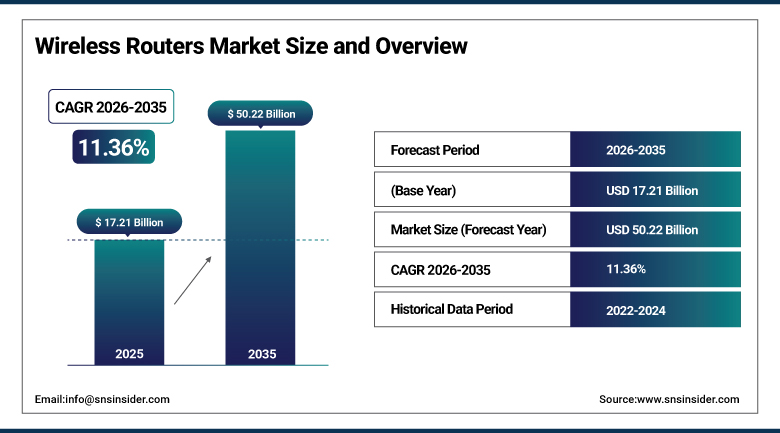
The Wireless Routers Market was valued at USD 17.21 billion in 2025 and is expected to reach USD 50.22 billion by 2035, growing at a CAGR of 11.36% from 2026-2035.
The Wireless Routers Market is witnessing strong growth due to increasing internet penetration, rapid adoption of connected devices, and rising demand for reliable high-speed wireless connectivity. The proliferation of smart homes, IoT deployments, telecommuting, video games, and video streaming services is creating a need for innovative wireless networking products. Moreover, the move tWi-Fi 6 and Wi-Fi 7 technologies is enhancing network speeds, capacity, and latency, thus motivating customers and businesses to replace their existing networks. Increasing use of fiber broadband, 5G networks, and cloud computing applications is adding to the demand for routers. The growing levels of digitization and connected devices are providing additional support to market growth.
⮞ITU estimates that approximately 6 billion people were online in 2025, representing about three-quarters of the world's population, creating a large installed base for wireless networking equipment.
To Get more information Wireless Routers Market - Request Free Sample Report
Wireless Routers Market Trends
-
Rising adoption of connected devices and smart home technologies is driving demand for high-speed wireless routers with reliable connectivity.
-
Increasing internet usage, video streaming, cloud applications, and online gaming are accelerating demand for faster and higher-capacity wireless networking solutions.
-
Growing adoption of Wi-Fi 6 and Wi-Fi 7 technologies is improving network speeds, capacity, latency, and connectivity across residential and enterprise environments.
-
Increasing deployment of 5G broadband and fixed wireless access is creating demand for advanced routers supporting high-speed cellular and wireless connectivity.
-
Advancements in mesh networking and multi-gigabit technologies are expanding coverage, reducing connectivity dead zones, and improving performance across large premises.
U.S. Wireless Routers Market Outlook
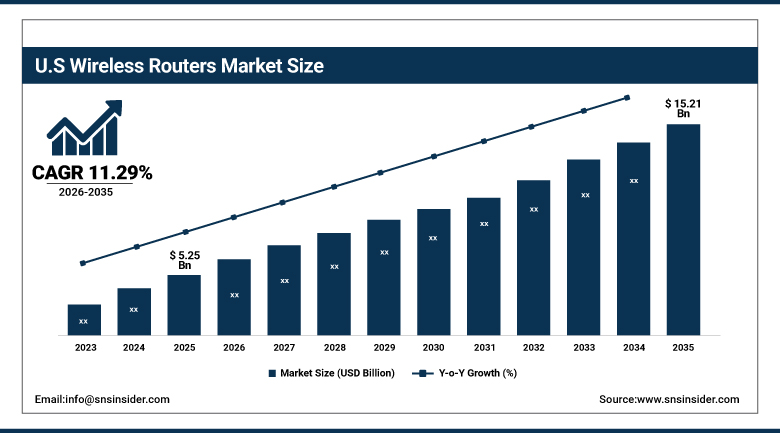
U.S. Wireless Routers Market was valued at USD 5.25 billion in 2025 and is expected to reach USD 15.21 billion by 2035, growing at a CAGR of 11.29% from 2026-2035.
The U.S. Wireless Routers Market is witnessing strong growth due to widespread broadband adoption, increasing internet usage, and the rapid proliferation of connected devices across households and businesses. Increased need for fast connectivity for remote working, online gaming, video streaming, smart homes, and IoT uses is contributing to the upgrading of routers. Moreover, with the use of Wi-Fi 6 and Wi-Fi 7 technologies, there is an increased need to upgrade older networking hardware due to the provision of faster speeds, better capacity, and low latency. There is also the growth of fiber broadband, 5G services, cloud computing and connectivity in enterprises that is increasing demand for routers in the US.
⮞FCC data show that fixed broadband is widely deployed across the U.S., with fiber and other high-speed technologies continuing to expand access to faster internet connections.
Wireless Routers Market Segment Analysis
-
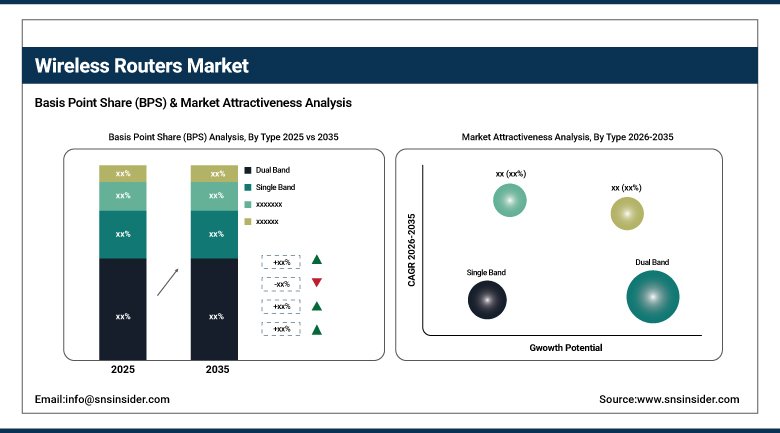
By Type, Dual Band dominated the Wireless Routers Market with 50% share in 2025; Tri Band is expected to grow at the fastest CAGR of 12.18% from 2026–2035.
-
By Wi-Fi Standard, 802.11ac (Wi-Fi 5) dominated the Wireless Routers Market with 42% share in 2025; 802.11be (Wi-Fi 7) is expected to grow at the fastest CAGR of 15.89% from 2026–2035.
-
By Frequency Band, 5 GHz dominated the Wireless Routers Market with 58% share in 2025; 6 GHz is expected to grow at the fastest CAGR of 13.21% from 2026–2035.
-
By Application, Residential dominated the Wireless Routers Market with 54% share in 2025; Industrial is expected to grow at the fastest CAGR of 14.18% from 2026–2035.
-
By End User, Individual Consumers dominated the Wireless Routers Market with 49% share in 2025; Service Providers are expected to grow at the fastest CAGR of 12.68% from 2026–2035.
By Type, Dual Band dominates the wireless routers market, Tri Band grows fastest.
Dual Band segment dominated the Wireless Routers Market with the highest revenue share of about 50% in 2025 Because it works on both 2.4 GHz and 5 GHz frequencies, offering an optimum blend of coverage, speed, and device compatibility. The rising use of connected devices, broadband adoption at home, and wireless connectivity needs have boosted the market prospects of the segment worldwide.
Tri Band segment is expected to grow at the fastest CAGR of 12.18% from 2026-2035 Due to the rising need for increased bandwidth and performance of multiple devices that are connected through the network. Tri-Band routers ensure sufficient capacity for applications like 4K streaming, gaming, and smart-home devices. Increased Wi-Fi traffic and number of connected devices is bound to increase the demand further.
⮞In February 2025, TP-Link launched the Archer GE650 Tri-Band Wi-Fi 7 Gaming Router, offering speeds up to 11 Gbps, dual 5 Gbps ports, and gaming acceleration features to support bandwidth-intensive applications and multiple connected devices.
By Wi-Fi Standard, 802.11ac (Wi-Fi 5) dominates the wireless routers market, 802.11be (Wi-Fi 7) grows fastest.
802.11ac (Wi-Fi 5) segment dominated the Wireless Routers Market with the highest revenue share of about 42% in 2025 owing to its extensive adoption, proven ecosystem, inexpensive hardware, and compatibility with many phones, computers, and other devices. Its efficient high-speed operation meets all networking needs for both household and business usage. The availability of devices and updates in standards also continue to drive the market.
802.11be (Wi-Fi 7) segment is expected to grow at the fastest CAGR of 15.89% from 2026-2035 This is attributed to the rise in the need for high speed, low latency, and reliable wireless connections. The new technology comes with greater bandwidth and better efficiency for networks. More usage of advanced devices, cloud computing, and gaming is likely to enhance the use of Wi-Fi 7 in the future.
⮞In January 2025, ASUS introduced the ROG Rapture GT-BE19000AI gaming router at CES, integrating a neural processing unit, AI-powered game acceleration, and adaptive quality-of-service capabilities to support next-generation Wi-Fi 7 connectivity.
By Frequency Band, 5 GHz dominates the wireless routers market, 6 GHz grows fastest.
5 GHz segment dominated the Wireless Routers Market with the highest revenue share of about 58% in 2025 due to the favorable ratio between its speed, capacity, and compatibility with already existing wireless devices. This band offers a faster data transmission compared to 2.4 GHz but with less congestion. Increased consumption of broadband, online gaming, and video streaming is making the demand higher.
6 GHz segment is expected to grow at the fastest CAGR of 13.21% from 2026-2035 due to higher demand for extra frequencies, low network congestion, and fast wireless connections. The band allows advanced Wi-Fi technology and offers more bandwidth for applications requiring high speed. Increased use of Wi-Fi 6E and Wi-Fi 7 devices, smart homes, and enterprise networks will drive market growth.
⮞In May 2025, TP-Link introduced the Deco BE65-Outdoor Wi-Fi 7 mesh router, incorporating 6 GHz connectivity, 320 MHz channels, Automated Frequency Coordination, and Multi-Link Operation to extend high-capacity wireless networking into outdoor residential environments.
By Application, Residential dominates the wireless routers market, Industrial grows fastest.
Residential segment dominated the Wireless Routers Market with the highest revenue share of about 54% in 2025 because of the extensive availability of broadband connections at home and the growing presence of mobile phones, laptops, smart TVs, video game consoles, and other connected gadgets. There is now an ever-growing consumer demand for reliable wireless networks for various purposes.
Industrial segment is expected to grow at the fastest CAGR of 14.18% from 2026-2035 due to rising utilization of IoT, automation, interconnected machines, and real-time monitoring systems. Wireless connectivity plays an important role in facilitating data communication in intelligent manufacturing facilities. Rising industry 4.0 initiatives and digitization of the factories along with requirement for flexible industrial network will drive the global use of advanced wireless routers.
⮞In March 2025, WoMaster introduced the WA512G-AX-5GM2-D industrial wireless router, integrating Wi-Fi 6 and 5G connectivity with dual-band 2.4 GHz and 5 GHz operation to support industrial automation, smart-city infrastructure, and Industrial IoT applications.
By End User, Individual Consumers dominates the wireless routers market, Service Providers grow fastest.
Individual Consumers segment dominated the Wireless Routers Market with the highest revenue share of about 49% in 2025 as a result of high Internet use in homes, growing broadband subscriptions, and reliance on connected devices. The need for streaming, gaming, telecommuting, and smart home applications keeps driving router purchases. Higher Internet penetration and greater device ownership keep strengthening the demand from consumers around the world.
Service Providers segment is expected to grow at the fastest CAGR of 12.68% from 2026-2035 due to increased broadband networks, fiber optics, and demand for superior customer premises networking equipment. Providers are continually upgrading their routers to provide high-speed internet connections. With more users, modernized networks, and adoption of Wi-Fi technology, the demand for such routers is set to rise worldwide.
⮞In May 2026, Calix expanded its Wi-Fi 7 portfolio with the GigaSpire 7u4 and GigaPro 7p6 devices, integrated with the Calix One platform to help broadband service providers deliver managed connectivity across residential, commercial, and multi-dwelling environments.
Regional Analysis
|
Region |
Major Country |
Share within Region, 2025 (%) |
|---|---|---|
|
North America |
United States |
66.5% |
|
Europe |
Germany |
24.0% |
|
Asia Pacific |
China |
46.0% |
|
Middle East & Africa |
UAE |
17.0% |
|
Latin America |
Brazil |
40.0% |
North America Wireless Routers Market Insights
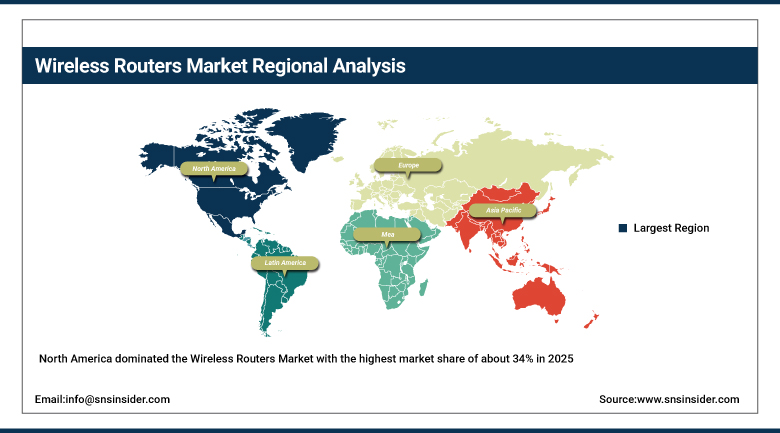
North America dominated the Wireless Routers Market with the highest market share of about 34% in 2025, Driven by high broadband penetration rates, extensive use of connected devices, and high demand for reliable high-speed home and business Internet connections. The expansion of smart-home technology, advanced networking infrastructure, router replacement, and the demand for Wi-Fi 6 and Wi-Fi 7 solutions contribute to regional dominance.
The U.S. Wireless Routers Market accounted for a market share of 66.5%, The market will be propelled by high broadband penetration, the proliferation of connected devices, and robust demand for fast wireless connectivity. Increasing adoption of smart home systems, network demands from enterprises, and the evolution to Wi-Fi 6, Wi-Fi 6E, and Wi-Fi 7 routers have increased the demand for the products.
⮞In July 2025, NETGEAR launched its Orbi 370 Series Wi-Fi 7 mesh networking system in the United States, expanding its residential router portfolio with dual-band connectivity, enhanced whole-home coverage, and integrated security features for connected households.
Get Customized Report as per Your Business Requirement - Enquiry Now
Europe Wireless Routers Market Insights
Europe Wireless Routers Market is witnessing steady growth, backed by enhanced deployment of fiber broadband network, internet penetration rate, and the adoption of connected devices. Rising demand for fast and stable home and business connectivity is driving the replacement of routers. Smart homes, streaming applications, IoT solutions, and Wi-Fi 6, Wi-Fi 7 technology are some of the factors that are helping to develop the regional market.
The Germany Wireless Routers Market accounted for a market share of 24.0%, Enabled through state-of-the-art broadband connectivity, rising usage of fiber optics, and the use of connected devices. Rising demand for reliable connectivity through the households and businesses is driving up-gradation of routers. Increased usage of smart homes technology, networking by enterprises, and new generation Wi-Fi technology, coupled with Germany’s technological infrastructure, drives the growth of this market.
⮞In September 2026, German networking manufacturer FRITZ! announced the market launch of its FRITZ!Box 6690 Pro cable router, incorporating tri-band Wi-Fi 7 connectivity, while presenting additional fiber-optic and DSL networking products at IFA 2026.
Asia Pacific Wireless Routers Market Insights
Asia Pacific is expected to grow at the fastest CAGR of about 12.26% from 2026–2035, backed by high-speed internet diffusion, growing broadband infrastructure development, and increasing usage of smartphones and smart home devices. The region is experiencing further acceleration due to digitalization, increasing data consumption, 5G roll-out, the rise of e-commerce, and fast networking infrastructure development in China, India, Japan, and South Korea.
The China Wireless Routers Market accounted for a market share of 46.0%, It is backed by fast digitalization, extensive broadband coverage, and a vast number of internet-enabled devices. Increasing need for fast internet connectivity, home automation, and wireless technology is leading to its acceptance. Excellent production capabilities of electronics, growing fiber optic coverage, affordable router costs, and e-commerce are other factors that make it even more developed.
⮞In May 2026, TP-Link India commenced local manufacturing of its Wi-Fi 7 product portfolio following the government's January 2026 lower 6 GHz spectrum notification, strengthening domestic production capabilities for next-generation wireless networking equipment.
Middle East & Africa and Latin America Wireless Routers Market Insights
The Middle East & Africa and Latin America Wireless Routers Market is gradually expanding, The need for broadband is driven by increased internet use, broadband network construction, and digitalization. Increased use of remote work options, digital learning, smart home devices, and digital entertainment is driving the need for stable wireless connectivity. Investment in fiber optic networks, 5G networks, smart cities, and rural connectivity is driving growth in regional markets.
The UAE Wireless Routers Market accounted for a market share of 17.0%, Backed by rising internet usage, digitalization, and developments in sophisticated telecommunication infrastructure. The increasing use of smart home gadgets, cloud-based services, streaming, and connectivity solutions is boosting the need for wireless connectivity. Development of 5G network infrastructure, smart city projects, and continuous development in broadband infrastructure development is boosting the growth of the market in UAE.
⮞In May 2026, e& UAE introduced its Fibre+ home connectivity experience, offering multi-gigabit broadband speeds of up to 10 Gbps and providing advanced Wi-Fi 7 routers with selected eLife Ultra Starter, Neo, and Neo Fusion subscriptions.
⮞In September 2026, Brazil's telecommunications regulator Anatel opened public consultations proposing technical requirements for outdoor Wi-Fi operation in the 6 GHz band, including standard-power equipment and Automated Frequency Coordination systems supporting advanced Wi-Fi 7 deployments.
Market Dynamics
Growth Drivers: Growing demand for high-speed internet and connected devices is accelerating adoption of advanced wireless routers globally
Increasing demand for high-speed internet connectivity is significantly driving the Wireless Routers Market. The increase in the use of devices such as smartphones, laptops, smart TVs, gaming consoles, IoT devices, and smart home appliances is leading to an increase in the number of devices accessing wireless networks at one time. The increase in the use of cloud-based apps, UHD video streaming, online gaming, and AI-based apps is further leading to an increase in bandwidth and low-latency needs. The Wi-Fi 7 technology is being adopted at a fast pace due to the need for increased bandwidth and performance, as per Counterpoint Research’s prediction that Wi-Fi 7 will make up 54% of global broadband CPE shipments in 2030.
Restraints: Intense price competition and declining retail shipments can limit revenue growth for wireless router manufacturers
Intense competition among networking equipment manufacturers is creating pricing pressure across the wireless router market. Consumers enjoy access to a wide array of offerings at varying price points, and cheaper providers have started to rival the big players in terms of networking. Wi-Fi CPE shipments fell by 6% year-over-year in the first quarter of 2026 as they have done in several years of decline since their 2021 peak. Even as more sophisticated Wi-Fi 7 offerings contribute to premium offerings, providers still have to innovate on technology while keeping prices competitive. Such factors may limit the profit margins that vendors can earn while also making growth difficult.
Opportunities: Rapid expansion of Wi-Fi 7 and multi-gigabit broadband creates significant opportunities for next-generation wireless router manufacturers
The rapid expansion of Wi-Fi 7 and multi-gigabit broadband services is creating substantial opportunities for wireless router manufacturers. Wi-Fi 7 integrates technologies like Multi-Link Operation, wider channels, and increased modulation efficiency to enable higher data rates and reduced latency. Counterpoint predicts that Wi-Fi 7-enabled broadband CPE will account for 54% of global shipment figures by 2030. In the case of the enterprise sector, modernization is happening at an accelerated pace, and Wi-Fi 7 will emerge as the most predominant enterprise-dependent access point generation by early 2026. Manufacturers can leverage their advantages by offering premium-class routers and CPE devices for the multi-gig era.
Recent Developments:
-
2026 : TP-Link continued expanding its Wi-Fi 7 router portfolio with new dual-band and tri-band models, including higher-speed 10G and 2.5G Ethernet connectivity, Multi-Link Operation, and EasyMesh support for high-performance home networking.
-
2026 : Huawei strengthened its wireless networking technology position through continued development of Wi-Fi 7 technologies and expanded Wi-Fi patent licensing activity, supporting the deployment of next-generation wireless connectivity across compatible devices and infrastructure.
-
2026 : NETGEAR continued expanding its Wi-Fi 7 router portfolio, including the Nighthawk RS100, targeting more affordable access to next-generation wireless connectivity while supporting multi-gigabit networking for homes and small businesses.
-
2026 : ASUSTeK Computer continued advancing Wi-Fi 7 networking products, with new-generation ROG and ZenWiFi systems targeting high-speed gaming, multi-device connectivity, mesh coverage, and demanding home networking applications.
Wireless Routers Market key players are:
-
TP-Link Systems Inc.
-
Huawei Technologies Co., Ltd.
-
NETGEAR, Inc.
-
Cisco Systems, Inc.
-
ASUSTeK Computer Inc.
-
D-Link Corporation
-
Xiaomi Corporation
-
ZTE Corporation
-
Ubiquiti Inc.
-
Nokia Corporation
-
Juniper Networks, Inc.
-
Hewlett Packard Enterprise Company
-
CommScope, Inc.
-
Belkin International, Inc.
-
Linksys Holdings, Inc.
-
Synology Inc.
-
Shenzhen Tenda Technology Co., Ltd.
-
Buffalo Inc.
-
Zyxel Communications Corporation
-
MikroTik
Wireless Routers Market Report Scope:
| Report Attributes | Details |
|---|---|
| Market Size in 2025 | USD 17.21 Billion |
| Market Size by 2035 | USD 50.22 Billion |
| CAGR | CAGR of 11.36% From 2026 to 2035 |
| Base Year | 2025 |
| Forecast Period | 2026-2035 |
| Historical Data | 2022-2024 |
| Report Scope & Coverage | Market Size, Segments Analysis, Competitive Landscape, Regional Analysis, DROC & SWOT Analysis, Forecast Outlook |
| Key Segments | • By Type (Single Band, Dual Band, Tri Band) • By Wi-Fi Standard (802.11n (Wi-Fi 4), 802.11ac (Wi-Fi 5), 802.11ax (Wi-Fi 6), 802.11be (Wi-Fi 7)) • By Frequency Band (2.4 GHz, 5 GHz, 6 GHz) • By Application (Residential, Commercial, Industrial, Public Wi-Fi, Smart Home) • By End User (Individual Consumers, Small & Medium Enterprises, Large Enterprises, Service Providers) |
| Regional Analysis/Coverage | North America (US, Canada), Europe (Germany, UK, France, Italy, Spain, Russia, Poland, Rest of Europe), Asia Pacific (China, India, Japan, South Korea, Australia, ASEAN Countries, Rest of Asia Pacific), Middle East & Africa (UAE, Saudi Arabia, Qatar, South Africa, Rest of Middle East & Africa), Latin America (Brazil, Argentina, Mexico, Colombia, Rest of Latin America). |
| Company Profiles | TP-Link Systems Inc., Huawei Technologies Co., Ltd., NETGEAR, Inc., Cisco Systems, Inc., ASUSTeK Computer Inc., D-Link Corporation, Xiaomi Corporation, ZTE Corporation, Ubiquiti Inc., Nokia Corporation, Juniper Networks, Inc., Hewlett Packard Enterprise Company, CommScope, Inc., Belkin International, Inc., Linksys Holdings, Inc., Synology Inc., Shenzhen Tenda Technology Co., Ltd., Buffalo Inc., Zyxel Communications Corporation, and MikroTik. |

Frequently Asked Questions
Key players in the Wireless Routers Market include TP-Link Systems Inc., Huawei Technologies Co., Ltd., NETGEAR, Inc., Cisco Systems, Inc., and ASUSTeK Computer Inc., among others.
Key opportunities in the Wireless Routers Market include expansion of Wi-Fi 7 adoption, increasing demand for high-speed connectivity, and growing deployment of smart home and connected devices.
The Dual Band segment dominated the Wireless Routers Market, accounting for approximately 49.50% market share.
The North America region dominated the Wireless Routers Market in 2025 with a 33.50% share, driven by high firearm sales and strong defense procurement.
