
The 5G mmWave Technology Market is growing as telecom operators and enterprises look for faster data speeds, lower latency and more network capacity in crowded areas. Millimeter wave spectrum can carry large volumes of data over short distances, which makes it useful for stadiums, airports, city centers, factories and fixed wireless broadband. Rising mobile data traffic, the spread of connected devices and the need for private networks are increasing the use of mmWave equipment and services. Vendors are also developing better chips, antennas and repeaters that extend coverage, which will support market growth.
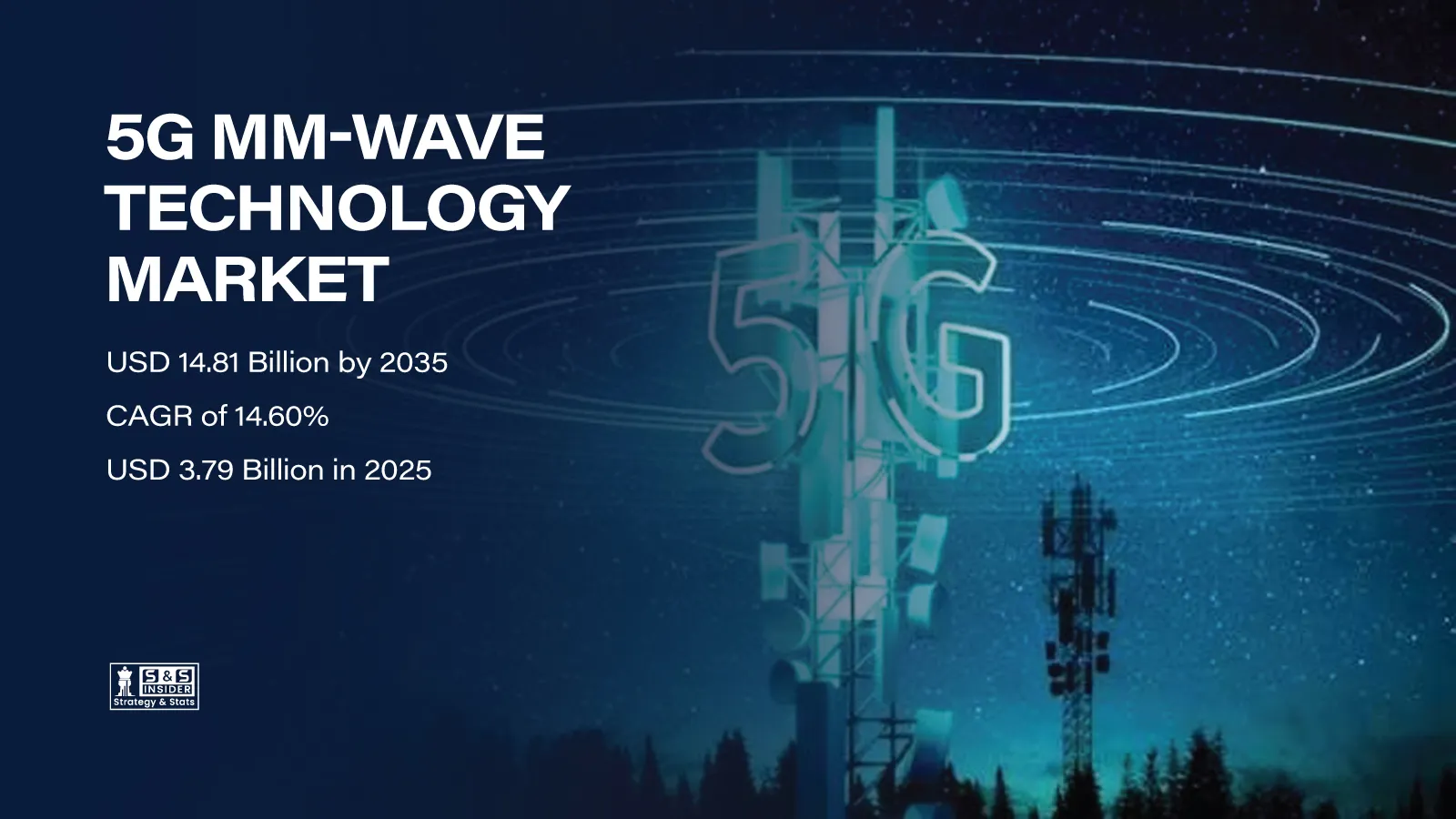
The 5G mmWave Technology Market value stood at USD 3.79 billion in 2025 and is anticipated to grow to USD 14.81 billion by 2035, growing at a CAGR of 14.60% in the forecast period of 2026-2035. Hardware held around 53.14% of the market by component, while telecom operators accounted for 62.48% of total demand in 2025.
Unlock exclusive market insights download the brochure to explore global 5G mmWave Technology Market trends, emerging opportunities, competitive developments, and forecasts through 2035.
Regional Analysis of the 5G mmWave Technology Market
The 5G mmWave technology market is expanding across North America, Europe, Asia-Pacific, Latin America and Middle East & Africa. North America dominated the market with around 37.62% share in 2025 owing to early mmWave spectrum auctions, strong operator investment and high demand for fixed wireless access. North America is dominated by the US, which had a market valuation of USD 1.27 billion in 2025 and is forecasted to grow at a CAGR of 14.10%. Europe accounted for around 25.73% and Germany, the UK and Italy were leading in mmWave trials and enterprise use cases.
Asia-Pacific will be driven by the highest CAGR of 16.12% due to large-scale 5G rollouts, strong device manufacturing and growing smart factory projects and the leading countries in Asia-Pacific include Japan, South Korea and China. Latin America and Middle East & Africa are witnessing stable growth due to new spectrum allocations, rising mobile data use and early fixed wireless deployments.
Top 10 Trends in the 5G mmWave Technology Market
- Rising use of fixed wireless access, the fastest-growing use case at a CAGR of 17.86%.
- Continued leadership of enhanced mobile broadband in high-traffic venues.
- Strong demand for the 24–57 GHz band, which held 63.27% share in 2025.
- Growing interest in the 57–95 GHz band for very high-capacity links.
- Fast growth of services as operators seek planning, deployment and support.
- Rising enterprise adoption for private networks in factories and campuses.
- Use of repeaters and smart surfaces to extend mmWave coverage indoors.
- New modem-RF systems that support higher peak speeds in smartphones.
- Expanded test and measurement tools for new frequency ranges.
- Growing investment in mmWave chip startups and module makers.
5G mmWave Technology Market Growth Drivers and Opportunities
Growth prospects for the market are due to rising mobile data traffic and the need for high-capacity networks in dense urban areas. Operators are using mmWave to ease congestion where mid-band spectrum alone cannot meet demand. Device makers are also adding mmWave support to more smartphones and routers. For example, in March 2026, Qualcomm unveiled the Snapdragon X105 modem-RF system, with a peak downlink speed of 14.80 Gbps.
The growing potential is evident among enterprises, private networks and fixed wireless broadband providers. For example, in April 2026, Ericsson and du completed a 5G standalone proof of concept in the UAE using extended-range mmWave on the AIR 5343 radio. Short signal range, high deployment costs, line-of-sight limits and slow spectrum release in some countries are some challenges in this market.
Top 10 Companies in the 5G mmWave Technology Market
The 5G mmWave technology industry is made up of chipset makers, network equipment vendors, component suppliers and test equipment providers. The competitive advantage for these companies lies in RF design expertise, strong patent portfolios, close ties with telecom operators and the ability to deliver reliable products at scale.
- Qualcomm Incorporated
- Telefonaktiebolaget LM Ericsson
- NEC Corporation
- Sivers Semiconductors AB
- Anritsu Corporation
- Nokia Corporation
- Samsung Electronics Co., Ltd.
- Huawei Technologies Co., Ltd.
- Keysight Technologies, Inc.
- Movandi Corporation
- Qualcomm Incorporated
Qualcomm Incorporated is a U.S.-based semiconductor company known for mobile processors and wireless technology. It supplies modems, RF front-end parts and antenna modules that enable mmWave in smartphones and other devices. In March 2026, the company unveiled the Snapdragon X105 modem-RF system with a peak downlink speed of 14.80 Gbps.
- Telefonaktiebolaget LM Ericsson
Ericsson is a Swedish telecom equipment company serving mobile operators worldwide. It provides radio access networks, core networks and mmWave radios for 5G deployments. In April 2026, Ericsson and du completed a 5G standalone proof of concept in the UAE using extended-range mmWave on its AIR 5343 radio.
- NEC Corporation
NEC Corporation is a Japanese technology company active in network infrastructure and IT services. It develops radio units and transport solutions for 5G operators. In May 2026, NEC announced a 40 GHz distributed MIMO technique, developed with NTT, that raised tunnel trial throughput from about 430 Mbps to 560 Mbps.
- Sivers Semiconductors AB
Sivers Semiconductors AB is a Swedish company specialized in RF and photonics chips. It designs mmWave beamformers and transceivers for 5G and fixed wireless access. In May 2026, the company signed a USD 1.50 million development agreement with Tachyon Networks for a 60 GHz transceiver.
- Anritsu Corporation
Anritsu Corporation is a Japanese test and measurement company serving telecom and electronics firms. It provides tools used to test 5G devices, base stations and networks. In February 2026, Anritsu added a 16 GHz frequency range 3 option to its MT8000A 5G device test station.
Company Profile
A detailed company profile can cover:
- Business overview and company snapshot
- Product portfolio and frequency band coverage
- Market position and competitive analysis
- Financial performance, where available
- Recent developments, partnerships and acquisitions
- SWOT analysis
The remaining companies can be assessed using the same framework in a comprehensive market research report.
Future Outlook of the 5G mmWave Technology Market
Growth in the 5G mmWave technology industry is set to continue as operators look for more capacity in busy locations and enterprises build private networks. Fixed wireless access, higher frequency bands and better coverage tools will widen the range of use cases. Asia-Pacific will add strong demand, while North America will remain a key market for deployments. Companies that improve chip efficiency, coverage and cost may gain a stronger competitive position over the forecast period.



