
According to the latest SNS Insider Computer Vision in Healthcare Market report, the global market is growing quickly as hospitals, diagnostic centers and technology suppliers use image analysis in daily clinical work. Imaging volumes keep rising and there are not enough radiologists to read them. Software that can review scans, slides and surgical video helps care teams keep up with this workload.
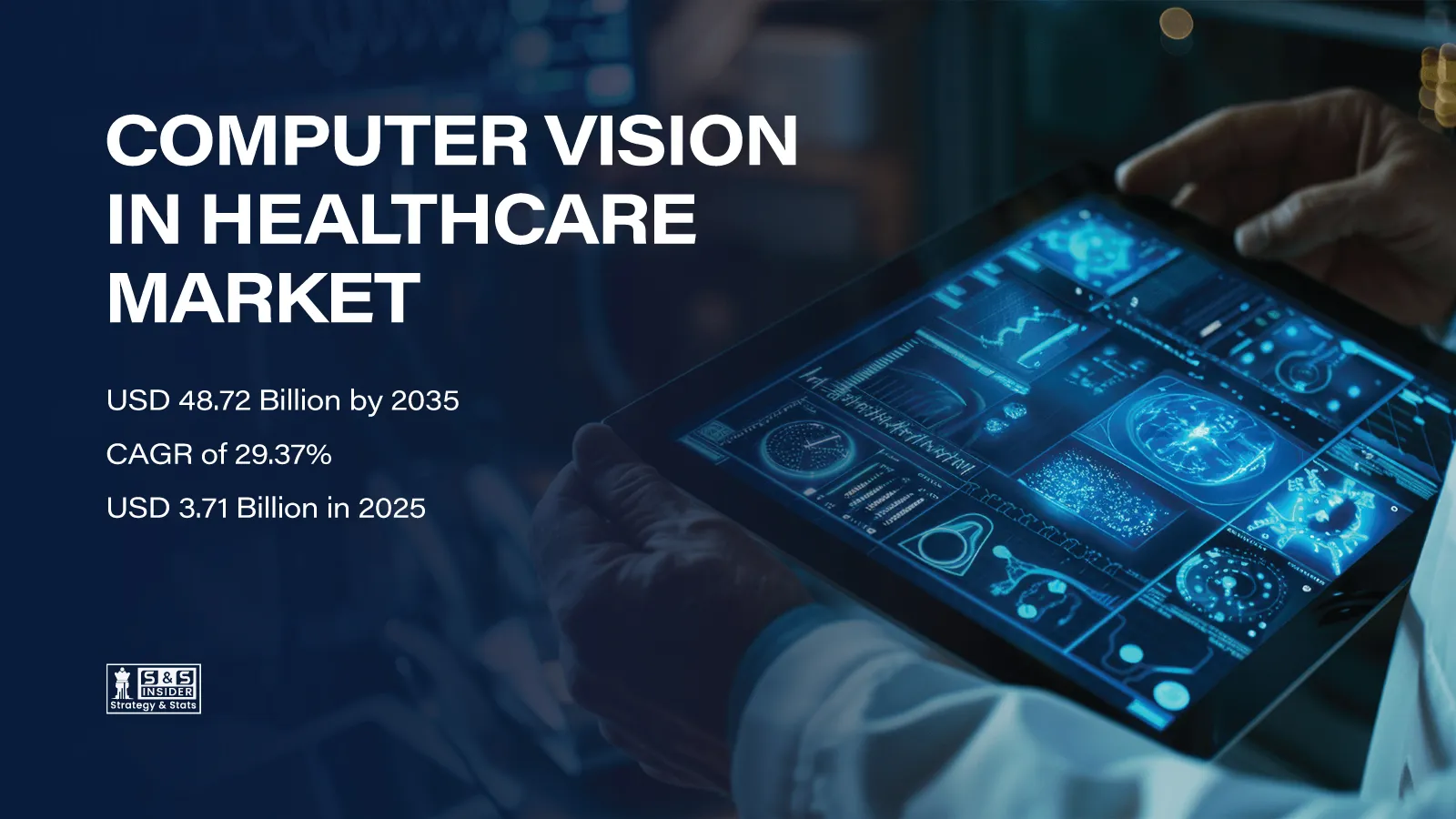
The global computer vision in healthcare market was valued at USD 3.71 Billion in 2025. It is estimated at USD 4.80 Billion in 2026 and is projected to reach USD 48.72 Billion by 2035, growing at a CAGR of 29.37% during 2026–2035.
Hardware holds the largest share today because hospitals need cameras, processors and imaging systems to run these tools. Software is growing faster. Once the hardware is in place, providers add new algorithms and pay for them as subscriptions.
Medical imaging and diagnostics remains the main use. Surgical assistance is growing fastest as operating rooms start to record and analyze video. More regulatory approvals for AI-enabled devices are also making buyers more confident.
North America is the largest regional market. Asia Pacific has the strongest growth outlook, supported by hospital digitization and rising imaging volumes.
Market Size and Forecast
|
Market Indicator |
Value |
|
Market Size, 2025 |
USD 3.71 Billion |
|
Market Size, 2026 |
USD 4.80 Billion |
|
Market Forecast, 2035 |
USD 48.72 Billion |
|
CAGR, 2026–2035 |
29.37% |
|
Leading Region, 2025 |
North America (37.18%) |
|
Fastest-Growing Region |
Asia Pacific (31.11% CAGR) |
Demand Drivers and Constraints
Primary Demand Drivers
-
Rising imaging volumes and radiologist shortages: Hospitals use computer vision to sort urgent cases and shorten reading times when staff are stretched.
-
More regulatory approvals for AI devices: A growing number of cleared tools gives providers more confidence to use them in clinical work.
-
Growth in digital pathology and cancer screening: Digitized slides and screening programs create large image sets that software can review consistently.
-
Surgical robotics and operating room video: Video analysis supports surgical guidance, workflow tracking and training.
-
Lower cost of processing hardware: Cheaper graphics processors and edge devices make it practical to run models inside hospitals.
Potential Growth Constraints
-
Data privacy and patient consent requirements.
-
Models that perform unevenly across sites and scanners.
-
Gaps in reimbursement for AI-assisted reads.
-
Complex integration and high upfront infrastructure costs.
Demand Structure by Component
Hardware (2025 Market Share: 38.64%)
Hardware accounted for 38.64% of the market in 2025. Computer vision tools need cameras, sensors, processing units and imaging devices before any software can run, so hospitals spend on this layer first. Operating rooms, endoscopy suites and imaging departments are adding equipment that can capture and process images in real time. Edge devices let hospitals analyze data on site, which reduces delay and keeps patient images inside their own networks. Hardware demand will stay steady as facilities replace older systems and expand AI use to new departments.
Current trend: Hospitals are adding edge computing devices to imaging and surgical suites.
Major trends: Graphics processing units, edge servers, high-resolution medical cameras and embedded vision modules.
Software (Forecast CAGR: 31.46%)
Software is projected to grow at a CAGR of 31.46% during 2026–2035. Once a hospital has the right hardware, it can add new algorithms without replacing equipment. Providers buy tools for triage, detection, measurement and reporting, often through subscriptions or platforms that hold many applications. Each new regulatory approval adds to the range of software clinicians can use. Platforms that bring several algorithms into one workflow are especially appealing, because they cut down on separate logins and contracts.
Current trend: Hospitals are moving to platforms that host many algorithms.
Major trends: AI marketplaces, foundation models, cloud deployment and subscription pricing.
Demand Structure by Product Type
PC-Based Systems (2025 Market Share: 48.73%)
PC-based systems held 48.73% of the market in 2025. These systems use workstations and servers with strong processing power, which suits detailed analysis of CT, MRI and pathology images. Radiology departments already run reading workstations, so adding vision software to them is simple. PC-based systems can also handle large datasets and complex models that smaller devices cannot run. Their flexibility and fit with existing hospital IT keep them at the center of most deployments.
Current trend: AI analysis is being built into existing reading workstations.
Major trends: GPU-equipped workstations, server-based inference, workstation integration with picture archiving and communication systems (PACS) and multi-model processing.
Smart Camera-Based Systems (Forecast CAGR: 30.02%)
Smart camera-based systems are expected to grow at a CAGR of 30.02% through 2035. These devices capture and process images in one unit, so they need less supporting infrastructure. Hospitals use them for patient monitoring, fall detection, operating room tracking and point-of-care imaging. Their small size and lower cost suit wards, clinics and remote sites. Better onboard processors are widening the tasks these cameras can handle without a link to a central server.
Current trend: More smart cameras are being used for patient monitoring in wards.
Major trends: Onboard AI processors, contactless monitoring, compact vision sensors and operating room tracking.
Demand Structure by Application
Medical Imaging and Diagnostics (2025 Market Share: 38.17%)
Medical imaging and diagnostics represented 38.17% of the market in 2025. Radiology, cardiology, pathology and ophthalmology produce large numbers of images every day and reading them takes skilled time. Computer vision tools flag urgent findings, measure structures and point out possible problems, which helps clinicians work through their caseloads faster. Most approved AI devices today focus on imaging, so buyers have the widest choice here. Higher scan volumes and screening programs will keep this application the largest through the forecast period.
Current trend: AI triage is becoming part of routine radiology work.
Major trends: Stroke and trauma detection, cancer screening support, automated measurements and digital pathology review.
Surgical Assistance (Forecast CAGR: 33.55%)
Surgical assistance is projected to grow at a CAGR of 33.55% during 2026–2035. Robotic systems and recorded procedures produce video that software can analyze for guidance, instrument tracking and quality review. Hospitals use these insights to improve consistency, train surgeons and plan operating room schedules. As more procedures are done with robots and cameras, more surgical video becomes available for analysis. This growing pool of data supports faster adoption across specialties.
Current trend: More surgical video is being recorded and analyzed.
Major trends: Instrument tracking, surgical phase recognition, augmented guidance and operating room analytics.
Demand Structure by End User
Healthcare Providers (2025 Market Share: 45.83%)
Healthcare providers accounted for 45.83% of market revenue in 2025. Hospitals and health systems run the largest imaging departments, operating rooms and inpatient wards, so they have the broadest need for computer vision. They use these tools to manage workloads, improve patient safety and support clinical decisions. Large systems often buy platforms that can be used across many sites. Ongoing staff shortages and pressure on budgets are expected to keep investment steady.
Current trend: Health systems are rolling out AI tools across all their sites.
Major trends: Enterprise AI platforms, patient safety monitoring, imaging triage and workflow automation.
Diagnostic Centers (Forecast CAGR: 31.82%)
Diagnostic centers are expected to grow at the fastest end-user CAGR of 31.82% through 2035. Outpatient imaging groups handle high volumes and must report results quickly, which makes automated analysis valuable. Computer vision helps them read more studies without hiring as many staff and keeps report quality consistent. Many centers prefer cloud-based tools that need little on-site setup. Growth in outpatient imaging and screening will continue to support demand.
Current trend: Outpatient imaging centers are adopting cloud-based AI reading tools.
Major trends: Cloud deployment, high-volume screening support, report automation and pay-per-use pricing.
Key Market Participants
The computer vision in healthcare market includes medical imaging manufacturers, AI software developers and hardware suppliers.
Key participants include GE HealthCare, Siemens Healthineers, Koninklijke Philips, Aidoc, NVIDIA, Viz.ai, PathAI, Tempus AI (including Paige), Lunit, Oxipit, Subtle Medical, Basler AG, Coreline Soft and Harrison.ai.
Companies compete on clinical accuracy, the number of regulatory approvals they hold, how well they fit into hospital workflows and how easily their tools can be deployed. Suppliers that offer proven results across different sites and scanners, along with simple integration, are well placed as buyers grow more selective.
Regional Market Dynamics
North America (2025 Market Share: 37.18%)
North America led the global market with a 37.18% share in 2025. The United States accounts for 88.46% of regional demand, supported by a large number of approved AI devices, high imaging volumes and early adoption by large health systems. The U.S. market was valued at USD 1.22 Billion in 2025 and is projected to grow at a CAGR of 30.21%. Canada adds demand through provincial imaging programs and research hospitals. Strong venture funding and close links between hospitals and technology firms support continued growth.
Direction: The region will stay the largest market, supported by regulatory approvals and health system investment.
Europe (Second-Largest Regional Market)
Europe is the second-largest regional market. Germany leads with 22.37% of regional demand, helped by hospital modernization funding and a large base of imaging equipment. The United Kingdom, France and the Nordic countries are also adopting AI tools in radiology and pathology. Strict data protection rules lead many buyers to choose locally hosted options. Clear certification paths for medical AI are helping more products reach clinical use.
Direction: Steady growth, driven by digital health funding and wider pathology and screening programs.
Asia Pacific (Forecast CAGR: 31.11%)
Asia Pacific is expected to grow fastest, with a CAGR of 31.11% through 2035. China leads with 38.29% of regional demand, supported by large hospital networks and fast growth in imaging volumes. Japan and South Korea add demand through advanced hospitals and strong local AI developers. India and Southeast Asia are building new digital facilities. Shortages of specialists across the region make automated image analysis especially useful.
Direction: The fastest regional growth, supported by hospital digitization and specialist shortages.
Middle East & Africa (2025 Market Share: 5.41%)
The Middle East & Africa held 5.41% of the market in 2025. Saudi Arabia leads with 27.64% of regional demand, supported by national programs that connect hospitals through shared digital platforms. The United Arab Emirates is investing in AI-enabled care and smart hospital projects. In Africa, adoption is growing slowly through private hospital groups and donor-funded screening programs. Limited budgets and infrastructure gaps make cloud-based options attractive.
Direction: New opportunities as national health modernization programs expand.
Latin America (2025 Market Share: 6.12%)
Latin America accounted for 6.12% of the market in 2025. Brazil leads with 41.18% of regional demand, supported by its large public health system and growing private imaging chains. Mexico, Chile and Colombia are adding AI tools in major urban hospitals. Currency swings and uneven infrastructure lead buyers to prefer subscription and cloud-based models. Wider screening programs could create further demand over time.
Direction: Gradual growth, supported by private hospital investment and low-cost cloud deployment.
Market Outlook (2026–2035)
The global computer vision in healthcare market is forecast to reach USD 48.72 Billion by 2035, reflecting steady investment in AI-enabled clinical tools.
Rising imaging volumes, more regulatory approvals and growth in digital pathology will remain the main growth drivers. Software and surgical assistance are expected to gain share as hospitals add new algorithms and record more procedures.
Diagnostic centers and outpatient imaging groups will add a growing share of demand, alongside large hospital systems.
Regional growth will stay uneven. North America will keep the largest position and Asia Pacific will grow fastest.
Overall, the computer vision in healthcare market is positioned for strong growth through 2035, with success increasingly decided by clinical accuracy, regulatory clearance, workflow integration and flexible deployment.



