
According to the recent SNS Insider’s report, the global geocomposites market is about to experience an era of sustained growth owing to the rising focus on efficient drainage, soil stabilization, and environmental containment solutions among infrastructure builders. The increase in construction activities, stringent landfill regulations, and investment in climate change resilient infrastructure are driving the demand for geosynthetic products with multiple functionalities.
Geocomposites consist of various engineered products like geotextiles, geonets, geogrids, and geomembranes that are combined to offer drainage, filtration, separation, reinforcement, or containment. These materials are becoming popular owing to their capability to cut down the amount of aggregate needed and their easy installation process.
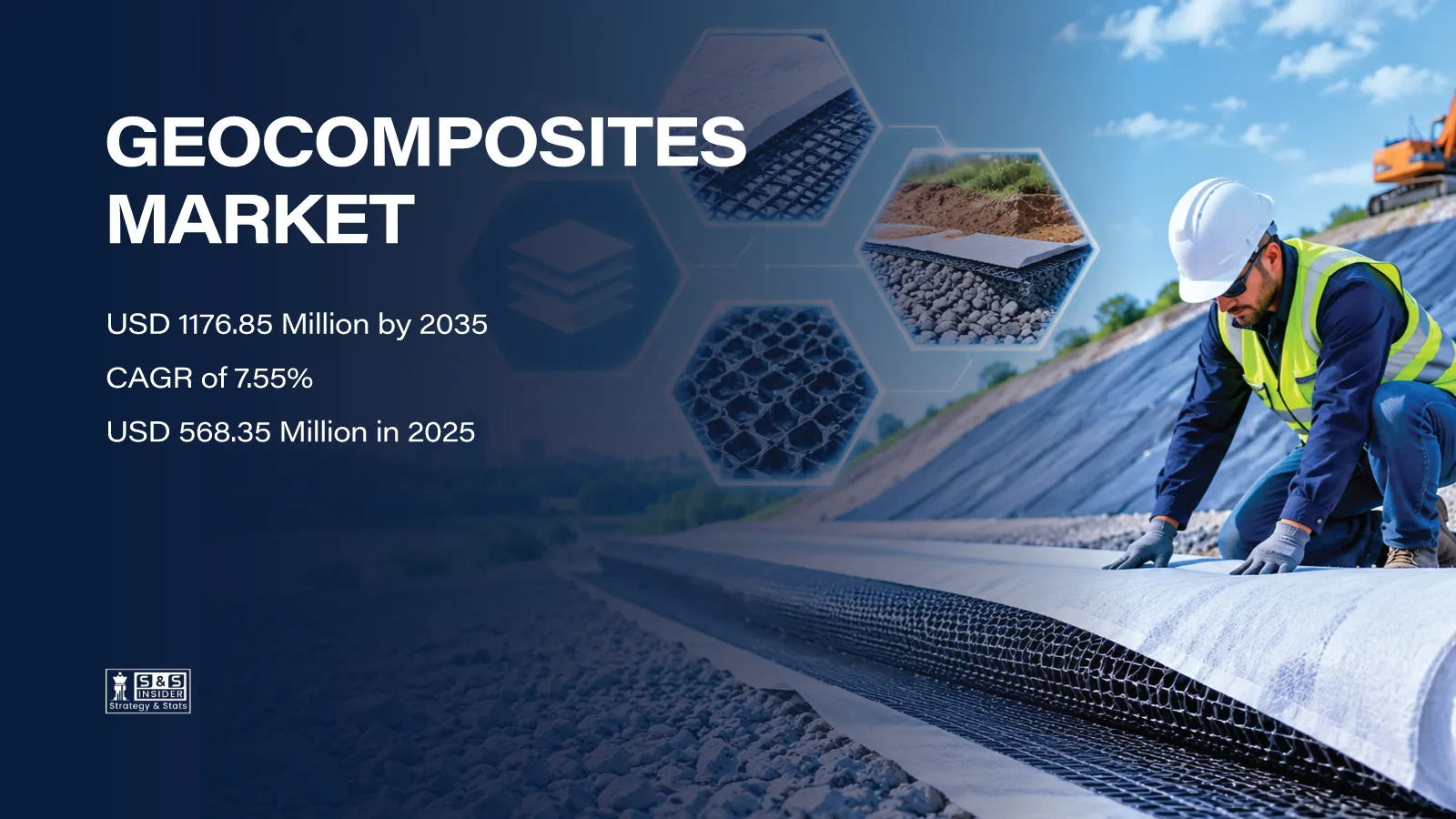
The global geocomposites market was valued at USD 568.35 Million in 2025 and is expected to reach USD 611.26 Million in 2026, rising to USD 1176.85 Million by 2035, registering a CAGR of 7.55% during 2026–2035.
Modernization of infrastructure is the main factor that drives demand, while environmental protection and stormwater management represent new uses for products other than traditional road construction. Companies are designing drainage cores that resist compression, light-weight reinforcement systems, and special composites.
Asia Pacific dominates the global market and is also projected to achieve the fastest regional growth, supported by construction activity in China, India and Southeast Asia.
Through 2035, competitive differentiation will increasingly depend on product durability, technical performance, sustainability, installation efficiency and compliance with evolving engineering specifications.
Market Size and Forecast
|
Market Indicator |
Value |
|---|---|
|
Market Size, 2025 |
USD 568.35 Million |
|
Market Size, 2026 |
USD 611.26 Million |
|
Market Forecast, 2035 |
USD 1176.85 Million |
|
CAGR, 2026–2035 |
7.55% |
|
Leading Region |
Asia Pacific (38.47%) |
|
Fastest-Growing Region |
Asia Pacific (8.74% CAGR) |
|
Leading Type |
Geotextile-Geonet (31.75%) |
|
Leading Function |
Drainage (45.00%) |
|
Leading Application |
Road and Highway (40.38%) |
Demand Drivers and Constraints
Primary Demand Drivers
-
Infrastructure expansion: Increasing investment in highways, railways, airports and urban infrastructure supports demand for engineered drainage and soil stabilization materials.
-
Environmental protection regulations: Stronger requirements for landfill containment, leachate management and mining waste control encourage adoption of specialized geocomposites.
-
Stormwater management: Growing exposure to extreme rainfall and flooding increases the importance of efficient drainage and erosion protection systems.
-
Construction efficiency: Lightweight geocomposites can reduce aggregate transportation, excavation requirements and installation time.
-
Mining and industrial development: Tailings facilities, industrial sites and renewable energy projects create additional opportunities for drainage and containment applications.
-
Sustainable construction practices: Interest in resource-efficient construction encourages the evaluation of composite materials that can reduce dependence on conventional granular layers.
Potential Growth Constraints
-
Fluctuating polypropylene, polyethylene and polyester prices affect manufacturing costs.
-
Limited technical awareness and qualified installation resources restrict adoption in developing markets.
-
Competition from traditional gravel drainage systems and standalone geosynthetics creates pricing pressure.
-
Delays in government infrastructure projects affect procurement schedules.
-
Project-specific testing and performance certification increase product qualification requirements.
Demand Structure by Type
Geotextile-Geonet Composites (2025 Market Share: 31.75%)
The geotextile-geonet combination is the biggest category, forming 31.75% of revenue shares globally in 2025. Such types of products include drainage nets and filtering geotextile layers that allow effective water flow without transporting soil particles. Usage in highways, retaining walls, landfill drainage systems and foundation protections ensures the demand already exists. Ease of transportation, reliable hydraulic behavior and applicability to standard construction technologies benefit contractors. The growth of transportation and environmental projects will ensure leadership up to 2035.
Current trend: Strong adoption of prefabricated drainage composites in transportation and environmental engineering.
Major trends: Improved flow capacity, multilayer drainage structures, landfill leachate collection and installation efficiency.
Geotextile-Geocore Composites (Forecast CAGR: 8.64%)
Composites comprising geotextile and geocore are expected to experience the highest rate of growth among all geosynthetics product segments in terms of value CAGR at 8.64% during the period 2026-2035. The 3D cores engineered within the composites form channels for drainage capable of resisting large compressive forces and thus are appropriate for applications ranging from tunnels to heavy-duty embankments, subterranean structures, and even green roofs. The increasing demand is driven by the need for reliable drainage properties within confined spaces in engineering constructions.
Current trend: Rising demand for compression-resistant drainage systems in complex civil engineering projects.
Major trends: Three-dimensional polymer cores, high-load drainage, underground waterproofing protection and customized composite structures.
Demand Structure by Function
Drainage (2025 Market Share: 45.00%)
Functionality based segmentation is dominated by the category of drainage, which accounts for 45.00% of market revenues in 2025. The drainage process is important in maintaining the integrity of pavement substructures, retaining walls, embankments and underground structures. They offer controlled drainage channels that ensure hydrostatic pressure is kept low. Rehabilitation of infrastructure projects, urban stormwater initiatives and landfill construction remain sources of significant demand. Their ability to take up the place of heavy aggregate drainage layers adds to their appeal.
Current trend: Growing preference for engineered drainage layers that simplify construction and improve water management.
Major trends: Subsurface drainage, retaining wall protection, stormwater infrastructure and lightweight construction systems.
Separation (Forecast CAGR: 7.76%)
The segmentation process is projected to grow with a 7.76% compound annual growth rate (CAGR) through 2026–2035. The benefits of separation geocomposites include prevention of subgrade weakness from blending into aggregate layers while retaining performance capacity of highways, railroads, industries and car parks. Construction activities in soft soils create a need for such products that increase the durability of foundations without necessitating early repairs.
Current trend: Increasing integration of separation layers in transport infrastructure and weak-soil construction.
Major trends: Subgrade protection, pavement lifecycle improvement, railway ballast separation and reduced aggregate consumption.
Demand Structure by Application
Road and Highway (2025 Market Share: 40.38%)
Road and highway constructions remain the most important end-use sector, accounting for 40.38% share of global geocomposites revenues by 2025. The geocomposites find applications for the purpose of subsurface drainage, pavement layer separation and moisture control in highways and other infrastructure. Large scale transportation projects in Asia Pacific, Europe and North America provide support to the demand for geocomposites, along with the need to repair the existing roads.
Current trend: Increasing specification of multifunctional geocomposites for highway construction and rehabilitation.
Major trends: Pavement drainage, roadbed stabilization, accelerated construction and longer infrastructure service life.
Water and Wastewater Management (Forecast CAGR: 8.16%)
Water and wastewater management is projected to be the fastest-growing application, with an 8.16% CAGR during 2026–2035. Investment in reservoirs, canals, treatment facilities, stormwater basins and flood protection infrastructure is expanding demand for engineered drainage and protective layers. Geocomposites support filtration, liner protection and groundwater control in facilities requiring reliable hydraulic performance. Water scarcity, urban expansion and climate adaptation spending are expected to strengthen demand for durable systems that protect critical water infrastructure.
Current trend: Accelerating adoption in water infrastructure upgrades and flood management projects.
Major trends: Reservoir liner protection, municipal drainage modernization, wastewater infrastructure and climate-resilient water systems.
Regional Market Dynamics
Asia Pacific (2025 Market Share: 38.47%; Forecast CAGR: 8.74%)
Asia Pacific leads the geocomposites market with a 38.47% revenue share in 2025 and is projected to register the fastest CAGR of 8.74% through 2035. China accounts for 42.80% of regional demand, supported by highway, railway, hydropower and municipal drainage development. India contributes through transportation expansion and water infrastructure investment, while Indonesia, Vietnam and Thailand offer opportunities in flood protection and urban construction. Regional manufacturing capacity and increasing acceptance of engineered geosynthetics support continued expansion.
Direction: Largest and fastest-growing regional market, driven by infrastructure investment and environmental engineering.
Europe (2025 Market Share: 26.91%)
Europe accounts for 26.91% of global revenue, supported by established engineering standards and environmental protection requirements. Germany leads regional demand with a 19.60% share, while France, the United Kingdom, Italy and Poland contribute through transportation rehabilitation, landfill management and flood resilience projects. Demand increasingly emphasizes certified materials, long-term performance and efficient construction methods. Upgrades to aging transport networks and environmental facilities offer opportunities for specialized drainage and containment composites.
Direction: Stable expansion supported by infrastructure renewal, technical standards and environmental compliance.
North America (2025 Market Share: 21.08%)
North America represents 21.08% of global market revenue in 2025. The United States dominates regional demand with an 84.30% share and a market value of USD 101.00 Million. Highway rehabilitation, landfill containment, mining infrastructure and water management projects support adoption. Canada contributes demand through transportation, mining and energy-related construction. Established engineering specifications and growing interest in efficient drainage solutions provide opportunities for specialized manufacturers.
Direction: Sustained demand from infrastructure modernization, environmental containment and industrial construction.
Latin America (2025 Market Share: 6.80%)
Latin America holds 6.80% of global revenue, with Brazil accounting for 47.20% of regional demand. Highway construction, landfill modernization, mining operations and hydropower projects represent important applications. Chile and Peru generate demand from copper mining infrastructure, while Mexico, Argentina and Colombia provide opportunities in transportation and industrial development. Growth prospects remain linked to infrastructure investment, although exchange-rate fluctuations and procurement delays can affect project implementation.
Direction: Gradual market expansion supported by mining investment and transportation infrastructure development.
Middle East & Africa (2025 Market Share: 6.74%)
The Middle East & Africa accounts for 6.74% of the global market, with Saudi Arabia representing 28.40% of regional demand. Large infrastructure developments, water storage facilities, highways and urban construction projects support geocomposite adoption across Gulf economies. South Africa, Egypt and Morocco contribute demand from mining and transportation projects. Water scarcity and demanding environmental conditions create opportunities for effective drainage and protective systems.
Direction: Emerging growth opportunities associated with infrastructure development, water management and mining applications.
Competitive Landscape
The global geocomposites industry includes established geosynthetics manufacturers and regional suppliers competing through product performance, engineering support, manufacturing capacity and distribution capabilities.
Key market participants covered by SNS Insider include Solmax, Officine Maccaferri, HUESKER, NAUE, Thrace Group, ABG, Climax Synthetics, GSE Environmental, Strata Geosystems and Terram.
Competition increasingly emphasizes high-performance drainage structures, material durability, technical certification and project-specific engineering solutions. Manufacturers capable of providing reliable product testing and installation guidance are positioned to strengthen relationships with infrastructure contractors and environmental engineering firms.
Market Outlook (2026–2035)
The global geocomposites market is forecast to reach USD 1176.85 Million by 2035, supported by infrastructure investment, environmental protection requirements and expanding water management applications.
Demand will increasingly favor products combining multiple engineering functions while reducing construction complexity and material consumption. Road infrastructure will remain a major application, while water and wastewater management provides an important growth opportunity.
Asia Pacific is expected to sustain regional leadership, with Europe and North America generating demand through infrastructure rehabilitation and environmental compliance.
Polymer price volatility, project delays and technical qualification requirements remain significant industry challenges.
Overall, geocomposites market growth through 2035 will depend on engineering innovation, infrastructure spending, sustainable material adoption and the increasing need for reliable drainage and ground protection systems.



