According to the latest SNS Insider research, the global healthcare process mining software market is entering a period of rapid expansion as hospitals, healthcare networks and insurance providers invest in technologies that improve operational visibility and eliminate inefficiencies.
The market was valued at USD 2.18 billion in 2025, is estimated to reach USD 2.98 billion in 2026 and is projected to reach USD 50.19 billion by 2035, expanding at a CAGR of 36.84% during 2026–2035.
Healthcare organizations are increasingly using process mining technology to examine how activities move through electronic health records, billing platforms, scheduling systems and administrative databases. By reconstructing actual workflows from digital event records, these solutions help identify unnecessary steps, delays, repeated tasks and opportunities for process improvement.
The integration of artificial intelligence and automation is further expanding the technology's commercial potential. Healthcare administrators can now move beyond identifying operational bottlenecks toward anticipating disruptions and initiating corrective actions.
Demand remains particularly strong among hospitals managing complex patient journeys and insurance organizations seeking greater transparency in claims processing and prior authorization.
North America currently represents the largest regional market, while Asia-Pacific is positioned for the fastest expansion through 2035.
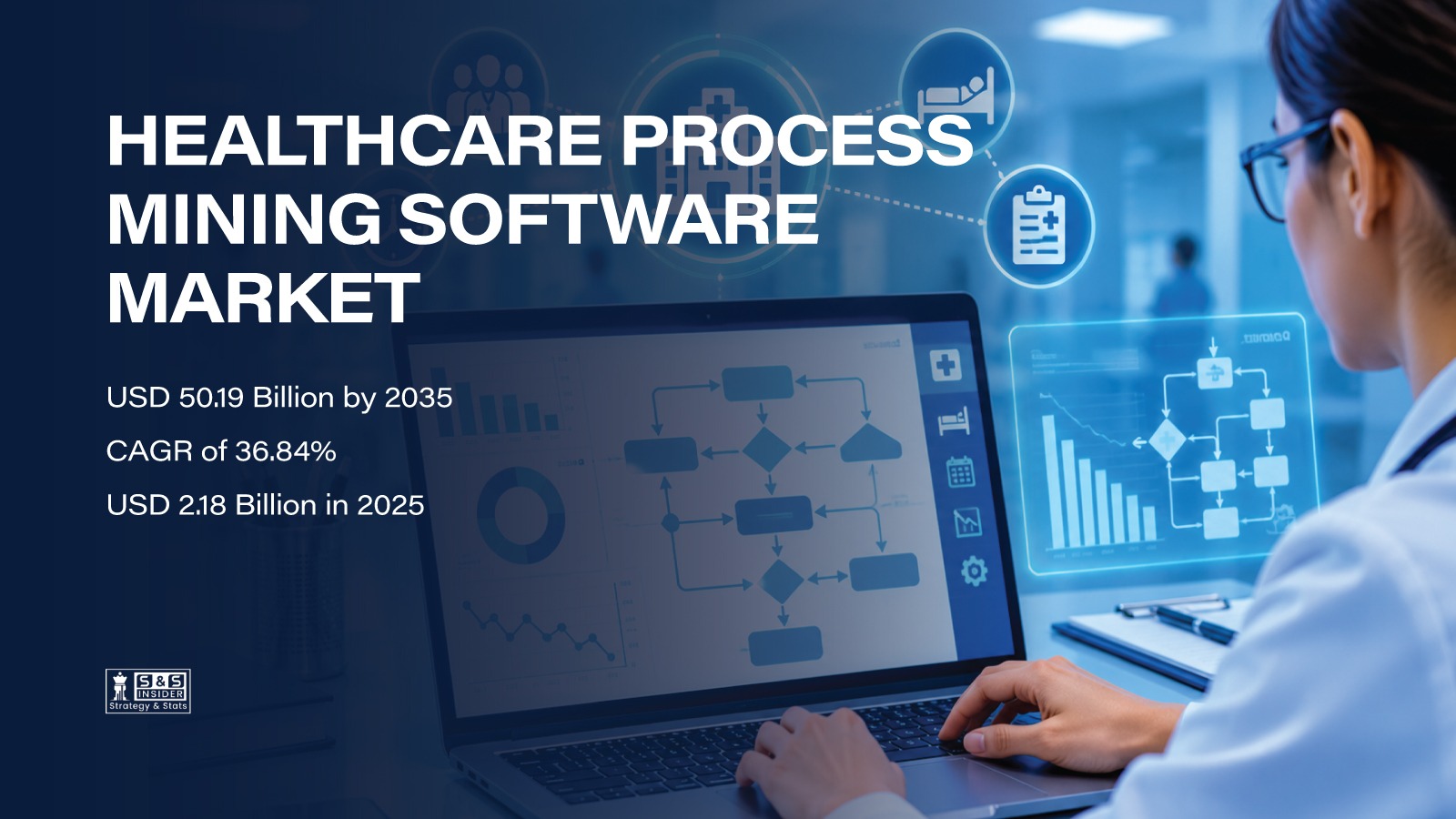
Healthcare Process Mining Software Market Size and Forecast
|
Market Indicator |
Value |
|---|---|
|
Global Market Size, 2025 |
USD 2.18 Billion |
|
Estimated Market Size, 2026 |
USD 2.98 Billion |
|
Forecast Market Size, 2035 |
USD 50.19 Billion |
|
CAGR, 2026–2035 |
36.84% |
|
Leading Region, 2025 |
North America — 36.41% |
|
Fastest-Growing Region |
Asia-Pacific — 40.67% CAGR |
|
Leading Component, 2025 |
Software — 70.38% |
|
Leading End User, 2025 |
Hospitals and Health Systems — 58.14% |
Demand Drivers and Constraints
Primary Demand Drivers
- Pressure to reduce healthcare operating costs: Hospitals are seeking clearer visibility into administrative expenses, treatment delays and resource utilization to improve financial performance.
- Expansion of electronic health records: Growing volumes of digitally recorded healthcare activities provide the event data necessary for detailed workflow analysis.
- Artificial intelligence integration: Machine learning, intelligent automation and conversational analytics are making process mining platforms more accessible to clinical and administrative teams.
- Prior authorization modernization: Regulatory requirements for faster authorization decisions are encouraging insurers and providers to assess processing delays and improve workflow transparency.
- Healthcare workforce shortages: Providers are investing in technologies that identify repetitive administrative activities and reduce unnecessary workloads.
- Cloud-based software adoption: Subscription platforms and managed implementation services are helping organizations deploy process intelligence capabilities without extensive infrastructure investments.
Potential Growth Constraints
- Sensitive healthcare information: Patient confidentiality requirements and cybersecurity risks can complicate data extraction and analytics deployment.
- Fragmented technology infrastructure: Legacy hospital systems and incompatible data formats increase integration costs.
- Implementation complexity: Process mining requires accurate timestamps, consistent event records and specialized technical expertise.
- Organizational resistance: Healthcare professionals may be reluctant to change established processes without evidence of operational or clinical benefits.
- Budget limitations: Smaller providers may prioritize essential clinical systems over advanced operational analytics.
Demand Structure by Component
Software Segment — 70.38% Market Share in 2025
Software dominates the healthcare process mining software market, accounting for approximately 70.38% of revenue in 2025.
Hospitals and health systems are adopting platforms that convert fragmented operational records into visual representations of patient and administrative workflows. These applications help decision-makers evaluate service delays, examine process variations and monitor operational performance across departments.
The growing availability of enterprise analytics platforms is encouraging healthcare organizations to connect process mining with existing electronic health records, financial management systems and automation technologies.
Current trend: Increasing deployment of integrated process intelligence platforms across healthcare operations.
Major trends: AI-powered workflow discovery, automated bottleneck identification, predictive analytics and enterprise system integration.
Services Segment — 39.17% Forecast CAGR
The services segment is expected to register the fastest component-level growth, advancing at a CAGR of approximately 39.17% through 2035.
Demand is increasing for implementation consulting, data preparation, system integration, technical training and managed analytics services.
Healthcare organizations frequently require external expertise to convert complex operational information into reliable process models. Service providers are therefore expanding offerings that combine software implementation with workflow redesign and performance monitoring.
Current trend: Growing demand for specialized implementation and managed process optimization services.
Demand Structure by Process Type
Process Discovery — 46.37% Market Share in 2025
Process discovery is the largest process type segment and is expected to represent ~46.37% of the market in 2025.
The technology reconstructs real workflows from recorded activities, allowing healthcare administrators to compare operational performance across facilities, departments and service lines.
Uses include identifying patient admission delays, mapping diagnostic workflows, assessing billing procedures and finding unnecessary administrative handoffs.
For healthcare organizations, process discovery is often the first rung on the ladder to process intelligence, as it exposes operational patterns that traditional reporting will not find.
Current trend: Wider use of event-driven workflow visualization in hospital management.
Conformance and Compliance Monitoring — 40.92% Forecast CAGR
Conformance and compliance monitoring is projected to be the fastest-growing process-type segment, with a CAGR of approximately 40.92% during 2026–2035.
These applications compare actual operational activities against established procedures, regulatory requirements and internal performance standards.
Healthcare organizations can identify unexpected process deviations, investigate compliance risks and improve consistency in administrative and clinical operations.
Current trend: Increasing adoption of continuous compliance monitoring and automated workflow auditing.
Demand Structure by Application
Claims and Revenue Cycle Management — 34.52% Market Share in 2025
The claims and revenue cycle management holds the highest share of application, with around 34.52% in 2025.
Healthcare services uses process mining to explore billing inefficiencies, denied claims, reimbursement delays and recurring administrative tasks.
By looking at each stage in the revenue cycle, a company can spot where the bottlenecks are in payment processing, and what operational changes can increase collections and reduce administrative costs.
Process intelligence is also used by insurance companies in their claims adjudication and authorization workflows.
Current trend: Growing investment in revenue cycle transparency and claims workflow automation.
Patient Admissions and Discharge Management — 41.26% Forecast CAGR
The patient admissions and discharge management is expected to grow at a CAGR of around 41.26% through 2035.
Hospitals are increasingly focused on improving patient flow to alleviate overcrowding in emergency departments, boost bed availability and cut down on unnecessary waits.
Process mining can help the administrator to analyze admission timelines, department transfers, diagnostic delays and discharge coordination.
These learnings are informing operational changes to improve resource availability and patient experience.
Current trend: Accelerating adoption of real-time patient journey analysis and hospital capacity optimization.
Demand Structure by End User
Hospitals and Health Systems — 58.14% Market Share in 2025
Hospitals and health systems hold the largest share of the market, with a revenue share of about 58.14% in 2025.
Large healthcare networks handle significant volumes of clinical, administrative and financial transactions, offering significant opportunities for process optimization.
Process mining is increasingly viewed by hospital executives as a strategic tool to improve operational efficiency while maintaining clinical service quality.
Applications include emergency departments, operating rooms, diagnostic services, patient scheduling and financial operations.
Payers — 40.38% Forecast CAGR
Payers are expected to register the fastest end-user growth, advancing at approximately 40.38% CAGR during 2026–2035.
Health insurers are investing in process analytics to improve authorization timelines, claims administration, compliance monitoring and member service operations.
In the United States, updated federal prior authorization requirements for covered medical items and services are reinforcing the need for measurable processing performance.
Current trend: Growing insurer demand for workflow intelligence and automated administrative decision support.
Regional Market Dynamics
North America — 36.41% Market Share in 2025
North America dominated the global market due to the presence of advanced healthcare infrastructure, high adoption of electronic health records, and huge investment in hospital technology.
United States was USD 653.70 million in 2025 and is projected to reach USD 20,788.05 million by 2035, exhibiting a CAGR of 35.72% during the forecast period.
With increasing reimbursement delays, workforce pressures and administrative inefficiencies, healthcare organizations are turning to process mining in greater numbers.
Direction: Continued leadership driven by healthcare automation and operational cost management.
Europe — Established Healthcare Digitalization Market
The second largest regional market, Europe is supported by healthcare modernization programs and increasing demand for efficient clinical operations.
Germany, United Kingdom and Netherlands are big markets for process analytics adoption.
Healthcare providers are leveraging process mining to understand patient pathways, maximize hospital resources and improve administrative coordination.
Strict data protection requirements also impact software architecture and purchasing decisions.
Direction: Sustained adoption supported by digital health investment and regulatory requirements.
Asia-Pacific — 40.67% Forecast CAGR
Asia-Pacific is anticipated to be the fastest growing market with a CAGR of around 40.67% from 2026 to 2035.
China, India, Japan, South Korea and Australia are investing in operational analytics and building out digital healthcare infrastructure.
Big hospital networks are becoming more interested in technologies that can increase patient throughput, resource allocation and service coordination.
Cloud-based solutions and the existence of regional integration partners should help drive broader adoption.
Direction: Rapid growth driven by hospital modernization and increasing healthcare technology investment.
Latin America and Middle East & Africa
Healthcare providers in Latin America and the Middle East & Africa are investing in digital infrastructure, creating development opportunities.
Key Latin American markets are Brazil and Mexico, while Saudi Arabia and the United Arab Emirates are leading healthcare modernization with big digital initiatives.
However, smaller providers may be limited in their ability to adopt due to limited analytics expertise, challenges with technology integration and budget constraints.
Direction: Gradual market development supported by infrastructure upgrades and digital transformation programs.
Competitive Landscape
The global healthcare process mining software market includes established enterprise technology companies and specialized process intelligence providers.
Important participants include Celonis, UiPath, Microsoft, IBM, SAP, ARIS, Appian, QPR Software, Skan AI, Fluxicon, iGrafx, ABBYY, Pegasystems and Salesforce.
Competition increasingly focuses on healthcare-specific software integration, artificial intelligence capabilities, process automation, implementation support and data security.
Vendors offering solutions that connect process discovery with automated operational improvements may gain an advantage as healthcare organizations seek measurable returns on technology investments.
Market Outlook (2026–2035)
The SNS Insider forecast projects the healthcare process mining software market will reach USD 50.19 billion by 2035, representing substantial growth from its USD 2.18 billion valuation in 2025.
Expansion will be shaped by increasing healthcare operating costs, growing digital information volumes, administrative automation requirements and stronger demand for measurable efficiency improvements.
Artificial intelligence is expected to extend process mining capabilities beyond historical workflow analysis toward predictive operational monitoring and automated intervention.
Healthcare organizations will increasingly evaluate technology investments based on their ability to shorten processing times, improve service coordination, reduce unnecessary administrative work and support compliance.
North America is expected to remain a major revenue contributor, while Asia-Pacific offers the strongest regional growth potential.
Overall, healthcare process mining software is evolving from a specialized analytical application into an important component of digital healthcare operations, with future market growth dependent on interoperability, practical automation capabilities, data protection and demonstrable operational value