
According to the latest SNS Insider Personalized Medicine Biomarkers Market report, the global industry is experiencing substantial expansion as healthcare providers increasingly use molecular information to guide clinical decisions, select targeted therapies and assess individual disease risks.
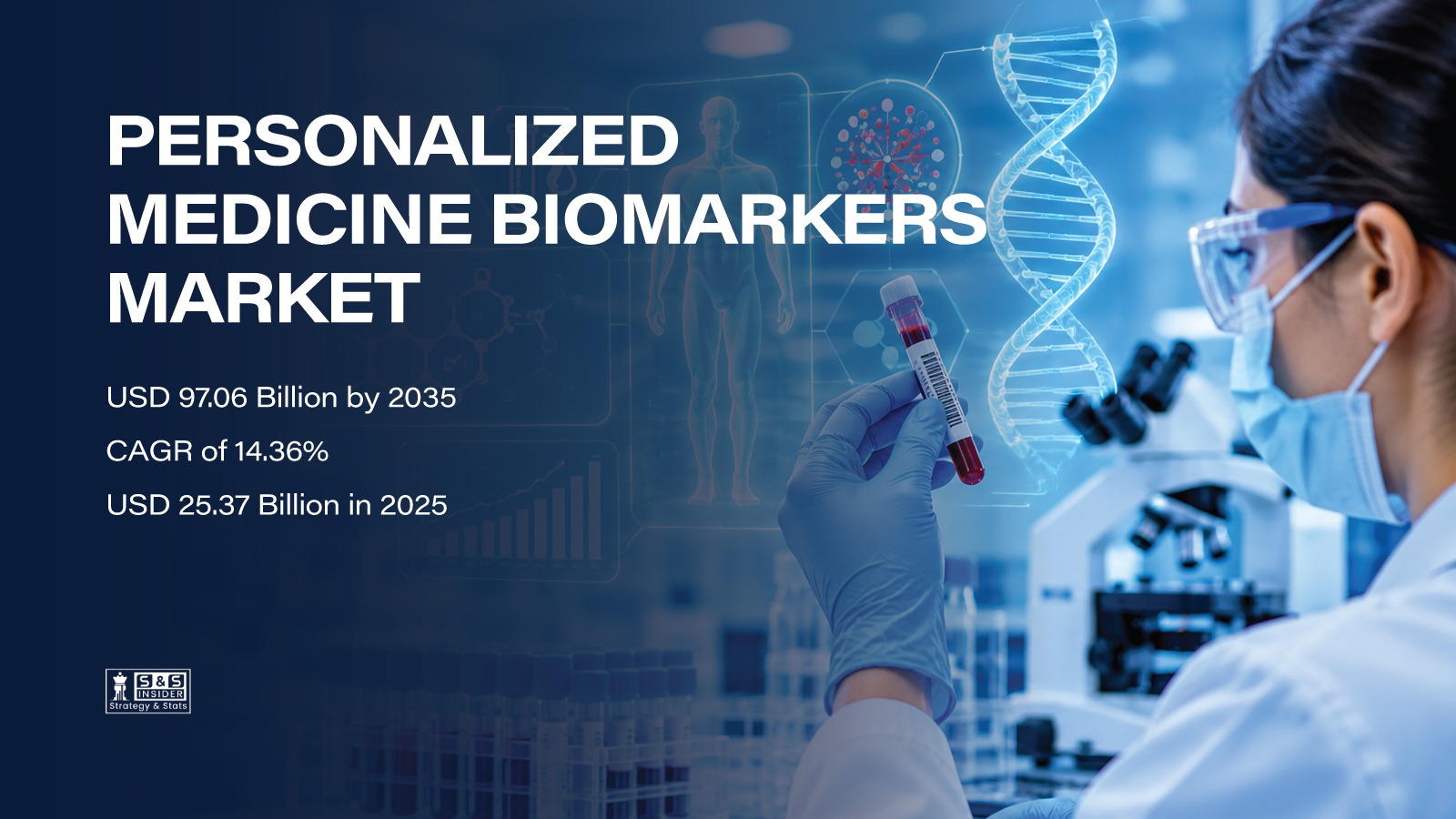
The global personalized medicine biomarkers market was valued at USD 25.37 billion in 2025, is estimated at USD 29.01 billion in 2026 and is projected to reach USD 97.06 billion by 2035, growing at a CAGR of 14.36% during 2026–2035.
Medical care is shifting away from one-size-fits-all treatment protocols to approaches that consider patients’ genetic profile, molecular profiles and measurable biological responses. This shift is opening up opportunities for diagnostic labs, biotech companies, sequencing technology vendors, and pharmaceutical developers.
Advances in next-generation sequencing, liquid biopsy, proteomics and artificial intelligence are improving the clinical accessibility of biomarker testing. Meanwhile, expanding oncology pipelines and increasing investment in companion diagnostics are strengthening commercial demand for validated molecular assays.
Market development remains closely linked to reimbursement policies, clinical evidence, laboratory infrastructure and regulatory approvals. North America currently leads global revenue, while Asia-Pacific is expected to record the fastest expansion through 2035.
Demand Drivers and Constraints
Primary Demand Drivers
- Precision oncology adoption: Growing use of molecular testing to identify patients eligible for targeted cancer treatments is increasing demand for clinically validated biomarkers.
- Advances in genomic sequencing: Improving sequencing efficiency and declining testing costs are expanding access to comprehensive molecular profiling.
- Increasing chronic disease burden: Cancer, diabetes, cardiovascular disorders and neurological diseases are creating opportunities for personalized diagnosis and treatment monitoring.
- Expansion of companion diagnostics: Pharmaceutical companies are integrating biomarker testing into drug development to identify suitable patient populations and support treatment decisions.
- Liquid biopsy innovation: Blood-based molecular tests are creating new possibilities for disease detection, therapy monitoring and assessment of residual disease.
- AI-enabled diagnostics: Advanced analytical tools are helping laboratories interpret increasingly complex biological datasets.
Potential Growth Constraints
- High development and validation costs for advanced molecular diagnostic assays.
- Uneven reimbursement coverage across healthcare systems.
- Limited availability of sequencing infrastructure in emerging markets.
- Differences in laboratory testing standards and regulatory requirements.
- Challenges involving patient data privacy, genomic interpretation and specialist availability.
Demand Structure by Application
Treatment Selection (2025 Market Share: 49.63%)
Treatment selection represents the largest application segment, accounting for 49.63% of market revenue in 2025.
As decisions about therapy often depend on detecting certain genetic changes, biomarker profiling-based treatment has become more important in cancer treatment. Diagnostic laboratories test for the mutation status of tumors and other biomarkers to determine if patients can be treated with certain strategies.
The emergence of more and more therapies targeted at specific genes or proteins creates a need for companion diagnostics and full genetic profile analysis.
Adoption will continue to grow until 2035 due to the development of precision medicine.
Current trend: Increasing clinical use of molecular testing before treatment initiation.
Major trends: Companion diagnostic development, targeted therapy selection, molecular profiling and treatment-response prediction.
Early Detection and Screening (Forecast CAGR: 15.82%)
Early detection and screening is projected to be the fastest-growing application segment, expanding at a CAGR of 15.82% from 2026 to 2035.
Demand is strengthening as diagnostic developers pursue technologies capable of identifying disease-associated biological changes before symptoms become apparent.
Liquid biopsy platforms, circulating tumor DNA analysis and multi-cancer detection technologies are attracting commercial interest.
However, widespread adoption will depend on demonstrating clinical utility, diagnostic accuracy and cost-effectiveness across intended screening populations.
Current trend: Growing development of minimally invasive molecular screening technologies.
Major trends: Blood-based cancer detection, risk stratification, multi-biomarker panels and preventive diagnostics.
Demand Structure by Indication
Oncology (2025 Market Share: 37.58%)
Oncology dominates the personalized medicine biomarkers market, representing 37.58% of global revenue in 2025.
Cancer treatment increasingly relies on molecular characteristics rather than tumor location alone. Biomarker testing helps identify actionable mutations, assess therapeutic eligibility and monitor potential disease progression.
The expansion of targeted oncology drugs and immunotherapies is encouraging healthcare providers to incorporate molecular diagnostics into clinical decision-making.
Diagnostic companies are also developing broader testing panels that evaluate multiple biological targets using a single patient sample.
Current trend: Strong demand for genomic profiling and biomarker-guided cancer treatment.
Major trends: Precision oncology, liquid biopsy, companion diagnostics and molecular monitoring.
Diabetes (Forecast CAGR: 17.26%)
Diabetes is expected to register the fastest growth among indications, with a projected CAGR of 17.26% through 2035.
Increasing interest in metabolic risk assessment and individualized chronic disease management is creating demand for biomarkers that help evaluate disease progression and treatment response.
Researchers are exploring combinations of genetic information, metabolic measurements and continuous monitoring data to identify differences between patient populations.
As clinical evidence develops, these approaches could support more individualized prevention and treatment strategies.
Current trend: Expanding research into individualized metabolic disease management.
Major trends: Metabolic risk profiling, predictive diagnostics, biomarker-based monitoring and personalized intervention strategies.
Demand Structure by Biomarker Type
Genomic Biomarkers (2025 Market Share: 41.72%)
Genomic biomarkers account for the largest market share, representing 41.72% in 2025.
Their established clinical role in cancer diagnostics, inherited disease assessment and therapy selection supports widespread adoption.
Technologies such as next-generation sequencing and polymerase chain reaction allow laboratories to identify genetic variations associated with disease characteristics or treatment response.
Increasing diagnostic automation and expanded testing capacity are expected to support demand across hospitals, reference laboratories and pharmaceutical research facilities.
Current trend: Growing integration of genomic testing into clinical workflows.
Major trends: Comprehensive genomic profiling, targeted sequencing panels, automated interpretation and precision therapeutics.
Metabolic Biomarkers (Forecast CAGR: 16.94%)
The metabolic biomarkers market is expected to grow at a CAGR of 16.94% during 2026–2035.
Genetic markers describe molecular characteristics inherited or acquired, while metabolic measurements can contain information about the current physiological state of a patient.
Advancement in mass spectrometry and targeted analytical panels are increasing the ability to interrogate metabolites related to disease activity and treatment response.
There is expected to be buoyant commercial development, driven by increasing interest in diabetes, cardiovascular health and metabolic disorders.
Current trend: Increasing demand for biomarker panels that assess physiological changes.
Major trends: Metabolomics, mass spectrometry, treatment-response monitoring and multiomics integration.
Demand Structure by End User
Hospitals and Clinics (2025 Market Share: 43.18%)
The Hospitals and Clinics segment had the largest share of end users with 43.18% of revenue in 2025.
Molecular diagnostics are becoming increasingly useful in clinical settings and healthcare institutions are responding by expanding testing capabilities and forming relationships with specialized reference laboratories.
Molecular results impact eligibility for therapies and multidisciplinary treatment planning and thus cancer centers are important customers.
Healthcare networks are also exploring standardized testing pathways to help improve access to diagnostics across various facilities.
Current trend: Expanding integration of biomarker testing into hospital-based diagnostics.
Pharmaceutical and Biotechnology Companies (Forecast CAGR: 15.93%)
Pharmaceutical and biotechnology companies represent the fastest-growing end-user segment, with a projected CAGR of 15.93% through 2035.
Drug developers increasingly use biomarkers for patient stratification, clinical trial enrollment, response assessment and companion diagnostic development.
These applications create demand for specialized assay development, central laboratory services and molecular data interpretation.
Current trend: Increasing integration of biomarker strategies into pharmaceutical research and clinical development.
Key Market Participants
The competitive landscape includes diagnostic technology providers, specialized molecular testing companies and commercial laboratory networks.
Major participants identified in the SNS Insider report include Foundation Medicine, Guardant Health, Natera, Illumina, QIAGEN, Myriad Genetics, NeoGenomics, Veracyte, Tempus AI, Caris Life Sciences, Labcorp, Quest Diagnostics, Agilent Technologies, Roche Diagnostics, Thermo Fisher Scientific, Abbott and Personalis.
Competition increasingly depends on analytical performance, clinical validation, test turnaround times, reimbursement access and partnerships with pharmaceutical developers.
Companies offering integrated genomic, proteomic and diagnostic capabilities may benefit as healthcare providers seek more comprehensive biological information from fewer testing workflows.
Regional Dynamics
North America (2025 Market Share: 47.82%)
In 2025, North America will contribute 47.82% of the worldwide revenue in the personalized healthcare biomarkers market.
The region boasts state-of-the-art genomic research infrastructure, well-established pharmaceutical industries, and extensive clinical use of molecular diagnostics.
The United States has produced USD 10.48 billion in 2025 and is anticipated to grow at a CAGR of 14.88% through 2035.
Strong regional demand is underpinned by oncology research activity, diagnostic innovation and established reimbursement pathways.
Direction: Sustained leadership through advanced diagnostic adoption.
Europe — Established Molecular Diagnostics Market
Europe is a key regional market supported by national health care systems, academic research institutions and pharmaceutical development activities.
Germany, France and United Kingdom contributes significantly in the demand for molecular testing.
The development of genomic medicine initiatives and increasing acceptance of companion diagnostics are expected to help in market development but reimbursement differences remain a challenge.
Direction: Steady expansion supported by clinical research and diagnostic modernization.
Asia-Pacific (Forecast CAGR: 16.67%)
Asia-Pacific is forecast to be the fastest-growing regional market, registering a CAGR of 16.67% from 2026 to 2035.
China, Japan, India and South Korea are expanding genomic research, molecular laboratory capacity and precision medicine applications.
Growing cancer treatment demand, clinical trial activity and greater availability of affordable sequencing technologies are supporting regional expansion.
Direction: Rapid growth driven by expanding healthcare infrastructure and genomic testing access.
Latin America
Brazil is the regional leader in the adoption of biomarkers and is supported by well-established oncology centers, private healthcare networks and expanding molecular diagnostic capacity.
Opportunities also exist in Mexico and Argentina as targeted treatments and specialized laboratory services become more accessible.
Direction: Gradual development through diagnostic infrastructure expansion.
Middle East & Africa
Saudi Arabia and the United Arab Emirates are investing in genomic research and specialized healthcare infrastructure.
Expanding cancer treatment capabilities and international laboratory partnerships could improve access to personalized diagnostic services.
However, affordability and limited testing infrastructure remain important barriers in several markets.
Direction: Emerging opportunities supported by healthcare investment and genomic medicine initiatives.
Market Outlook (2026–2035)
The global personalized medicine biomarkers market is projected to reach USD 97.06 billion by 2035, supported by continued advances in molecular diagnostics, precision therapeutics and clinical biomarker applications.
Oncology will continue to be a major demand driver, and the assessment and early detection of metabolic disease will be another growth area.
By integrating genomic, proteomic, and metabolic information, increasingly comprehensive diagnostics could be realized, particularly as analytical technologies become more widely available.
“Commercial success will depend on showing clinical value, getting reliable reimbursement and building testing into the everyday healthcare workflows.
North America is expected to maintain its strong competitive position, and Asia-Pacific offers significant opportunities for diagnostic manufacturers, laboratory networks and biotechnology companies.
Overall, the market's long-term expansion will depend on translating molecular innovation into accessible, clinically useful and economically sustainable personalized healthcare solutions.



