
According to the latest SNS Insider Acne Treatment Market report, the global industry is experiencing sustained expansion as demand for effective dermatological therapies increases among adolescents and adults. Greater awareness of persistent acne, wider access to prescription medicines and increasing availability of clinically established topical treatments are influencing purchasing decisions across developed and emerging economies.
The acne treatment industry is evolving from a market centered primarily on teenage skincare toward a broader therapeutic category addressing inflammatory conditions, adult acne, recurring breakouts and long-term disease management. Pharmaceutical manufacturers are responding with improved drug formulations, combination therapies and treatment options designed to enhance tolerability and patient adherence.
Distribution is also changing. Traditional pharmacies remain the primary purchasing destination, but online pharmacies, digital consultations and prescription delivery services are creating additional opportunities for pharmaceutical suppliers.
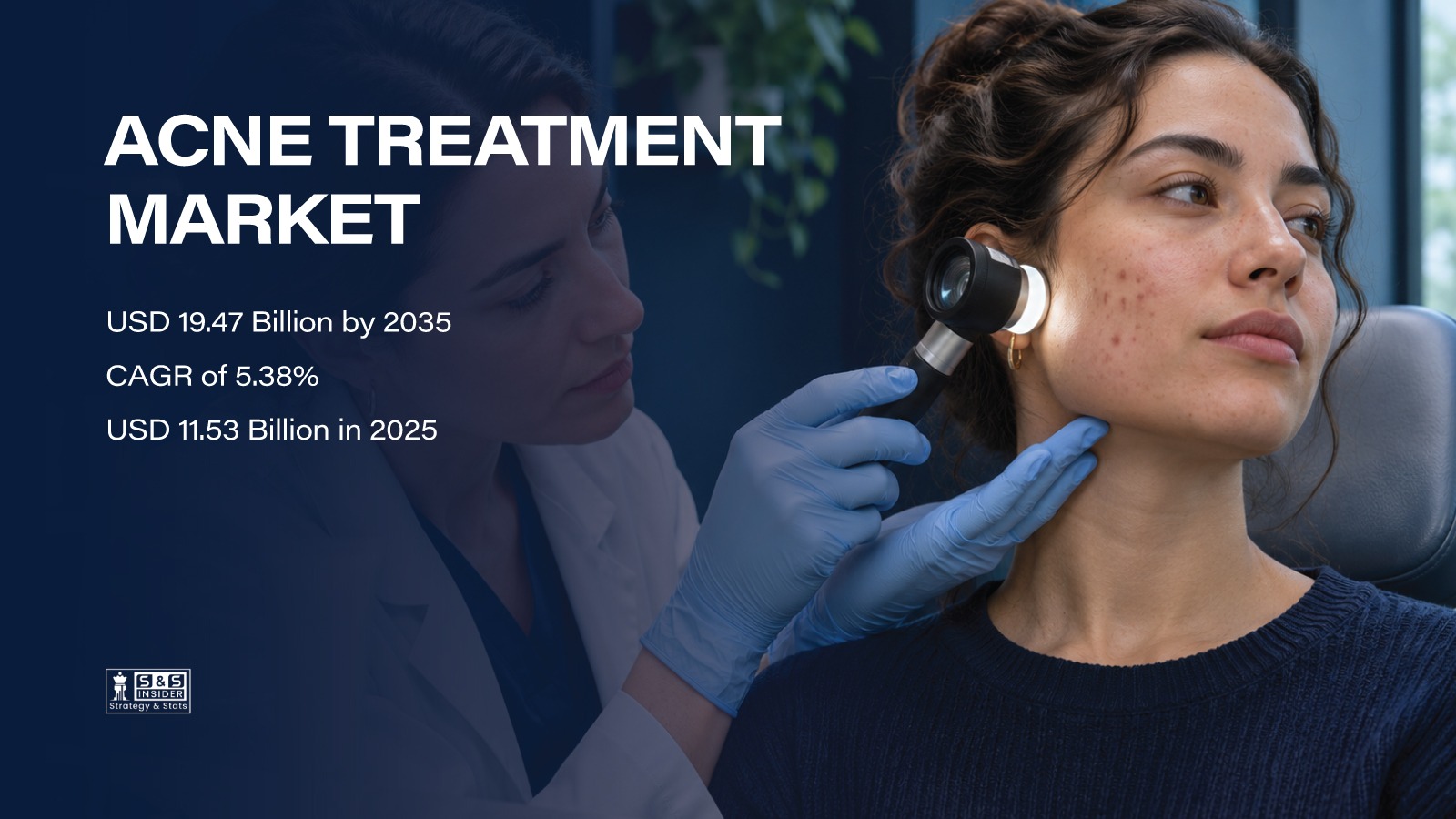
The global Acne Treatment Market was valued at USD 11.53 billion in 2025, is estimated to reach USD 12.15 billion in 2026 and is forecast to grow to USD 19.47 billion by 2035, registering a CAGR of 5.38% during 2026–2035.
North America remains the largest regional market, while Asia-Pacific is expected to record the fastest expansion. Growth through 2035 will increasingly depend on pharmaceutical innovation, affordable treatment availability, improved patient adherence and effective distribution strategies.
Market Size and Growth Forecast
|
Market Indicator |
Value |
|---|---|
|
Global Market Size, 2025 |
USD 11.53 Billion |
|
Estimated Market Size, 2026 |
USD 12.15 Billion |
|
Forecast Market Size, 2035 |
USD 19.47 Billion |
|
CAGR, 2026–2035 |
5.38% |
|
U.S. Market Size, 2025 |
USD 4.39 Billion |
|
Largest Regional Market |
North America (44.62%) |
|
Fastest-Growing Region |
Asia-Pacific (7.03% CAGR) |
The forecast reflects consistent underlying demand rather than reliance on a single breakthrough treatment. Recurring therapy requirements, broad pharmaceutical availability and the expansion of digital healthcare are expected to support market development throughout the forecast period.
Demand Drivers and Constraints
Primary Demand Drivers
- Persistent acne across age groups: Treatment demand extends beyond adolescence as adult patients seek solutions for recurring inflammatory and hormonal acne.
- Pharmaceutical innovation: Improved retinoids, fixed-dose combination medicines and non-antibiotic therapies are expanding available treatment options.
- Growth of online dermatology: Digital consultations and electronic prescriptions improve treatment accessibility, particularly where specialist appointments are difficult to obtain.
- Over-the-counter availability: Accessible topical therapies allow consumers to begin managing suitable mild acne symptoms without prescription appointments.
- Increasing dermatological awareness: Educational campaigns and social media discussions encourage earlier recognition of acne-related concerns.
- Expanding emerging-market access: Rising incomes, growing pharmacy networks and affordable generic medicines support treatment adoption.
Potential Growth Constraints
- Skin irritation, dryness and other treatment-related adverse effects.
- Antibiotic resistance concerns limiting prolonged antimicrobial therapy.
- High costs associated with selected branded prescription medicines.
- Inconsistent treatment adherence and early discontinuation.
- Regulatory and monitoring requirements for higher-risk medicines.
Manufacturers must balance effectiveness, affordability and tolerability to maintain patient demand and support sustainable growth.
Demand Structure by Drug Class
Antibiotics (2025 Market Share: 26.40%)
Antibiotics represent the largest drug-class segment, contributing approximately 26.40% of global acne treatment revenue in 2025.
Their established role in managing inflammatory acne supports continued prescribing across dermatology practices. Commonly used treatments include topical clindamycin and oral tetracycline-class medicines, depending on clinical severity and individual patient requirements.
However, concerns regarding antimicrobial resistance are changing prescribing patterns. Clinical guidelines encourage limiting antibiotic exposure and using appropriate combination regimens, creating opportunities for alternative therapies.
Through 2035, antibiotic demand will remain relevant, although competition from newer pharmaceutical approaches may influence its market position.
Current trend: Established therapeutic demand alongside increasing antibiotic stewardship.
Major trends: Combination prescribing, shorter antibiotic courses, generic competition and development of non-antibiotic alternatives.
Retinoids (Forecast CAGR: 6.62%)
Retinoids are projected to become the fastest-growing drug-class segment, registering a CAGR of approximately 6.62% during 2026–2035.
These drugs target the important mechanisms that are involved in the formation of acne, such as follicular obstruction and abnormal turnover of skin cells. Topical formulations remain commonly used, while oral isotretinoin is used in select patients with severe or treatment-resistant acne with appropriate clinical supervision.
The availability of some topical retinoids in better formulations is increasing access to treatment.
Sustained demand for adequate maintenance therapies is also boosting the market, driven by growing interest in maintaining clearer skin after initial improvement.
Current trend: Growing adoption of retinoid-based acne management.
Major trends: Better-tolerated formulations, combination therapies, expanded pharmacy availability and maintenance treatment strategies.
Demand Structure by Route of Administration
Topical Treatments (2025 Market Share: 51.67%)
Topical medicines dominate the market, accounting for approximately 51.67% of revenue in 2025.
Creams, gels, lotions and foams remain widely used because many patients can manage mild to moderate acne through treatments applied directly to affected areas.
The segment benefits from extensive product availability across prescription and non-prescription categories. Manufacturers are developing formulations that combine active ingredients while attempting to reduce irritation and simplify application.
Current trend: Continued preference for accessible, convenient topical therapies.
Major trends: Fixed-dose combinations, improved delivery systems, gentler formulations and expanded over-the-counter access.
Oral Treatments (Forecast CAGR: 6.41%)
Oral acne medicines are forecast to grow at a CAGR of approximately 6.41% through 2035.
Demand is associated with patients requiring systemic treatment for more extensive, persistent, or severe acne.
Oral antibiotics, selected hormonal therapies and isotretinoin remain important options when clinically appropriate. Increasing access to dermatology consultations may improve diagnosis and treatment selection.
However, adverse-effect monitoring, pregnancy-related precautions and responsible prescribing remain critical considerations.
Current trend: Increasing demand for medically supervised treatment of complex acne.
Major trends: Specialist prescribing, improved patient monitoring, oral therapy innovation and personalized treatment selection.
Demand Structure by Acne Type
Inflammatory Acne (2025 Market Share: 54.17%)
Inflammatory acne is the largest market segment accounting for approximately 54.17% of the revenue in 2025.
More intensive treatment may be necessary for papules, pustules and deeper inflammatory lesions due to the discomfort, visible symptoms and potential for scarring.
These clinical needs warrant spending on prescription therapies, dermatology consultations and ongoing disease management.
Current trend: Strong therapeutic demand associated with clinically significant inflammatory acne.
Major trends: Combination medicines, early intervention, prescription innovation and treatment adherence programs.
Non-Inflammatory Acne (Forecast CAGR: 6.04%)
The Non-Inflammatory Acne market is expected to grow at a CAGR of ~6.04% during 2026-2035.
Comedonal acne is another type of acne that is very common and includes blackheads and whiteheads.
Consumer awareness of the need for early management of acne and better access to topical products is driving the demand. Availability in retail and in digital educational resources also affects purchase behavior.
Current trend: Rising interest in early management of comedonal acne.
Major trends: Pharmacy-based treatment, topical retinoids, consumer education and accessible preventive care routines.
Demand Structure by Distribution Channel
Retail Pharmacies (2025 Market Share: 47.93%)
Retail pharmacies still dominate the distribution channel contributing about 47.93 % to the market revenue by 2025.
This is important because it makes it easy to access prescription drugs and over-the-counter acne treatments.
Pharmacist recommendations, established retail networks and repeat medication purchases drive ongoing demand.
Current trend: Continued pharmacy leadership supported by convenient product availability.
Major trends: Expanded dermatology assortments, generic alternatives, pharmacist guidance and repeat purchasing.
Online Pharmacies (Forecast CAGR: 7.78%)
Online pharmacies are expected to experience the highest growth in distribution channel having a CAGR of nearly 7.78% during the forecast period.
Accessibility to acne treatment has been improved by digital prescription services, home delivery, and the integration of the teledermatology platform.
Discreet ordering, price comparisons and ease of re-filling are increasingly important to younger consumers and those with recurring conditions.
Current trend: Accelerating digital distribution of acne medicines.
Major trends: Teledermatology integration, subscription refills, direct-to-consumer platforms and online prescription fulfillment.
Regional Market Dynamics
North America (2025 Market Share: 44.62%)
North America leads the global market with approximately 44.62% revenue share in 2025.
The U.S. is the largest national market in the region, with a value of USD 4.39 billion in 2025, and is expected to grow at a CAGR of 5.54% during the forecast period of 2026-2035.
The region benefits from established dermatology services, the wide availability of pharmaceuticals, and robust demand for both branded and generic treatments.
Digital health care and prescription-to-OTC switches will probably affect distribution in the future.
Direction: Stable growth supported by pharmaceutical innovation and established treatment infrastructure.
Europe — Established Dermatology Market
Europe has developed healthcare, established dermatology practices and broad availability of prescription medicine.
Germany is expected to account for an estimated 22.47% of the regional market by 2025.
Demand is underpinned by pharmaceutical innovation, increasing availability of alternative therapies and expansion of digital pharmacy services in major European economies.
Direction: Sustained development influenced by treatment innovation, reimbursement policies and regulatory requirements.
Asia-Pacific (Forecast CAGR: 7.03%)
The Asia-Pacific region is projected to witness the fastest growth in the regional market with a CAGR of about 7.03% between 2026 and 2035.
China is projected to account for about 31.58% of the regional revenue by 2025.
Growth is driven by rising disposable incomes, growing dermatological awareness, expanding pharmaceutical distribution and strong demand from younger generations.
Opportunities also arise from India’s generic pharmaceutical industry and the emergence of online medicine delivery services.
Direction: Accelerating expansion supported by affordability, healthcare access and digital commerce.
Latin America and Middle East & Africa
Latin America offers opportunities through growing pharmacy networks, private dermatology services and increasing access to affordable medicines. Brazil represents approximately 44.11% of its regional market.
The Middle East & Africa is developing through expanding healthcare infrastructure and consumer interest in dermatological care. Saudi Arabia contributes approximately 26.83% of regional revenue.
Direction: Gradual growth supported by improving accessibility and regional pharmaceutical distribution.
Competitive Landscape
The acne treatment industry combines established dermatology manufacturers, pharmaceutical developers and specialty therapeutic companies.
Key participants identified in the SNS Insider report include Galderma, Bausch Health, Sun Pharma, Almirall, Glenmark Pharmaceuticals, Cosmo Pharmaceuticals, Journey Medical, Mayne Pharma, Sol-Gel Technologies, Cipher Pharmaceuticals, Cutia Therapeutics and Biofrontera.
Competition increasingly focuses on product effectiveness, improved tolerability, treatment convenience, regulatory approvals and geographic expansion.
Companies offering differentiated formulations and strong pharmacy distribution capabilities are positioned to benefit from changing treatment preferences.
Market Outlook (2026–2035)
The SNS Insider baseline forecast projects the global acne treatment market to reach USD 19.47 billion by 2035, supported by a CAGR of 5.38% during 2026–2035.
Future growth will be driven by continued demand from adolescent and adult patients, greater availability of pharmaceutical therapies and improved access to treatments.
Oral therapies for retinoids are expected to grow above average. For online pharmacies, commercial channels are gaining more and more significance.
North America is expected to remain the leading region, but Asia-Pacific offers more growth opportunities due to rising healthcare access and pharmaceutical consumption.
Concerns about treatment tolerability, antibiotic resistance and affordability exist, but manufacturers that produce and market clinically viable products with ease of administration and accessible distribution are likely to stay competitive.
Overall, the acne treatment market is positioned for steady expansion through 2035, with innovation in pharmaceutical formulations, growing adult treatment demand and digital healthcare adoption shaping its long-term development



