
According to the latest SNS Insider High Voltage Interlock Loop Connector Market report, demand is rising as electric vehicle makers and equipment builders add more high-voltage circuits. Each of these circuits needs a reliable way to cut power when a connector is opened or damaged. HVIL connectors do this job, so they are becoming a standard part of every battery system.
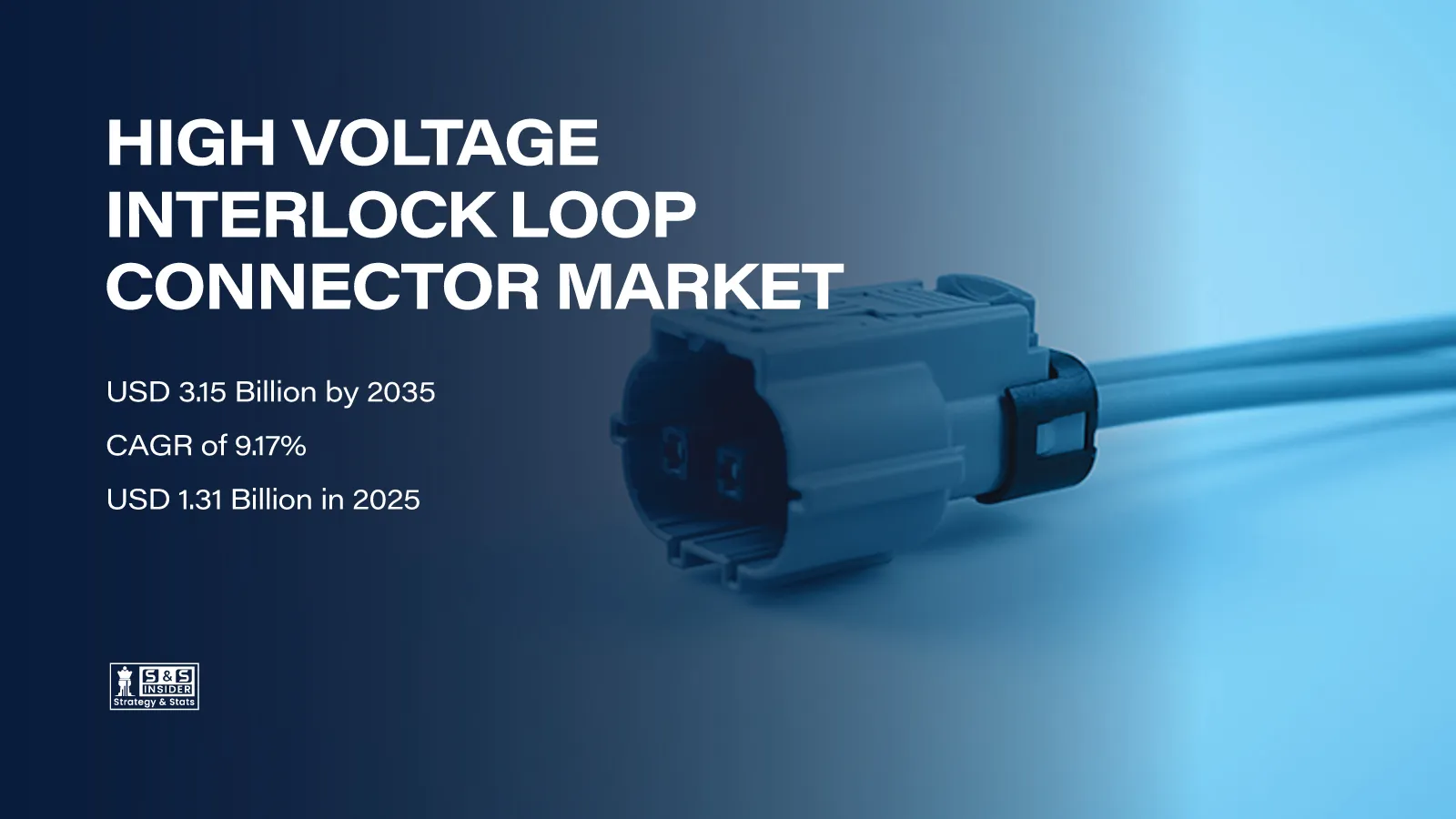
The global high voltage interlock loop connector market was valued at USD 1.31 Billion in 2025 and is estimated at USD 1.43 Billion in 2026. It is projected to reach USD 3.15 Billion by 2035, growing at a CAGR of 9.17% during 2026–2035.
The move from 400 V to 800 V vehicle platforms is changing product needs. Higher voltage raises the safety demands on each connector, so automakers are buying more advanced interlock designs per vehicle.
Automobiles remain the main buyer, but industrial equipment is a growing source of demand. Stricter battery safety rules in major markets are also making interlock protection a firm requirement rather than an option.
Asia Pacific is both the largest and the fastest-growing region. Its lead comes from the scale of electric vehicle and battery production in China, Japan, South Korea and India.
Market Size and Forecast
|
Market Indicator |
Value |
|
Market Size, 2025 |
USD 1.31 Billion |
|
Market Size, 2026 |
USD 1.43 Billion |
|
Market Forecast, 2035 |
USD 3.15 Billion |
|
CAGR, 2026–2035 |
9.17% |
|
Leading Region, 2025 |
Asia Pacific (43.86%) |
|
Fastest-Growing Region |
Asia Pacific (10.79% CAGR) |
Demand Drivers and Constraints
Primary Demand Drivers
-
Tighter battery safety rules: China's GB 38031-2025 standard, in force since July 2026, raises the safety bar for traction batteries and the circuits linked to them.
-
Shift to 800 V platforms: Higher system voltage increases the interlock content needed in each connector.
-
Rising EV output: Electric car sales rose 20% in 2025 to more than 20 million units, which lifts connector volumes.
-
Commercial vehicle electrification: Electric buses and trucks use larger battery packs with more high-voltage connection points.
-
Support in emerging markets: Programs such as India's PM E-DRIVE scheme, extended to March 2028, support local EV production.
Potential Growth Constraints
-
Changes to EV incentives in China and the United States.
-
Long qualification cycles of up to 36 months.
-
Strong price pressure from local suppliers and yearly cost-down demands from buyers.
-
Volatile prices for copper, plastics and plating metals.
-
Design complexity as voltage ratings and sealing needs rise.
Demand Structure by Type
Wire-to-Wire (2025 Market Share: 40.73%)
Wire-to-wire connectors held 40.73% of the market in 2025. They join cable harnesses across the battery, inverter, motor and charging systems and most vehicles use many of them. Automakers prefer them because they are well proven, easy to route and simple to service. Each high-voltage link needs an interlock circuit, so connector count rises with every added system. As electric vehicle output grows, demand for this type will stay steady through 2035.
Current trend: Wider use of sealed, compact wire-to-wire designs in battery and drive systems.
Major trends: Integrated interlock pins, higher current ratings, improved sealing and lighter housings.
Board-to-Board (Forecast CAGR: 11.24%)
Board-to-board connectors are projected to grow at a CAGR of 11.24% through 2035. Battery management systems, onboard chargers and power electronics now pack more functions onto circuit boards. These designs need compact links that carry high voltage safely between boards. Board-to-board connectors save space and cut assembly steps, which suits tightly packed power modules. As suppliers build more integrated electronic units, demand for this type is rising faster than for other designs.
Current trend: Growing use of compact board-level connections in power electronics.
Major trends: Fine-pitch high-voltage designs, module integration, automated assembly and higher heat tolerance.
Demand Structure by Application
Automobile Industry (2025 Market Share: 47.19%)
The automobile industry accounted for 47.19% of the market in 2025. Battery electric and plug-in hybrid vehicles use interlock loops to stop power flow when a high-voltage connector opens. This protects workers during assembly and repair and protects passengers after a crash. Safety standards in China, Europe and North America make this protection mandatory. Higher vehicle output and the move to higher-voltage systems keep this application the largest source of demand.
Current trend: Rising interlock content per vehicle as platforms move to higher voltage.
Major trends: 800 V architectures, crash-safe disconnection, modular harnesses and supplier consolidation.
Industrial Manufacturing (Forecast CAGR: 11.01%)
Industrial manufacturing is expected to grow at a CAGR of 11.01% during 2026–2035. Factories are adding electric forklifts, robots, energy storage units and high-power drives. This equipment carries the same risks as vehicles when high-voltage connections are opened. Plant operators and equipment makers are using interlock connectors to protect staff and meet workplace safety rules. Wider use of battery-powered machines across many industries is broadening demand beyond the auto sector.
Current trend: Growing use of interlock connectors in battery-powered industrial equipment.
Major trends: Energy storage systems, electric material handling, rugged connector designs and safety compliance.
Demand Structure by Voltage
400 V (2025 Market Share: 54.73%)
The 400 V segment held 54.73% of the market in 2025. Most electric vehicles on the road today use 400 V systems and many new models still do. These platforms are mature, cost less to build and have a well-established supply chain. Connector makers produce large volumes of qualified 400 V parts, which keeps prices stable. This segment will keep a large share through the forecast period as mass-market models continue to use it.
Current trend: Steady volume demand from mass-market electric vehicle platforms.
Major trends: Cost reduction, standard designs, high-volume production and proven qualification.
800 V (Forecast CAGR: 13.11%)
The 800 V segment is projected to grow at a CAGR of 13.11% through 2035. Higher voltage allows faster charging and lower current, which reduces cable weight and heat. Premium and performance models adopted 800 V first and more mainstream vehicles and commercial trucks are now following. These systems need connectors with stronger insulation, wider creepage distances and reliable interlock circuits. This change raises the value of each connector sold.
Current trend: Fast adoption of 800 V systems in new vehicle platforms.
Major trends: Ultra-fast charging, 1,000 V-rated connectors, advanced insulation and commercial vehicle use.
Key Market Participants
The high voltage interlock loop connector market includes global connector makers, wiring harness suppliers and specialized automotive component companies.
Key participants include TE Connectivity, Amphenol, Molex, Rosenberger, Hirose Electric, Yazaki and Japan Aviation Electronics Industry (JAE).
Competition centers on voltage ratings, sealing performance, compact size and proven qualification with automakers. Suppliers that can meet strict safety standards, deliver at scale and handle yearly price cuts are best placed to win long-term vehicle programs.
Regional Market Dynamics
North America (2025 Market Share: 19.64%)
North America held 19.64% of the global market in 2025. The United States leads regional demand, with a market value of USD 217.07 Million in 2025 and a projected CAGR of 8.71%. Demand comes from domestic electric vehicle plants, battery factories and commercial fleet electrification. The end of federal clean vehicle credits in September 2025 has slowed some consumer demand. Even so, automakers continue to launch new electric models and connector demand follows these programs.
Direction: Moderate growth supported by local EV and battery production despite policy changes.
Europe (2025 Market Share: 26.47%)
Europe is the second-largest regional market, with a 26.47% share in 2025. Germany, France and the United Kingdom are the largest national markets, supported by major automakers and their supplier networks. Strict emission targets push manufacturers to expand electric vehicle production. European brands are also early adopters of 800 V platforms, which raises demand for higher-rated connectors. Strong safety rules keep interlock protection a standard feature.
Direction: Steady expansion driven by emission targets and early 800 V adoption.
Asia Pacific (Forecast CAGR: 10.79%)
Asia Pacific led the market with a 43.86% share in 2025 and is expected to grow fastest, with a CAGR of 10.79% through 2035. China is the main market, driven by the world's largest electric vehicle and battery output and the new GB 38031-2025 safety standard. Japan and South Korea add demand through major automakers and connector suppliers. India is growing quickly with support from the PM E-DRIVE scheme.
Direction: Fastest regional growth supported by large-scale EV production and stricter battery safety rules.
Middle East & Africa
The Middle East & Africa region held 4.72% of the market in 2025. The UAE, Saudi Arabia and South Africa lead regional demand. Governments in the Gulf are funding electric mobility, charging networks and local vehicle assembly as part of national economic plans. South Africa adds demand through its vehicle export industry. Limited local production and charging infrastructure keep the region small for now.
Direction: Early-stage growth driven by national electrification programs.
Latin America
Latin America held 5.31% of the market in 2025. Brazil and Mexico are the leading countries. Mexico benefits from vehicle and component plants that supply North America, while Brazil is seeing early growth in electric buses and imported electric cars. Currency swings and uneven charging infrastructure slow adoption across the region.
Direction: Gradual growth supported by regional vehicle manufacturing and electric bus programs.
Market Outlook (2026–2035)
The global high voltage interlock loop connector market is forecast to reach USD 3.15 Billion by 2035, as high-voltage safety becomes a core part of electric vehicle and equipment design.
Battery safety rules, rising EV output and the shift to 800 V platforms will remain the main growth drivers. Price pressure and long qualification cycles will continue to test suppliers.
Industrial equipment, energy storage and commercial vehicles will widen demand beyond passenger cars.
Asia Pacific will remain the largest and fastest-growing region, while Europe and North America will grow steadily on the strength of local production and safety requirements.
Overall, the high voltage interlock loop connector market is set for steady expansion through 2035. Success will depend on voltage performance, compact design, proven safety qualification and the ability to deliver at competitive cost.



