According to the latest SNS Insider’s report, the human centric lighting market report, there is an increasing global human centric lighting market owing to the adoption of lighting systems that consider biological rhythms by commercial, health, educational buildings and residential developments.
This market involves the shift from traditional lighting systems to adaptive systems whereby the brightness and temperature of colors change depending on the time of day using advanced technological lighting systems combining adjustable LED lights, sensors and controls.
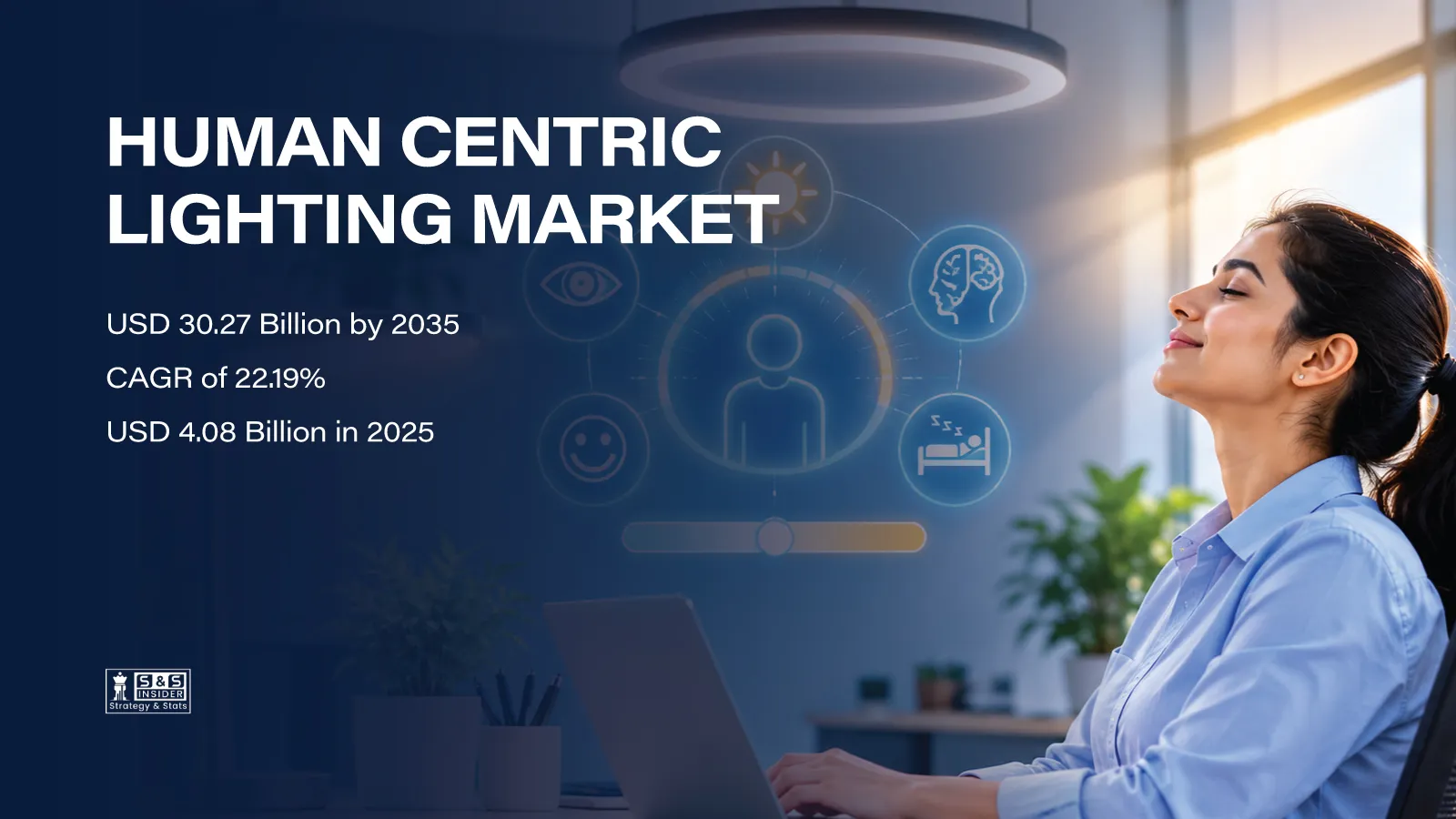
The global human centric lighting market value is expected to rise from USD 4.08 billion in 2025 to USD 4.99 billion in 2026 and further to USD 30.27 billion in 2035 growing at a rate of 22.19% between 2026 and 2035.
There has been increased demand due to focus on occupant satisfaction, energy efficiency, workplace wellness and digital infrastructure development in addition to accessibility of wireless connectivity and tunable lighting technologies. Europe dominates the global market whereas Asia Pacific represents the highest growth opportunities.
Market Size and Forecast
|
Market Indicator |
Value |
|---|---|
|
Market Size, 2025 |
USD 4.08 Billion |
|
Market Size, 2026 |
USD 4.99 Billion |
|
Market Forecast, 2035 |
USD 30.27 Billion |
|
CAGR, 2026–2035 |
22.19% |
|
Leading Region |
Europe (36.84%) |
|
Fastest-Growing Region |
Asia Pacific (26.06% CAGR) |
|
Leading Offering |
Hardware (68.74%) |
|
Leading Application |
Commercial (55.94%) |
Demand Drivers and Constraints
Primary Demand Drivers
-
Growing awareness of circadian wellness: Organizations are adopting adjustable lighting to support visual comfort and more appropriate daytime and nighttime illumination.
-
Smart building expansion: Connected infrastructure enables automated brightness adjustment, occupancy monitoring and integrated lighting management.
-
Healthcare modernization: Hospitals and senior living facilities are evaluating dynamic lighting for patient rooms, nursing environments and overnight care.
-
Energy-efficient building upgrades: LED-based lighting systems support efficiency objectives while enabling advanced illumination controls.
-
Increasing retrofit opportunities: Wireless controllers and adaptable fixtures make intelligent lighting upgrades more practical in existing buildings.
-
Expanding residential automation: Smart homes increasingly incorporate programmable lighting schedules and adjustable color temperatures.
Potential Growth Constraints
-
Higher initial investment compared with conventional lighting installations.
-
Integration challenges involving legacy electrical infrastructure and building management platforms.
-
Limited standardization of circadian lighting performance measurements.
-
Shortages of qualified professionals for system design and commissioning.
-
Uncertainty regarding the long-term health outcomes of specific lighting configurations.
Demand Structure by Offering
Hardware (2025 Market Share: 68.74%)
The hardware component represents the dominant share of the human-centric lighting market, which will account for 68.74% of the global revenue by 2025. Tunable luminaires, LED drivers and controllers represent the material component of adaptive lighting systems. Developers and institutional purchasers focus on investing in hardware due to the fact that lighting fixtures need to meet basic illumination requirements before any other functions can be added. There is high demand for tunable lighting systems in office buildings, hospitals, educational facilities and premium residential buildings.
Current trend: Strong demand for integrated tunable LED fixtures and intelligent control hardware.
Major trends: Spectral adjustment, occupancy sensing, daylight-responsive controls and modular lighting components.
Services (Forecast CAGR: 29.75%)
The fastest growth is forecasted in the services segment, which is expected to grow at a CAGR of 29.75% in the period of 2026 to 2035. HCL necessitates unique design and system commissioning to manage lighting schedules. Technical assistance becomes essential for building owners who are looking forward to integrating their lighting systems with occupancy and natural lighting conditions as well as automation infrastructure. Healthcare institutes and educational institutions have more emphasis on professional services because their lighting needs differ based on location and time of usage.
Current trend: Increasing demand for professional commissioning and managed lighting services.
Major trends: Remote optimization, lifecycle maintenance, performance monitoring and lighting-as-a-service models.
Demand Structure by Installation Type
New Installations (2025 Market Share: 58.62%)
New installations hold the leading position, accounting for 58.62% of the market value in 2025. The incorporation of adaptive lighting during the early stages of building construction enables architects and engineers to plan the positioning of luminaires and electricity systems, as well as daylight and control networks. Tunable lighting is being considered for commercial offices, healthcare and educational campus constructions. New installations offer an opportunity to integrate lighting with building automation and energy management. Construction and infrastructure spending are expected to drive demand through 2035.
Current trend: Growing incorporation of adaptive lighting into new commercial and institutional buildings.
Major trends: Integrated building design, connected controls, automated daylight management and wellness-focused construction.
Retrofit Installations (Forecast CAGR: 24.38%)
The retro-fit installation market is expected to witness a CAGR growth of 24.38% between 2026-2035. The existing commercial buildings, hospitals, schools and residential spaces will be an emerging market as the existing lighting system installations near the end of their lifecycle. Wireless control system technology will lower the requirement for re-wiring, thus making it easier for occupied spaces to upgrade. The building owner can integrate conventional lighting replacement with adjustable color temperature and scheduling automation.
Current trend: Accelerating replacement of fixed-output lighting with adaptable LED systems.
Major trends: Wireless retrofits, simplified commissioning, energy-efficient renovation and intelligent lighting upgrades.
Demand Structure by Application
Commercial (2025 Market Share: 55.94%)
Commercial applications account for the largest share of the human centric lighting market, representing 55.94% of revenue in 2025. Offices, retail environments, co-working facilities and other commercial buildings require lighting systems capable of supporting varied activities across extended operating hours. Corporate occupiers increasingly consider workplace comfort and environmental performance when upgrading facilities. Adaptive lighting allows facility managers to modify brightness and color temperature according to occupancy and daylight conditions. Demand is supported by smart office development, commercial refurbishment and building management integration.
Current trend: Increasing specification of dynamic lighting in modern commercial workplaces.
Major trends: Automated workplace illumination, occupancy-based adjustments, centralized controls and wellness-oriented building design.
Healthcare (Forecast CAGR: 23.92%)
Healthcare is expected to register the fastest application growth, with a CAGR of 23.92% through 2035. Hospitals, rehabilitation facilities and senior living environments are increasingly evaluating circadian-oriented lighting for patient rooms, treatment areas and staff workspaces. Dynamic systems can provide different lighting conditions for daytime activities and nighttime care while helping reduce unnecessary disturbance. Healthcare operators also require dependable controls, appropriate visual conditions and integration with facility management systems. Growing investment in hospital modernization and specialized care infrastructure creates opportunities for lighting manufacturers and service providers.
Current trend: Expanding deployment of adaptive lighting in hospitals and long-term care facilities.
Major trends: Patient-room lighting customization, nighttime illumination, staff-oriented lighting schedules and healthcare facility modernization.
Demand Structure by Light Source
LED (2025 Market Share: 84.37%)
LED technology dominates the market, accounting for 84.37% of revenue in 2025. LEDs provide controllable brightness, adjustable color temperatures, long operating lives and relatively efficient energy consumption. These characteristics make them suitable for dynamic lighting systems in commercial, residential, healthcare and educational environments. Established manufacturing networks and improving compatibility with digital controls reinforce their market position.
Current trend: Widespread adoption of tunable white LED lighting.
Major trends: Multi-channel LED modules, advanced dimming, spectral tuning and connected luminaires.
OLED (Forecast CAGR: 29.97%)
OLED lighting is projected to expand at a CAGR of 29.97% during 2026–2035. Its thin form factors and diffuse light distribution create opportunities in premium interiors, hospitality environments and specialized healthcare applications. OLED panels can support decorative and integrated lighting designs where visual comfort and aesthetics are important. However, manufacturing costs and technical performance requirements continue to influence broader commercial adoption.
Current trend: Growing interest in premium OLED-based interior lighting.
Major trends: Flexible illumination panels, integrated architectural lighting, improved panel durability and glare-conscious designs.
Demand Structure by Connectivity
Wired Systems (2025 Market Share: 61.73%)
Wired connectivity holds the largest market share at 61.73% in 2025. Established communication protocols and predictable network performance make wired systems attractive for hospitals, commercial offices, educational campuses and other large facilities. Integration with centralized building management infrastructure further supports adoption, particularly in new construction where cabling can be incorporated during electrical installation.
Current trend: Continued preference for dependable wired lighting control networks.
Major trends: DALI-based communication, centralized building control, integrated automation and network standardization.
Wireless Systems (Forecast CAGR: 27.82%)
Wireless systems are anticipated to expand at a CAGR of 27.82% during 2026–2035. Bluetooth mesh, Zigbee and other wireless technologies allow building operators to install adaptable controls with less additional cabling. Their flexibility is particularly valuable for retrofit projects, changing workplace layouts and residential applications. Smartphone configuration and remote system updates also simplify ongoing lighting management.
Current trend: Rapid adoption of wireless lighting controls in retrofit projects.
Major trends: Bluetooth mesh networking, Zigbee integration, mobile commissioning and remotely adjustable lighting schedules.
Regional Market Dynamics
Europe (2025 Market Share: 36.84%)
Europe leads the global human centric lighting market with a 36.84% share in 2025. Germany, the United Kingdom, France and Nordic countries are important markets, supported by established lighting industries, building renovation activity and strong interest in energy efficiency. Commercial offices, healthcare facilities and educational institutions increasingly consider adaptive lighting when upgrading building infrastructure. Europe's mature lighting design ecosystem and extensive installed building stock also create demand for specialized retrofit solutions.
Direction: Market leadership supported by building modernization, lighting expertise and sustainability initiatives.
North America (2025 Market Share: 27.46%)
North America accounts for 27.46% of global revenue in 2025, led by the United States. The U.S. human centric lighting market was valued at USD 889.35 Million in 2025 and is projected to expand at a CAGR of 22.81% during 2026–2035. Corporate wellness initiatives, healthcare construction, university modernization and smart building investment support regional demand. Canada contributes through healthcare, education and commercial infrastructure projects, particularly in areas experiencing limited winter daylight.
Direction: Strong expansion supported by healthcare investment, workplace modernization and connected building adoption.
Asia Pacific (Forecast CAGR: 26.06%)
Asia Pacific is expected to be the fastest-growing regional market, with a CAGR of 26.06% through 2035. China, Japan, India and South Korea are investing in commercial infrastructure, smart buildings and modern lighting technologies. Rapid urban development and expanding institutional construction create opportunities for tunable lighting installations. Regional manufacturers and technology providers are also improving access to intelligent lighting products through broader distribution networks.
Direction: Fastest regional expansion supported by infrastructure development and smart building investment.
Latin America
Latin America represents an emerging market, with Brazil, Mexico, Argentina and Colombia providing opportunities for advanced lighting adoption. Commercial construction, hospitality investment and energy-efficient renovation are supporting interest in adjustable lighting systems. Adoption is expected to develop progressively as project budgets, technology availability and local installation expertise improve.
Direction: Gradual growth supported by commercial modernization and energy-efficient lighting upgrades.
Middle East & Africa
The Middle East and Africa market is expanding through premium commercial development, hospitality construction, healthcare projects and smart city initiatives. Saudi Arabia, the UAE, Qatar and South Africa are important demand centers. New infrastructure projects provide opportunities to integrate intelligent lighting into building designs, while growing sustainability awareness encourages consideration of energy-efficient systems.
Direction: Emerging opportunities driven by smart infrastructure, hospitality expansion and institutional development.
Key Market Participants
The competitive landscape includes Signify, Acuity Brands, Zumtobel Group, Lutron Electronics, Glamox, TRILUX and Wipro Lighting.
Competition increasingly focuses on tunable lighting performance, integrated control systems, ease of installation and long-term service capabilities. Manufacturers are expanding connected lighting offerings, while partnerships with control technology providers help deliver more comprehensive building solutions.
Market Outlook (2026–2035)
The SNS Insider baseline forecast projects the human centric lighting market to reach USD 30.27 Billion by 2035, expanding at a CAGR of 22.19% during 2026–2035.
Expansion will be driven by the shift to adaptive buildings, which will result in increased demand for energy-efficient lighting as well as better focus on occupant comfort. Adoption will be boosted further by the availability of wireless control systems and affordable tunable LED products.
The commercial segment will continue to be the leading end-use application for LED lighting products, but there will also be substantial potential in healthcare, retrofitting, OLED and wireless LED.
Europe will continue to have a solid market presence, whereas Asia Pacific will provide the fastest growth rate regionally.
Overall, the human centric lighting market is entering a period of accelerated development, with long-term competitiveness determined by system affordability, lighting performance, integration flexibility and the ability to deliver reliable, occupant-focused illumination solutions.