The global LTE & 5G for critical communications market is entering a period of significant expansion as governments, emergency response agencies and industrial enterprises invest in resilient broadband communication infrastructure. Increasing demand for mission-critical voice, video and data connectivity is accelerating the transition from traditional narrowband radio systems toward advanced LTE and 5G networks.
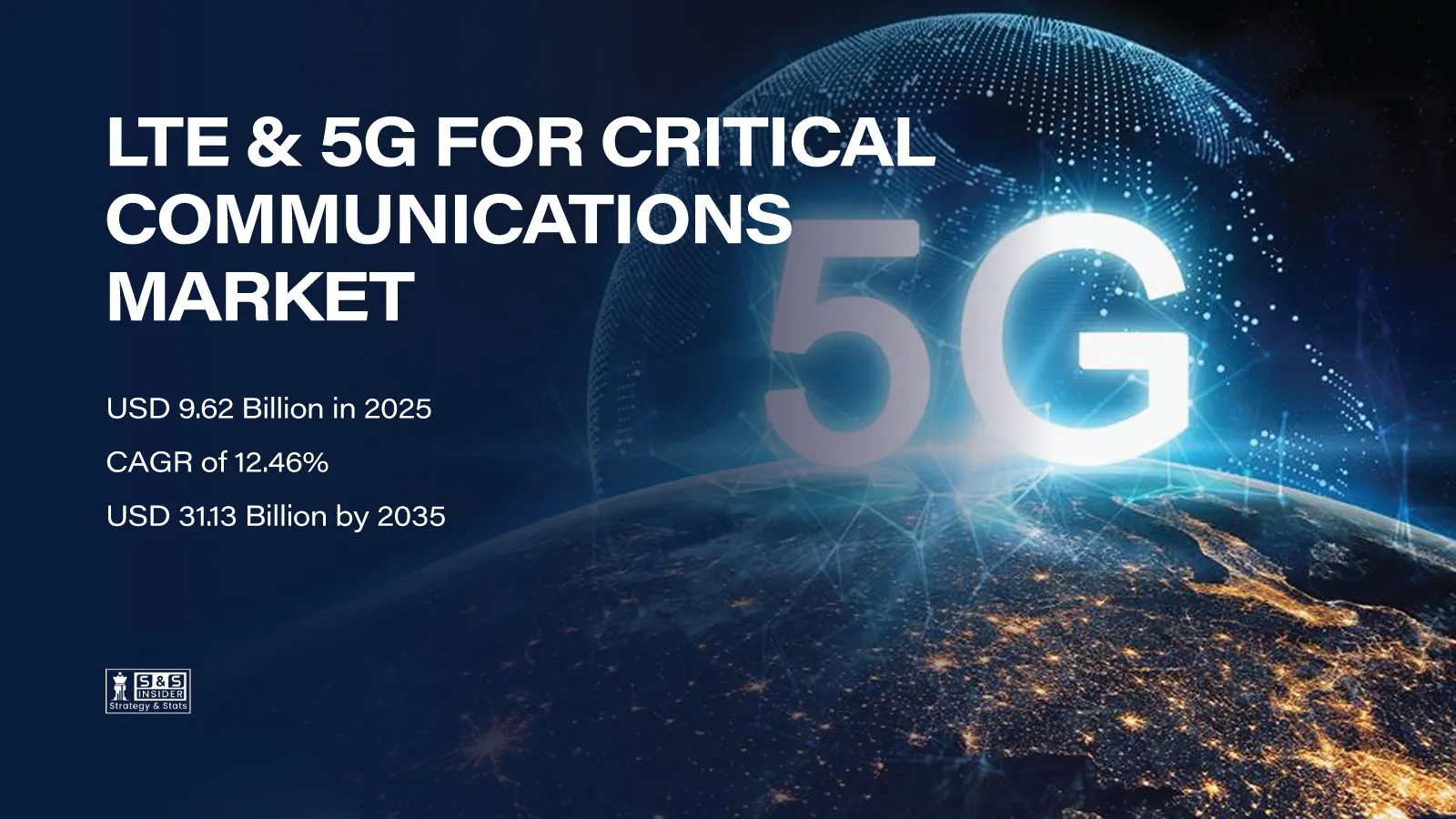
According to SNS Insider, the global LTE & 5G for Critical Communications Market was valued at USD 9.62 billion in 2025, is estimated to reach USD 10.82 billion in 2026 and is projected to expand to USD 31.13 billion by 2035, registering a CAGR of 12.46% during 2026–2035.
Public safety modernization programs, standalone 5G deployment, network slicing and private wireless infrastructure are transforming mission-critical communications. Police departments, emergency medical services, utilities, transportation operators and industrial facilities increasingly require uninterrupted connectivity for real-time coordination and operational safety.
The market is also benefiting from hybrid network architectures that combine dedicated infrastructure with commercial mobile coverage. North America maintains regional leadership, while Asia-Pacific is expected to record the fastest expansion through 2035.
Market Size and Forecast
|
Market Indicator |
Value |
|---|---|
|
Market Size, 2025 |
USD 9.62 Billion |
|
Market Size, 2026 |
USD 10.82 Billion |
|
Market Forecast, 2035 |
USD 31.13 Billion |
|
CAGR, 2026–2035 |
12.46% |
|
Leading Region |
North America (37.42%) |
|
Fastest-Growing Region |
Asia-Pacific (14.43% CAGR) |
|
Leading Technology |
LTE (53.84%) |
|
Leading Deployment |
Private Networks (52.17%) |
Demand Drivers and Constraints
Primary Demand Drivers
-
Public safety network modernization: Governments are upgrading emergency communication systems to support secure voice, live video, geographic information and coordinated disaster response.
-
Migration from narrowband radio: Replacement of aging terrestrial trunked radio infrastructure is creating demand for broadband-compatible devices and network equipment.
-
Standalone 5G and network slicing: Dedicated network resources improve traffic prioritization, security and performance for critical operations.
-
Private industrial networks: Utilities, railways, ports and mining operators are expanding private wireless connectivity for automation and worker safety.
-
Advancing mission-critical standards: Improved interoperability supports broader deployment of mission-critical push-to-talk, video and messaging services.
Potential Growth Constraints
-
High infrastructure deployment and maintenance costs.
-
Delays and budget overruns in national emergency network programs.
-
Limited availability of suitable radio spectrum.
-
Complex integration with existing radio communication systems.
-
Cybersecurity, network resilience and interoperability requirements.
Demand Structure by Component
Hardware (2025 Market Share: 43.68%)
Hardware dominated the market with a 43.68% share in 2025, supported by substantial investment in base stations, network equipment, rugged smartphones, vehicle routers and communication terminals. Emergency response agencies require reliable infrastructure capable of operating across demanding environments, including remote areas and disaster-affected locations. Government modernization projects and industrial private network deployments generate recurring equipment demand. Hardware suppliers also benefit from replacement programs, network extensions and maintenance requirements as organizations expand coverage and adopt 5G-compatible devices.
Current trend: Sustained demand for resilient communication equipment and broadband-capable terminals.
Major trends: Rugged 5G devices, hybrid radio handsets, portable network infrastructure and coverage expansion.
Software (Forecast CAGR: 15.38%)
Software is projected to be the fastest-growing component segment, expanding at a CAGR of 15.38% during 2026–2035. Cloud-native network management, mission-critical applications and software-defined communication platforms are creating new opportunities for technology providers. Public safety organizations increasingly require integrated solutions for dispatch coordination, video transmission, location tracking and secure messaging. Network slicing orchestration and remote software upgrades also help operators improve network efficiency without replacing physical infrastructure.
Current trend: Accelerating adoption of integrated mission-critical software platforms.
Major trends: Cloud-native cores, network orchestration, advanced analytics and subscription-based communication services.
Demand Structure by Technology
Public Safety (2025 Market Share: 43.86%)
Public safety application emerged as the biggest revenue contributor to the market with a 43.86% share in 2025. Communication is vital in ensuring that emergency response by the police departments, fire departments, ambulances and disaster management agencies is efficient. Broadband policies are playing a major role in securing specialized networks and communication devices. There is growing use of body-worn cameras, location services and mobile command apps which are creating demand.
Current trend: Expansion of nationwide and regional emergency broadband networks.
Major trends: Mission-critical push-to-talk, emergency video, responder location tracking and priority connectivity.
Utilities (Forecast CAGR: 14.92%)
The utilities application is expected to be the fastest growing segment with a CAGR of 14.92% during the period 2026–2035. Infrastructure operators for electricity, water, and energy are increasingly depending on secure wireless communications to coordinate their assets, keep an eye on sub-stations and work with field staffs. Private networks based on LTE and 5G ensure coverage and guarantee continuity of operations in cases where the infrastructure gets interrupted. Utility companies need to upgrade their communication capabilities in line with their digitalization efforts.
Current trend: Increasing deployment of private broadband networks across utility infrastructure.
Major trends: Smart grid connectivity, remote monitoring, outage response and industrial network automation.
Demand Structure by Deployment
Private Networks (2025 Market Share: 52.17%)
The deployment segment was dominated by private networks, holding a 52.17% market share in 2025. Critical infrastructure operators are increasingly looking at dedicated wireless systems that give them control over network security, capacity and coverage. Private infrastructure is used by industrial facilities, utilities, transportation networks and emergency organizations to support operational applications without being fully dependent on public mobile networks. Investment is also driven by data sovereignty requirements, infrastructure resilience and predictable communication performance.
Current trend: Growing demand for dedicated and independently managed wireless infrastructure.
Major trends: Private LTE, enterprise 5G, dedicated network cores and industrial connectivity.
Hybrid Networks (Forecast CAGR: 16.74%)
Deployment of hybrid networks will increase the most, at a CAGR of 16.74% up until 2035. This kind of networking utilizes private communication networks which have coverage offered by commercial mobile networks, thus making it possible for organizations to achieve both control and coverage. Public safety organizations and industries are increasingly considering hybrid networking because it can help them cut down on their infrastructure costs while at the same time ensuring that they maintain their ability to communicate.
Current trend: Increasing integration of private networks with commercial broadband services.
Major trends: Hybrid connectivity, priority network slicing, seamless roaming and shared infrastructure.
Regional Market Dynamics
North America (2025 Market Share: 37.42%)
North America dominated the global market in 2025 with a revenue share of 37.42% due to the vast public safety broadband infrastructure and established telecommunications capabilities. The United States is a major part of the regional demand, contributing about 88.43% of the North American revenue. Canada continues to invest in emergency network modernization. The U.S. market is expected to grow at a CAGR of 11.86% through 2035 to reach USD 3.18 billion in 2025. Network upgrades, rural coverage expansion and private wireless deployments across utilities and transportation remain important commercial opportunities.
Direction: Continued market leadership supported by public safety investment and advanced network modernization.
Europe (Second-Largest Regional Market)
Europe is the second-largest regional market for mission-critical broadband systems as there are plans to upgrade old radio infrastructure used for emergency purposes with modern mission-critical broadband technology by the respective governments. UK, Germany, France and Belgium are considered the key markets for public safety and secured communication system. Germany was contributing around 23.81% to the European revenue in 2025. Growth is expected from investment in railway communications, utility and broadband networks.
Direction: Steady expansion through emergency communication modernization and industrial broadband adoption.
Asia-Pacific (Forecast CAGR: 14.43%)
The Asia-Pacific region is expected to be the fastest growing in terms of regional revenue, witnessing a CAGR of 14.43% in the coming years from 2026-2035. China, South Korea, India, Japan and Australia are investing in building public safety broadband infrastructure and private wireless networks. China made up 34.72% of regional revenue share in 2025. Growth drivers include investment in smart infrastructure development, transportation improvements, disaster management systems, and industrial automation.
Direction: Rapid growth supported by infrastructure investment, industrial digitalization and 5G deployment.
Middle East & Africa (Saudi Arabia: 31.58% Regional Share in 2025)
Expansion of the Middle East & Africa Market: Government bodies and corporations are investing in communication infrastructure to ensure security. In 2025, Saudi Arabia contributed 31.58% to the total revenue of the region owing to its investments in security systems and infrastructure in the energy industry. The UAE is making progress towards developing infrastructure as well, whereas there are possibilities in South Africa and Kenya. Private LTE and 5G networks are increasingly relevant for remote industrial operations and emergency coordination.
Direction: Emerging expansion supported by smart infrastructure, energy operations and public safety modernization.
Latin America (Brazil: 44.96% Regional Share in 2025)
LatAm is the emerging market for LTE and 5G critical communications where Brazil constitutes 44.96% of the region’s revenue for the year 2025. The countries such as Brazil, Mexico, Argentina, and Colombia are upgrading their emergency communication system and industrial connectivity solutions. Applications such as mining, energy, transportation, and municipal security are driving the demand. However, although public budget limitations and spectrum availability are the key barriers, the opportunities have been created through managed services and private broadband networks.
Direction: Gradual market development supported by industrial connectivity and emergency communication upgrades.
Competitive Landscape
The LTE & 5G for critical communications market includes established telecommunications equipment manufacturers, mission-critical communication specialists and mobile network operators. Major participants include Motorola Solutions, Nokia, Ericsson, Huawei, Samsung Electronics, Hytera, Sepura, Leonardo, AT&T and Verizon.
Competition centers on network reliability, standards compliance, broadband coverage, device interoperability and cybersecurity capabilities. Vendors are expanding integrated product lines that combine communications hardware, mission-critical software, and managed network services. Recent developments • In June 2025, Nokia launched its MC_linX mission-critical platform. • In June 2026, Motorola Solutions launched new mission-critical broadband solutions.
Market Outlook (2026–2035)
The global LTE & 5G for critical communications market is projected to hit USD 31.13 billion by 2035, driven by growing investment in strong wireless infrastructure.
Public safety modernization will be a major growth driver, with utilities, transportation operators and industrial enterprises driving additional demand for private and hybrid networks. Future technology investment is expected to be driven by standalone 5G, network slicing and integrated mission-critical applications. North America will maintain its established market position while Asia-Pacific is anticipated to provide the fastest regional expansion.
Overall, the market's long-term growth will depend on reliable broadband deployment, interoperability, network security and the ability to support uninterrupted communications across essential services