
According to the latest SNS Insider Phenolic Resin Market report, the global market is experiencing steady expansion as manufacturers increase their reliance on heat-resistant adhesives, engineered wood materials, insulation products and industrial molding compounds.
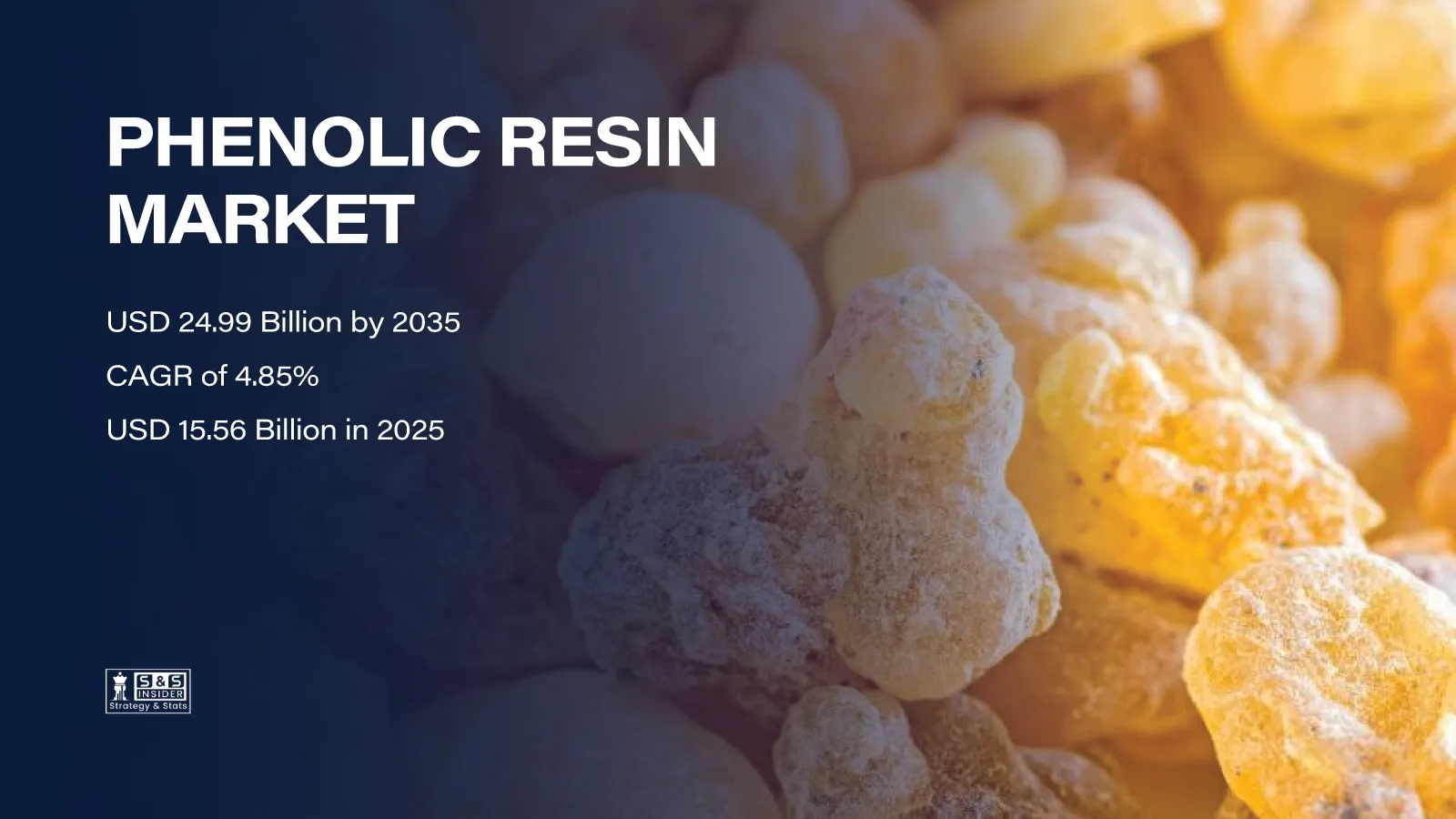
The global phenolic resin market was valued at USD 15.56 billion in 2025, is estimated to reach USD 16.31 billion in 2026 and is forecast to expand to USD 24.99 billion by 2035, registering a CAGR of 4.85% during 2026–2035.
Phenolic resins are increasingly important in applications requiring mechanical durability, thermal stability, moisture resistance and flame performance. Demand is particularly strong in wood processing, automotive manufacturing, electrical equipment, building insulation and industrial composites.
The market is undergoing a gradual transition toward lower-emission formulations and partially bio-based alternatives. Manufacturers are developing advanced resol and novolac resins to satisfy changing environmental requirements while maintaining established performance characteristics.
Raw material price fluctuations, formaldehyde regulations and competition from alternative binders remain important challenges. However, infrastructure development, energy-efficient construction and expanding electrical applications provide opportunities for differentiated products.
Asia-Pacific remains the largest regional market and is also projected to achieve the fastest growth through 2035, supported by extensive manufacturing activity across China, India, Japan and South Korea.
Demand Drivers and Constraints
Primary Demand Drivers
-
Growing consumption of engineered wood, plywood and structural panels increases demand for moisture-resistant phenolic adhesives.
-
Expanding construction and renovation activities support fire-resistant insulation boards, laminates and protective building materials.
-
Automotive manufacturing requires thermally stable resins for friction materials, brake components and molded parts.
-
Electrical equipment production increases demand for insulating compounds and heat-resistant components.
-
Development of lower-emission and bio-based resin formulations creates new opportunities among sustainability-focused industrial customers.
-
Infrastructure modernization supports demand for specialized resins used in composites, coatings and industrial applications.
Potential Growth Constraints
-
Volatile phenol and formaldehyde feedstock prices affect manufacturing costs and profitability.
-
Strict chemical emission regulations increase testing, certification and reformulation requirements.
-
Competition from polyurethane and alternative adhesive technologies limits penetration in selected applications.
-
High technical qualification costs can delay adoption of newly developed specialty formulations.
-
Supply chain disruptions and inconsistent industrial production affect regional demand patterns.
Demand Structure by Type
Resol — Largest and Fastest-Growing Type (48.69% Share in 2025; 5.92% CAGR)
Resol resins accounted for approximately 48.69% of global revenue in 2025 and are projected to register the fastest type-level CAGR of 5.92% through 2035. Their ability to cure under suitable heating conditions makes them particularly suitable for wood adhesives, insulation foams and industrial laminates. Growing production of exterior-grade plywood and oriented strand board supports recurring demand. Manufacturers are also improving curing efficiency and developing low-emission formulations to satisfy environmental standards. Increased adoption of structural timber products and fire-resistant building materials is expected to reinforce resol's market position.
Current trend: Expanding demand for fast-curing, lower-emission resol formulations.
Major trends: Structural wood adhesives, lignin-modified resins, improved curing performance and fire-resistant insulation.
Demand Structure by Form
Liquid — Dominant Form (54.00% Market Share in 2025)
Liquid phenolic resins represented 54.00% of market revenue in 2025, supported by extensive applications in wood adhesives, laminates and insulation production. Liquid formulations enable efficient pumping, mixing and coating processes across continuous manufacturing operations. Large engineered wood producers particularly favor formulations that maintain consistent viscosity and predictable curing behavior. Demand is expected to remain strong across Asia-Pacific, North America and Europe as manufacturers expand panel production and upgrade processing efficiency. Suppliers offering customized formulations and reliable technical support are positioned to benefit from long-term industrial purchasing relationships.
Current trend: Stable industrial demand for process-efficient liquid resin systems.
Major trends: Automated application, viscosity optimization, bulk supply arrangements and low-emission formulations.
Solid — Fastest-Growing Form (5.45% CAGR)
Solid phenolic resins are projected to expand at a CAGR of 5.45% between 2026 and 2035. Available as powders, flakes and granules, these resins serve molding compounds, friction materials, abrasives and electrical insulation applications. Their storage characteristics and controlled processing performance make them useful for specialized manufacturing. Growing production of electrical connectors, vehicle components and industrial equipment supports demand. Manufacturers are developing grades with improved thermal resistance and processing consistency to meet increasingly demanding product specifications.
Current trend: Increasing consumption of solid resins in precision industrial applications.
Major trends: Powder molding compounds, electric vehicle components, advanced friction materials and specialty electrical insulation.
Demand Structure by Application
Wood Adhesives — Leading Application (32.49% Share in 2025)
Wood adhesives dominated the market with a 32.49% revenue share in 2025. Phenolic resin adhesives provide durable bonding in plywood, oriented strand board, laminated veneer lumber and other engineered wood products. Their resistance to moisture and environmental exposure supports applications requiring long service life. Residential construction, renovation activity and increasing adoption of engineered timber create recurring demand for high-performance adhesive systems. Manufacturers are prioritizing reduced emissions, faster curing and improved production efficiency. Demand should remain resilient as wood processing industries expand across established and emerging manufacturing markets.
Current trend: Strong consumption of durable adhesives for engineered wood manufacturing.
Major trends: Low-emission bonding, structural timber applications, faster press cycles and sustainable panel production.
Insulation — Fastest-Growing Application (6.26% CAGR)
Insulation is expected to register the fastest application-level CAGR of 6.26% through 2035. Phenolic foam provides thermal insulation and favorable fire-performance characteristics, supporting its use in roofing systems, building envelopes and ventilation infrastructure. Growing emphasis on building energy efficiency and fire safety encourages adoption in commercial and residential construction. Renovation programs and stricter building specifications are creating opportunities for advanced insulation materials. Suppliers developing high-performance formulations with improved processing characteristics are positioned to benefit from expanding demand for efficient building solutions.
Current trend: Rising use of phenolic insulation in energy-efficient construction.
Major trends: Building retrofits, improved thermal insulation, fire-performance requirements and specialty foam formulations.
Demand Structure by End-Use Industry
Automotive and Transportation — Largest End-Use (30.00% Share in 2025)
Automotive and transportation industries accounted for 30.00% of the market revenue in 2025. The phenolic resins are used in brake pads, clutch parts, molded electrical components, filters, and heat resistant assemblies. They have dimensional stability and thermal resistance that enables their use in harsh operating conditions. There is also an emergence of insulating components in vehicle electrification. In addition to use in automotive manufacturing, railways and aerospace industries use specialized phenolic resins in certain fire-resistant components.
Current trend: Sustained demand for thermally stable transportation components.
Major trends: Electric vehicle insulation, friction materials, heat-resistant molding and lightweight component development.
Electrical and Electronics — Fastest-Growing End-Use (5.65% CAGR)
Projected growth rate in the electrical and electronics application segment is expected to be at a CAGR of 5.65% between 2026 and 2035. The phenolic resin is useful for electrical insulation, moldable connectors, switchgear parts, and certain circuit board laminates. Power network infrastructure, installation of data centers, automation, and manufacture of electrical equipment will drive the demand. Manufacturers prefer materials that can withstand heat, provide stability in dimensions, and have reliable performance. Resin types tailored for such applications are seen as having potential.
Current trend: Growing demand for high-performance electrical insulation materials.
Major trends: Data center infrastructure, electrical connectors, power distribution equipment and advanced molding compounds.
Regional Market Dynamics
Asia-Pacific — Largest and Fastest-Growing Region (37.76% Share; 5.55% CAGR)
The Asia Pacific region constituted 37.76% of the world phenolic resin market in 2025 and is estimated to have the highest regional CAGR of 5.55% up to 2035. China is the biggest producer and consumer owing to its flourishing furniture, engineered wood, electronics and construction industries. India is contributing increasing demand from its infrastructure, automobile and industrial sectors, whereas Japan and South Korea are driving consumption of specialty resins. Growth in Southeast Asian manufacturing is generating more opportunities.
Direction: Market leadership and accelerated expansion supported by manufacturing capacity and infrastructure investment.
North America — Established Industrial Market (27.80% Share in 2025)
North America contributed 27.80% to the global revenue in 2025, backed by the presence of well-established engineered wood, construction, automotive, and specialty chemicals industries. The USA is the major market in North America, contributing USD 3.68 billion in 2025, with a forecasted CAGR of 4.55% during 2026-2035. Demand from Canada arises from its engineered wood and forestry industries, whereas demand from Mexico arises from its automotive and electrical industries. Growing concern about formaldehyde emissions and energy efficiency is driving investments in compliant resin formulations and production technologies.
Direction: Steady expansion through industrial modernization and low-emission product development.
Europe — Regulatory-Driven Specialty Market (23.15% Share in 2025)
The Europe segment contributed to 23.15% of the worldwide market revenue in 2025. Countries like Germany, France, Italy, Spain and United Kingdom are some of the major consuming countries that are backed up by the automotive industry, engineered wood industry and insulation industry. Chemical safety regulations and building performance regulations are playing a role in resins' choice. Suppliers are working on developing lower emission, partially renewable and specialized resins due to customer changing preferences.
Direction: Growth centered on compliant formulations, specialty applications and sustainable material innovation.
Latin America — Developing Market (5.40% Share in 2025)
The Latin American region contributed 5.40% of the market value share in 2025, with Brazil and Mexico as prominent industrial markets. Market demands are driven by activities such as wood processing, production of furniture, automobiles and building materials. Opportunities exist for the producers of adhesives and molding resins through the growth of exports of engineered wood products and industrialization. Currency variations, cost of imported materials, and investment conditions could affect the buying decision.
Direction: Gradual expansion supported by wood processing and industrial manufacturing activity.
Middle East & Africa — Emerging Market (5.89% Share in 2025)
The Middle East & Africa represented 5.89% of global revenues in 2025. The countries such as Saudi Arabia and the United Arab Emirates, together with other countries of the Persian Gulf, stimulate demand by means of construction, infrastructure and insulation application. Moreover, oil and gas industries have demands on specialized resin-based paints and materials. South Africa along with other African regions provide demand through housing, manufacturing of furniture, and industrialization process.
Direction: Emerging opportunities driven by construction investment, industrial diversification and petrochemical development.
Competitive Landscape
The phenolic resins industry can be considered to have moderate consolidation, and competition depends on production capacity, special formulation skills, technical expertise, and reliable supply of feedstock. The companies identified as major players in the market by SNS Insider are Sumitomo Bakelite Co., Ltd., SI Group, Inc., Prefere Resins Holding GmbH, and Hexion Inc.
The companies are focusing on production of lower emission resins, incorporation of bio-based raw materials, optimal manufacturing operations, and special formulations for wood adhesives, automotive parts, and electrical applications. Some recent developments in the industry are the September 2026 restructuring of Sumitomo Bakelite's North American phenolic resin business and the July 2025 joint venture between Hexion and Bloom Biorenewables for renewable lignin-based adhesives.
Market Outlook (2026–2035)
The global phenolic resin market is projected to grow from USD 16.31 billion in 2026 to USD 24.99 billion by 2035 at a CAGR of 4.85%. Future growth will be driven by increasing use of engineered wood, need for fire resistant insulation, production of transport products and development of electrical infrastructure. Though traditional applications will continue driving demand, higher value applications are emerging in the areas of lower emission adhesives, bio-based resins and electrical materials.
Asia Pacific region is expected to continue being the dominant growth driver, while North America and Europe will focus on process efficiency, regulatory compliance and specialty products. Fluctuating raw material prices and competition from alternative adhesives will continue posing challenges for producers. Companies able to offer performance coupled with better environmental characteristics and technical services will have an advantage.
Overall, the phenolic resin market is positioned for sustained expansion through 2035, with future competitiveness increasingly determined by application-specific innovation, industrial efficiency and the transition toward lower-emission materials.



