
According to SNS Insider, the global Activated Carbon Market is entering a period of accelerated expansion as governments strengthen drinking water standards, industrial operators improve pollution control and manufacturers adopt advanced adsorption technologies.
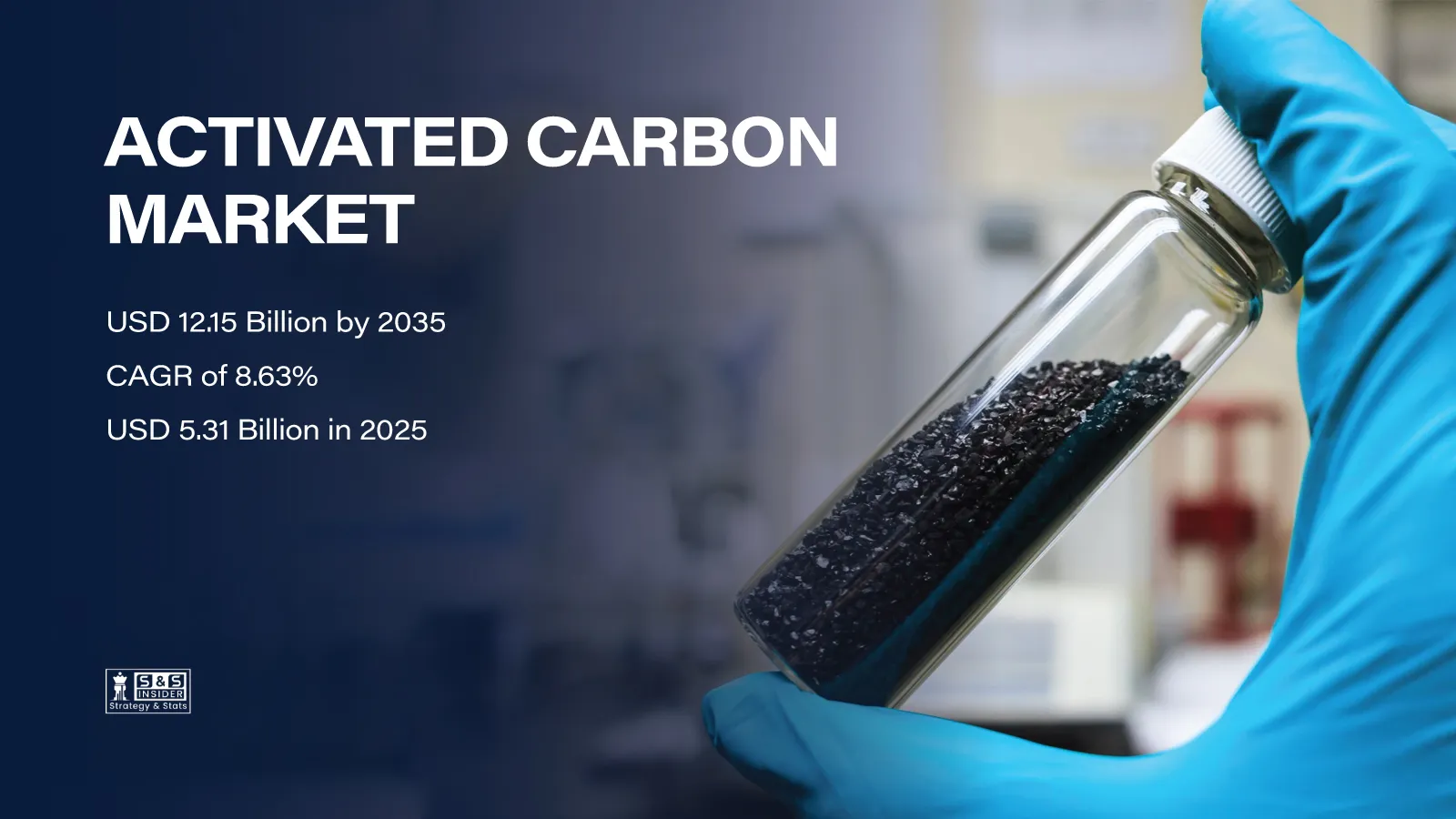
The global activated carbon market was valued at USD 5.31 billion in 2025, is estimated to reach USD 5.77 billion in 2026 and is projected to expand to USD 12.15 billion by 2035, registering a CAGR of 8.63% during 2026–2035.
Demand is increasingly influenced by regulatory measures addressing per- and polyfluoroalkyl substances (PFAS), volatile organic compounds and industrial contaminants. Activated carbon remains an important filtration material because its porous structure enables adsorption of impurities from liquids and gases.
Market development is also shifting toward reusable filtration media, carbon reactivation services and specialized grades for pharmaceutical manufacturing, chemical processing, energy storage and environmental remediation.
Asia Pacific dominates global consumption and production, while North America and Europe are strengthening investment in advanced treatment infrastructure. Through 2035, suppliers offering certified filtration materials, reliable feedstock sourcing and reactivation capabilities are positioned to benefit from recurring industrial and municipal demand.
Market Size and Forecast
|
Market Indicator |
Value |
|---|---|
|
Market Size, 2025 |
USD 5.31 Billion |
|
Market Size, 2026 |
USD 5.77 Billion |
|
Market Forecast, 2035 |
USD 12.15 Billion |
|
CAGR, 2026–2035 |
8.63% |
|
Leading Region, 2025 |
Asia Pacific (44.62%) |
|
Fastest-Growing Region |
Asia Pacific (10.28% CAGR) |
|
Leading Type |
Powdered (47.36%) |
|
Leading Application |
Water Treatment (38.46%) |
Demand Drivers and Constraints
Primary Demand Drivers
-
Stricter drinking water standards: PFAS monitoring and treatment requirements are increasing demand for granular activated carbon across municipal water systems.
-
Industrial pollution control: Chemical plants, power facilities and manufacturing operations use carbon filtration to manage emissions, solvents and wastewater contaminants.
-
Expansion of water infrastructure: Urbanization and industrial development are encouraging investment in municipal and industrial purification systems.
-
Growing reactivation demand: Regeneration of spent carbon offers opportunities to reduce material consumption and establish recurring service contracts.
-
Specialty industrial applications: Pharmaceuticals, food processing, mining and energy storage are expanding the range of activated carbon applications.
Potential Growth Constraints
-
Volatility in coal, wood and coconut shell raw material prices.
-
High energy consumption during carbon activation and reactivation.
-
Competition from membrane filtration and ion exchange technologies.
-
Trade barriers affecting international material sourcing.
-
Certification requirements and lengthy procurement cycles for drinking water applications.
Demand Structure by Type
Powdered Activated Carbon (2025 Market Share: 47.36%)
Powdered activated carbon dominated the market with a 47.36% revenue share in 2025, supported by its rapid adsorption performance and widespread application in municipal water treatment, pharmaceutical purification, food processing and industrial emissions control. Its fine particle structure enables effective removal of dissolved organic compounds, taste-related impurities and selected contaminants. Municipal utilities frequently use powdered grades for seasonal treatment requirements, while industrial operators employ them in chemical purification and mercury capture. Through 2035, established processing infrastructure and recurring consumption are expected to sustain demand.
Current trend: Continued demand from municipal water treatment and industrial purification.
Major trends: Seasonal contaminant treatment, powdered carbon injection, pharmaceutical purification and optimized adsorption efficiency.
Granular Activated Carbon (Forecast CAGR: 9.62%)
Granular activated carbon is estimated to see the highest compound annual growth rate (CAGR) of 9.62%, over 2026-2035. It is capable of being used in fixed-bed filtration systems and therefore is ideal for drinking water purification, PFAS elimination, groundwater cleanup and industrial gas purification. In contrast to powder activated carbon, granular activated carbon has the capacity to be thermally reactivated, which improves economics through the lifecycle.
Current trend: Accelerating installation of granular filtration systems for contaminant removal.
Major trends: PFAS treatment, carbon reactivation, fixed-bed filtration and reusable adsorption media.
Demand Structure by Raw Material
Coal-Based Activated Carbon (2025 Market Share: 43.84%)
Coal Activated Carbon generated 43.84% of total revenue in the market in 2025, retaining its leadership due to the presence of production capacity and suitability for commercial use. Coal activated carbon is used in municipal water treatment, industrial gas purification, wastewater treatment, and emissions management. Production capacities are present in China, the USA, and Europe. Future demand from 2026 until 2035 will be determined by investments in filtration and raw material costs.
Current trend: Stable industrial consumption supported by large-scale manufacturing capacity.
Major trends: Water purification, industrial emissions treatment, raw material optimization and production efficiency.
Coconut Shell Activated Carbon (Forecast CAGR: 9.84%)
Coconut shell-based activated carbon is expected to grow at a CAGR of 9.84% through 2035, supported by demand for hard, microporous, low-ash filtration materials. These characteristics make it suitable for drinking water purification, gold recovery, food processing and selected pharmaceutical applications. Indonesia, the Philippines, India and Sri Lanka represent important supply markets. Growing interest in agricultural by-product utilization creates opportunities for producers, although seasonal shell availability and processing costs remain important commercial considerations.
Current trend: Increasing preference for coconut shell-derived filtration materials.
Major trends: Biomass utilization, specialty adsorption grades, gold recovery and sustainable feedstock sourcing.
Demand Structure by Application
Water Treatment (2025 Market Share: 38.46%)
Water treatment represented the largest application segment, accounting for 38.46% of global revenue in 2025. Activated carbon is widely employed to remove taste and odor compounds, organic contaminants, chlorine and selected synthetic chemicals from drinking water and industrial wastewater. Growing attention to PFAS contamination is encouraging utilities to evaluate granular filtration systems and related reactivation services. Infrastructure modernization, industrial discharge requirements and recurring media replacement are expected to support consistent demand through 2035.
Current trend: Increasing investment in advanced drinking water and wastewater purification.
Major trends: PFAS remediation, municipal filtration upgrades, contaminant monitoring and reactivation contracts.
Air & Gas Purification (Forecast CAGR: 10.24%)
The purification of air and gases is estimated to be the highest growth segment, showing a CAGR of 10.24% between 2026 and 2035. The activated carbon is used in the removal of volatile organic compounds, control of industrial odors, elimination of selected gases, and emission management. Some of the end-use applications include chemical processing, power generation, automotive filtration, and commercial air purification. There is a rising trend for impregnated carbons, which are targeted for specific gases.
Current trend: Expanding adoption of specialized adsorption systems for air quality management.
Major trends: VOC removal, industrial odor control, impregnated carbon development and gas filtration.
Demand Structure by End Use
Municipal (2025 Market Share: 36.72%)
Municipal end-users formed 36.72% of the share in 2025, thanks to the drinking water treatment requirements and continuous functioning of public infrastructure. Activated carbon is used by water utilities to control organic compounds, taste and odor problems and certain emerging contaminants. Long-term supply contracts and regular changing of filter media ensure the recurrent demand. Growing regulation and focus on treatment efficacy should maintain the municipal consumption over the forecast period.
Current trend: Rising municipal investment in drinking water filtration.
Major trends: Multi-year supply agreements, PFAS treatment, carbon regeneration and infrastructure modernization.
Industrial (Forecast CAGR: 9.46%)
Industrial end use is anticipated to expand at a CAGR of 9.46% between 2026 and 2035. Activated carbon is used by chemical producers, miners, pharmaceutical plants, power stations and food processors to purify products, treat wastewater, recover solvents and control emissions. Demand for specialized carbon products is being fueled by rising industrial production and more stringent environmental rules. Integrated filtration services also are supporting opportunities for suppliers providing material replacement and reactivation.
Current trend: Growing demand for customized industrial adsorption solutions.
Major trends: Process water purification, solvent recovery, specialty carbon grades and industrial wastewater treatment.
Regional Market Dynamics
Asia Pacific (2025 Share: 44.62%; Forecast CAGR: 10.28%)
Asia Pacific dominated the activated carbon market with a 44.62% share in 2025 and is also expected to grow fastest, at a CAGR of 10.28% through 2035. China, India, Japan, South Korea, Indonesia and Sri Lanka represent important production and consumption centers. Strong manufacturing activity, coconut shell availability, industrial pollution control and expanding water treatment infrastructure support demand. Regional producers also benefit from exports to North American and European customers seeking diversified filtration material supplies.
Direction: Market leadership supported by manufacturing scale, feedstock availability and environmental infrastructure investment.
North America (2025 Market Share: 20.84%)
North America accounted for 20.84% of the global revenue in 2025, owing to its established water treatment, industrial filtration, and carbon reactivation facilities. The United States continues to be the leading country market with a contribution of USD 975.14 million in 2025 at a projected CAGR of 8.84%. Canada contributes through mining, industrial processing and municipal water use. The dollars spent on PFAS treatment will be opportunities for certified granular carbon suppliers and service providers.
Direction: Continued expansion through water treatment modernization, reactivation capacity and specialized filtration services.
Europe (2025 Market Share: 22.91%)
Europe held a share of 22.91% of the global market in 2025 owing to advanced municipal water infrastructure and stringent environmental policies. The main markets include Germany, UK, France, Netherlands, Belgium, and Italy. Increasing concerns regarding PFAS contamination, wastewater micropollutants, and industrial emissions are driving the investments in activated carbon treatment infrastructure. Reactivation plants in the region also aid in recycling the materials and filtration costs.
Direction: Growth supported by environmental compliance, PFAS monitoring and expanded carbon reactivation infrastructure.
Latin America (2025 Market Share: 6.38%)
Latin America had a share of 6.38% in global revenue in 2025, with Brazil, Mexico, Chile, Peru and Argentina being the principal regions. Demand from mining facilities, municipal water treatment, food processing and industrial manufacturing is fueling growth. Gold recovery applications continue to be significant in the region, and the increase in industrial manufacture leads to prospects for wastewater treatment and air filtration systems. The dependence on foreign filtration systems makes logistics a competitive advantage.
Direction: Gradual market expansion through mining activity, industrial development and water treatment investment.
Middle East & Africa (2025 Market Share: 5.25%)
The Middle East & Africa accounted for 5.25% of the market in 2025. Saudi Arabia, the UAE, Qatar, South Africa and Egypt are important demand centers. Desalination infrastructure, industrial water treatment, and oil and gas processing and mining operations help bolster consumption of activated carbon. Water security and industrial development present opportunities for filtration suppliers, but import dependence and infrastructure differences impede regional growth.
Direction: Emerging opportunities supported by desalination, water security projects and industrial purification requirements.
Competitive Landscape
The activated carbon market includes established international producers, regional manufacturers and specialized reactivation service providers. Key participants include Kuraray Co., Ltd. (Calgon Carbon Corporation), Osaka Gas Chemicals Co., Ltd., Haycarb PLC, Jacobi Carbons AB, Donau Carbon GmbH, CarboTech AC GmbH, Kureha Corporation, Oxbow Activated Carbon LLC, Ingevity Corporation, Arq, Inc. and DESOTEC.
Competition increasingly centers on product certification, raw material sourcing, adsorption performance, technical expertise and recycling infrastructure. In February 2026, Calgon Carbon announced plans to invest approximately USD 100 million to expand drinking water carbon reactivation capacity in Ohio. In that month Kemira said it would build an activated carbon reactivation plant in Tarragona, Spain, in line with the industry's increasing focus on reusable filtration materials.
Market Outlook (2026–2035)
The global activated carbon market is projected to reach USD 12.15 billion by 2035, driven by growing demand for advanced water treatment, industrial emissions management and specialized adsorption materials. We expect PFAS treatment requirements to remain a key commercial driver, encouraging investment in granular filtration systems and long-term reactivation services. At the same time, industrial applications and carbon products from coconut shells provide opportunities for above average growth.
The Asia Pacific region is expected to remain dominant, with North America and Europe continuing to invest in treatment infrastructure and recycling capacity. Volatility of raw materials, energy intensive production and competition from alternative filtration technologies will remain challenges.
Overall, the activated carbon market is positioned for sustained expansion through 2035, with future competitiveness increasingly determined by purification performance, sustainable production, reactivation capabilities and reliable material supply.



