
The global radiation hardened electronics market is entering a period of steady expansion as satellite constellations, military space systems, nuclear infrastructure and advanced medical equipment require semiconductor components capable of operating under intense radiation exposure. Increasing investment in space exploration, autonomous satellite operations and radiation-resistant computing is reshaping demand for specialized integrated circuits, processors, memory devices and power management solutions.
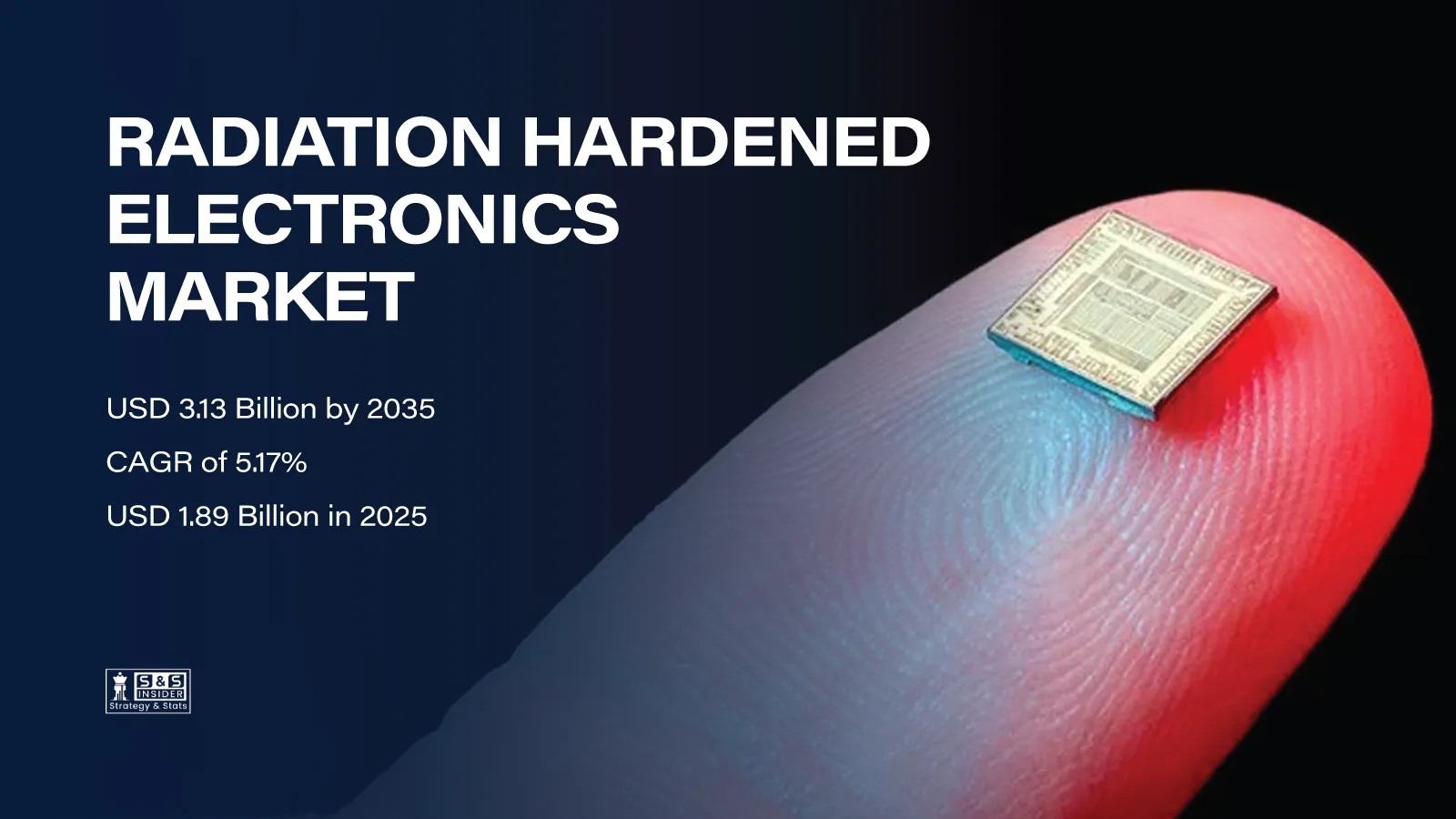
According to SNS Insider, the global Radiation Hardened Electronics Market was valued at USD 1.89 billion in 2025, is estimated to reach USD 1.99 billion in 2026 and is projected to expand to USD 3.13 billion by 2035, registering a CAGR of 5.17% during 2026–2035.
The market is transitioning toward higher-performance, energy-efficient semiconductor architectures as satellite manufacturers seek increased computing capabilities without compromising reliability. Radiation hardening by design, advanced silicon-on-insulator processes and emerging gallium nitride technologies are enabling suppliers to address increasingly demanding operating environments.
Commercial satellite deployments are also changing procurement patterns, encouraging the adoption of qualified, cost-efficient components alongside traditional space-grade electronics.
North America leads global demand through established space and defense programs, while Asia-Pacific is emerging as the fastest-growing region as China, India and Japan expand domestic space technologies.
Through 2035, competitive advantage will increasingly depend on semiconductor qualification capabilities, advanced fabrication processes, supply chain reliability and integration into next-generation satellite platforms.
Market Size and Forecast
|
Market Indicator |
Value |
|---|---|
|
Market Size, 2025 |
USD 1.89 Billion |
|
Market Size, 2026 |
USD 1.99 Billion |
|
Market Forecast, 2035 |
USD 3.13 Billion |
|
CAGR, 2026–2035 |
5.17% |
|
Largest Region, 2025 |
North America (39.27%) |
|
Fastest-Growing Region |
Asia-Pacific (6.26% CAGR) |
|
Leading Component |
Power Management (28.63%) |
|
Leading Application |
Space (51.93%) |
Demand Drivers and Constraints
Primary Demand Drivers
-
Expanding satellite constellations: Increasing deployment of communication, navigation and Earth observation satellites generates sustained demand for radiation-resistant processors and power components.
-
Growing defense space investments: Military surveillance, missile warning and secure communication systems require reliable electronics capable of surviving harsh radiation environments.
-
Advancement in semiconductor technologies: Silicon-on-insulator, FinFET architectures and wide-bandgap materials improve radiation tolerance and computational efficiency.
-
Deep-space exploration: Lunar missions, planetary probes and long-duration spacecraft require highly qualified components with extended operational lifetimes.
-
Nuclear infrastructure modernization: Reactor monitoring, instrumentation, inspection robotics and safety systems create additional applications.
-
Increasing medical equipment deployment: Particle therapy and radiation treatment systems require dependable electronic controls and monitoring components.
Potential Growth Constraints
-
High development and qualification costs associated with radiation-hardened semiconductor manufacturing.
-
Limited availability of specialized foundries and qualified manufacturing processes.
-
Complex export controls affecting international component procurement.
-
Lengthy radiation testing and certification procedures.
-
Relatively small production volumes compared with conventional commercial semiconductors.
Demand Structure by Component
Radiation Hardening by Design (2025 Market Share: 53.18%)
Radiation hardening by design accounted for 53.18% of global market revenue in 2025, representing the leading manufacturing technique.
This approach incorporates protective circuit architectures, redundancy, specialized layouts and error-correction mechanisms to improve semiconductor resistance to radiation effects.
Manufacturers favor design-based solutions because they can utilize established fabrication infrastructure while reducing dependence on specialized production processes.
Growing demand for cost-efficient satellite electronics and modern computing architectures is supporting adoption across commercial and government space programs.
Current trend: Increasing utilization of design-level radiation protection in semiconductor development.
Major trends: Redundant circuit architectures, error-correcting logic, advanced chip layouts and commercial foundry integration.
Radiation Hardening by Process (Forecast CAGR: 6.74%)
Radiation hardening by process is expected to be the fastest growing segment, growing at a CAGR of 6.74% through 2035. The technique modifies semiconductor fabrication processes to improve resistance against ionizing radiation, permanent component degradation and latch-up events.
Demand is especially strong in deep-space exploration, high-reliability defense systems and applications where stringent radiation performance is required. Further opportunities are being created by government initiatives to support trusted semiconductor manufacturing and specialized foundry capacity.
Current trend: Growing investment in specialized radiation-resistant fabrication technologies.
Major trends: Silicon-on-insulator manufacturing, advanced process qualification, trusted foundries and high-reliability semiconductor development.
Demand Structure by Application
Space (2025 Market Share: 51.93%)
Space applications dominated the market, accounting for 51.93% of global revenue in 2025.
Satellites, launch vehicles, planetary exploration systems and orbital infrastructure operate in environments where radiation can disrupt conventional electronic components. Increasing deployment of low Earth orbit satellite constellations is generating demand for dependable processors, memory devices, communication circuits and power management components.
Long-duration exploration programs also require electronics with demonstrated radiation endurance and operational stability. Through 2035, commercial satellite manufacturing and advanced space computing will remain important sources of market demand.
Current trend: Growing semiconductor demand from satellite constellations and deep-space missions.
Major trends: Onboard computing, autonomous satellites, radiation-tolerant processors and advanced spacecraft power systems.
Medical (Forecast CAGR: 6.31%)
The medical application segment is expected to grow at the highest CAGR of 6.31% during the forecast period, 2026-2035. Radiotherapy equipment or proton therapy systems and advanced medical imaging technologies need electronic components that can withstand repeated exposure to radiation and keep working.
Investment in reliable sensing, control and monitoring electronics is being spurred by the growth of specialized cancer treatment facilities, particularly in Asia and Europe. Radiation resistant components can also help reduce equipment downtime and help maintain consistent operation of treatment systems.
Current trend: Increasing utilization of radiation-tolerant electronics in advanced cancer treatment equipment.
Major trends: Proton therapy systems, radiation-resistant sensors, medical control electronics and high-reliability imaging infrastructure.
Demand Structure by Material
Silicon (2025 Market Share: 66.12%)
The material category was dominated by silicon, which held a 66.12% market share in 2025. The dominance of silicon is due to its well-developed manufacturing infrastructure, qualification expertise, and compatibility with processors and memory devices.
Silicon on insulator technologies are also radiation tolerant, making them an attractive choice for satellite electronics and aerospace applications. The manufacturing expertise and relatively favorable economics will keep the demand for silicon strong up to 2035.
Current trend: Continued preference for qualified silicon-based semiconductor technologies.
Major trends: Silicon-on-insulator architectures, advanced fabrication nodes, radiation-resistant integrated circuits and improved manufacturing efficiency.
Gallium Nitride (Forecast CAGR: 5.96%)
Gallium nitride is estimated to become the fastest-growing materials market segment, growing at a CAGR of 5.96% between 2026 and 2035.
The high switching efficiency and power densities as well as radiation resistance of this material makes it very useful for satellite power supply systems and RF applications. There is increasing emphasis on making the spacecraft lighter while enhancing its electrical characteristics.
Current trend: Expanding qualification and adoption of wide-bandgap semiconductor devices.
Major trends: Compact power converters, high-frequency switching, satellite power optimization and radiation-resistant GaN transistors.
Regional Market Dynamics
North America (2025 Market Share: 39.27%)
North America held 39.27% share of world income in 2025, and thus is identified as the most dominant market on a regional basis. This is mainly due to the contribution from the United States, which has been demanding owing to NASA programs, space military expenditure, and the production of commercial satellites along with an already existing network of quality semiconductors manufacturers.
United States market earned revenues of USD 654.18 million in 2025 and is expected to grow at CAGR 5.52% from 2026 to 2035. Canada’s contributions include satellite engineering, space research, and international space collaborations.
Direction: Continued leadership supported by defense investment, space exploration and advanced semiconductor development.
Asia-Pacific (Forecast CAGR: 6.26%)
The Asia-Pacific region is forecast to grow at the highest rate among all regions at a CAGR of 6.26% till 2035. China, India and Japan are enhancing their capabilities for satellite production, launching and development of space technology.
South Korea provides knowledge in semiconductors, and investments in nuclear infrastructure and particle therapy centers generate additional demand. The government efforts to encourage local manufacturing of electronics also favor development of alternative suppliers.
Direction: Rapid expansion driven by satellite programs, semiconductor localization and growing nuclear and medical applications.
Europe — Established Space Semiconductor Market
Europe maintains an important market position through the European Space Agency, national aerospace programs and established semiconductor manufacturers. Germany, France, the United Kingdom and Sweden contribute to spacecraft development, radiation testing and specialized electronic component manufacturing.
Regional initiatives supporting independent semiconductor supply chains and secure satellite communication infrastructure are expected to create further opportunities. Nuclear energy operations and research facilities provide supplementary demand.
Direction: Steady expansion supported by sovereign space initiatives, semiconductor innovation and supply chain resilience.
Middle East & Africa — Emerging Space and Nuclear Applications
Middle East & Africa market is evolving on account of national satellite projects, investments in nuclear power and growth in aerospace. Saudi Arabia and United Arab Emirates are some of the key regional markets, while South Africa and Egypt provide satellite and research operations. The more advanced components are still being procured from outside sources.
Direction: Gradual growth supported by government space programs, nuclear infrastructure and international technology partnerships.
Latin America — Developing Satellite Electronics Demand
Latin America constitutes a smaller but growing market, where Brazil leads through its satellite programs and nuclear power capabilities. Argentina adds its expertise in Earth observation and spacecraft engineering, while Mexico and Chile have increasing involvement in small satellites. Demand is influenced by research budgets, satellite procurement and access to internationally qualified electronic components.
Direction: Moderate expansion supported by satellite development, research collaboration and growing aerospace capabilities.
Key Market Participants
The competitive landscape includes BAE Systems, Microchip Technology, Renesas Electronics, Infineon Technologies, STMicroelectronics, Texas Instruments, Analog Devices, Teledyne Technologies, Honeywell Aerospace, Frontgrade Technologies, AMD, Data Device Corporation, GSI Technology, QuickLogic and NanoXplore.
Competition increasingly centers on radiation qualification, component performance, advanced manufacturing processes and reliable access to specialized semiconductor fabrication. Companies investing in high-density memory, advanced processors and efficient power electronics are positioned to address emerging requirements across commercial satellite and defense programs.
Market Outlook (2026–2035)
The global radiation hardened electronics market is projected to reach USD 3.13 billion by 2035, expanding at a CAGR of 5.17% during 2026–2035. Growth will be supported by increasing satellite deployments, defense modernization, advanced space computing and expanding applications in nuclear and medical infrastructure.
As mission requirements become more demanding, manufacturers are expected to turn their attention to radiation-tolerant memory, efficient power management and advanced semiconductor materials. Despite significant challenges in terms of qualification costs, export restrictions and limited fabrication capacity, advances in semiconductor design and manufacturing should provide additional opportunities.
Overall, the radiation hardened electronics market is positioned for sustained expansion through 2035, with future competitiveness determined by component reliability, technological innovation, semiconductor supply security and integration into next-generation space systems.



