
According to SNS Insider, the global Medical Device Security Market is entering a period of accelerated expansion as regulators make cybersecurity requirements enforceable, ransomware pressure on healthcare operators intensifies and hospitals connect more clinical equipment to shared networks.
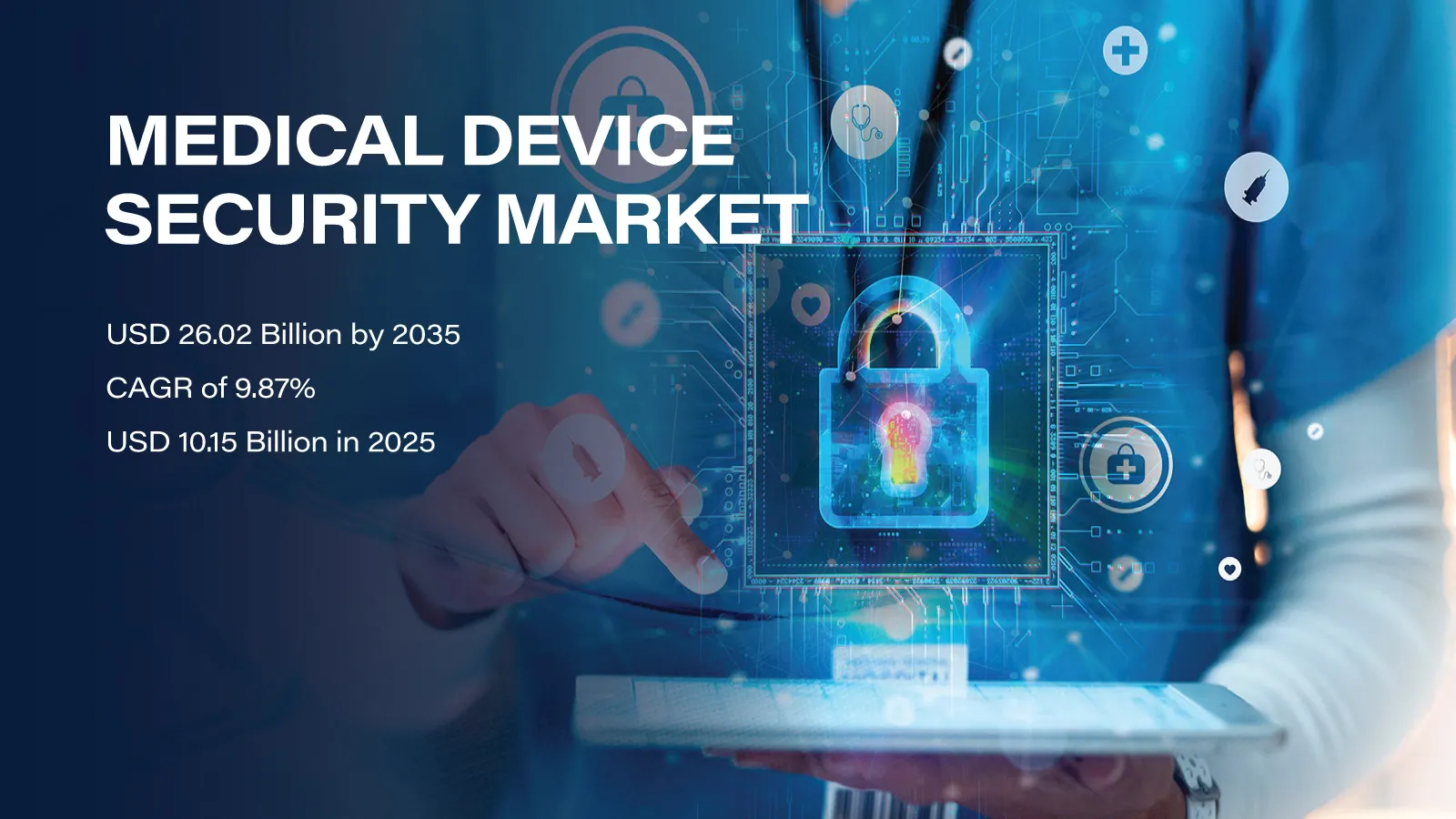
The global Medical Device Security Market was valued at USD 10.15 billion in 2025, is estimated to reach USD 11.15 billion in 2026 and is projected to expand to USD 26.02 billion by 2035, registering a CAGR of 9.87% during 2026–2035.
Demand is increasingly shaped by premarket and postmarket cybersecurity rules, along with the growing number of infusion pumps, imaging systems, monitors and implants that now sit on hospital networks. Security tools have become essential because many of these devices run older software and cannot be scanned or patched like ordinary computers.
Market development is also shifting toward managed monitoring, cloud-based visibility and software bill of materials management, as hospitals and manufacturers look to protect devices without interrupting patient care.
North America dominates global spending, while Asia Pacific is expanding fastest on the back of hospital digitization. Through 2035, suppliers that can prove clinical safety, connect device security with wider exposure management and support understaffed hospitals through managed services are positioned to benefit from recurring demand.
Market Size and Forecast
|
Market Indicator |
Value |
|
Market Size, 2025 |
USD 10.15 Billion |
|
Market Size, 2026 |
USD 11.15 Billion |
|
Market Forecast, 2035 |
USD 26.02 Billion |
|
CAGR, 2026–2035 |
9.87% |
|
Leading Region, 2025 |
North America (41.86%) |
|
Fastest-Growing Region |
Asia Pacific (10.89% CAGR) |
|
Leading Component |
Solutions (66.84%) |
|
Leading Device Type |
Hospital Medical Devices (46.31%) |
Demand Drivers and Constraints
Primary Demand Drivers
-
Rising ransomware activity: Healthcare organizations hold valuable data and cannot absorb long outages, so boards and insurers now treat device security as a patient safety matter.
-
Stricter regulation: The U.S. Quality Management System Regulation took effect in February 2026 and covers cyber devices under Section 524B, pushing manufacturers toward secure design, vulnerability monitoring and patch processes.
-
Connected and wearable devices: Insulin pumps, cardiac monitors and home equipment send data to cloud services and mobile apps, widening the attack surface beyond hospital walls.
-
Hospital digitization: New facilities often specify thousands of connected devices from the start, and cloud platforms give smaller hospitals access to monitoring without specialist staff.
-
Software bill of materials demand: Component inventories help buyers locate affected products quickly when a flaw is published, creating recurring monitoring and update work over long device lifecycles.
Potential Growth Constraints
-
Legacy devices that cannot be patched or replaced.
-
Shortage of staff who understand both clinical workflows and network defense.
-
Operational risk from scanning or blocking devices that deliver therapy.
-
Fragmented budgets and unclear ownership of device security in hospitals.
Demand Structure by Component
Solutions (2025 Market Share: 66.84%)
Solutions dominated the market with a 66.84% revenue share in 2025, as hospitals and manufacturers first buy the platforms that discover assets, assess vulnerabilities, monitor network behavior and enforce segmentation. Product categories include encryption, endpoint protection, network security and application security, typically licensed per device or per facility. Vendors can keep adding modules as customer security programs mature. Through 2035, the breadth of the product range and steady renewals are expected to sustain demand.
Current trend: Continued investment in discovery and monitoring platforms.
Major trends: Asset visibility, risk scoring, network segmentation and vulnerability prioritization.
Services (Forecast CAGR: 11.46%)
Services are estimated to see the highest CAGR of 11.46% over 2026–2035, driven by the shortage of internal security staff and the complexity of device environments. Hospitals rely on consultants for risk assessments, integrators for segmentation projects and managed providers for continuous monitoring, while manufacturers buy penetration testing and software bill of materials services ahead of regulatory submissions.
Current trend: Buyers favoring outcomes over standalone tools.
Major trends: Managed monitoring, incident response, penetration testing and integration projects.
Demand Structure by Device Type
Hospital Medical Devices (2025 Market Share: 46.31%)
Hospital medical devices accounted for 46.31% of revenue in 2025, since infusion pumps, patient monitors, imaging systems and ventilators form the largest connected fleets in care facilities. These devices handle sensitive data and directly affect patient safety, so they receive the first security investment. Many remain in service for years on older software, which keeps network-based controls essential.
Current trend: Enterprise security programs across large health systems.
Major trends: Segmentation, virtual patching, behavior monitoring and device inventory management.
Wearable and External Medical Devices (Forecast CAGR: 12.38%)
Wearable and external devices are projected to grow at the highest CAGR of 12.38% through 2035, as glucose monitors, insulin pumps, cardiac patches and home equipment connect to phones and cloud platforms. These products operate outside hospital networks, so manufacturers must build protection into firmware, applications and back-end services.
Current trend: Regulatory scrutiny of consumer-facing connected devices.
Major trends: Firmware security, application testing, encryption and continuous monitoring.
Demand Structure by Deployment Mode
On-Premises (2025 Market Share: 57.46%)
On-premises deployments held 57.46% of the market in 2025, because hospitals prefer to keep sensor appliances, analysis engines and data inside their own networks. Passive monitoring appliances on network switches are a common design for device discovery, and many contracts are renewed rather than replaced. Public and defense-related institutions also face policies that discourage external hosting of device data.
Current trend: Renewal of existing appliance-based deployments.
Major trends: Passive network monitoring, local data control and strict uptime requirements.
Cloud-Based (Forecast CAGR: 12.07%)
Cloud-based deployments are expected to grow at a CAGR of 12.07% between 2026 and 2035, supported by subscription pricing, faster updates and shared threat intelligence. Smaller hospitals can obtain monitoring without maintaining analysis servers, and hybrid designs that keep sensors local while analytics run in the cloud are becoming a common compromise.
Current trend: Subscription-based monitoring gaining ground in smaller hospitals.
Major trends: Hybrid architectures, regional hosting options and improved security certifications.
Demand Structure by End User
Healthcare Providers (2025 Market Share: 44.31%)
Healthcare providers formed 44.31% of the market in 2025, since hospitals and health systems operate the connected devices, hold the patient data and bear the operational impact of an attack. Security teams buy discovery, segmentation and monitoring tools to meet accreditation, insurance and regulatory expectations, and consolidation of hospital networks increases the scale of purchases.
Current trend: Rising enterprise-level security spending by large systems.
Major trends: Multi-site platforms, risk documentation and insurer-driven requirements.
Medical Device Manufacturers (Forecast CAGR: 11.58%)
Manufacturers are anticipated to expand at a CAGR of 11.58% between 2026 and 2035, as premarket cybersecurity requirements now apply to new and updated products. They invest in threat modeling, secure development tools, penetration testing and vulnerability response programs, while postmarket monitoring of products in the field adds a continuing need.
Current trend: Security becoming a core part of product development budgets.
Major trends: Software bill of materials management, threat modeling and postmarket vulnerability response.
Regional Market Dynamics
North America (2025 Share: 41.86%)
North America led the market with a 41.86% share in 2025, supported by binding premarket requirements, a large installed base of connected equipment and a concentrated group of specialist vendors. The United States remains the leading country market, contributing USD 3.83 billion in 2025 at a projected CAGR of 10.12%. In January 2026, the FDA issued a warning letter to Beta Bionics that cited a cybersecurity failure, and hospitals responded by tightening supplier requirements. Canada adds demand through provincial health programs and attention to critical infrastructure.
Direction: Spending shifting from pilot projects to enterprise programs, with regulation and insurer expectations as the main catalysts.
Europe
Europe holds the second-largest position, with Germany leading through its large hospital sector and strong medical device industry. The United Kingdom, France and the Nordic countries also invest steadily. Manufacturers must satisfy the medical device regulation, hospitals fall under network and information security rules and a new cyber resilience law for digital products adds further duties. Buyers favor suppliers that offer local hosting and compliance with European data protection law.
Direction: Growth supported by overlapping compliance requirements and demand for documented security programs.
Asia Pacific (Forecast CAGR: 10.89%)
Asia Pacific is the fastest-growing region, with a projected CAGR of 10.89% through 2035. China holds the largest national share, while Japan and South Korea contribute through advanced hospital networks and device manufacturing, and India and Australia expand demand through digital health programs. Many hospitals are connecting equipment at scale for the first time, which allows security to be built in from the start, and regional exporters must meet U.S. and European premarket rules.
Direction: Rapid growth supported by hospital digitization, rising health spending and export-driven compliance needs.
Latin America (2025 Market Share: 5.62%)
Latin America accounted for 5.62% of revenue in 2025, with Brazil the leading national market. Large private hospital groups in Brazil and Mexico are investing in monitoring and segmentation after repeated attacks on regional health organizations, while public hospitals adopt more slowly because of budget limits. Managed services offer a practical entry point, and insurers are beginning to ask for evidence of basic protections.
Direction: Gradual expansion led by private hospital groups and managed security services.
Middle East & Africa (2025 Market Share: 5.41%)
The Middle East & Africa represented 5.41% of the market in 2025. Saudi Arabia leads, supported by national health transformation programs, new hospital projects and government cybersecurity mandates, with the UAE and Qatar following through flagship hospitals. South Africa drives demand in Africa, while funding limits and skills shortages constrain adoption elsewhere.
Direction: Emerging opportunities tied to government-led hospital programs and simple managed service models.
Competitive Landscape
The medical device security market is fragmented, with network security leaders, connected device specialists, healthcare-focused start-ups and device makers all competing for hospital and manufacturer budgets. Key participants include Palo Alto Networks, Inc., Cisco Systems, Inc., Check Point Software Technologies Ltd., Armis, Inc., Claroty Ltd., Forescout Technologies, Inc., Axonius, Inc. (Cynerio), Ordr, Inc., Medcrypt, Inc., Synopsys, Inc., ClearDATA, GE HealthCare, Fortinet, Inc. and Zscaler, Inc.
Competition increasingly centers on platform breadth, clinical safety validation, regulatory readiness and managed service capability. In July 2025, Axonius acquired Cynerio, a medical device security specialist, in a deal reported at more than USD 100 million. In December 2025, ServiceNow agreed to acquire Armis for USD 7.75 billion, in line with the industry’s growing preference for linking device security with broader exposure management.
Market Outlook (2026–2035)
The global medical device security market is projected to reach USD 26.02 billion by 2035, driven by tighter regulation, persistent ransomware risk and the spread of wearable and remote monitoring devices. We expect software bill of materials requirements and managed services to remain key commercial drivers, particularly for hospitals without dedicated security teams. At the same time, wearable devices, cloud-based deployments and device manufacturers provide opportunities for above-average growth.
North America is expected to remain the largest market, with Asia Pacific continuing to expand fastest. Unpatchable legacy equipment, workforce shortages and the operational risk of automated blocking will remain challenges.
Overall, the medical device security market is positioned for sustained expansion through 2035, with future competitiveness increasingly determined by clinical safety assurance, regulatory readiness, platform integration and the ability to support hospitals that lack internal security staff.



