
The global natural refrigerants market is poised for an important phase of development as regulatory bodies, industries and refrigeration equipment companies push forward the transition process for the sake of sustainability in the cooling industry. Stricter regulations concerning greenhouse gases like HFCs along with increasing demands for cold chain storage and advanced energy efficiency in refrigerators are influencing the dynamics of natural refrigerants.
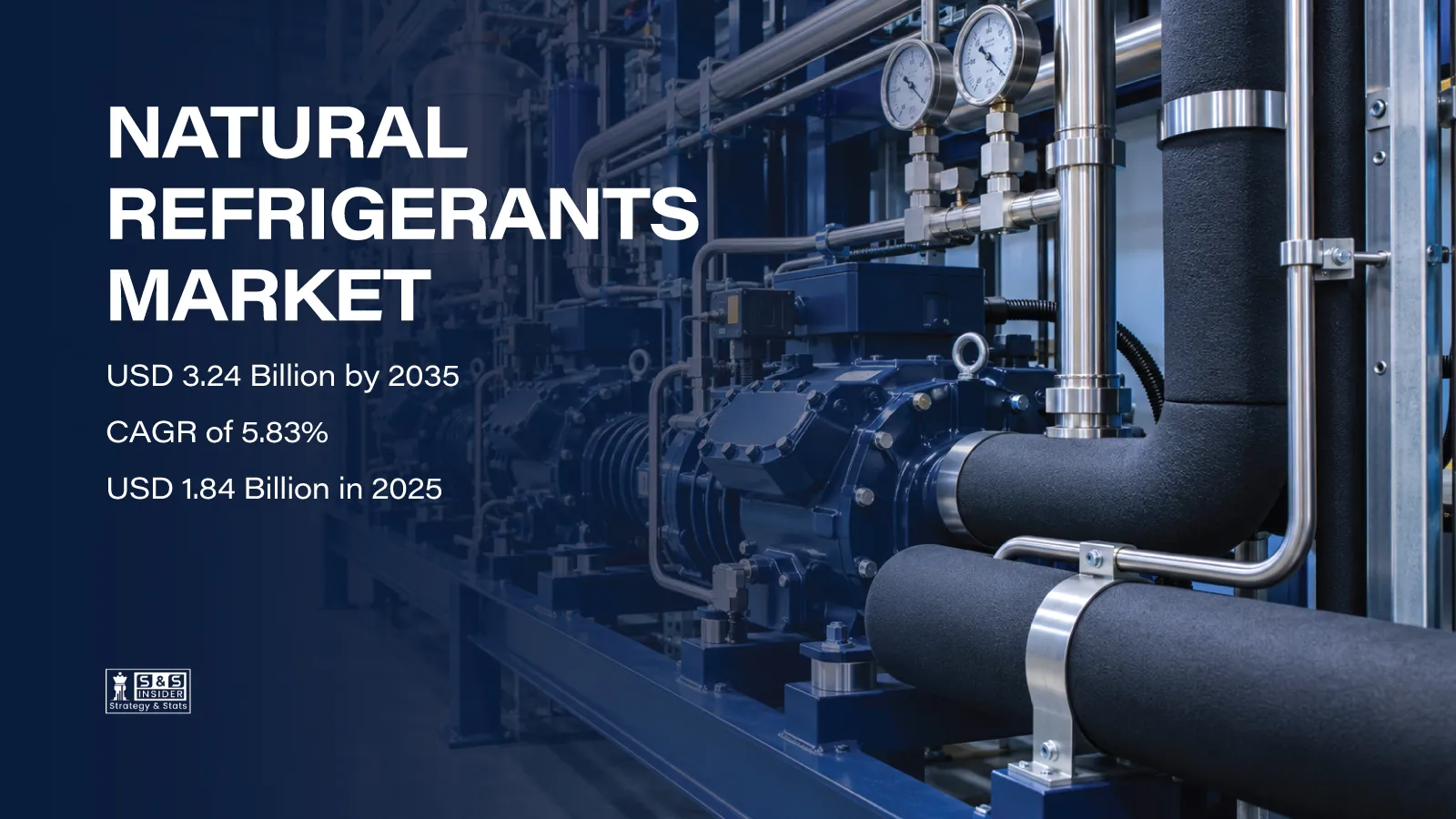
According to SNS Insider, the Natural Refrigerants Market size stood at USD 1.84 Billion in 2025 and is projected to touch USD 3.24 Billion by 2035 at a CAGR of 5.83%.
Natural refrigerant industry growth is highly dependent upon regulations adherence, equipment upgrades and adoption of eco-friendly cooling technology infrastructure.
In the domestic cooling equipment sector and certain types of commercial equipment, there will be a growing need for hydrocarbon refrigerants like R-290 (propane) and R-600a (isobutane). Ammonia will be in-demand in the industrial sector while CO2 will increase its applications for supermarkets, cold chain and heat pumps. Also, industry growth will encounter the problems of high costs of installation, lack of compatibility, expertise and safety conditions.
The development of the industry until 2035 depends on the efficiency of manufacturers of the equipment and refrigerants in achieving a balance between performance parameters and infrastructure costs.
Demand Drivers and Constraints
Primary Demand Drivers
-
Environmental regulations: The Kigali Amendment, European Union F-gas legislation and national HFC reduction policies encourage the transition toward refrigerants with lower global warming potential.
-
Energy-efficient refrigeration: Industrial facilities and commercial operators are investing in advanced cooling systems to improve operational efficiency and reduce electricity consumption.
-
Cold chain infrastructure expansion: Growing requirements for temperature-controlled food storage, pharmaceutical distribution and refrigerated logistics support natural refrigerant adoption.
-
Commercial refrigeration modernization: Supermarkets, retail chains and food service operators are evaluating CO₂-based systems as part of equipment replacement and sustainability programs.
-
Technological improvements: Developments in compressors, heat exchangers, electronic controls and system architecture are broadening the practical applications of natural refrigerants.
Potential Growth Constraints
-
High initial investment requirements for advanced refrigeration equipment.
-
Flammability considerations associated with certain hydrocarbon refrigerants.
-
Toxicity management requirements for ammonia-based systems.
-
High operating pressures in carbon dioxide refrigeration applications.
-
Limited availability of specialized technicians in some developing markets.
Market Demand Structure by Refrigerant Type
Hydrocarbons — Leading Refrigerant Segment
Hydrocarbons represent the largest refrigerant type in the available SNS Insider analysis, accounting for more than 42% of the market in 2023.
Propane and isobutane are increasingly used in domestic refrigerators, small commercial refrigeration units and selected air conditioning applications.
Their relatively low global warming potential and thermodynamic properties have made them appealing as far as their use in environmentally-friendly equipment is concerned.
But due to the flammability of the hydrocarbons, there is a need for proper equipment design and charge handling procedures. Manufacturers are designing compressors which can be used together with them.
Current trend: Growing integration of hydrocarbon refrigerants into energy-efficient domestic and commercial cooling equipment.
Major trends: R-290 heat pumps, R-600a refrigerators, compact cooling systems and improved refrigerant safety engineering.
Ammonia — Established Industrial Refrigeration Solution
Ammonia remains a widely used natural refrigerant in industrial cooling operations, particularly food processing, cold storage and large-scale temperature-controlled manufacturing.
Its strong thermodynamic performance makes it suitable for facilities requiring substantial refrigeration capacity and continuous operation.
Industrial operators are increasingly evaluating low-charge ammonia systems and hybrid ammonia–CO₂ architectures to improve safety and operational flexibility.
Ammonia refrigeration nevertheless requires careful system engineering, leak detection, qualified maintenance personnel and compliance with applicable safety standards.
The long-term opportunity lies in modernizing established industrial infrastructure while extending ammonia-based solutions into additional high-capacity applications.
Current trend: Increasing interest in low-charge industrial ammonia refrigeration.
Major trends: Packaged ammonia systems, industrial heat pumps, cascade refrigeration and advanced safety monitoring.
Carbon Dioxide — Expanding Commercial Refrigeration Applications
Carbon dioxide, commonly designated R-744, is becoming increasingly important in supermarket refrigeration, refrigerated warehouses and commercial heat pump systems.
Its low global warming potential and suitability for advanced refrigeration architectures make it attractive for businesses seeking to reduce dependence on high-GWP synthetic refrigerants.
Transcritical CO₂ refrigeration technologies are improving through enhanced compressor designs, pressure management, heat recovery and optimized control systems.
Although high operating pressures and performance considerations in hot climates can increase engineering complexity, technological developments are helping address these challenges.
Demand is expected to strengthen as commercial operators replace aging equipment and invest in environmentally responsible cooling infrastructure.
Current trend: Increasing deployment of CO₂-based commercial refrigeration systems.
Major trends: Transcritical refrigeration, heat recovery integration, advanced pressure controls and high-efficiency supermarket cooling.
Demand Structure by End-Use Industry
Industrial — Largest End-Use Segment
Industrial applications accounted for more than 38% of the natural refrigerants market in the available SNS Insider 2023 analysis.
Cooling systems in food-processing plants, cold stores, industries and industrial refrigerated supply chains have to be effective enough to ensure tough operational conditions.
Ammonia and carbon dioxide seem especially appropriate in this context due to their properties and previous success in industrial refrigeration.
Construction of food preserving and temperature-sensitive logistics systems is providing new opportunities for refrigeration systems.
Current trend: Industrial refrigeration upgrades emphasizing efficiency and regulatory compliance.
Commercial — Growing Sustainable Cooling Requirements
Commercial refrigeration demand is influenced by supermarket modernization, food retail expansion, hospitality infrastructure and sustainability commitments.
Retail businesses are evaluating natural refrigerant technologies to reduce refrigerant-related emissions and improve long-term equipment performance.
CO₂ systems are particularly important in larger commercial installations, while hydrocarbons support selected smaller refrigeration applications.
Equipment replacement cycles and changing environmental regulations are expected to influence investment decisions through 2035.
Current trend: Increasing adoption of low-GWP refrigeration systems across supermarkets and commercial buildings.
Domestic — Hydrocarbon Refrigerants Support Equipment Transition
Domestic refrigeration represents an important application for hydrocarbon-based technologies, particularly isobutane in household refrigerators and propane in certain heat pump and air conditioning systems.
Appliance manufacturers are integrating compatible components, improved insulation and energy-efficient compressor technologies to optimize overall equipment performance.
Future demand will be influenced by appliance replacement cycles, energy efficiency standards, household purchasing power and relevant refrigerant safety regulations.
Current trend: Wider incorporation of natural refrigerants into residential cooling and heating equipment.
Regional Market Dynamics
Europe — Established Market Leadership
Europe accounted for more than 42% of the global natural refrigerants market in the available SNS Insider 2023 analysis.
The region's established regulatory framework, particularly restrictions on fluorinated greenhouse gases, has encouraged the development and commercialization of lower-GWP refrigeration technologies.
Germany, France, the United Kingdom, Italy and other European economies represent important markets for natural refrigerant equipment and supporting infrastructure.
Supermarket refrigeration, industrial cooling and heat pump installations remain significant application areas.
Direction: Continued expansion supported by environmental legislation and refrigeration system modernization.
Asia-Pacific — Strong Growth Opportunities
Asia-Pacific is identified as the fastest-growing region in the available SNS Insider analysis.
China, India, Japan and South Korea are important markets because of their manufacturing activity, expanding food distribution networks and growing refrigeration requirements.
Increasing investment in cold storage, commercial infrastructure and energy-efficient appliances is creating opportunities for natural refrigerant suppliers and equipment manufacturers.
The region's future growth will also depend on technician availability, equipment affordability and implementation of national refrigerant regulations.
Direction: Expanding opportunities supported by industrial development and cooling infrastructure investment.
North America — Regulatory Transition Supports Adoption
North American demand is being influenced by HFC phasedown policies, commercial equipment modernization and investment in sustainable refrigeration.
The United States represents an important market for refrigeration equipment manufacturers and component suppliers as regulatory requirements affect technology selection.
Food retail, cold storage, industrial processing and heat pump applications offer opportunities for compatible natural refrigerant technologies.
Direction: Increasing investment in lower-emission refrigeration and advanced cooling systems.
Latin America and Middle East & Africa
Latin America and the Middle East & Africa present developing opportunities for natural refrigerant applications.
Food processing, refrigerated distribution, industrial manufacturing and commercial infrastructure are creating additional cooling requirements.
However, equipment costs, servicing capabilities, regional regulatory conditions and climate-specific system performance will influence adoption.
Direction: Gradual market development through infrastructure expansion and refrigeration technology upgrades.
Competitive Landscape
The natural refrigerants industry includes refrigerant suppliers, refrigeration component manufacturers and integrated cooling system developers.
Companies identified in the SNS Insider competitive landscape include Linde plc, A-Gas International, Airgas, Danfoss, GEA Group, BITZER, Mayekawa, Johnson Controls, CAREL Industries, Secop, Mitsubishi Heavy Industries and Panasonic.
Competition is increasingly shaped by energy performance, equipment compatibility, safety engineering, regulatory readiness and the availability of technical support.
Manufacturers are investing in compressor technology, refrigeration controls, system integration and refrigerant handling capabilities to address changing customer requirements.
Strategic partnerships between component suppliers, system integrators and industrial operators are expected to support technology deployment across different cooling applications.
Market Outlook (2026–2035)
The global natural refrigerants market is positioned for continued development through 2035 as environmental regulations and commercial investment reshape refrigeration technology choices.
Hydrocarbons are expected to remain important in domestic appliances and selected commercial equipment, while ammonia will continue supporting industrial refrigeration applications.
Carbon dioxide systems offer meaningful opportunities in supermarkets, cold storage and integrated heating and cooling applications.
The transition toward natural refrigerants will not depend solely on regulatory requirements. Equipment reliability, lifetime operating costs, energy efficiency, installation complexity and technician expertise will increasingly influence purchasing decisions.
Manufacturers capable of delivering efficient, safe and application-specific refrigeration solutions are likely to benefit from growing demand.
Overall, the natural refrigerants market's long-term outlook reflects a structural shift toward sustainable cooling, with industry development increasingly supported by technological innovation, regulatory compliance and investment in energy-efficient refrigeration infrastructure.



