
According to SNS Insider, the global Patient Safety and Risk Management Software Market is entering a period of steady expansion as regulators tighten adverse event reporting rules, accreditation bodies raise expectations and healthcare providers work to reduce preventable harm and liability costs.
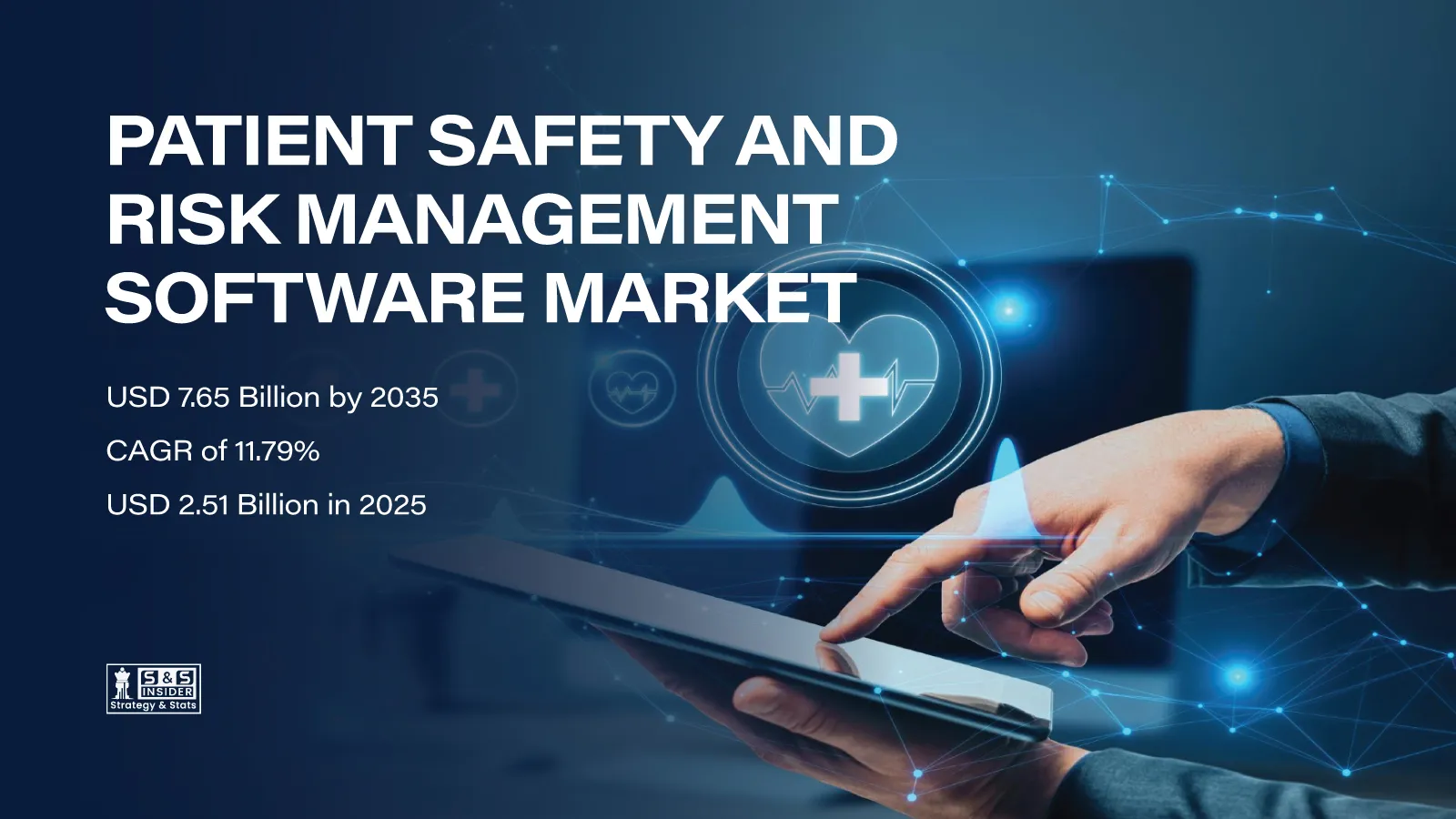
The global patient safety and risk management software market was valued at USD 2.51 billion in 2025, is estimated to reach USD 2.81 billion in 2026 and is projected to expand to USD 7.65 billion by 2035, registering a CAGR of 11.79% during 2026–2035.
Demand is increasingly influenced by mandatory incident reporting, accreditation standards and the cost of malpractice claims. Hospitals are replacing paper forms and spreadsheets with platforms that capture incidents, analyze root causes, track corrective actions and connect safety data with electronic health records and quality dashboards.
Market development is also shifting toward AI-based event classification, single platforms that combine safety, claims, quality and compliance, and cloud and hybrid deployment models.
North America leads global demand, while Asia Pacific is growing fastest. Through 2035, vendors offering strong EHR integration, deep analytics and broad platform coverage are positioned to benefit from recurring hospital and health system demand.
Market Size and Forecast
|
Market Indicator |
Value |
|
Market Size, 2025 |
USD 2.51 Billion |
|
Market Size, 2026 |
USD 2.81 Billion |
|
Market Forecast, 2035 |
USD 7.65 Billion |
|
CAGR, 2026–2035 |
11.79% |
|
Leading Region, 2025 |
North America (43.87%) |
|
Fastest-Growing Region |
Asia Pacific (14.08% CAGR) |
|
Leading Type |
Risk Management and Safety Solutions (64.18%) |
|
Leading Deployment |
Cloud-Based (63.84%) |
Demand Drivers and Constraints
Primary Demand Drivers
-
Regulatory mandates for incident reporting: Accreditation bodies and regulators expect hospitals to document and investigate adverse events, and from 1 April 2026 the Centers for Medicare & Medicaid Services requires hospitals in its quality reporting programs to report on a Patient Safety Structural Measure covering five domains.
-
AI and predictive analytics: Machine learning tools suggest event types, estimate harm severity and detect clusters of similar incidents, shortening the time between an event and corrective action.
-
EHR integration and interoperability: Direct access to medication orders, laboratory results and patient location improves report accuracy and lets clinicians file events within their normal workflow.
-
Rising medical errors and healthcare-associated harm: The World Health Organization stated in September 2026 that about 1 in 10 patients is harmed during health care, encouraging boards and payers to fund reporting systems.
-
Value-based care and liability cost pressure: Malpractice settlements, insurance premiums and penalties for hospital-acquired conditions give hospitals a clear reason to track claims and risks early.
-
Government and national patient safety programs: National quality targets, such as China’s 2025 National Medical Quality and Safety Improvement Targets, are directing hospitals to strengthen safety management.
Potential Growth Constraints
-
Integration complexity with legacy hospital IT systems.
-
Data privacy and cybersecurity risk linked to HIPAA and GDPR compliance.
-
High implementation, support and staff training costs.
-
EHR vendor bundling and vendor lock-in that limit independent software.
Demand Structure by Type
Risk Management and Safety Solutions (2025 Market Share: 64.18%)
Risk management and safety solutions dominated the market with a 64.18% share in 2025, as event reporting, incident tracking, root-cause analysis and safety analytics sit at the center of every hospital quality program. Accreditation bodies and payers expect documented review of adverse events and near misses, and these modules give clinical leaders a structured way to capture, assess and act on safety data. Hospitals usually buy them first and add other modules to the same platform later.
Current trend: Continued demand for structured event reporting and review across hospitals.
Major trends: Incident tracking, root-cause analysis, safety analytics and AI-based severity prediction.
Governance, Risk, and Compliance Solutions (Forecast CAGR: 14.12%)
Governance, risk and compliance solutions are estimated to see the highest CAGR of 14.12% over 2026–2035. Hospitals face a growing list of policies, audits and regulatory filings, and want a single environment for policy approvals, audit schedules and compliance evidence. Regulatory scrutiny, board-level interest in enterprise risk and the push to retire stand-alone spreadsheets are lifting demand among large and mid-sized providers.
Current trend: Rising adoption of unified compliance and audit management platforms.
Major trends: Policy management, audit tracking, enterprise risk oversight and benchmarking across hospital units.
Demand Structure by Deployment
Cloud-Based (2025 Market Share: 63.84%)
Cloud-based deployment accounted for 63.84% of the market in 2025, as it removes the need for local servers and allows faster rollout across multiple facilities. Subscription pricing, automatic upgrades and remote access suit hospitals with limited technical staff, and mobile reporting encourages clinicians to file events promptly. Security certifications and uptime commitments from vendors have eased earlier concerns about storing sensitive safety records outside the hospital.
Current trend: Steady shift from paper and local systems to subscription-based platforms.
Major trends: Mobile event reporting, multi-facility rollout, automatic upgrades and vendor security certification.
Hybrid (Forecast CAGR: 14.47%)
Hybrid deployment is expected to grow at a CAGR of 14.47% between 2026 and 2035. Many large systems prefer to keep sensitive data or legacy interfaces on local servers while using cloud services for analytics, dashboards and mobile reporting. Hybrid models offer a gradual path to the cloud and satisfy data residency rules in countries where patient information must stay within national borders.
Current trend: Growing preference for phased cloud migration among large health systems.
Major trends: Data residency compliance, cloud analytics, legacy interface retention and gradual migration.
Demand Structure by End User
Hospitals (2025 Market Share: 44.76%)
Hospitals accounted for 44.76% of demand in 2025 because they handle the highest numbers of admissions, procedures and medication orders, and therefore generate most safety events. Accreditation surveys, public quality ratings and malpractice exposure push them to maintain formal event reporting and review, and dedicated risk managers and quality teams operate the software daily. Teaching hospitals add demand through resident education and peer review programs.
Current trend: Consolidation of reporting tools across hospital networks.
Major trends: Accreditation readiness, enterprise safety platforms, peer review and quality dashboards.
Ambulatory Care Centers (Forecast CAGR: 13.93%)
Ambulatory care centers are anticipated to expand at a CAGR of 13.93% during 2026–2035. Care is moving from inpatient wards to outpatient surgery centers, clinics and diagnostic sites, and these providers now carry reporting duties similar to hospitals. With limited administrative staff, they favor simple cloud-based tools with templates for common events that start working within a few weeks. Home healthcare providers and long-term care centers are following the same direction.
Current trend: Growing adoption of simple cloud-based reporting tools outside hospitals.
Major trends: Outpatient care expansion, template-based reporting, quick deployment and home care adoption.
Demand Structure by Organization Size
Large Organizations (2025 Market Share: 47.91%)
Large organizations, including hospitals with more than 500 beds and multi-hospital systems, held 47.91% of the market in 2025. They need advanced reporting across several locations, have staff dedicated to safety and compliance, and hold budgets for enterprise licensing. Requirements for sophisticated analytics, multi-system integration and customization raise average contract values, and contracts usually cover multiple facilities despite long purchasing cycles.
Current trend: Enterprise-wide contracts covering several facilities.
Major trends: Multi-system integration, advanced analytics, customization and enterprise licensing.
Small Organizations (Forecast CAGR: 13.96%)
Small organizations, such as hospitals with fewer than 100 beds, are projected to grow at a CAGR of 13.96% between 2026 and 2035. Low-cost cloud subscriptions with fixed per-site pricing, combined with regulatory demands for incident documentation, are supporting adoption. Vendors offer streamlined software with built-in forms and dashboards so small providers can deploy it without hiring extra informatics staff.
Current trend: Rising uptake of low-cost, ready-to-use cloud platforms.
Major trends: Fixed per-site pricing, built-in forms, simplified dashboards and compliance-driven adoption.
Regional Market Dynamics
North America (2025 Share: 43.87%)
North America led the patient safety and risk management software market with a 43.87% share in 2025, supported by stringent reporting guidelines, malpractice exposure and early adoption of cloud-based safety tools. The United States is the leading country market, valued at USD 962.61 million in 2025 and projected to grow at a CAGR of 11.62% during 2026–2035. The Joint Commission’s Accreditation 360 changes took effect on 1 January 2026, and following the HHS Office of Inspector General’s September 2025 findings on the Patient Safety Organization program, hospitals are asking for tools that submit data in standardized formats. Canadian provinces contribute through shared incident learning initiatives.
Direction: Continued expansion through accreditation pressure, enterprise platform consolidation and EHR-integrated safety analytics.
Europe
Europe is the second-largest regional market, led by Germany, followed by the United Kingdom and France. National learning systems and hospital quality standards keep demand stable. NHS England’s Learn from Patient Safety Events service recorded 804,069 patient safety events in the January to March 2026 quarter, a volume that calls for structured local analysis. In Germany, hospital risk management rules encourage anonymous, penalty-free reporting, and a patient-oriented incident portal launched in 2024 had received about 2,000 reports by September 2026. Regional tenders favor vendors that comply with European data protection law and support local languages.
Direction: Growth supported by national learning systems, data protection compliance and multilingual platforms.
Asia Pacific (Forecast CAGR: 14.08%)
Asia Pacific is the fastest-growing region, at a projected CAGR of 14.08% through 2035. Expanding hospital networks, government quality campaigns and rising medical tourism are encouraging formal safety reporting. Japan leads the region, followed by China, where national quality targets guide hospital improvement plans. In July 2026, the Australian Commission on Safety and Quality in Health Care released a draft third edition of its national standards, consolidating eight standards into three. India, South Korea and Southeast Asia are adding first-time installations in private hospital chains seeking international accreditation.
Direction: Fastest growth supported by hospital expansion, national quality programs and cloud-based, mobile reporting tools.
Latin America
Latin America is a smaller region, led by Brazil, with Mexico, Argentina and Colombia also contributing. Private hospital groups lead adoption as they compete on accreditation and international quality rankings. In July 2025, Brazil’s health surveillance authority ANVISA published Technical Note 09/2025, requiring monitoring and reporting of 30 never events. Public hospitals face budget limits and uneven digital capability, and usually start with cloud reporting modules in one or two facilities before expanding.
Direction: Gradual expansion through private hospital groups, insurer requirements and local implementation partners.
Middle East & Africa
The Middle East & Africa holds the smallest regional share, but national health transformation programs in the Gulf are creating new demand. Saudi Arabia and the UAE are the main buyers, with Qatar and Kuwait following. In May 2025, the Department of Health in Abu Dhabi signed a memorandum of understanding to develop a common portal for reporting patient safety incidents across the emirate’s hospitals. South Africa and Kenya lead adoption in Africa through private hospitals, while limited funding and infrastructure hold back public systems.
Direction: Emerging opportunities supported by Gulf health programs, private hospital groups and local integrator partnerships.
Competitive Landscape
The patient safety and risk management software market has a moderate level of concentration. Key participants include RLDatix, Riskonnect, Origami Risk, symplr, Radar Healthcare, Sentact and Press Ganey.
Competition increasingly centers on integration with clinical systems, depth of analytics, ease of configuration and the ability to cover incident management, claims and compliance in one platform. In February 2025, Radar Healthcare acquired EIDO Healthcare to add digital consent and patient information capabilities. In March 2025, Riskonnect released Predictive Category Classification and Adverse Event Severity Prediction in its Healthcare Risk and Patient Safety solution. In December 2025, Sentact acquired Performance Health Partners and the Vizient Patient Safety Organization, which has 332 participating organizations. In April 2026, RLDatix introduced Risk Insights Dashboards on its RLD360 platform, and in May 2026 Press Ganey published its 2026 Patient Safety Organization executive summary covering 194 health systems. In August 2026, Origami Risk added root-cause analysis, failure mode analysis and daily safety huddles to its unified platform.
Market Outlook (2026–2035)
The global patient safety and risk management software market is projected to reach USD 7.65 billion by 2035, driven by reporting mandates, AI-based analytics, EHR integration and wider cloud adoption. We expect regulatory reporting requirements to remain a key commercial driver, encouraging investment in enterprise safety platforms and compliance modules. At the same time, ambulatory care centers, small organizations and hybrid deployment provide opportunities for above average growth.
North America is expected to remain the largest market, while Asia Pacific continues to expand fastest on hospital growth and national quality programs. Legacy system integration, privacy and cybersecurity risk, implementation costs and bundled EHR modules will remain challenges.
Overall, the patient safety and risk management software market is positioned for sustained expansion through 2035, with future competitiveness increasingly determined by integration depth, analytic capability, platform breadth and the ability to serve both large health systems and small providers.



