
The global service integration and management market is poised to grow steadily due to rising needs by companies to gain control of their technology environments that have become highly fragmented. Dependence on cloud computing platforms, outsourced IT services, cybersecurity firms, and enterprise software suppliers has increased the need for service integration and management.
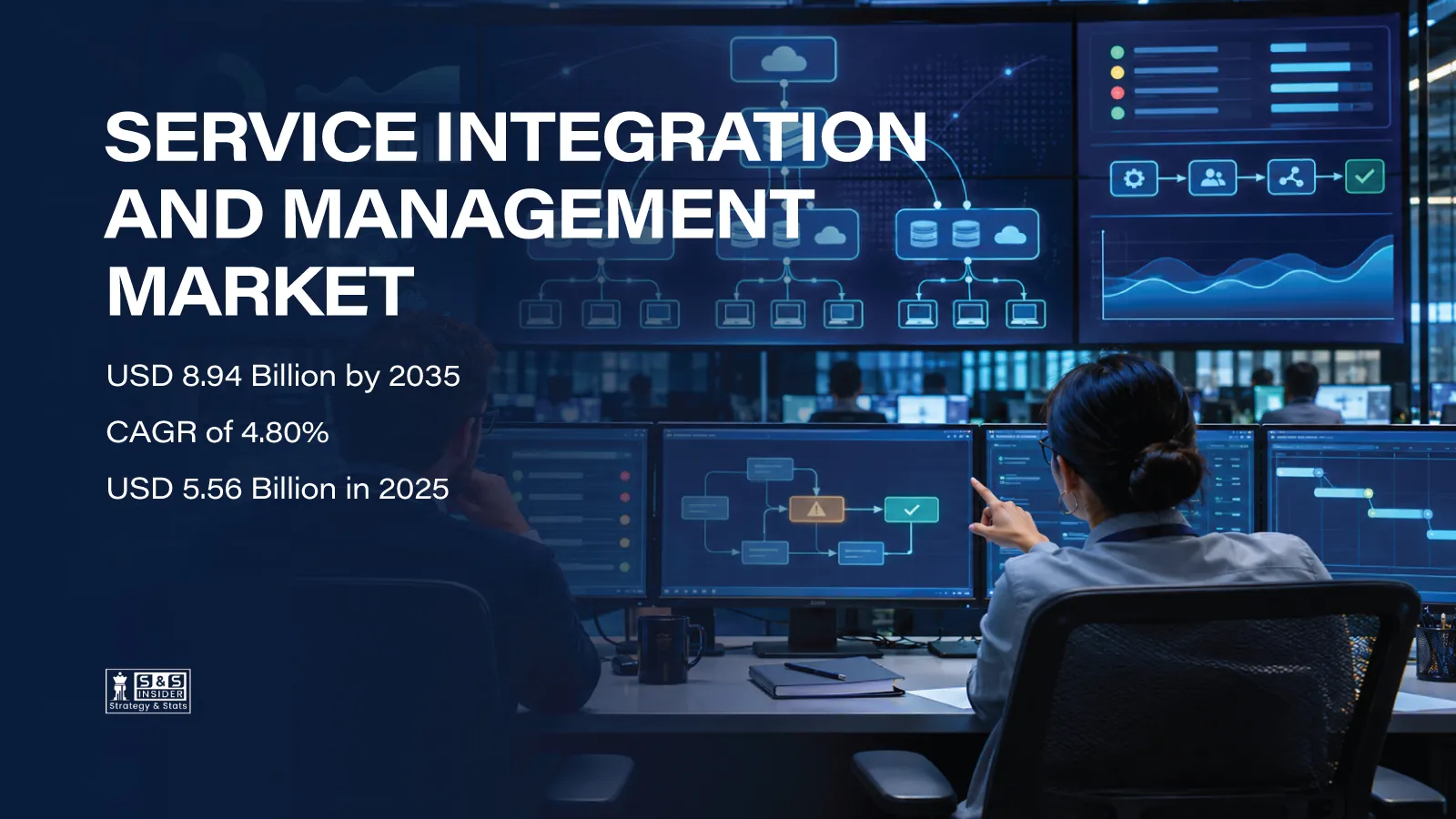
According to SNS Insider, the global service integration and management market was valued at USD 5.56 billion in 2025, is estimated to reach USD 5.83 billion in 2026 and is forecast to expand to USD 8.94 billion by 2035, registering a CAGR of 4.80% during 2026–2035.
Service integration and management (SIAM) enables organizations to coordinate multiple internal and external IT providers through standardized processes, shared performance indicators and unified governance arrangements. Rather than managing individual suppliers independently, enterprises increasingly require integrated operating models that establish accountability across their entire service ecosystem.
The demand for such services is high especially in large corporations, banks, telecommunication companies and public sector entities dealing with complicated outsourcing contracts. At the same time, cloud-based integration platforms and automation tools provide new possibilities for small businesses to use service management systems.
North America remains the largest regional market, while Asia Pacific is projected to record the fastest expansion through 2035.
Market Size and Forecast
|
Market Indicator |
Value |
|---|---|
|
Global Market Size, 2025 |
USD 5.56 Billion |
|
Global Market Size, 2026 |
USD 5.83 Billion |
|
Global Market Forecast, 2035 |
USD 8.94 Billion |
|
CAGR, 2026–2035 |
4.80% |
|
North America Market Share, 2025 |
39.86% |
|
Asia Pacific Forecast CAGR |
7.20% |
|
Leading Component |
Services (58.73%) |
|
Leading Service Model |
External Service Integrator (46.28%) |
Demand Drivers and Constraints
Primary Demand Drivers
-
Expansion of multi-vendor IT environments: Enterprises increasingly depend on different providers for cloud infrastructure, cybersecurity, applications and technical support, creating demand for coordinated service delivery.
-
Increasing regulatory oversight: Financial institutions and critical infrastructure companies are now expected to manage third-party risks and achieve operational resilience and proven supplier performance.
-
Accelerating cloud adoption: Hybrid and multi-cloud environments require consistent incident management, service monitoring and contractual accountability across technology providers.
-
Growing demand for IT outsourcing: Companies looking for specialist skills and operational flexibility are more and more demanding that an independent service integrator manages their outsourcing activities.
-
Artificial intelligence and automation: AI-supported incident classification, workflow automation and predictive monitoring offer opportunities to improve service efficiency.
-
Enterprise digital transformation: Technology modernization initiatives increase the number of interconnected systems and providers requiring unified management.
Potential Growth Constraints
-
Complex implementation requirements across established supplier contracts and service management processes.
-
Resistance among competing technology vendors to sharing operational information.
-
Shortages of experienced service integration specialists and governance professionals.
-
High initial transformation costs for organizations operating fragmented legacy systems.
-
Challenges demonstrating measurable returns from service coordination investments.
Demand Structure by Component
Services (2025 Market Share: 58.73%)
Services represent the largest component of the global market, accounting for approximately 58.73% of revenue in 2025.
The demand for such services is focused on integration and implementation, consulting, training, support, and maintenance. The company will need specialized help in establishing its governance structure, process standardization of suppliers, and linking of their separate IT service environment.
Firms that are going through significant transformations related to outsourcing often rely on providers to define roles and create performance measurement systems. Another source of demand is created by long-term service contracts.
Current trend: Strong demand for managed service integration and enterprise-wide supplier governance.
Major trends: IT service consolidation, supplier performance management, standardized service catalogs and operational resilience consulting.
Solutions (Forecast CAGR: 7.38%)
Solutions are projected to be the fastest-growing component, registering a CAGR of approximately 7.38% during 2026–2035.
While business solutions help facilitate supplier management, financial management and contract management, technical solutions assist with workflow management, monitoring and reporting capabilities.
Due to this increasing demand, it has been becoming easier for companies to link their current ticketing systems and service management systems using application programming interfaces.
The demand for centralized dashboards and automated management of incidents will further fuel its adoption.
Current trend: Accelerating deployment of cloud-based service integration platforms.
Major trends: Workflow automation, integrated monitoring, AI-assisted service operations and supplier analytics.
Demand Structure by Service Model
External Service Integrator (2025 Market Share: 46.28%)
External service integrators dominate the market, holding approximately 46.28% of revenue in 2025.
Firms are increasingly turning to outside entities to integrate multiple service providers, resolve disputes, monitor contract performance, and set up common standards of operation.
Outside integrators have specific knowledge of the process and will help to minimize conflicts when multiple vendors are involved in providing one business service.
This approach applies especially well to large financial firms, telecommunications companies, and government agencies that deal with complex IT ecosystems.
Current trend: Growing preference for independent, accountable multi-supplier management.
Major trends: Supplier-neutral governance, service-level monitoring, cross-provider incident resolution and integrated performance reporting.
Hybrid Service Integrator (Forecast CAGR: 6.84%)
The hybrid service integrator model is expected to expand at a CAGR of approximately 6.84% through 2035.
It consists of a combination of strategic oversight within the organization and technology reporting services from external sources.
Organizations have control over their key supplier contacts but have access to specialized integration skills without the need for large internal teams.
Such hybrid arrangements are becoming increasingly popular among organizations that seek flexibility, effectiveness and visibility into the performance of the outsourced services.
Current trend: Increasing adoption of shared governance models combining internal and external expertise.
Major trends: Flexible integration contracts, collaborative supplier management, automated reporting and managed governance services.
Demand Structure by Deployment and End Use
Cloud Deployment (2025 Market Share: 54.36%)
Cloud deployment accounted for approximately 54.36% of the market in 2025.
Organizations increasingly favor cloud-based platforms because they support centralized visibility, faster implementation and connectivity across distributed service environments.
Subscription-based delivery models can also reduce infrastructure requirements and improve access to advanced automation capabilities.
Large enterprises accounted for 66.84% of market demand in 2025, reflecting their extensive supplier networks and complex technology estates.
Current trend: Growing demand for scalable, cloud-enabled service integration.
Major trends: Multi-cloud monitoring, automated workflow integration, centralized reporting and platform interoperability.
IT and Telecommunications (2025 Market Share: 27.84%)
IT and telecommunications represent the largest end-use industry, accounting for approximately 27.84% of the market in 2025.
Telecommunications operators manage extensive supplier ecosystems covering network infrastructure, customer support, enterprise applications and cloud services.
Coordinated service management helps organizations maintain operational continuity across interconnected technical environments.
Healthcare and life sciences is expected to be the fastest-growing end-use segment, registering a CAGR of approximately 6.92% during 2026–2035, supported by increasing integration of clinical, administrative and cloud technology providers.
Regional Market Dynamics
North America (2025 Market Share: 39.86%)
North America accounted for approximately 39.86% of global revenue in 2025, maintaining its position as the largest regional market.
The region benefits from mature outsourcing arrangements, widespread multi-cloud adoption and substantial enterprise technology investment.
Financial institutions, healthcare organizations and government agencies increasingly prioritize supplier accountability and service continuity.
The United States market was valued at USD 1.94 billion in 2025, supported by demand from large enterprises and public sector organizations.
Direction: Continued market leadership supported by enterprise modernization and regulatory oversight.
Europe (2025 Market Share: 27.54%)
Europe represented approximately 27.54% of global market revenue in 2025.
The United Kingdom, Germany, France and Nordic countries maintain established service integration practices across financial services and public sector outsourcing.
The European Union's Digital Operational Resilience Act, applicable since January 2025, has strengthened regulatory attention on information and communication technology third-party risk.
These requirements support demand for supplier monitoring, service accountability and operational resilience capabilities.
Direction: Steady expansion supported by regulatory compliance and established outsourcing frameworks.
Asia Pacific (Forecast CAGR: 7.20%)
Asia Pacific accounted for approximately 22.31% of the global market in 2025 and is projected to grow at the fastest regional CAGR of 7.20% through 2035.
India, China, Japan, Australia and Southeast Asian economies are expanding their digital infrastructure and enterprise outsourcing capabilities.
Increasing multi-cloud adoption, digital government initiatives and technology modernization are strengthening demand for integrated supplier management.
India's established IT services industry also supports regional delivery capabilities.
Direction: Fastest regional expansion driven by digital transformation and outsourcing growth.
Latin America and Middle East & Africa
Latin America accounted for 4.48% of global market revenue in 2025, while the Middle East and Africa represented 5.81%.
In Latin America, Brazil and Mexico are important demand centers as banks and telecommunications operators modernize their IT infrastructure.
Across the Middle East, digital government initiatives, smart city investments and enterprise cloud adoption support demand for service coordination.
Saudi Arabia and the United Arab Emirates remain significant markets for large-scale technology integration.
Direction: Emerging opportunities supported by infrastructure modernization and expanding outsourced IT operations.
Competitive Landscape
The global service integration and management market includes multinational IT service providers, consulting organizations, outsourcing specialists and enterprise technology integrators.
Major participants identified by SNS Insider include Accenture, IBM, Tata Consultancy Services, Infosys, HCLTech, Wipro, Capgemini, DXC Technology, Cognizant, NTT DATA, Kyndryl, CGI and Tech Mahindra.
Competition increasingly centers on supplier governance expertise, automation capabilities, industry-specific solutions and the ability to coordinate complex technology environments.
Providers offering integrated service platforms alongside consulting and managed services are positioned to address growing demand for comprehensive enterprise IT oversight.
Market Outlook (2026–2035)
The global service integration and management market is forecast to increase from USD 5.83 billion in 2026 to USD 8.94 billion by 2035, registering a CAGR of 4.80%.
Growth will be supported by expanding multi-vendor technology environments, regulatory expectations for operational resilience and continued enterprise cloud adoption.
Automation and artificial intelligence are expected to improve incident coordination, service monitoring and supplier performance assessment, potentially reducing administrative workloads.
External integrators will remain important for complex enterprise environments, while hybrid models and cloud-based solutions should expand access among mid-sized organizations.
North America is expected to maintain its leading market position, while Asia Pacific offers stronger growth opportunities as digital infrastructure and outsourcing activity expand.
Overall, the service integration and management market is positioned for steady expansion through 2035, with competitive advantage increasingly determined by independent supplier governance, platform interoperability, automation and measurable service performance.



