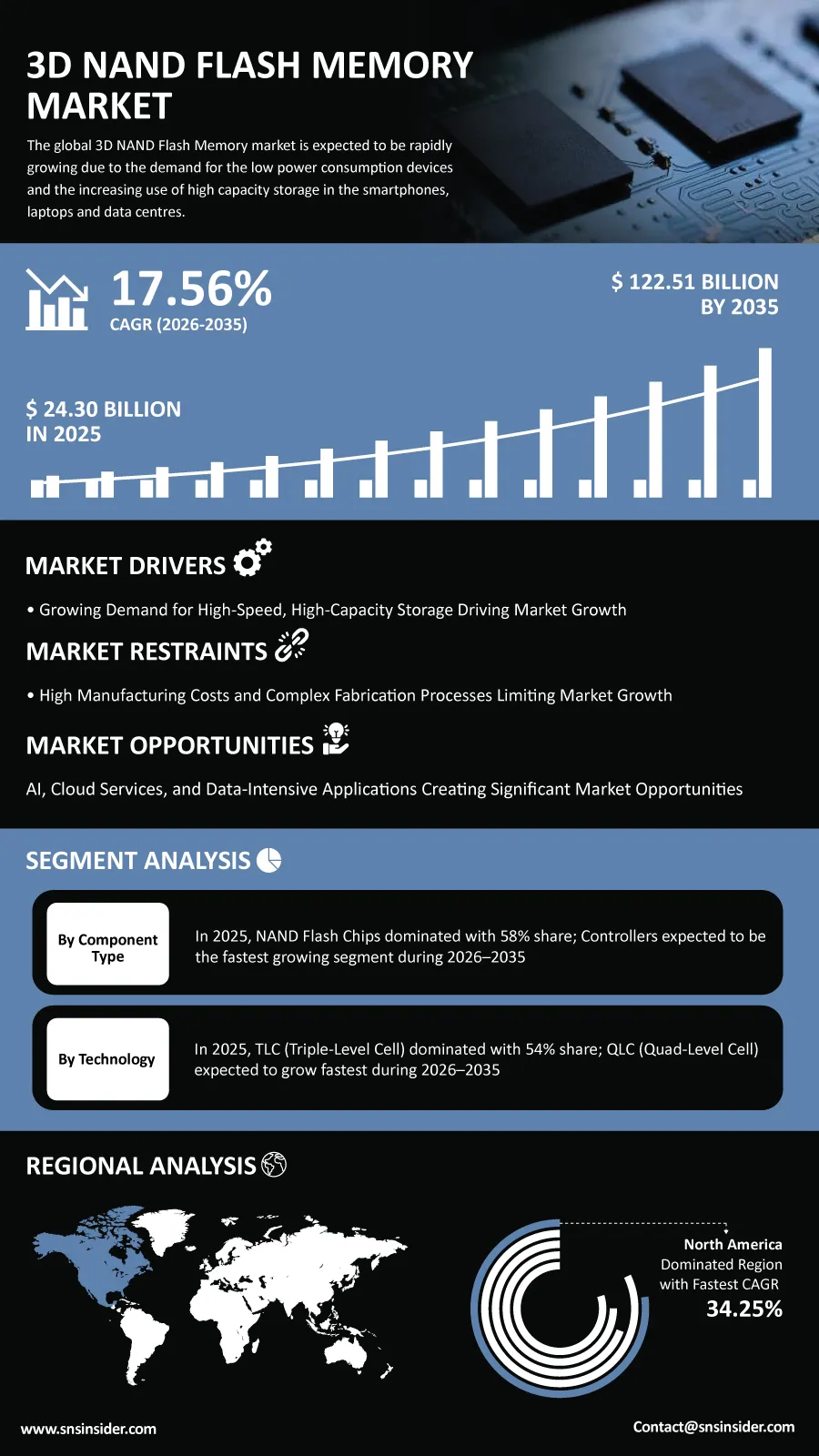
The global market for 3D NAND Flash memory is projected to see immense growth in the next decade due to the increasing demand for large-capacity, energy-efficient storage systems. As per a new research report from SNS Insider, the global 3D NAND Flash Memory Market size at USD 24.30 billion in 2025, is projected to reach USD 122.51 billion by 2035, with a compound annual growth rate CAGR of 17.56%.
The digital transformation is taking place at an extremely fast pace, along with the exponential growth of the generation of data, resulting in the adoption of the latest flash technology. Investments are being made in storage systems that would support AI, edge computing, HPC and other applications in the future.
Higher-level NAND architecture as well as better memory technologies for increasing storage density and reliability have been launched by manufacturers. It is making possible the application of high-performance storage solutions to smartphones, notebooks, SSDs, cars' electronics, and hyperscale data centers.
To Get Detailed Insights on the 3D NAND Flash Memory Market – Request a Sample Report
Expansion of AI and Cloud Infrastructure Creates Significant Growth Opportunities
Rising investments in cloud and AI-enabled computing platforms have been redefining the world’s storage needs. Companies are utilizing ever-evolving storage technologies to meet their needs of analyzing large volumes of data, running machine learning algorithms, and processing data in real time.
The accelerated growth of interlinked devices, industrial Internet of Things, and smart consumer electronics is also providing additional impetus to the market potential. Semiconductor manufacturers have continued their substantial spending on research and development in order to enhance scalability, memory capacity, and energy efficiency.
As digital services keep growing all over the world, the requirement for high-speed, reliable, and dense memories will continue being one of the primary factors influencing market development in the future.
Key Market Insights Highlight Shifting Demand Patterns
By components, NAND Flash Chips will contribute 58% share to the total market revenue by 2025, as they are integral components of smartphones and storage systems used in enterprises and solid-state drives. It is estimated that controllers will witness the fastest growth rate up till 2035, owing to advancements in storage efficiency and performance.
As per the technological aspect, TLC memory is expected to account for 54% of market revenues in 2025 because of its combination of storage capacity, endurance, and cost-effectiveness. QLC technology is expected to register the highest growth rate during the forecast period due to increasing demand for higher capacity storage in cloud and enterprise applications.
On the basis of application, smartphones and tablets are set to contribute 50% of the total market revenue by 2025 due to increasing need for storage in mobile applications, multimedia and advanced operating system. The data centers will be the fastest growing application category due to rapid expansion of cloud computing, AI processing and hyperscale infrastructure worldwide.
According to the end user, consumer electronics will have a 52% share of market revenue by 2025 because they are being widely adopted on the platforms of smartphones, laptops, gaming consoles and portable electronics. Both enterprise and cloud storage will have maximum growth from 2020 to 2035.
High-Performance Storage Continues to Transform Digital Infrastructure
Increased use of data-hungry applications is resulting in greater investments in cutting-edge memory solutions that can provide improved access times and increased storage capacity. Organizations are using high-capacity solid-state drives and storage systems for critical business processes and greater efficiency.
Automotive electronics, industrial automation, and advanced communication networks are areas where new possibilities are emerging for the application of 3D NAND technology. Further developments in memory structures will enhance the performance of products while catering to the need for small and power-efficient storage devices.
North America Accounts for 34.25% Market Share in 2025 as Asia Pacific Records a 19.32% CAGR
North America is forecasted to generate 34.25% of the total market revenue in 2025 owing to its semiconductor innovation, cloud infrastructure, enterprise technology adoption, and consumer electronics penetration.
The Asia Pacific region is likely to emerge as the region with the highest growth rate, recording a CAGR of 19.32% through 2035. Factors such as semiconductor manufacturing ability, smartphone production, hyperscale data center growth, and investment in AI, cloud computing, and digital infrastructure are propelling the regional market growth.
Demand for high density flash memory is anticipated to increase due to continued investments in advanced semiconductor ecosystems by governments and technology firms.
Industry Participants Focus on Memory Innovation
The competitive environment continues to be quite dynamic with the major players focusing on future memory designs, high-level NANDs, and new process technology. It is important for them to focus on the growing demands of consumer electronic products, enterprise storage, automotive sector, and cloud services for their energy-efficient solutions, cost-effective and long-lasting nature.
Key companies operating in the global 3D NAND Flash Memory Market include Samsung Electronics Co., Ltd., Intel Corporation, Toshiba Memory Corporation, Western Digital Corporation, Micron Technology Inc., SK Hynix Inc., Kingston Technology Company, Inc., Crucial Technology, SanDisk Corporation, Transcend Information Inc., Phison Electronics Corporation, Infineon Technologies AG, Microchip Technology Inc., ON Semiconductor, VIA Technologies Inc., Integrated Silicon Solution Inc., Western Digital Technologies, Inc., ADATA Technology Co., Ltd., Seagate Technology Holdings plc, and NetApp Inc.
An SNS Insider analyst Sushant Kadam commented, “The accelerating growth of artificial intelligence, cloud computing, and data-intensive enterprise applications is significantly increasing demand for high-density memory technologies. Companies that continue advancing storage performance, manufacturing efficiency, and scalable memory architectures will be well positioned to capitalize on the next wave of global digital infrastructure investments.”
About the Author

Get in touch