
According to the latest SNS Insider Ambulatory EHR Market report, the global market is growing steadily as more procedures and chronic care move from hospitals to clinics, physician offices, and surgery centers. These outpatient sites need record systems that are fast, connected, and easy for clinicians to use. As a result, the ambulatory EHR is becoming a core tool for daily practice rather than a back-office system.
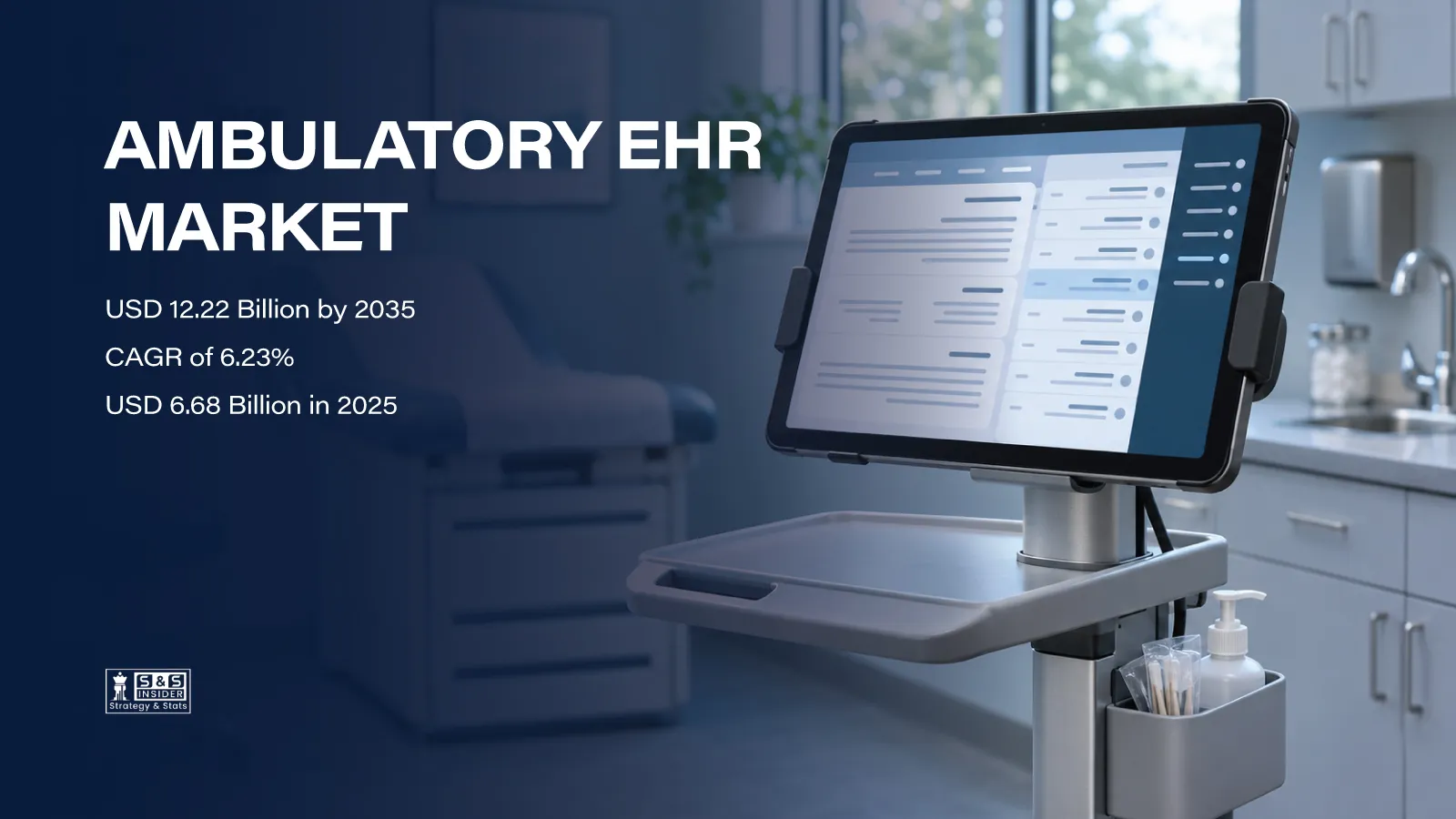
The global ambulatory EHR market was valued at USD 6.68 Billion in 2025 and is estimated at USD 7.10 Billion in 2026. It is expected to reach USD 12.22 Billion by 2035, growing at a CAGR of 6.23% during 2026–2035.
Cloud-based systems now lead the market. Practices choose them because they cost less to start, need little in-house IT support, and receive updates automatically. On-premise systems are expected to lose share over the forecast period.
Practice management remains the largest application. Health analytics is growing fastest because value-based contracts reward practices that can track outcomes and costs. AI tools that draft clinical notes are also changing what buyers expect from their software.
North America remains the largest regional market, and Asia Pacific offers the strongest growth as outpatient networks expand and digital health programs mature.
To Get Detailed Insights on the Ambulatory EHR Market – Request a Sample Report
Demand Drivers and Constraints
Primary Demand Drivers
-
Shift to outpatient care: More procedures and chronic disease visits now happen outside hospitals, which raises the number of sites that need a dedicated EHR.
- Interoperability rules: Mandates against information blocking require practices to share records quickly with patients, hospitals, and payers.
- Value-based reimbursement: Payment models tied to electronic reporting push practices to adopt systems that capture and report quality data.
- AI documentation tools: Ambient note-taking reduces the time clinicians spend on paperwork, which makes system upgrades easier to justify.
- System replacement cycles: Many practices are retiring older platforms, and younger physicians expect modern, mobile-friendly tools.
Potential Growth Constraints
- Ransomware risk, breach penalties, and rising cyber insurance costs.
- Privacy rules in the U.S. and Europe that slow the move to cloud systems.
- High costs for implementation and data migration, plus disruption to daily work.
- A lack of dedicated IT staff in small practices.
- Complex integration with laboratories, imaging centers, and billing firms.
Demand Structure by Delivery Mode
Cloud-Based (2025 Market Share: 57.67%; Forecast CAGR: 7.20%)
Cloud-based systems were the fastest growing delivery mode, growing at a CAGR of 7.20% and accounted for 57.67% of the ambulatory EHR market in 2025. Practices prefer cloud systems because they don’t have to make large upfront investments for hardware or house servers on site. The vendor takes care of updates, backups and security patches, which is ideal for small offices with limited IT support. Clinicians can also retrieve records from any location. We expect that most replacements of older on-premise systems reaching end-of-life will be cloud-based.
Current trend: On-premise ambulatory systems are being replaced with cloud platforms.
Major trends: Subscription pricing, automatic updates, remote access, and built-in security controls.
Demand Structure by Practice Size
Large Practices (2025 Market Share: 53.70%)
In 2025, large practices accounted for 53.70% of the market. These groups have high patient volumes across multiple locations and need a system that connects scheduling, clinical notes, billing and reporting. They have larger contracts and often buy add-on modules for analytics and patient engagement. There’s also a lot of participation from big groups on value-based contracts that require detailed reporting. Regular upgrades and shifting to newer platforms ensure steady spending in this segment.
Current trend: Large groups are consolidating multi-site practices onto a single enterprise platform.
Major trends: Enterprise-wide deployment, integrated billing, population health tools, and AI documentation.
Small and Medium Practices (Forecast CAGR: 7.33%)
Small and medium practices are projected to grow at a CAGR of 7.33% through 2035. Cloud systems with monthly pricing have lowered the cost of entry, so smaller offices can now afford tools that were once limited to large groups. Vendors are also building simpler products with faster setup and bundled billing. Reporting rules apply to practices of every size, which adds further pressure to upgrade. Even so, a lack of IT staff keeps many small offices dependent on vendor support.
Current trend: Small practices are adopting affordable, all-in-one cloud EHR packages.
Major trends: Bundled practice management, fast onboarding, mobile apps, and managed support services.
Demand Structure by Application
Practice Management (2025 Market Share: 23.18%)
The practice management segment is the largest application segment with a 23.18% market share in 2025. Scheduling, registration, insurance checks, billing… These are all things every practice needs and so they’re bundled into nearly every purchase. Errors in claims and delays in payment have a direct impact on revenue, so practices are very particular about reliable systems. More and more vendors are integrating practice management and clinical records into one product, making it simpler for practices to move to a single supplier.
Current trend: Scheduling, billing, and clinical records are being combined into one platform.
Major trends: Automated claims, eligibility checks, online scheduling, and revenue cycle tools.
Health Analytics (Forecast CAGR: 8.65%)
Health analytics is projected to register a CAGR of 8.65% from 2026 to 2035. Value-based contracts pay practices based on outcomes and cost, so practices need clear data on their patients and their performance. Tools for analytics allow them to identify care gaps, monitor quality measures and manage chronic disease groups. With more stored data available and AI tools improving, practices can use this information routinely during visits, not just in periodic reviews.
Current trend: Practices are using analytics to meet the reporting needs of value-based contracts.
Major trends: Quality dashboards, risk scoring, care gap alerts, and population health management.
Demand Structure by End User
Hospital-Owned Ambulatory Centers (2025 Market Share: 42.50%)
Hospital-owned ambulatory centers accounted for 42.50% of market revenue in 2025. Health systems keep buying outpatient sites and want them on the same record platform as their hospitals, so that patient data moves easily between settings. These centers often adopt the parent system’s EHR and receive its IT support. As hospitals move more procedures to lower-cost outpatient sites, the number of connected ambulatory locations keeps growing.
Current trend: Health systems are extending their hospital EHR to their outpatient networks.
Major trends: Single patient records, shared scheduling, referral management, and system-wide analytics.
Independent Ambulatory Centers (Forecast CAGR: 8.23%)
The independent ambulatory centers will witness the highest end-user CAGR through 2035, at a CAGR of 8.23%. Patients and payers are seeking lower-cost care, and the number of independent surgery centers, specialty clinics, and physician-owned sites of care is growing. These sites need systems that fit their specialties and connect to outside hospitals and labs. “Cloud products customized for a particular specialty give them access to modern tools without the expense of a large enterprise system.”
Current trend: Independent centers are choosing specialty-focused cloud EHR systems.
Major trends: Specialty templates, interoperability connections, patient portals, and AI scribing tools.
Key Market Participants
The ambulatory EHR market includes large enterprise EHR vendors, specialty-focused software companies, and cloud-native suppliers that serve smaller practices.
Key participants include Epic Systems Corporation, Oracle Corporation (Oracle Health), athenahealth, eClinicalWorks, NextGen Healthcare, Veradigm, Greenway Health, AdvancedMD, Tebra Technologies, ModMed, Elation Health, DrChrono (EverHealth), Canvas Medical, Nextech Systems, MEDITECH, and CompuGroup Medical.
Competition centers on ease of use, AI documentation, interoperability, and total cost. Vendors that cut clinician workload, connect smoothly with outside partners, and offer simple cloud pricing are best placed to win new business.
Regional Market Dynamics
North America (2025 Market Share: 47.74%)
In 2025, North America dominated the global ambulatory EHR market with 47.74% share. United States 84.70% Country Revenue Distribution: Regional. The market was valued at USD 2.70 Billion in 2025 and is expected to reach USD 5.03 Billion by 2035, growing at a CAGR of 6.42%. Rules prohibiting information blocking, payment models tied to electronic reporting and a large pool of practices retiring older systems are supporting demand. Canada adds demand through provincial digital health programs.
Direction: The region keeps its leading position as practices replace older systems and adopt AI documentation tools.
Asia Pacific (Forecast CAGR: 8.44%)
The Asia Pacific region is projected to experience the fastest regional growth, with a CAGR of 8.44% through 2035. Asia Pacific revenue is led by Japan with 31.47% of the region, which has a large number of clinics and national initiatives to digitize medical records. China, India, South Korea and Australia are expanding outpatient care and digital health systems. Growing insurance penetration and a surge in private clinics are fueling new demand for cheap cloud-based EHR systems.
Direction: The region posts the fastest expansion as outpatient networks grow and digital health programs mature.
Overall, the ambulatory EHR market is set for steady growth through 2035, and vendors will succeed mainly on ease of use, AI support, interoperability, and affordable cloud delivery
About the Author

Get in touch




