
According to SNS Insider, the global Enterprise Governance, Risk and Compliance (eGRC) Market is experiencing substantial growth as organizations strengthen regulatory oversight, cybersecurity governance, operational resilience and enterprise risk management capabilities.
The Enterprise Governance, Risk, and Compliance Market was valued at USD 49.37 billion in 2025, is estimated to reach USD 55.86 billion in 2026 and is forecast to expand to USD 169.68 billion by 2035, registering a CAGR of 13.14% during 2026–2035.
Enterprise governance, risk and compliance platforms are evolving from standalone compliance management applications into integrated enterprise intelligence systems. Organizations increasingly require centralized solutions that connect regulatory obligations, internal controls, cybersecurity risks, supplier assessments and audit activities.
Market demand is evolving through artificial intelligence, cloud deployment and automated compliance workflows. Financial institutions, healthcare organizations, government agencies and multinational enterprises are investing in technology to enhance risk visibility and reduce dependence on fragmented reporting systems.
To Get Detailed Insights on the Enterprise Governance, Risk, and Compliance Market – Request a Sample Report
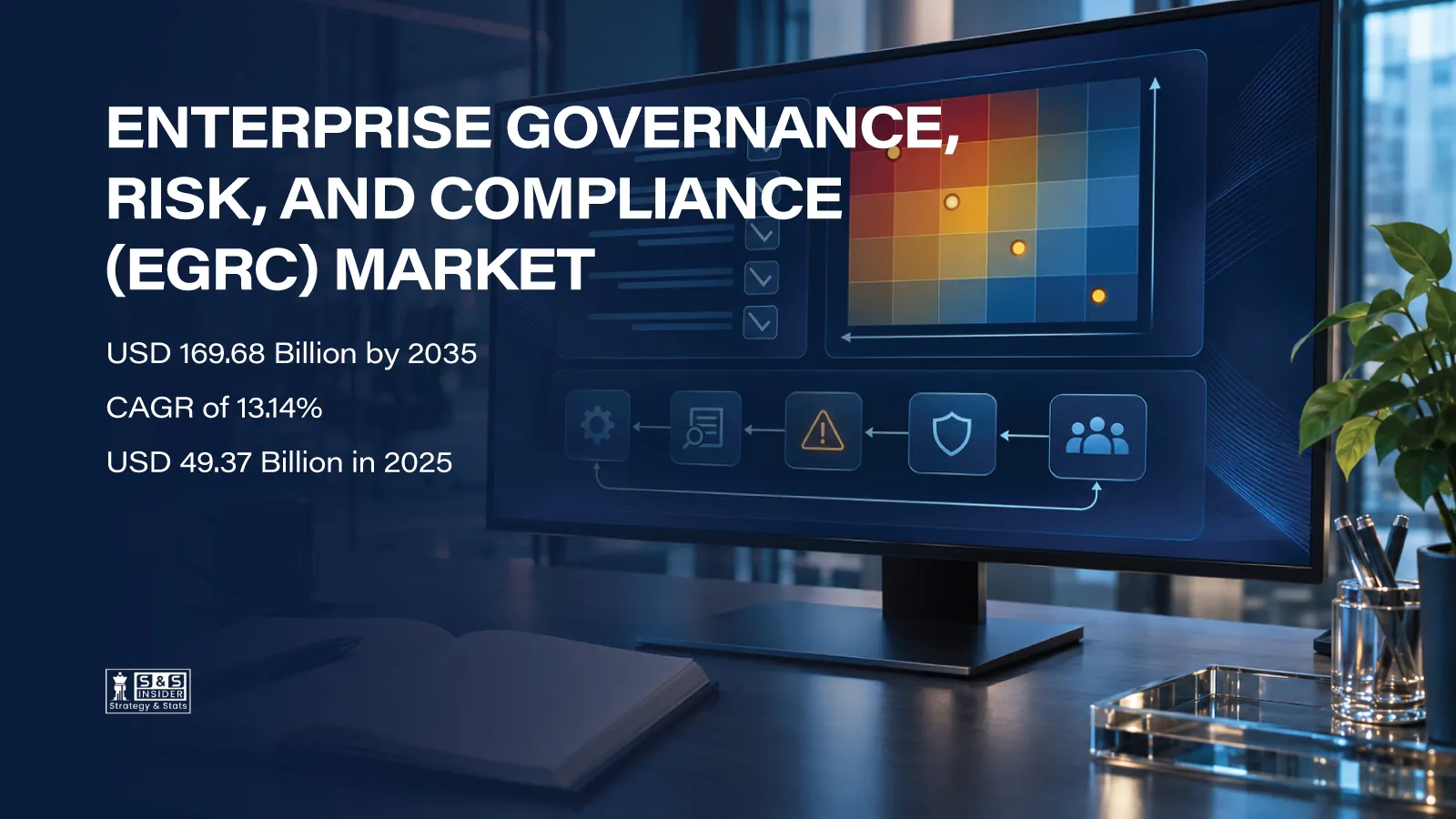
North America dominates global revenue, while Asia-Pacific offers the strongest growth opportunities. Through 2035, competitive success will increasingly depend on regulatory intelligence, AI integration, platform interoperability and continuous risk monitoring.
Market Size and Forecast
|
Market Indicator |
Value |
|---|---|
|
Market Size, 2025 |
USD 49.37 Billion |
|
Market Size, 2026 |
USD 55.86 Billion |
|
Market Forecast, 2035 |
USD 169.68 Billion |
|
CAGR, 2026–2035 |
13.14% |
|
Leading Region |
North America (37.84%) |
|
Fastest-Growing Region |
Asia-Pacific (15.52% CAGR) |
|
Leading Component |
Software (66.12%) |
|
Leading Deployment |
Cloud (58.47%) |
Demand Drivers and Constraints
Primary Demand Drivers
-
Increasing regulatory complexity: GDPR, DORA, cybersecurity reporting obligations and financial regulations are encouraging organizations to consolidate governance and compliance activities.
-
Rising cybersecurity and third-party risks: Growing reliance on cloud infrastructure and external technology providers increases demand for integrated risk monitoring.
-
Artificial intelligence adoption: AI-assisted compliance mapping, risk identification and audit automation improve the efficiency of governance operations.
-
Expanding cloud-based solutions: Subscription platforms enable faster implementation, scalable compliance management and regular regulatory updates.
-
Growing board-level accountability: Corporate leadership increasingly requires real-time reporting on operational resilience, compliance performance and enterprise risk exposure.
Potential Growth Constraints
-
High implementation and integration expenses for enterprise-wide platforms.
-
Complex data migration from disconnected legacy compliance systems.
-
Shortages of qualified governance, risk and compliance professionals.
-
Data sovereignty and cybersecurity concerns affecting cloud deployment.
-
Organizational resistance to standardized risk reporting processes.
Demand Structure by Component
Software — Largest Component (2025 Market Share: 66.12%)
Software dominated the enterprise governance, risk and compliance market with a 66.12% revenue share in 2025. Demand is supported by organizations replacing spreadsheets and disconnected applications with integrated platforms covering regulatory compliance, enterprise risk, internal audits, policy management and third-party assessments.
Financial institutions and multinational enterprises continue to be important customers because they require centralized control documentation and standardized regulatory reporting. Subscription licensing also encourages organizations to build on top of existing deployments with add-on analytics and risk management modules. AI-enabled automation and continuous control monitoring will drive demand for software through 2035.
Current trend: Growing adoption of integrated enterprise risk and compliance software.
Major trends: AI-powered risk analytics, automated regulatory mapping, centralized audit management and continuous control monitoring.
Services — Fastest-Growing Component (Forecast CAGR: 14.86%)
Services are expected to grow at a CAGR of 14.86% during 2026–2035 due to the demand for consulting, implementation, integration and managed compliance operations.
Organizations need the right kind of specialized help to establish risk frameworks, connect enterprise applications, migrate compliance records and establish effective governance processes. Companies operating in multiple jurisdictions also require ongoing regulatory updates and control assessments.
For businesses that don’t have a large internal compliance team, managed services can be a solution. “Enterprise platforms will become more sophisticated, and implementation partners and specialized consulting providers will be well positioned to capture further opportunities.
Current trend: Increasing outsourcing of platform implementation and compliance management.
Major trends: Managed GRC services, regulatory advisory, enterprise integration and automated control testing.
Demand Structure by Deployment Mode
Cloud — Leading and Fastest-Growing Deployment (2025 Share: 58.47%; CAGR: 15.12%)
The cloud deployment is expected to grow at a CAGR of 15.12% during the forecast period 2025-2035, and will contribute 58.47% of the market revenue in 2025.
Cloud based eGRC solutions offer centralized risk information access, automatic software updates and integration with enterprise applications. Companies are increasingly turning to subscription-based platforms to reduce their infrastructure needs and to support teams located in different parts of the world.
The availability of secure cloud environments and packaged compliance frameworks also opens up more possibilities for smaller businesses. The hybrid deployment model is still a good fit for companies who want to have more control over sensitive information.
Current trend: Accelerating migration toward cloud-native compliance platforms.
Major trends: SaaS adoption, sovereign cloud deployment, automated framework updates and real-time compliance dashboards.
Demand Structure by Organization Size
Large Enterprises — Dominant Segment (2025 Market Share: 64.38%)
In 2025, the large enterprises accounted for 64.38% of the market demand because of their complicated operating structures and large regulatory responsibilities.
Multinational corporations must coordinate across multiple departments and jurisdictions to perform risk assessment, internal controls, supplier compliance and audit activities. Integrated eGRC platforms provide centralized oversight and support consistent reporting to management and regulators. The demand for cybersecurity, technology governance and operational resilience will continue to be strong as digital transformation of enterprises picks up.
Current trend: Consolidation of enterprise-wide risk management systems.
Major trends: Centralized governance, supplier risk integration, executive dashboards and enterprise AI oversight.
Small and Medium Enterprises — Accelerating Cloud Adoption
With the increasing regulatory obligations beyond the big companies, small and medium enterprises are adopting affordable cloud-based governance and compliance solutions. Smaller organizations can enhance audit readiness, without the burden of maintaining large internal risk management departments, through simplified subscription packages, pre-defined control libraries and managed services. Incremental investment through 2035 should be driven by increasing cybersecurity exposure and supplier compliance requirements.
Current trend: Rising adoption of packaged cloud compliance solutions.
Major trends: Subscription-based GRC, automated compliance templates, outsourced monitoring and simplified risk assessments.
Demand Structure by Industry Vertical
BFSI — Largest Industry Vertical (2025 Market Share: 27.46%)
Banking, Financial Services and Insurance held a share of 27.46% in the market revenue in 2025. A wide set of regulations applies to banks, insurers, payment companies and investment institutions in relation to financial crime, operational resilience, cybersecurity and internal controls.
As financial institutions become more reliant on external technology vendors, they are incorporating third-party risk assessments into enterprise governance platforms. Regulatory reporting, ongoing monitoring and operational resilience testing are expected to support investment through to 2035.
Current trend: Strong demand for integrated financial risk and regulatory compliance platforms.
Major trends: Operational resilience monitoring, anti-money laundering controls, third-party risk management and automated regulatory reporting.
Healthcare and Life Sciences — Fastest-Growing Vertical (Forecast CAGR: 14.97%)
The healthcare and life sciences sector is expected to grow at a CAGR of 14.97% for the period 2026-2035. Hospitals, pharmaceutical manufacturers and healthcare service providers have growing requirements for integrated systems to manage patient data protection, operational risks, clinical compliance and supplier accountability.
The growth of connected healthcare infrastructure and digital clinical workflows adds further governance requirements. Demand is expected to strengthen as organizations invest in security resilience, audit readiness and consistent compliance management across distributed healthcare operations.
Current trend: Increasing integration of healthcare compliance and enterprise risk management.
Major trends: Patient data governance, clinical compliance automation, healthcare cybersecurity and vendor risk monitoring.
Regional Market Dynamics
North America — Largest Regional Market (2025 Share: 37.84%)
North America held 37.84% of the total revenue share globally in 2025, due to the developed adoption of enterprise software and widespread regulatory supervision. The United States is the largest contributor with a market valuation of USD 16.33 billion in 2025 and a projected CAGR of 12.62% during 2026-2035.
Financial institutions, healthcare organizations, technology companies and government contractors are ramping up investments in automated compliance monitoring. Canada is driving demand through banking regulation, cyber security governance and public sector modernization.
Direction: Continued market leadership supported by regulatory complexity and advanced technology adoption.
Europe — Second-Largest Region (2025 Market Share: 26.12%)
Europe accounted for 26.12% of global market revenue in 2025. Key markets include Germany, the United Kingdom, France and Nordic countries where companies are strengthening governance frameworks to address GDPR, DORA, NIS2 and relevant sustainability reporting mandates. This is particularly the case for financial institutions, multinational corporations and public agencies that need consistent compliance documentation across jurisdictions.
Direction: Sustained expansion driven by regulatory harmonization and operational resilience requirements.
Asia-Pacific — Fastest-Growing Region (2025 Share: 24.46%; CAGR: 15.52%)
The Asia-Pacific region contributed 24.46% of market revenue in 2025 and is projected to register the highest regional CAGR of 15.52% by 2035. China, India, Japan, South Korea, Australia and Singapore are all strengthening requirements for corporate governance, cybersecurity and data protection. The rise of digital banking, the adoption of enterprise cloud and the modernization of technology is driving organizations to replace manual compliance processes with integrated platforms.
Direction: Rapid growth supported by digital transformation and expanding regulatory obligations.
Latin America — Emerging Market (2025 Share: 4.92%)
Latin America was 4.92% of market revenue in 2025. Brazil and Mexico are leading the demand in the region, supported by the modernization of financial services, data protection requirements and stronger corporate compliance practices. Opportunities also are present in Chile and Colombia as financial institutions and enterprises strengthen their internal controls and cybersecurity governance.
Direction: Gradual expansion supported by financial digitization and regulatory development.
Middle East & Africa — Developing Market (2025 Share: 6.66%)
Middle East & Africa accounted for 6.66% of global revenue in 2025. Saudi Arabia and the United Arab Emirates are important markets driven by national digital transformation strategies and cybersecurity initiatives. Banking, telecommunications and government organizations in South Africa, Egypt and Nigeria are seeing increasing demand.
Direction: Expanding opportunities through public-sector modernization and enterprise risk management investment.
Competitive Landscape
The market includes major enterprise software providers and specialized governance technology companies.
Representative participants include IBM Corporation, SAP SE, Oracle Corporation, ServiceNow, Diligent Corporation, MetricStream, Archer Technologies, LogicGate, Workiva, NAVEX, OneTrust, Wolters Kluwer, Riskonnect, SAI360 and AuditBoard.
Competition increasingly centers on AI capabilities, regulatory content coverage, integration flexibility and continuous risk monitoring. In January 2026, Diligent acquired 3rdRisk to strengthen its AI-native third-party risk management capabilities, illustrating growing interest in integrated supplier risk solutions.
Market Outlook (2026–2035)
Global enterprise governance, risk and compliance market is expected to reach USD 169.68 billion by 2035, at a CAGR of 13.14%. The growth will be fueled by growing regulatory requirements, cyber security threats, third-party dependencies and the use of artificial intelligence in enterprise operations.
Specialized services will help organizations deploy increasingly complex compliance frameworks, and cloud platforms will enable wider adoption. It is expected that North America will be the top region with Asia-Pacific holding the fastest growth. Enterprise governance, risk and compliance is becoming increasingly a strategic business function and long-term growth will increasingly depend on intelligent automation, integrated risk visibility and continuous regulatory compliance.
About the Author

Get in touch




