
According to the latest SNS Insider Magnesium Oxide Board Market report, the global market is entering a period of steady expansion as construction companies prioritize fire-resistant building materials, moisture protection, and durable mineral-based panels.
The global magnesium oxide board market is undergoing a transition from specialized construction applications toward broader adoption in residential, commercial, and prefabricated building systems. Growing demand for non-combustible wall assemblies, stricter building safety requirements, and the expansion of modular construction are creating new opportunities for manufacturers and building material suppliers.
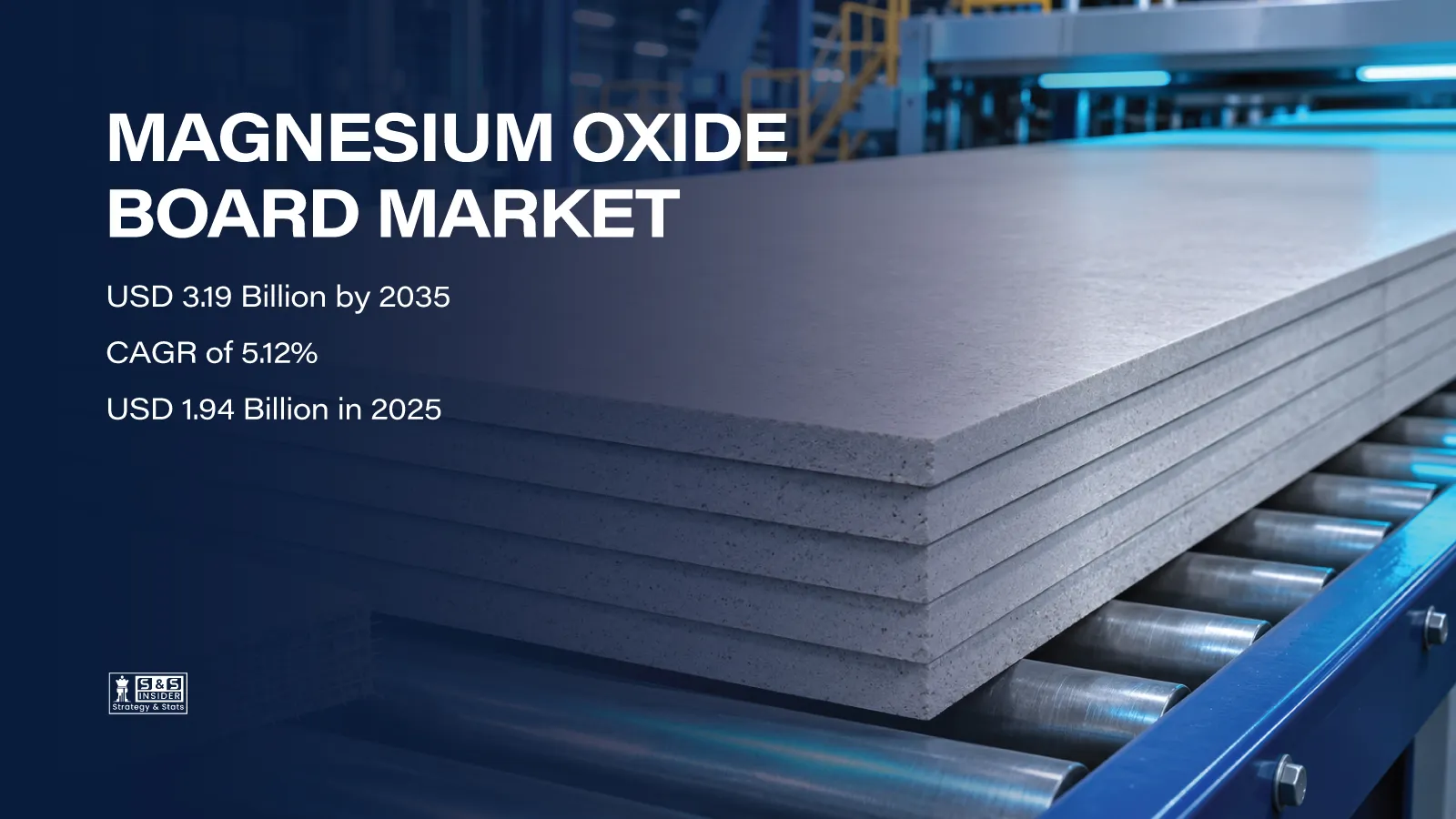
The global Magnesium Oxide Board Market was valued at USD 1.94 Billion in 2025 and is projected to reach USD 2.04 Billion in 2026 and USD 3.19 Billion by 2035, expanding at a reported CAGR of 5.12% during 2026–2035.
Magnesium oxide boards offer resistance to fire, moisture, mold, and pests, making them attractive alternatives to conventional gypsum and certain cement-based panels in performance-sensitive applications. Manufacturers are increasingly emphasizing improved binder chemistry, certified fire performance, and dimensional stability to address historical concerns regarding product quality.
To Get Detailed Insights on the Magnesium Oxide Board Market – Request a Sample Report
Geographically, Asia-Pacific dominates global demand, supported by extensive manufacturing capacity and construction activity. Europe is expected to experience the fastest growth as building regulations and renovation requirements encourage the specification of non-combustible materials.
Through 2035, competition will increasingly depend on product certification, manufacturing consistency, installation efficiency, and the ability to serve high-performance construction applications.
Market Size and Forecast
| Market Indicator | Value |
|---|---|
| Market Size, 2025 | USD 1.94 Billion |
| Market Size, 2026 | USD 2.04 Billion |
| Market Forecast, 2035 | USD 3.19 Billion |
| CAGR, 2026–2035 | 5.12% |
| Leading Region | Asia-Pacific (51.34%) |
| Fastest-Growing Region | Europe (5.88% CAGR) |
| Leading Product Type | Thin Boards |
| Fastest-Growing Product Type | Medium Boards (5.91% CAGR) |
Demand Drivers and Constraints
Primary Demand Drivers
- Stricter fire safety regulations: Increasing requirements for fire-resistant wall systems, building envelopes, and public infrastructure support demand for non-combustible mineral boards.
- Growth in residential construction: Housing development, renovation projects, and urban expansion increase consumption of wall panels, ceiling boards, and flooring underlayment.
- Expansion of prefabricated construction: Modular building manufacturers require lightweight, dimensionally stable panels compatible with factory-based assembly.
- Demand for moisture-resistant materials: Construction activity in humid and coastal regions supports the use of boards designed to withstand moisture, mold, and pest exposure.
- Commercial building modernization: Hospitals, hotels, educational facilities, and office developments increasingly prioritize durable, fire-rated interior assemblies.
- Sustainable construction initiatives: Interest in durable building materials, reduced maintenance requirements, and documented environmental performance encourages product innovation.
Potential Growth Constraints
- Price competition from established gypsum, cement, and fiber cement board products.
- Inconsistent binder formulations and concerns regarding moisture-related corrosion.
- Limited installer familiarity and product approval challenges in certain markets.
- Fluctuations in magnesium compound prices and international freight costs.
- Dependence on imported boards in regions with limited domestic manufacturing.
Demand Structure by Product Type
Thin Boards — Leading Product Category
Thin magnesium oxide boards, generally measuring below 8 mm, represent the largest product category in 2025.
These panels are widely used for interior wall coverings, ceiling installations, partitions, and decorative building applications. Their relatively low weight and convenient handling make them suitable for renovation projects and high-volume interior finishing.
Demand is particularly strong in Asia-Pacific, where residential development and commercial refurbishment generate substantial requirements for affordable construction panels.
Manufacturers compete through pricing, consistent surface quality, and reliable distribution networks. Through 2035, thin boards are expected to maintain an important position in mainstream interior construction.
Current trend: Sustained demand for lightweight, easy-to-install mineral panels.
Major trends: Interior renovation, affordable housing, improved surface finishes, and wider contractor accessibility.
Medium Boards — Fastest-Growing Product Category (5.91% CAGR)
Medium magnesium oxide boards, typically between 8 mm and 15 mm thick, are projected to register the fastest growth, with a CAGR of 5.91% during 2026–2035. These products offer additional strength and fastening performance for wall sheathing, flooring substrates, fire-rated partitions, and prefabricated panel systems. Demand is increasing as commercial builders and modular construction companies seek materials capable of meeting multiple performance requirements within integrated building assemblies. Manufacturers are expanding certified product ranges and improving panel compatibility with insulation systems and factory-based construction processes.
Current trend: Accelerating adoption in modular buildings and fire-rated assemblies.
Major trends: Prefabricated wall systems, structural insulated panel facings, enhanced fastening performance, and certified construction solutions.
Thick Boards — Specialized Construction Applications
Thick magnesium oxide boards, generally above 15 mm, serve applications requiring greater panel rigidity, durability, or specialized assembly performance.
Potential applications include selected industrial flooring systems, robust partitions, and demanding building installations where thinner panels may not provide sufficient mechanical performance.
Demand is influenced by project-specific engineering requirements, installation costs, and competition from conventional heavy-duty construction boards.
Current trend: Selective adoption in demanding construction applications.
Major trends: Industrial refurbishment, durable flooring assemblies, specialized fire-resistant systems, and higher-performance panel engineering.
Demand Structure by Application
Residential Construction — Largest Application Segment
Residential construction accounts for the largest application segment of the magnesium oxide board market in 2025. Single-family houses, apartment developments, and residential renovation projects require substantial quantities of wall linings, ceiling panels, bathroom boards, and flooring substrates. Builders are increasingly evaluating mineral-based panels for applications where moisture resistance, fire protection, and durability justify higher material costs. Demand is supported by urban housing development and government-backed residential construction programs, particularly across Asia-Pacific. Through 2035, the segment is expected to benefit from renovation activity, prefabricated housing, and wider awareness of moisture-resistant construction materials.
Current trend: Increasing use of durable mineral boards in residential interiors.
Major trends: Affordable housing, bathroom renovations, modular homes, and fire-resistant wall assemblies.
Commercial Buildings — Fastest-Growing Application (5.68% CAGR)
Commercial construction is projected to be the fastest-growing application segment, registering a CAGR of 5.68% during 2026–2035. Hospitals, schools, hotels, offices, and retail facilities require building materials capable of meeting demanding fire safety and long-term maintenance requirements. Magnesium oxide boards are increasingly considered for corridors, internal partitions, ceilings, and other applications where certified mineral-based assemblies offer practical advantages. Commercial renovation programs also create opportunities as property owners upgrade older buildings to satisfy changing safety standards.
Current trend: Rising specification of fire-rated boards in institutional and commercial facilities.
Major trends: Public building renovations, fire safety upgrades, prefabricated commercial structures, and durable interior systems.
Industrial Construction — Performance-Driven Demand
Industrial buildings represent a specialized application area, including manufacturing facilities, warehouses, utility rooms, and industrial service buildings. Material selection is influenced by fire exposure, environmental conditions, maintenance requirements, and compatibility with industrial construction systems. Magnesium oxide boards can provide value in selected protective linings and partitions where suitable tested assemblies are available.
Current trend: Targeted demand for fire-resistant industrial construction panels.
Major trends: Warehouse development, industrial maintenance, protective partitions, and infrastructure modernization.
Regional Market Dynamics
Asia-Pacific — Largest Market (51.34% Share)
Asia-Pacific accounted for 51.34% of global magnesium oxide board revenue in 2025, establishing its position as the leading regional market. China remains central to regional production because of its magnesium mineral resources and extensive board manufacturing infrastructure. The country accounts for approximately 52.60% of Asia-Pacific market revenue. India, Japan, South Korea, and Southeast Asian countries contribute demand through residential construction, infrastructure development, and commercial building projects. Export-oriented manufacturing networks also support supply to North America, Europe, and the Middle East.
Direction: Continued market leadership supported by construction demand and established manufacturing capacity.
North America — Second-Largest Market (21.82% Share)
North America represented approximately 21.82% of global market revenue in 2025. The United States is the dominant national market, accounting for 86.40% of regional revenue. Its magnesium oxide board market was valued at USD 0.37 Billion in 2025, with a projected CAGR of 4.97% through 2035. Demand is supported by residential resilience improvements, fire-resistant construction, and growing interest in modular building systems. Manufacturers are also exploring domestic production to reduce import-related costs and strengthen supply chain reliability.
Direction: Steady expansion supported by building resilience and localized manufacturing.
Europe — Fastest-Growing Region (5.88% CAGR)
Europe accounted for approximately 20.67% of global market revenue in 2025 and is projected to grow at a CAGR of 5.88% during 2026–2035. Strengthening fire safety standards, energy-efficiency requirements, and investment in building renovation are encouraging demand for mineral construction panels. Germany leads regional consumption with a 21.35% share, supported by prefabricated construction and refurbishment activity. The United Kingdom, France, Italy, and Nordic countries also offer opportunities for certified fire-resistant boards.
Direction: Fastest regional expansion driven by regulatory changes and advanced construction practices.
Middle East & Africa — Infrastructure-Led Opportunities
The Middle East & Africa accounted for 4.28% of global market revenue in 2025. Saudi Arabia represents the largest regional country market, with a 31.20% share, supported by major residential, hospitality, and infrastructure developments. Fire-resistant and moisture-tolerant materials are relevant for commercial towers, transportation facilities, and public buildings.
Direction: Gradual expansion through infrastructure investment and construction modernization.
Latin America — Emerging Construction Demand
Latin America held approximately 1.89% of global revenue in 2025, with Brazil accounting for 47.80% of the regional market. Growing residential development, commercial construction, and interest in dry construction methods support market opportunities. However, import costs and competition from established materials continue to restrict wider adoption.
Direction: Moderate growth supported by specialized construction applications.
Competitive Landscape
The global magnesium oxide board market remains fragmented, with competition shaped by manufacturing efficiency, material quality, certification, and distribution capabilities. Companies identified in the SNS Insider report include DragonBoard USA, DuPont, Huber Engineered Woods, and US MGO. Manufacturers are prioritizing improved magnesium sulfate formulations, certified fire-resistant assemblies, and factory-applied protective barriers. Regional production investments are also becoming strategically important as suppliers seek to reduce shipping expenses and improve delivery reliability. Product consistency, technical documentation, and installer support are expected to remain important competitive differentiators.
Market Outlook (2026–2035)
The global magnesium oxide board market is forecast to reach USD 3.19 Billion by 2035, supported by increasing demand for fire-resistant, durable, and moisture-tolerant construction materials. Residential construction will continue providing a substantial demand base, while commercial buildings and medium-thickness boards are expected to deliver relatively faster growth.
Europe offers strong expansion potential through regulatory modernization, while Asia-Pacific is expected to retain its leading market position through established production capacity and construction demand. The transition toward modular construction, locally manufactured panels, and improved binder technologies could create additional opportunities for suppliers. However, successful adoption will depend on product certification, consistent manufacturing quality, competitive pricing, and installer familiarity.
Overall, the magnesium oxide board market is positioned for steady growth through 2035, with fire safety compliance, construction efficiency, and material performance emerging as major competitive priorities.
About the Author

Get in touch




