
Fiber Cement Board Market Report Scope & Overview:
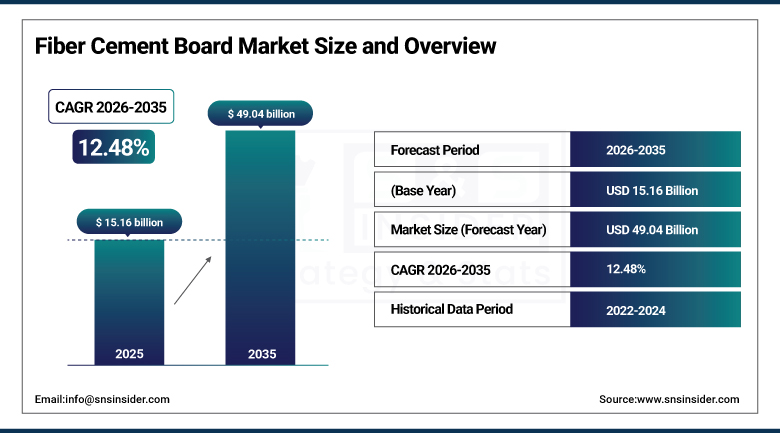
The Fiber Cement Board Market was valued at USD 15.16 Billion in 2025 and is expected to reach USD 49.04 Billion by 2035, growing at a CAGR of 12.48% from 2026 to 2035.
Fiber cement board is a composite construction material manufactured from a precise mixture of Portland cement, silica sand, cellulosic fibre pulp, and water that is processed through autoclave curing or air-curing methods to create dimensional sheet panels. Whose unique combination of cement's inherent fire resistance and dimensional stability with cellulosic fibre's tensile reinforcement creates a material. The fire resistance rating, moisture resistance, termite resistance, impact toughness, and dimensional stability under temperature and humidity cycling substantially exceeds the performance of traditional building materials including wood siding, vinyl cladding, and gypsum board in demanding outdoor exposure environments. Fiber cement boards are manufactured in density ranges from approximately 0.8 grams per cubic centimetre for lightweight low-density interior partition panels through 1.2 grams per cubic centimetre for medium-density general construction boards to above 1.5 grams per cubic centimetre for high-density exterior cladding.
James Hardie Industries unveiled a new and expanded range of Hardie fiber cement products at the 2025 International Builders' Show in February 2025, introducing enhanced textures including wood grain, stucco, and stone finishes whose photo-realistic replication capability allows architects and builders to achieve specific aesthetic design objectives while retaining fiber cement's fire resistance, moisture resistance, and minimal maintenance characteristics that wood and stone alternatives require seasonal maintenance to preserve. James Hardie's Q3 fiscal 2025 results disclosed an adjusted EBITDA of USD 262 million at a margin of 27.5 percent, demonstrating the strong operational leverage of its manufacturing network whose high fixed-cost facilities deliver improving margins as North American residential construction activity sustains demand for its HardiePlank, HardiePanel, and HardieTrim product lines.
Market Size and Forecast
-
Market Size in 2026E: USD 17.05 Billion
-
Market Size by 2035: USD 49.04 Billion
-
CAGR: 12.48% from 2026 to 2035
-
Fastest Growing Region: Asia Pacific
-
Largest Region: Asia Pacific
To Get more information on Fiber Cement Board Market - Request Free Sample Report
Fiber Cement Board Market Trends
-
Factory-painted and pre-finished fiber cement boards are reducing installation time and labor costs.
-
Digitally printed fiber cement panels are enabling customized architectural façade designs.
-
Low-carbon fiber cement formulations are gaining demand through sustainable construction initiatives.
-
Seismic-resistant fiber cement systems are witnessing higher adoption in disaster-prone regions.
-
Modular and prefabricated construction is driving increased demand for precision-engineered fiber cement boards.
The U.S. Fiber Cement Board Market Outlook
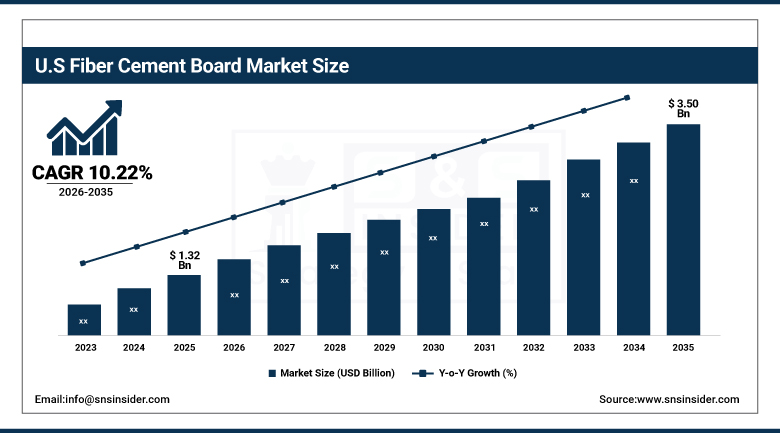
The U.S. Fiber Cement Board Market was valued at approximately USD 1.32 Billion in 2025 and is expected to reach approximately USD 3.50 Billion by 2035, growing at a CAGR of approximately 10.22%.
The United States is a commercially significant fiber cement board market, driven by the dominant market position of James Hardie Industries whose HardiePlank and HardiePanel products command the majority of U.S. fiber cement siding product specification at residential construction. The progressive building code adoption of non-combustible exterior cladding requirements in wildfire-designated fire hazard severity zones across California, Colorado, Oregon, and other western states whose regulatory mandates create compliance-driven fiber cement adoption beyond voluntary material preference, and the growing residential renovation market. Whose exterior siding replacement projects represent a substantial and growing fiber cement demand segment as homeowners upgrading wood, vinyl, and deteriorated asbestos-cement cladding specify James Hardie and CertainTeed fiber cement alternatives.
The Philippine Department of Trade and Industry welcomed the USD 50.4 million Mabalacat fiber cement board plant investment by Thailand-based Shera in October 2024, a development that positioned the Philippines to reduce its complete reliance on imported fiber cement boards through domestic production commissioning in early 2025 creating 300 local manufacturing jobs.
Fiber Cement Board Market Segment Analysis
-
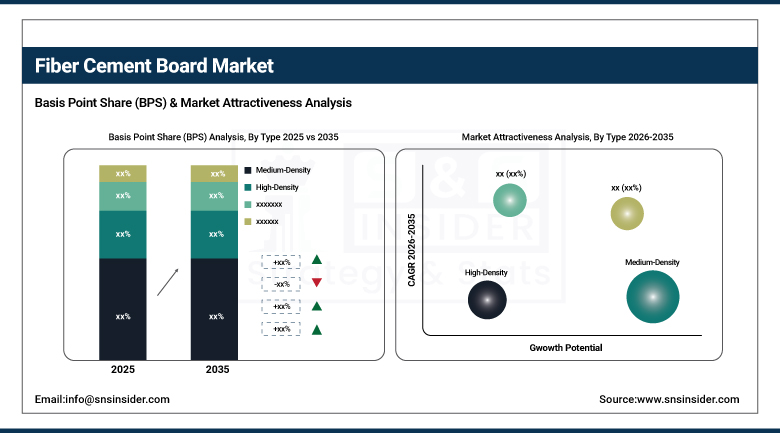
By Type, the medium-density segment dominated the Fiber Cement Board market with 42.75% share in 2025, while the high-density segment is growing at the fastest CAGR of 13.42% during 2026 to 2035.
-
By Product, the fiber cement siding segment dominated the Fiber Cement Board market with approximately 39.10% share in 2025, while the fiber cement backer board segment is growing rapidly through bathroom and kitchen renovation.
-
By Application, the exterior cladding segment dominated the Fiber Cement Board market with 38.30% share in 2025, while the roofing and interior partition applications are growing during 2026 to 2035.
-
By End Use, the residential segment dominated the Fiber Cement Board market with 51.40% share in 2025, while the commercial segment is growing at the fastest CAGR of 13.78% during 2026 to 2035.
-
By Raw Material, Portland cement dominated the market in 2025, accounting for approximately 46.8% of the global market share, while cellulosic fiber/pulp is projected to be the fastest-growing segment during 2026–2035, registering a CAGR of approximately 6.9%
By Type, medium-density dominates, high-density grows fastest
Medium-density fiber cement boards retained 42.75% of Fiber Cement Board market share in 2025, reflecting their status as the general-purpose construction panel whose strength, workability, machinability, and cost balance makes them the default specification for the widest range of interior and exterior applications. Compatibility with standard carpentry tools and dimensional stability under humidity variation, preventing the cracking at joints that wood-based alternatives create, sustain specifier preference in residential construction.
High-density boards are growing fastest at 13.42% CAGR through high-rise residential, commercial, and industrial construction across Asia Pacific whose structural requirements at elevation demand the greater density and load resistance that high-density formulations provide.
By End Use, residential dominates, commercial grows fastest
Residential construction retained the dominant end use position with 51.40% of Fiber Cement Board market revenue in 2025, reflecting the enormous global residential construction and renovation demand whose exterior siding, interior partition, bathroom wall tile backer, and soffit applications collectively create the largest single end use category for fiber cement board consumption. The residential renovation market represents a particularly large and growing fiber cement demand segment as ageing housing stock in North America, Europe, and Australia reaches the exterior cladding replacement milestone where the performance deterioration of original wood, vinyl, or asbestos-cement siding creates compelling renovation economics for fiber cement alternatives whose 50-year-plus functional lifespan dramatically exceeds vinyl siding's 15 to 25 year aesthetic and structural life.
Commercial construction is growing fastest at a CAGR of 13.78% through the rising construction of retail centres, office buildings, mixed-use developments, and institutional facilities across developing economies whose commercial real estate development is proportional to urbanization and economic growth, creating concentrated fiber cement specification demand at commercial architects and developers whose building performance and lifecycle cost requirements align with fiber cement's value proposition.
Regional Analysis
|
Region |
Major Country |
Share within Region, 2025 (%) |
|---|---|---|
|
North America |
United States |
84.73% |
|
Europe |
Germany |
27.84% |
|
Asia Pacific |
China |
31.00% |
|
Middle East & Africa |
UAE |
22.84% |
|
Latin America |
Brazil |
43.84% |
North America Fiber Cement Board Market Insights
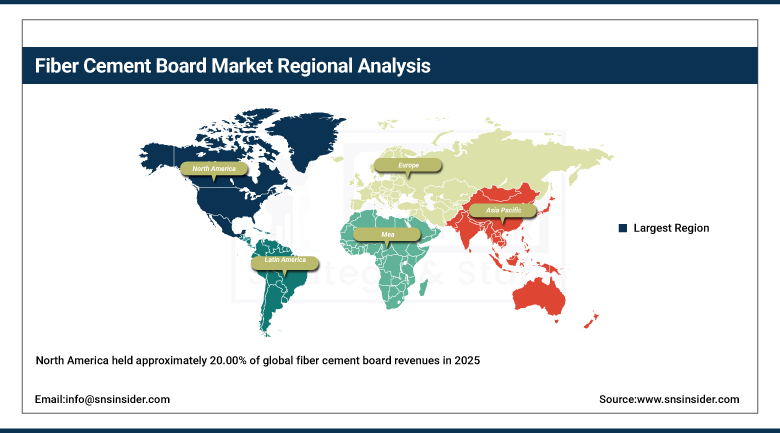
North America held approximately 20.00% of global fiber cement board revenues in 2025. The United States accounts for approximately 84.73% of regional revenue at USD 1.32 Billion through James Hardie's dominant North American fiber cement siding market position, CertainTeed's fiber cement product range, and the progressive building code adoption of non-combustible exterior cladding requirements in wildfire risk zones. Canada contributes meaningful supplementary demand through residential construction and the adoption of fiber cement as an alternative to traditional vinyl and wood siding.
Get Customized Report as per Your Business Requirement - Enquiry Now
Europe Fiber Cement Board Market Insights
Europe held prominent share of global fiber cement board revenues in 2025. Germany accounts for approximately 27.84% of European revenues through its large construction market, Etex Group and Cembrit's European manufacturing operations, and the domestic renovation market's specification of fiber cement for exterior renovation projects. European building regulations' progressive tightening of energy efficiency and fire safety requirements for building envelopes are creating structural demand for high-performance cladding systems in which fiber cement plays a central role. The United Kingdom, France, and Scandinavia each contribute meaningful European demand.
Asia Pacific Fiber Cement Board Market Insights
Asia Pacific dominated the global fiber cement board market in 2025, holding approximately 45.00% of global revenues and driving the fastest regional growth. China accounts for approximately 31.00% of Asia Pacific revenues through its enormous residential construction sector, growing commercial development, and the domestic presence of major fiber cement manufacturers. India is growing rapidly through government-backed affordable housing programmes including Pradhan Mantri Awas Yojana, and SCG Building Materials and Shera serve Southeast Asian construction markets from Thailand. Japan and South Korea contribute through their advanced construction industries.
MEA & Latin America Fiber Cement Board Market Insights
Middle East and Latin America represent growing fiber cement board markets where urbanization and construction sector expansion are creating demand. The UAE leads MEA revenues of the regional total through its large commercial and hospitality construction sector, high performance requirements for coastal construction, and growing specification of fire-rated materials in high-rise residential and commercial towers. Brazil leads Latin American revenues of the regional total through its large housing deficit creating residential construction demand and the construction industry's progressive adoption of fiber cement as a durable alternative to clay brick.
Market Dynamics
Growth Drivers: Building code adoption of non-combustible exterior cladding requirements in wildfire-prone regions and rapid urbanization creating construction demand for durable low-maintenance building materials.
The progressive adoption of non-combustible exterior cladding building code requirements across fire-prone jurisdictions globally represents a structural regulatory demand driver whose mandated material substitution creates fiber cement adoption independent of the cost and performance competitive considerations that voluntary specification requires. California's building codes requiring non-combustible siding materials in Wildland Urban Interface fire hazard severity zones affecting millions of residential and commercial buildings, combined with similar regulatory adoption in Australian state building codes following 2019-2020 bushfire events and European building regulation updates following Grenfell Tower and similar façade fire incidents, create a global regulatory tailwind that progressively expands the fiber cement-mandated construction market.
Rapid urbanization in Asia Pacific, South Asia, and Sub-Saharan Africa, where the United Nations estimates 2.5 billion additional urban residents by 2050, creates sustained construction demand whose volume and quality requirements sustain fiber cement consumption growth.
Restraints: Higher installation labor cost than vinyl siding alternatives and weight-related handling and structural support requirements creating adoption barriers for specifiers prioritizing simplest installation and lowest initial material cost.
Fiber cement board's weight, typically 10 to 20 kilograms per square metre for standard thickness cladding panels, creates handling, lifting, and structural support requirements that exceed those of lightweight vinyl siding or thin engineered wood composite products whose installation productivity advantages at the per-panel cycle time level can create total installed cost competitiveness despite fiber cement's superior durability at the lifecycle cost comparison. The breaking risk during on-site cutting and handling for inexperienced installers unfamiliar with fiber cement's brittleness under impact and tensile stress, combined with the silica dust exposure hazard requiring wet cutting methods and respiratory protection whose compliance burden adds installation complexity, creates adoption barriers at contractors whose vinyl and wood siding installation experience does not transfer directly to fiber cement installation best practice.
Opportunities: Green building certification market requiring low-embodied-carbon cladding materials and digitally printed architectural fiber cement panels enabling premium design facade applications.
Green building certification requirements across LEED, BREEAM, WELL, and Green Star programmes are creating specifier scoring incentives for building materials whose environmental performance credentials including recycled content, regional sourcing, low volatile organic compound emissions, and embodied carbon reduction can each contribute points toward certification targets. Fiber cement's potential for clinker replacement with supplementary cementitious materials including fly ash, slag, and geopolymer binders is progressively improving its embodied carbon profile toward levels competitive with alternative facade materials, creating a certification credential improvement pathway that sustainably-specified commercial construction projects can reward through preferred material specification. Digitally printed fiber cement panel facades capable of replicating marble, concrete, brick, and custom graphic patterns at commercial building scale are creating a premium design application market.
Recent Developments:
-
2025: James Hardie unveiled an expanded fiber cement product range at the 2025 International Builders' Show including enhanced texture options, and reported Q3 fiscal 2025 adjusted EBITDA of USD 262 million at a 27.5% margin demonstrating strong North American residential construction demand performance.
-
2024: Etex Group acquired BGC's fiber cement and gypsum wallboard businesses, achieving a top-three global fiber cement market position with enhanced Australian construction market access, and the Philippine DTI welcomed Shera's USD 50.4 million Mabalacat fiber cement board plant establishing domestic production.
-
2024: SCG Building Materials expanded fiber cement production capacity across Southeast Asian markets to serve regional construction demand growth, and Nichiha Corporation launched new digitally printed architectural fiber cement panels for commercial facade applications.
Fiber Cement Board Market Key Players are:
-
James Hardie Industries PLC
-
Etex Group SA
-
Nichiha Corporation
-
Saint-Gobain SA (CertainTeed)
-
Cembrit Holding A/S
-
SCG Building Materials (Shera, Thailand)
-
Everest Industries Limited
-
Beijing Hocreboard Building Materials Co. Ltd.
-
Mahaphant Fibre Cement Co. Ltd.
-
Swisspearl Group
-
Plycem (Elementia)
-
BirlaNu Ltd.
-
Sahyadri Industries Pvt. Ltd.
-
Toray Industries Inc.
-
GAF Materials Corporation
-
CenturyPly
-
Allura
-
PREFA GmbH
-
Redwood Group
-
Yuanda China Holdings Ltd.
Fiber Cement Board Market Report Scope:
| Report Attributes | Details |
|---|---|
| Market Size in 2025 | USD 15.16 Billion |
| Market Size by 2035 | USD 49.04 Billion |
| CAGR | CAGR of 12.48% From 2026 to 2035 |
| Base Year | 2025 |
| Forecast Period | 2026-2035 |
| Historical Data | 2022-2024 |
| Report Scope & Coverage | Market Size, Segments Analysis, Competitive Landscape, Regional Analysis, DROC & SWOT Analysis, Forecast Outlook |
| Key Segments | • By Type (High-Density, Medium-Density, Low-Density) • By Product (Fiber Cement Siding, Fiber Cement Backer Board, Fiber Cement Trim, Fiber Cement Roofing, Fiber Cement Flooring, Partition Boards, Others) • By Application (Exterior Cladding/Siding, Interior Walls & Partitions, Roofing, Flooring Underlayment, Soffit & Trim, Others) • By End Use (Residential, Commercial, Industrial, Infrastructure) • By Raw Material (Portland Cement, Cellulosic Fiber/Pulp, Silica/Sand, Others) |
| Regional Analysis/Coverage | North America (US, Canada), Europe (Germany, UK, France, Italy, Spain, Russia, Poland, Rest of Europe), Asia Pacific (China, India, Japan, South Korea, Australia, ASEAN Countries, Rest of Asia Pacific), Middle East & Africa (UAE, Saudi Arabia, Qatar, South Africa, Rest of Middle East & Africa), Latin America (Brazil, Argentina, Mexico, Colombia, Rest of Latin America). |
| Company Profiles | James Hardie Industries PLC, Etex Group SA, Nichiha Corporation, Saint-Gobain SA (CertainTeed), Cembrit Holding A/S, SCG Building Materials (Shera, Thailand), Everest Industries Limited, Beijing Hocreboard Building Materials Co. Ltd., Mahaphant Fibre Cement Co. Ltd., Swisspearl Group, Plycem (Elementia), BirlaNu Ltd., Sahyadri Industries Pvt. Ltd., Toray Industries Inc., GAF Materials Corporation, CenturyPly, Allura, PREFA GmbH, Redwood Group, and Yuanda China Holdings Ltd. |
Frequently Asked Questions
Asia Pacific dominated the Fiber Cement Board Market in 2025, holding approximately 45.00% of global revenues.
The medium-density segment dominated the Fiber Cement Board Market with 42.75% share in 2025.
The Fiber Cement Board Market is expected to grow at a CAGR of 12.48% from 2026 to 2035.
The primary growth factors are building code adoption of non-combustible exterior cladding requirements in wildfire-prone and fire-safety-regulated jurisdictions, rapid urbanisation creating residential and commercial construction demand in emerging economies.
The Fiber Cement Board Market was valued at USD 15.16 Billion in 2025.
