
The global market is entering a high-growth phase due to the transformation of demand for advanced microdisplays by spatial computing, immersive entertainment and wearable electronics, the latest SNS Insider OLED-on-Silicon Market report said. Organic light-emitting materials are combined with silicon backplanes in OLED-on-Silicon (OLEDoS) technology, which makes it possible to achieve exceptional pixel density, high contrast, and compact display architectures.
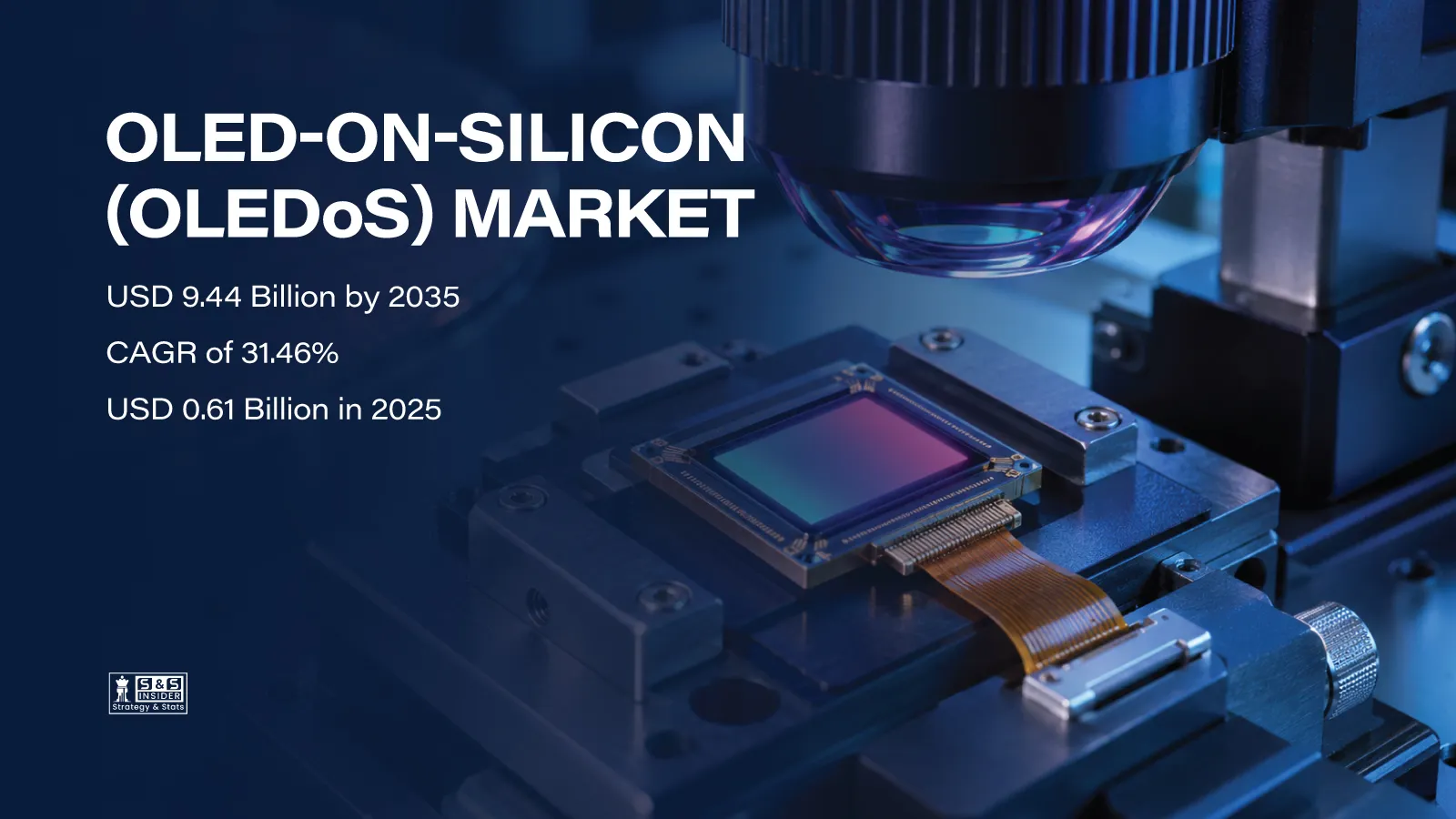
The global OLED-on-Silicon market was valued at USD 0.61 billion in 2025, is estimated to reach USD 0.80 billion in 2026, and is forecasted to expand to USD 9.44 billion by 2035, registering a CAGR of 31.46% during 2026-2035.
The demand for specialized electronic viewfinders and professional optical instruments is being replaced by mixed reality headsets, augmented reality glasses, and advanced visualization systems. Top electronics makers are pouring money into displays with greater resolutions, higher brightness and energy efficient designs to enable ever more sophisticated wearable devices.
To Get Detailed Insights on the OLED-on-Silicon (OLEDoS) Market – Request a Sample Report
Manufacturing economics are changing, too. Additionally, the transition to 12-inch silicon wafer manufacturing could unlock the potential for higher production volumes and lower per-unit costs, potentially encouraging use beyond premium devices.
At present, demand is led by North America, and the Asia-Pacific region is expected to experience the fastest growth as manufacturing capacity and investments in advanced display technology increase.
Market Size and Forecast
| Market Indicator | Value |
|---|---|
| Market Size, 2025 | USD 0.61 Billion |
| Market Size, 2026 | USD 0.80 Billion |
| Market Forecast, 2035 | USD 9.44 Billion |
| CAGR, 2026–2035 | 31.46% |
| Largest Region, 2025 | North America (36.42%) |
| Fastest-Growing Region | Asia-Pacific (33.60% CAGR) |
| Leading Product Type | Near-to-Eye Displays (62.94%) |
| Leading End User | Consumer Electronics (56.28%) |
Demand Drivers and Constraints
Primary Demand Drivers
-
Expansion of spatial computing: Increasing development of mixed reality and virtual reality headsets supports demand for ultra-high-resolution microdisplays.
-
Growing smart glasses adoption: Lightweight wearable devices require compact, energy-efficient display technologies capable of delivering clear visual information.
-
Advancement in display resolution: Improvements in pixel density, brightness, and refresh rates enhance immersive viewing experiences.
-
Increasing manufacturing capacity: Transitioning toward larger silicon wafers can improve production efficiency and lower manufacturing costs.
-
Defense and aerospace applications: Helmet-mounted systems, electronic sights, and simulation equipment generate demand for specialized microdisplays.
-
Automotive display innovation: Augmented reality head-up displays create opportunities for compact, high-brightness projection systems.
Potential Growth Constraints
-
High production costs and manufacturing yield challenges restrict adoption in price-sensitive electronics.
-
Brightness limitations and OLED material degradation affect outdoor wearable applications.
-
Concentrated manufacturing capacity increases dependence on a limited supplier base.
-
Trade restrictions and international supply chain disruptions create procurement uncertainty.
-
Complex thermal management and power efficiency requirements complicate product development.
Demand Structure by Product Type
Near-to-Eye Displays (2025 Market Share: 62.94%)
In 2025, the market leader for OLED-on-Silicon is near-to-eye displays, which accounted for 62.94% of revenue. The rise of mixed reality headsets, virtual reality devices, smart glasses and high resolution electronic viewfinders is bolstering the technology. OLEDoS technology allows manufacturers to place very dense pixels close to the user’s eyes with high contrast and small optical configurations. Increased spending on immersive computing platforms and enterprise visualization solutions is driving the demand. Through 2035, lighter wearables and more efficient displays are expected to reinforce the market position of the segment.
Current trend: Increasing integration of high-resolution OLED microdisplays into premium mixed reality headsets.
Major trends: Higher pixel density, compact optical systems, improved refresh rates, energy-efficient wearable displays, and spatial computing adoption.
Head-Up Displays (Forecast CAGR: 35.89%)
The head-up display is projected to grow at the highest CAGR of 35.89% during the forecast period 2026-2035. Car makers and aerospace equipment developers are exploring small projection technologies that can show navigation, operational information and safety alerts within the user’s field of vision. OLED-on-Silicon makes possible miniaturized optical engines where image clarity and response speed are important. Demand growth will depend on improvements in brightness, operating temperature tolerance and long-term reliability, especially for automotive and aviation environments.
Current trend: Growing development of augmented reality head-up display architectures.
Major trends: Windshield projection systems, automotive display integration, high-brightness optical engines, and ruggedized display technologies.
Demand Structure by Display Size
Above 1 Inch (2025 Market Share: 66.38%)
In 2025, 66.38% of the market revenue was made up of displays above one inch, driven by the demand for high-end virtual and mixed reality headsets. Larger microdisplays can accommodate more pixels and can provide wider viewing requirements, allowing manufacturers to provide more detailed immersive environments and better text readability. The developers of premium headsets are moving toward higher resolution panels to improve the realism of the visuals and to make the pixels less visible. Larger displays are more expensive to manufacture but the performance benefits are worth the cost for use in advanced spatial computing devices and specialized visualization equipment.
Current trend: Increasing demand for high-resolution microdisplays in premium immersive headsets.
Major trends: 4K-class resolution, wider viewing fields, higher pixel counts, enhanced color reproduction, and optical integration.
Up to 1 Inch (Forecast CAGR: 33.07%)
Microdisplays up to one inch is expected to grow at a CAGR of 33.07% till 2035. Demand is being driven by smart glasses, electronic camera viewfinders, miniaturized optical equipment and wearable visualization systems. These applications need lightweight components that fit in limited mechanical space, brightness and low power consumption. The manufacturers are improving the pixel architecture and the efficiency of the silicon backplane to give sharper images in smaller formats. The development of smart glasses with displays could see increased progress, opening up significant future demand as wearables continue to trend toward smaller devices.
Current trend: Miniaturization of OLED microdisplays for lightweight wearable electronics.
Major trends: Reduced pixel pitch, low-power display architectures, compact eyewear integration, and improved outdoor visibility.
Demand Structure by Technology
RGB OLED-on-Silicon (2025 Market Share: 52.31%)
In 2025, RGB OLED-on-Silicon captured 52.31% of the market due to the demand for high-performance microdisplays with good color reproduction and efficient light emission. Direct-emission RGB architectures are attractive for high-end immersive devices requiring high brightness and visual fidelity, as they can reduce light loss associated with color filters. Display manufacturers are exploring more sophisticated deposition techniques and pixel structures to enhance display efficiency and output. Further innovation is anticipated to allow adoption in complex headsets, specialized optical systems and future augmented reality applications.
Current trend: Development of higher-brightness direct-emission RGB microdisplays.
Major trends: Improved color efficiency, enhanced emitter performance, advanced deposition techniques, and high-resolution headset integration.
White OLED with Color Filter (Forecast CAGR: 36.24%)
White OLED with color filter technology is expected to grow at a CAGR of 36.24% during 2026-2035. Its manufacturing architecture is scalable for fine-pitch microdisplays, especially as manufacturers increase capacity for silicon wafer fabrication. Further improvements in the performance of color filters, light extraction and OLED materials may help overcome performance limitations and at the same time enable cost reductions. The technology is becoming increasingly relevant for companies developing commercially scalable displays for smart glasses and mid-range immersive devices where affordability and manufacturability are important purchasing considerations.
Current trend: Increasing focus on scalable, cost-efficient OLED microdisplay manufacturing.
Major trends: Larger wafer production, improved color filters, higher manufacturing yields, and optimized brightness performance.
Demand Structure by End User
Consumer Electronics (2025 Market Share: 56.28%)
Consumer electronics represented 56.28% of the global market in 2025, driven by immersive headsets, smart glasses, and electronic viewfinder applications. Technology manufacturers are integrating high-density microdisplays to improve image quality while reducing device weight and optical complexity. Growing spatial computing ecosystems, immersive gaming applications, and digital content platforms are supporting continued product development. Through 2035, expanding consumer acceptance of wearable computing and improvements in display affordability are expected to strengthen demand across premium and emerging device categories.
Current trend: Increasing commercialization of OLED-on-Silicon-enabled spatial computing products.
Major trends: Immersive entertainment, smart eyewear development, high-resolution headsets, and portable visualization systems.
Automotive (Forecast CAGR: 35.46%)
The automotive industry is expected to be the fastest-growing end-user segment with a CAGR of 35.46% till 2035. OLED-on-Silicon technologies are under evaluation by manufacturers for augmented reality head-up displays and compact in-vehicle visualization systems. Applications can improve information presentation by projecting navigation guidance and driving-related alerts within the driver’s line of sight. To be used commercially, the reliability must be demonstrated under demanding temperature conditions and long periods of operation. A successful qualification could give display suppliers long-term opportunities by locking them into future vehicle platforms.
Current trend: Increasing evaluation of advanced microdisplays for automotive visualization.
Major trends: Augmented reality windshields, compact projection modules, driver information systems, and automotive-grade display qualification.
Regional Market Dynamics
North America (2025 Market Share: 36.42%)
North America dominated the OLED-on-Silicon market with a 36.42% share in 2025. The United States represents the region's largest country market, supported by major consumer electronics companies, spatial computing development, and defense technology investment. Demand is driven by advanced headset platforms, enterprise training applications, and specialized military visualization equipment. Canada contributes through optical research and immersive technology development. Strong technology investment and product innovation are expected to sustain regional demand for premium microdisplays through 2035.
Direction: Continued market leadership supported by spatial computing investment, defense applications, and advanced wearable electronics.
Asia-Pacific (2025 Market Share: 34.15%; Forecast CAGR: 33.60%)
Asia-Pacific contributed 34.15% of global revenue in 2025 and is predicted to witness the fastest regional growth at 33.60% CAGR. Regional demand is driven by China, while South Korea, Japan and Taiwan offer advanced manufacturing capabilities and display technology expertise. Investments in larger silicon wafer production lines, microdisplay fabrication capacity and electronic component supply chains are boosting the region’s competitive position. The increasing manufacturing of smart glasses and assembly of immersive devices is expected to drive the growth of the market.
Direction: Fastest regional expansion driven by manufacturing capacity, display innovation, and wearable device production.
Europe (Third-Largest Regional Market)
Europe represents the third-largest OLED-on-Silicon market, with Germany leading regional activity alongside France, the United Kingdom, and the Netherlands. Demand is supported by automotive electronics, aerospace equipment, industrial visualization, and advanced photonics research. European companies and research institutions are developing high-resolution microdisplay technologies for specialized applications requiring precision and reliability. Investment in semiconductor research and optical engineering is expected to create additional opportunities for regional suppliers.
Direction: Steady expansion supported by automotive innovation, industrial applications, and microelectronics research.
Middle East & Africa
The Middle East & Africa is a growing market for OLED-on-Silicon displays, driven by defense modernization, immersive entertainment and professional training applications. Major regional markets include Saudi Arabia and the United Arab Emirates, while Israel and South Africa offer specialized electronics and research capabilities. The growing use of immersive education, simulation technologies and advanced visualization equipment could open up opportunities for international display suppliers. The market expansion will depend on the affordability of devices and local development of technology infrastructure.
Direction: Gradual growth supported by defense technology, immersive training, and expanding digital infrastructure.
Latin America
Latin America is still a developing market, with Brazil, Mexico, Argentina and Colombia leading the way. Demand is largely driven by immersive gaming, professional visualization, education and specialized industrial applications. Premium devices and import-related costs continue to be a barrier to wider adoption. But future demand could be driven by the increasing availability of mixed reality hardware, growing digital entertainment activity and electronics assembly capabilities. Falling prices for devices and wider commercial acceptance are expected to benefit regional prospects.
Direction: Emerging demand supported by immersive entertainment, enterprise applications, and improving device accessibility.
Competitive Landscape
The global OLED-on-Silicon market is characterized by the competition between specialized microdisplay manufacturers and large semiconductor display companies on brightness, resolution, manufacturing efficiency and product reliability.
Some of the prominent market participants identified by SNS Insider are Sony Semiconductor Solutions, Samsung Display, SeeYA Technology, Kopin, Lumicore, INT Tech.
Companies are investing in high-density RGB architectures, advanced OLED materials and larger silicon wafer manufacturing processes. Competing is increasingly driven by the ability to win design wins with major headset manufacturers, while maintaining consistent production yields and competitive pricing.
Market Outlook (2026–2035)
SNS Insider’s base case forecast sees the OLED-on-Silicon market growing to USD 9.44 billion by 2035, fueled by the rapid growth of immersive computing and high-resolution wearable displays.
The shift from premium headsets to slim smart glasses is a massive growth opportunity. Cost reductions and commercialization improvements may come gradually through manufacturing improvements such as larger wafer production and higher OLED efficiency.
Other demand drivers are expected to include defense visualization systems, automotive head-up displays and professional optical applications, besides consumer electronics.
However, high production costs, limitations of brightness, and concentrated manufacturing capacity are still important challenges.
Overall, OLED-on-Silicon technology is positioned for substantial expansion through 2035, with competitive success increasingly determined by display performance, manufacturing scalability, strategic partnerships, and the commercialization of next-generation wearable electronics.
About the Author

Get in touch




