
According to the latest SNS Insider report on the global Zero Liquid Discharge Systems Market, the industry is entering a period of sustained expansion as manufacturers prioritize industrial water recovery, wastewater recycling, and compliance with increasingly demanding environmental regulations.
The Zero Liquid Discharge (ZLD) Systems market is witnessing a paradigm shift from conventional wastewater treatment to integrated systems that recover usable water and eliminate the discharge of liquid waste from industrial facilities. Water intensive industries such as power generation, chemicals, textile, electronics and oil and gas are rethinking their water management strategies as freshwater shortages and treatment costs rise.
The global zero liquid discharge systems market was valued at USD 7.94 Billion in 2025, is estimated to reach USD 8.46 Billion in 2026, and is projected to expand to USD 15.00 Billion by 2035, registering a CAGR of 6.58% during 2026–2035.
To Get Detailed Insights on the Zero Liquid Discharge Systems Market – Request a Sample Report
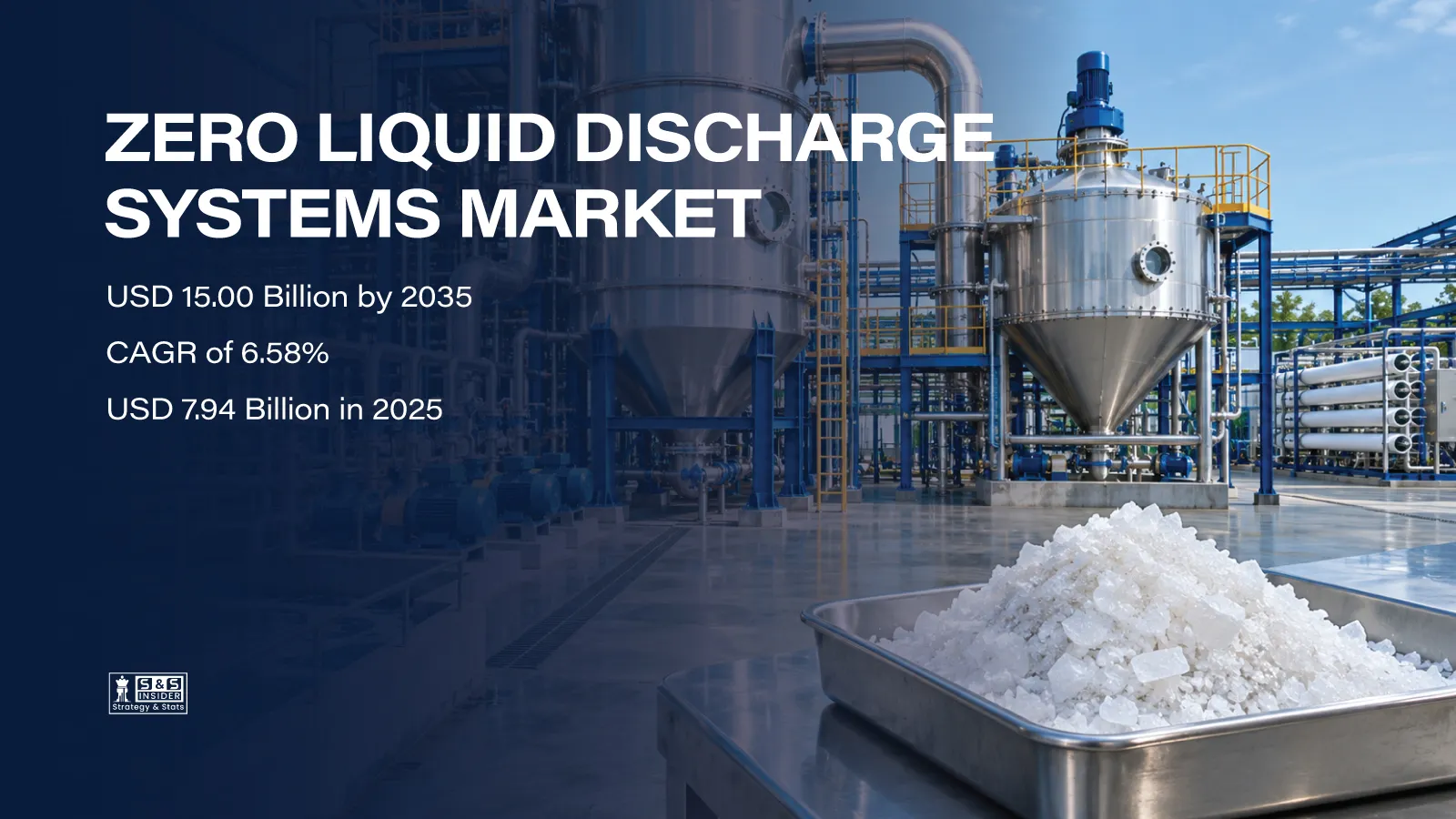
The trend in technology adoption is moving toward hybrid configurations that combine membrane filtration, reverse osmosis, evaporation and crystallization. These systems reduce the volume of wastewater that requires energy intensive thermal treatment, and increase overall water recovery.
We’re also seeing demand grow outside of traditional power and chemical industries. Their huge water needs and ever-more-complex wastewater streams are providing significant growth opportunities in semiconductor manufacturing, electronics production and mineral processing.
Asia Pacific is the largest market in terms of geographical presence due to the presence of large industrial manufacturing clusters along with stringent discharge regulations and rising water scarcity across China, India and Southeast Asia.
The outlook through 2035 suggests that energy efficiency, system reliability, recovery performance and ability to provide cost-effective industrial water reuse solutions will increasingly determine market competitiveness.
Demand Drivers and Constraints
Primary Demand Drivers
-
Increasing industrial water scarcity: Declining freshwater availability and rising industrial water consumption are encouraging manufacturers to install advanced recovery systems that reduce dependence on external water supplies.
-
Stricter wastewater discharge regulations: Environmental compliance requirements across industrial sectors are strengthening demand for systems capable of minimizing or eliminating liquid effluent.
-
Expansion of semiconductor manufacturing: New fabrication plants require extensive ultrapure water infrastructure, creating opportunities for high-recovery wastewater treatment and brine management.
-
Growing power sector wastewater treatment: Thermal power plants face requirements to manage cooling tower blowdown, flue gas desulfurization wastewater, and other contaminated streams.
-
Advancements in membrane technology: Improved reverse osmosis, electrodialysis, and membrane concentration systems are reducing the volume of wastewater requiring thermal processing.
-
Increasing interest in resource recovery: Industries are exploring opportunities to recover valuable salts and minerals from concentrated wastewater streams.
Potential Growth Constraints
-
High initial capital expenditure for integrated wastewater treatment infrastructure.
-
Significant energy consumption associated with evaporation and crystallization.
-
Complex equipment integration, scaling, membrane fouling, and maintenance requirements.
-
Additional costs associated with solid salt and sludge disposal.
-
Uneven regulatory enforcement and extended compliance deadlines in certain markets.
Demand Structure by System Type
Conventional Systems (2025 Market Share: 61.47%)
The conventional zero liquid discharge systems was the largest revenue-generating segment, accounting for an estimated 61.47% of the global market in 2025. In these plants, the treatment of industrial wastewater with a high concentration of dissolved solids is mainly carried out by thermal concentration, evaporation and crystallization. Their established track record in power generation and chemical processing and refining facilities supports continued adoption, particularly where the characteristics of the wastewater are difficult to manage with membranes alone. However, high energy requirements and large installation costs are important factors to consider when making a purchase.
Current trend: Continued deployment of proven thermal treatment systems in industrial facilities with complex wastewater streams.
Major trends: Thermal concentration, industrial wastewater recovery, crystallization efficiency, and treatment system modernization.
Hybrid Systems (Forecast CAGR: 8.31%)
Hybrid zero liquid discharge systems are estimated to witness a CAGR of around 8.31% in the forecast period of 2026-2035. These systems combine membrane-based treatment with thermal processes, thus reducing the volume of wastewater fed to evaporators and crystallizers. This configuration can reduce energy consumption, reduce equipment size and improve project economics compared to thermal treatment methods alone. With growing demand from electronics manufacturing, textiles and industrial processing facilities, modular hybrid configurations are being adopted.
Current trend: Increasing preference for integrated membrane-thermal wastewater recovery systems.
Major trends: Modular treatment platforms, high-recovery reverse osmosis, energy optimization, and automated process monitoring.
Demand Structure by Technology
Thermal-Based Technology (2025 Market Share: 58.64%)
Thermal-based technologies accounted for a share of approximately 58.64% in terms of global revenue in 2025. Still required to treat highly concentrated industrial wastewaters and convert the residual brines into manageable solids are evaporators, brine concentrators and crystallizers. Their capability to handle difficult wastewater compositions makes them especially important in power generation, chemicals and refining. Equipment manufacturers are using heat recovery and mechanical vapor recompression to cut operating costs.
Current trend: Sustained demand for thermal treatment equipment capable of managing highly saline wastewater.
Major trends: Mechanical vapor recompression, heat recovery, evaporation efficiency, and automated crystallization.
Membrane-Based Technology (Forecast CAGR: 8.74%)
Membrane-based technology is projected to register a CAGR of around 8.74% during the forecast period of 2026 to 2035. Progress in high-pressure reverse osmosis, electrodialysis and specialist membrane materials is improving water recovery and reducing reliance on energy-intensive thermal processes. Increasingly, industrial operators are integrating membrane concentration into treatment systems to improve efficiency and reduce overall lifecycle costs.
Current trend: Accelerating adoption of advanced membrane systems for high-recovery industrial wastewater treatment.
Major trends: High-pressure filtration, membrane durability, electrodialysis, and lower-energy brine concentration.
Demand Structure by Process
Evaporation and Crystallization (2025 Market Share: 48.93%)
Evaporation and crystallization accounted for roughly 48.93% of the global zero liquid discharge systems market in 2025. These processes are important as they convert concentrated wastewater into recoverable water and solid residues, allowing facilities to rid of liquid waste discharge. The segment is also projected to witness fastest process level growth of ~7.46% CAGR through 2035. The investment in advanced crystallization equipment is driven by the growing demand from industrial manufacturing, semiconductor fabrication and mineral processing.
Current trend: Growing demand for efficient brine concentration and industrial solid recovery.
Major trends: Advanced crystallizers, mechanical vapor recompression, salt recovery, and automated thermal processing.
Demand Structure by End-Use Industry
Power Generation (2025 Market Share: 32.18%)
The power generation segment was the largest end-use segment in 2025, accounting for around 32.18% of the global market. Waste water from cooling systems, ash handling and flue gas treatment in thermal power plants contains dissolved salts, metals and other contaminants. Utilities are upgrading wastewater treatment infrastructure to meet growing environmental compliance requirements and reduce fresh water withdrawal.
Current trend: Expansion of industrial wastewater recovery and treatment retrofits at power generation facilities.
Major trends: Cooling water recycling, flue gas wastewater treatment, thermal concentration, and regulatory compliance.
Electronics and Semiconductors (Forecast CAGR: 10.37%)
Electronics and semiconductors are the fastest growing end-use segment with a projected CAGR of approximately 10.37% during 2026-2035. Semiconductor fabrication requires large volumes of ultrapure water for wafer cleaning, rinsing and manufacturing processes. As the capacity of production grows, manufacturers are installing advanced wastewater recovery systems in new production facilities. Zero liquid discharge technologies allow semiconductor manufacturers to reduce their fresh water demand and better manage concentrated streams of wastewater.
Current trend: Increasing integration of water recycling and ZLD infrastructure in semiconductor manufacturing facilities.
Major trends: Ultrapure water recovery, high-efficiency membranes, semiconductor wastewater treatment, and integrated water management.
Regional Market Dynamics
Asia Pacific (2025 Market Share: 37.52%)
The Asia Pacific region is the leading region in the global zero liquid discharge systems market, with a share of around 37.52% of the revenue in 2025. The region is also expected to witness the fastest growth with a CAGR of around 8.46% through 2035.
China and India are major demand centers because of their large textile, chemical, power generation and industrial manufacturing activities. Semiconductor growth in Taiwan, South Korea and Japan is creating new opportunities for advanced water recovery solutions.
Direction: Strong regional leadership supported by industrial expansion, water scarcity, and increasingly demanding wastewater regulations.
North America — Established Industrial Water Treatment Market
The second largest regional market is North America, driven by environmental regulation, wastewater treatment in the power sector and investment in semiconductor manufacturing.
The U.S. market was valued at around USD 2.04 Billion in 2025 and is expected to grow at a CAGR of 6.02% between 2026 and 2035. Industrial wastewater compliance, produced water treatment and water conservation requirements at manufacturing plants affect demand.
Direction: Sustained expansion through industrial retrofits, semiconductor investment, and water recovery projects.
Europe — Regulatory Compliance Supports Demand
There is a well-established market for zero liquid discharge technologies in Europe, backed by environmental regulation and industrial sustainability programs. Important markets for advanced wastewater treatment solutions include Germany, Italy, France, Spain and the United Kingdom. Demand in the region is driven by chemical processing, pharma manufacturing, metals and power generation. Investments in water efficiency and wastewater recovery infrastructure are being driven by updates to industrial emission standards.
Direction: Steady growth supported by environmental compliance and industrial water efficiency.
Middle East & Africa — Water Scarcity Creates Opportunities
Water scarcity and industrialization are increasing in the Middle East and Africa, presenting opportunities for zero liquid discharge systems. Key markets in Saudi Arabia and the UAE include desalination brine management, petrochemical processing and industrial water recycling. Mining, metals and power generation also drive demand in South Africa.
Direction: Gradual expansion supported by water security investments and industrial wastewater management.
Latin America — Mining and Industrial Recycling Support Growth
Latin America is an emerging market with demand concentrated in Brazil, Chile, Mexico, Argentina and other industrial economies. The mining, chemical production and manufacturing industries are showing increasing interest in water recovery systems. Production of copper and lithium creates opportunities for brine treatment and mineral recovery technologies, especially in water-stressed regions.
Direction: Developing market opportunities supported by mining activity and industrial water conservation.
Competitive Landscape
The global zero liquid discharge systems market includes multinational water treatment companies, specialized technology providers, and regional engineering contractors. Key market participants include Veolia Water Technologies, Aquatech, Gradiant, Saltworks Technologies, Praj Industries, Ion Exchange (India), Concord Enviro Systems, and Effwa Infra and Research. Competition increasingly focuses on treatment efficiency, energy consumption, system reliability, project execution capabilities, and lifecycle operating costs. Technology providers are strengthening their portfolios through membrane innovation, advanced thermal concentration, modular engineering, and integrated wastewater recovery solutions.
Market Outlook (2026–2035)
The global zero liquid discharge systems market is projected to hit USD 15.00 Billion by 2035, driven by the industrial water scarcity, environmental compliance, and growing need for wastewater recycling, according to the SNS Insider report.
Industrial customers are focusing on energy efficiency and operating costs, so we should see hybrid treatment configurations and advanced membrane technologies coming into play.
Power generation will remain a traditional demand center, while electronics and semiconductors are expected to provide faster growth opportunities.
Asia Pacific is expected to retain its regional leadership, with significant industrial manufacturing capacity and increasing investment in water recovery infrastructure.
But high capital costs, energy-intensive treatment processes and the need to dispose of residual solids will continue to influence purchasing decisions.
Overall, the zero liquid discharge systems market is positioned for sustained expansion through 2035, with competitive success increasingly determined by advanced water recovery technologies, energy-efficient system design, and the ability to deliver reliable industrial wastewater recycling solutions.
About the Author

Get in touch




