
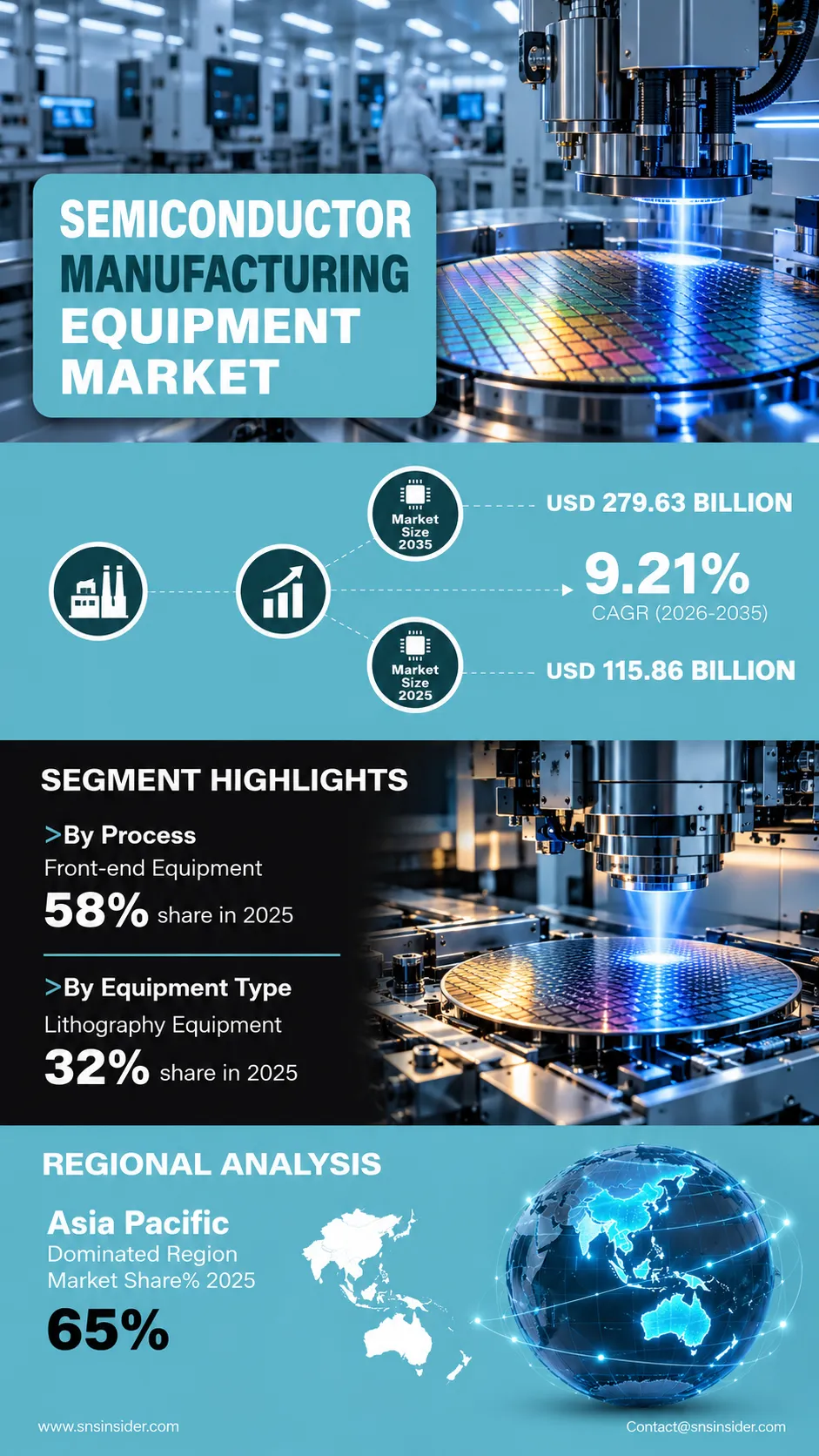
The global Semiconductor Manufacturing Equipment Market is entering a sustained expansion phase as chipmakers accelerate capacity additions to support artificial intelligence, high-performance computing, automotive electronics, and connected technologies. According to a recent study by SNS Insider, the global Semiconductor Manufacturing Equipment Market size valued at USD 115.86 billion in 2025, is anticipated to grow to USD 279.63 billion by 2035, registering a CAGR of 9.21% over the 2026–2035 forecast period.
The worldwide semiconductor industry is undergoing a major capacity transformation as manufacturers seek to localize production, strengthen supply resilience, and develop increasingly sophisticated chips. Investments in new fabrication facilities are consequently generating strong demand for equipment spanning wafer processing, lithography, deposition, inspection, testing, and packaging.
The transition toward smaller process nodes is also raising the technological requirements of semiconductor production. Meanwhile, demand from AI accelerators, data centers, electric vehicles, advanced communications, and consumer electronics is encouraging manufacturers to deploy increasingly precise and automated production systems.
To Get Detailed Insights on the Semiconductor Manufacturing Equipment Market – Request a Sample Report
Advanced Chip Architectures Create New Growth Opportunities
The expansion of semiconductor fabrication capacity across established and emerging manufacturing hubs is creating substantial opportunities for equipment suppliers. Government incentives aimed at strengthening domestic chip ecosystems are encouraging new fab projects while established producers continue expanding existing facilities.
Advanced packaging represents another important avenue for industry growth. The increasing use of chiplets and 2.5D and 3D architectures is shifting attention toward equipment capable of supporting complex assembly and integration processes. At the same time, artificial intelligence is being incorporated into factory operations to improve process control, equipment utilization, defect detection, and production yields.
Key Market Insights Highlight Shifting Demand Patterns
By process, front-end equipment is expected to account for 58% of market revenue in 2025, supported by continued investment in wafer fabrication technologies and advanced-node production. Packaging equipment is projected to be the fastest-growing process segment as chiplet-based architectures and high-performance computing applications increase demand for sophisticated packaging capabilities.
Based on equipment type, lithography equipment is anticipated to hold 32% of market revenue in 2025. The transition toward advanced lithography technologies is reinforcing its strategic importance in semiconductor manufacturing. Deposition equipment is expected to record the fastest growth as manufacturers require increasingly precise material layers for next-generation semiconductor structures.
By application, semiconductor fabrication plants and foundries are forecast to represent 55% of market revenue in 2025. Expansion of global fabrication capacity is driving equipment procurement across major production hubs. Testing and inspection are expected to experience the fastest growth as increasing device complexity makes defect detection and quality assurance more critical.
By end user, consumer electronics are projected to account for 38% of market revenue in 2025, supported by continued semiconductor demand across smartphones, computers, wearables, and connected devices. Automotive is expected to be the fastest-growing end-user segment as electric vehicles, advanced driver-assistance systems, infotainment platforms, and autonomous driving technologies increase semiconductor content per vehicle.
Smart Manufacturing Strengthens Equipment Demand
Semiconductor producers are increasingly adopting automation, advanced metrology, and data-driven manufacturing systems to improve production consistency. AI-enabled process monitoring can identify manufacturing variations earlier, helping fabs optimize yields and reduce costly production losses.
The growing importance of inspection and measurement technologies is particularly significant as chip geometries become smaller and manufacturing tolerances tighten. Equipment capable of detecting microscopic defects and maintaining process uniformity is becoming essential to high-volume advanced-node production.
Asia Pacific Leads Market with 65% Share as North America Accounts for 22%
Asia Pacific is expected to remain the largest regional market, accounting for approximately 65% of global revenue in 2025. China, Taiwan, South Korea, and Japan continue to anchor the region's semiconductor ecosystem through extensive fabrication capacity, electronics manufacturing infrastructure, and substantial investments in next-generation chips.
North America is projected to account for approximately 22% of global revenue in 2025. Government-backed semiconductor initiatives, domestic fab construction, and strong demand from AI, data centers, and defense applications are supporting regional equipment investment.
Europe is also strengthening its semiconductor capabilities through investments in automotive electronics, advanced manufacturing, and regional supply-chain resilience. Emerging activity across Latin America and the Middle East & Africa is gradually creating additional opportunities as digital infrastructure and electronics manufacturing capabilities expand.
Industry Participants Focus on Next-Generation Manufacturing
The competitive landscape remains highly technology-driven, with equipment manufacturers concentrating on precision, throughput, automation, and advanced-node compatibility. Suppliers are expanding portfolios to support increasingly complex semiconductor architectures while working closely with chipmakers on process development and manufacturing optimization.
Key companies operating in the global Semiconductor Manufacturing Equipment Market include Tokyo Electron Limited, ASML, Hitachi High-Tech Corporation, EV Group, Advanced Dicing Technologies, Evatec, Nikon Corporation, FormFactor, Lam Research Corporation, KLA Corporation, Advantest, Plasma-Therm, Nordson, QP Technologies, Modutek, Daifuku, and Canon.
An SNS Insider analyst Sushant Kadam commented, “The semiconductor industry's shift toward advanced nodes, AI-driven computing, and heterogeneous chip architectures is creating sustained demand for sophisticated manufacturing equipment. Suppliers that combine process precision with automation, inspection capabilities, and advanced packaging technologies will be positioned to benefit from the next phase of global semiconductor capacity expansion.”
About the Author

Get in touch




