
5G Radio Access Network Market Report Scope & Overview:
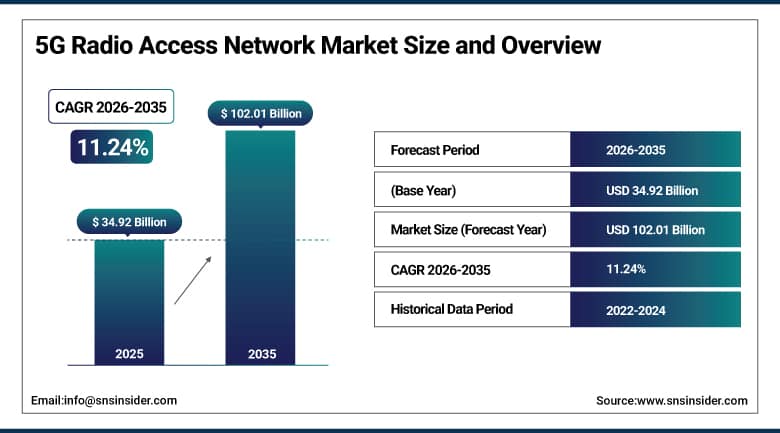
The 5G Radio Access Network Market was valued at USD 34.92 Billion in 2025 and is expected to reach USD 102.01 Billion by 2035, growing at a CAGR of 11.24% from 2026 to 2035.
The global 5G Radio Access Network (RAN) market is experiencing rapid growth driven by accelerating deployment of standalone (SA) and non-standalone (NSA) 5G networks worldwide. The market comprises radio units, baseband units, antennas, Massive MIMO systems, and fronthaul/backhaul infrastructure that enable high-speed connectivity, ultra-low latency, and massive IoT support. Increasing investments by telecom operators in network densification, small cells, and beamforming technologies are enhancing coverage and capacity in urban and rural areas. Furthermore, growing adoption of Open RAN, virtualized RAN architectures, and private 5G networks across manufacturing, healthcare, logistics, and smart city applications is creating significant long-term growth opportunities for the market.
In 2024, Ericsson and AT&T expanded their multi-year 5G RAN partnership encompassing the deployment of next-generation Radio System hardware across AT&T's U.S. network footprint. The partnership includes Ericsson's latest Massive MIMO radio units with integrated AI-based network optimization capabilities that dynamically adjust beam patterns, power allocation, and frequency utilization based on real-time traffic analysis, reducing energy consumption per transmitted gigabyte while maintaining coverage performance across AT&T's nationwide 5G coverage footprint.
Market Size and Forecast:
-
Market Size in 2026E: USD 38.84 Billion
-
Market Size by 2035: USD 102.01 Billion
-
CAGR: 11.24% from 2026 to 2035
-
Fastest Growing Region: North America
-
Largest Region: Asia Pacific
To Get More Information On 5G Radio Access Network Market - Request Free Sample Report
5G Radio Access Network Market Trends:
-
Growing adoption of Open RAN architectures is promoting multi-vendor interoperability, network flexibility, and cost-efficient deployment across global 5G infrastructure
-
Advancements in Massive MIMO technology with higher antenna configurations are improving spectral efficiency, network capacity, and coverage in high-density urban environments
-
AI-native RAN optimization is enhancing network performance through intelligent traffic management, predictive maintenance, automated fault detection, and dynamic resource allocation
-
Rising deployment of private 5G networks across manufacturing, logistics, ports, mining, and industrial facilities is creating a new enterprise-driven demand for dedicated RAN infrastructure
-
Increasing focus on energy-efficient RAN solutions is driving investments in intelligent power management, advanced cooling technologies, and energy-optimized baseband processing to reduce operational costs
U.S. 5G Radio Access Network Market Outlook:
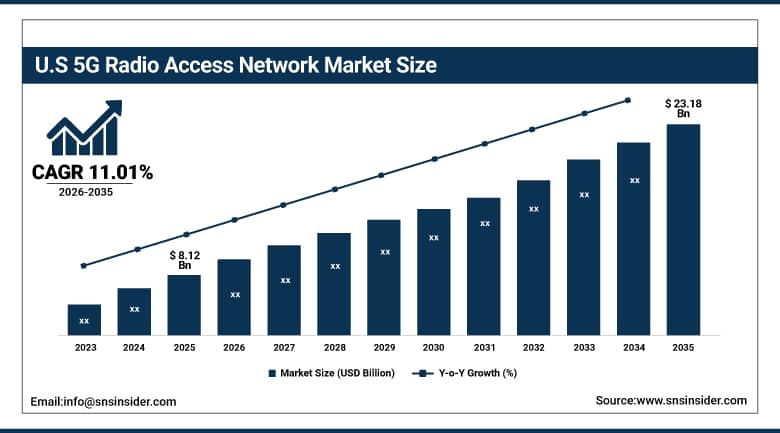
The U.S. 5G Radio Access Network Market was valued at approximately USD 8.12 Billion in 2025 and is expected to reach approximately USD 23.18 Billion by 2035, growing at a CAGR of approximately 11.01%.
The U.S. is among the world's most commercially significant 5G RAN markets, hosting the largest 5G capital expenditure programmes of AT&T, Verizon, and T-Mobile whose combined annual network infrastructure investment defines the commercial benchmark for 5G RAN equipment procurement globally. The FCC's C-band spectrum auction proceeds fund ongoing mid-band 5G infrastructure deployment, the NTIA's BEAD programme supports rural 5G coverage expansion, and the government's Open RAN policy orientation creates structured procurement preference for disaggregated network architecture whose vendor diversity reduces geopolitical supply chain concentration risk.
In 2024, Verizon awarded Nokia a significant 5G RAN expansion contract covering the deployment of Nokia AirScale Massive MIMO radio units across Verizon's C-band mid-band 5G expansion footprint, adding network capacity in high-traffic metropolitan markets and extending Nokia's multi-year position as a primary Verizon radio access network infrastructure supplier in a competitive procurement environment also serving Ericsson and Samsung.
5G Radio Access Network Market Segment Analysis:
-
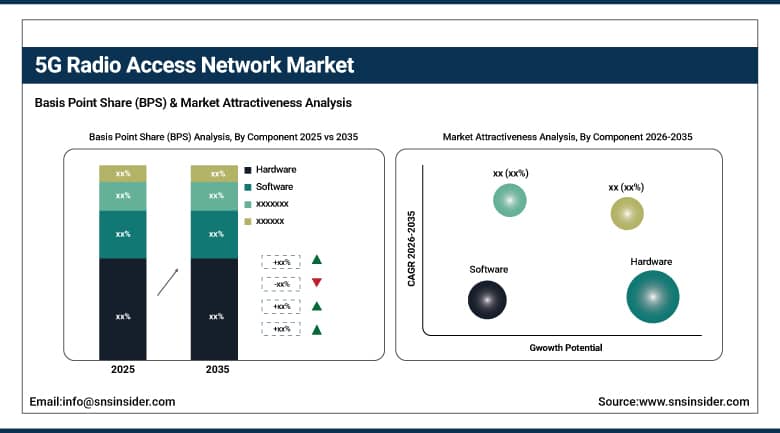
By Component, the Hardware segment dominated the 5G Radio Access Network Market with approximately 58% share in 2025, driven by the capital-intensive physical infrastructure requirement of 5G RAN while the Software segment is the fastest growing.
-
By Architecture Type, the CRAN segment dominated the 5G Radio Access Network Market with the largest share in 2025, while the Open RAN segment is the fastest growing.
-
By Deployment, the Outdoor segment dominated the 5G Radio Access Network Market with approximately 59% share in 2025, while the Indoor segment is the fastest growing.
-
By End Use, the Telecom Operators segment dominated the 5G Radio Access Network Market with the largest share in 2025, while the Enterprise segment is the fastest growing.
By Component, hardware dominates, software grows fastest
Hardware retained the dominant component position with approximately 58% of the 5G Radio Access Network market in 2025. The physical infrastructure requirement of 5G network deployment creates non-negotiable hardware capital expenditure whose antennas, radio units, and baseband processing equipment define the per-site investment structure of every 5G network build programme globally. Each new 5G macro cell site requires active antenna unit deployment whose Massive MIMO radio unit cost represents the single largest per-site equipment expenditure, while small cell densification programmes in high-traffic urban environments multiply hardware unit deployment count. The transition from 4G to 5G New Radio creates a hardware replacement cycle rather than a software upgrade pathway for most legacy 4G RAN equipment whose antenna and radio unit physical layer specifications are incompatible with 5G NR waveform requirements, sustaining hardware procurement volume across the global installed base refresh cycle.
Software is the fastest growing component because Open RAN's architectural disaggregation creates a growing pure-software RAN addressable market whose RAN Intelligent Controller xApp and rApp ecosystems, virtualized distributed unit software, and AI-powered network optimization platforms generate above-average revenue growth. Each telecom operator that commits to Open RAN deployment creates software procurement whose RIC application licensing, virtualized baseband software subscription, and AI optimization platform investment creates ongoing recurring revenue streams with margin profiles substantially above hardware. The growing enterprise private 5G network market's preference for software-defined network management platforms whose cloud-native deployment aligns with enterprise IT operations infrastructure further sustains software component growth above hardware.
By Architecture Type, CRAN dominates, Open RAN grows fastest
CRAN retained the dominant architecture position in the 5G Radio Access Network market in 2025. Centralized RAN's architectural maturity, proven deployment track record across 4G network generations, and spectral efficiency advantage from baseband pool centralization that enables coordinated multi-point interference management in dense deployment environments create operator confidence that sustains CRAN specification in network build programme’s where fiber fronthaul availability enables centralized baseband pool connectivity. The existing CRAN baseband pool infrastructure investments in urban dense deployment environments create natural architecture continuation preference in operators whose 5G deployment reuses existing 4G CRAN fiber fronthaul infrastructure, reducing incremental deployment cost relative to distributed alternative architectures.
Open RAN is the fastest growing architecture because the combination of government policy support in the U.S., EU, UK, and Japan creating structured public sector and MNO procurement preference, the demonstrated commercial viability of Rakuten Mobile's greenfield Open RAN deployment in Japan, and the O-RAN Alliance's progressive specification maturation that is closing interoperability and performance gaps relative to proprietary integrated alternatives collectively create commercial deployment momentum that is transitioning Open RAN from strategic aspiration to active network build programme commitment across tier-1 and tier-2 operators globally.
By Deployment, outdoor dominates, indoor grows fastest
Outdoor deployment retained the dominant position with approximately 59% of the 5G Radio Access Network market in 2025. Outdoor macro cell and small cell infrastructure defines the primary 5G coverage and capacity layer whose wide-area geographic service delivery, smart city connectivity, outdoor IoT sensor network support, and mobile broadband capacity for urban population density create the dominant RAN investment category. Each MNO's 5G spectrum license coverage obligation requires outdoor base station deployment whose geographic reach defines regulatory compliance, while competitive service differentiation in urban markets drives outdoor small cell densification whose high-density deployment multiplies per-market hardware unit count.
Indoor deployment is the fastest growing as the enterprise private 5G network market's expansion creates structured indoor RAN procurement whose manufacturing facility, corporate campus, hospital, and logistics warehouse applications require dedicated indoor radio infrastructure. Each manufacturing enterprise whose Industry 4.0 automation programme deploys autonomous mobile robots, computer vision quality inspection, and real-time production data analytics creates indoor private 5G RAN procurement whose latency and reliability requirements exceed achievable outdoor coverage penetration performance. The growing hospitality, stadium, convention center, and transportation hub market for premium indoor 5G connectivity creates additional indoor deployment volume whose commercial scale compounds the enterprise private network driver.
By End Use, telecom operators dominate, enterprises grow fastest
Telecom operators retained the dominant end-use position in the 5G Radio Access Network market in 2025. MNO capital expenditure on 5G RAN infrastructure represents the largest telecommunications infrastructure investment category globally, who’s multi-billion-dollar annual commitments by AT&T, Verizon, T-Mobile, Deutsche Telekom, Vodafone, China Mobile, China Unicom, and South Korean operators define market commercial scale. Each operator whose spectrum license conditions require 5G population coverage achievement by defined deadlines creates non-discretionary RAN hardware procurement whose regulatory compliance timeline creates structured capital expenditure commitments that sustain equipment vendor revenue regardless of macroeconomic conditions.
Enterprises are the fastest growing end-use segment because private 5G network adoption is creating a structurally new non-telco RAN procurement market whose industrial automation, healthcare connectivity, and logistics optimization applications generate demand for dedicated on-premise 5G infrastructure. Each manufacturing facility whose Industry 4.0 transformation programme requires guaranteed low-latency connectivity creates private 5G RAN procurement that is independent of public MNO network investment cycles. The enterprise private 5G market's addressable base encompasses hundreds of thousands of large manufacturing facilities, logistics centres, hospitals, and campuses globally whose connectivity investment creates a commercial expansion opportunity that compounds with the underlying MNO-driven market through the forecast period.
Regional Analysis:
|
Region |
Major Country |
Share within Region, 2025 (%) |
|---|---|---|
|
Asia Pacific |
China |
43.8% |
|
North America |
United States |
87.4% |
|
Europe |
Germany |
22.1% |
|
Middle East & Africa |
Saudi Arabia |
28.4% |
|
Latin America |
Brazil |
42.8% |
Asia Pacific 5G Radio Access Network Market Insights
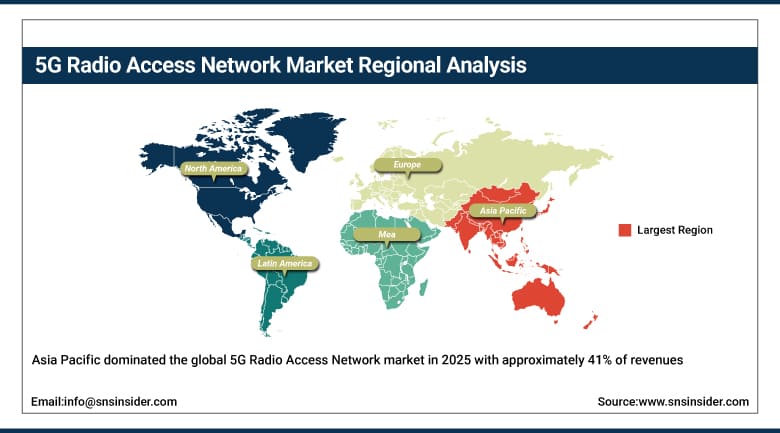
Asia Pacific dominated the global 5G Radio Access Network market in 2025 with approximately 41% of revenues, driven by China's extraordinary 5G base station deployment scale, South Korea's advanced 5G commercialization leadership, Japan's Open RAN deployment pioneering, and India's accelerating 5G infrastructure rollout. China accounts for approximately 43.8% of Asia Pacific revenues through China Mobile, China Unicom, and China Telecom's unprecedented 5G base station deployment scale whose cumulative installations exceed the combined 5G base station count of all other nations globally, with Huawei and ZTE serving the dominant share of domestic RAN infrastructure procurement.
South Korea's SK Telecom, KT, and LG U+ 5G SA deployment programme’s and Samsung's domestic vendor positioning, Japan's NTT Docomo and SoftBank's Massive MIMO and Open RAN programme’s, and India's Jio and Airtel 5G infrastructure deployment across 22 licensed service areas collectively create the secondary Asia Pacific RAN market whose commercial scale and technology leadership sustain the region's dominant global market position through 2035.
Get Customized Report as Per Your Business Requirement - Enquiry Now
North America 5G Radio Access Network Market Insights
North America held the second-largest regional share of the global 5G Radio Access Network market in 2025 at approximately 30%, driven by AT&T, Verizon, and T-Mobile's combined multi-billion-dollar annual 5G RAN capital expenditure programme’s that represent the world's most commercially significant concentration of 5G infrastructure investment outside Asia Pacific. The United States accounts for approximately 87.4% of North American revenues through its three-operator competitive 5G deployment dynamic, the FCC's mid-band spectrum allocation that enables coverage-competitive 5G deployment, and the government's Open RAN policy orientation that creates structured procurement preference for Ericsson, Nokia, and Samsung equipment.
Canada contributes approximately 12.6% of North American revenues through Bell Canada, Rogers Communications, and Telus's progressive 5G network expansion programme’s whose spectrum auction participation and urban market 5G deployment sustain consistent RAN equipment procurement from Ericsson and Nokia across the Canadian mobile network infrastructure supply landscape.
Europe 5G Radio Access Network Market Insights
Europe is a significant and policy-driven 5G RAN market where EU member state governments' 5G coverage obligations, the European Commission's Digital Decade connectivity targets, and national spectrum auction proceeds funding operator 5G infrastructure investment create structured deployment timelines across 27 member states. Germany accounts for approximately 22.1% of European revenues through Deutsche Telekom, Vodafone Germany, and Telefonica Deutschland's 5G network build programme’s, Germany's industrial private 5G network adoption in automotive and manufacturing sectors, and the regulatory framework's 5G coverage obligations for motorways, rail, and urban population centres.
The United Kingdom, France, Sweden, and Finland are significant secondary markets where BT/EE, Orange, and Nordic operator 5G programme’s, Ericsson's Swedish and Nokia's Finnish headquarters presence driving European supply chain investment, and the EU's Open RAN policy support create consistent RAN procurement. Nokia's European headquarters and Ericsson's Swedish operations define the regional equipment supplier commercial center.
MEA & Latin America 5G Radio Access Network Market Insights
Saudi Arabia leads MEA revenues at approximately 28.4% through STC, Mobily, and Zain Saudi Arabia's 5G deployment programme’s backed by Vision 2030 smart city investment. The UAE's du and e& network maturity and Gulf operator densification add complementary procurement. Brazil leads Latin American revenues at approximately 42.8% through Claro, TIM Brassil, and Vivo's spectrum deployment obligations that create consistent Ericsson and Nokia procurement. Colombia, Chile, and Mexico contribute growing demand through their own 5G spectrum auction deployment timelines through 2035.
Market Dynamics:
Growth Drivers: Expanding 5G network deployment investment and Open RAN architecture adoption reducing deployment cost
Telecom operator capital expenditure on 5G RAN infrastructure is the market's most commercially significant structural growth driver, sustained by the insatiable demand for mobile data throughput whose video streaming, cloud gaming, augmented reality, and IoT device connectivity create network capacity requirements that exceed the expansion capability of existing 4G LTE infrastructure within forecast period timelines. Each operator whose spectrum license conditions impose 5G population coverage deadlines creates non-discretionary hardware procurement whose regulatory compliance timeline creates structured equipment vendor revenue commitments. The global 5G subscriber base's projected growth trajectory, increasing from approximately 1.9 billion in 2024 toward 6 billion by 2030, creates proportional network capacity investment requirements that sustain RAN hardware and software procurement volume through the forecast period.
Open RAN architecture adoption is simultaneously reducing per-site deployment cost and expanding the vendor ecosystem whose competitive dynamics create pricing pressure on incumbent integrated RAN suppliers. Each operator that commits to Open RAN deployment creates procurement diversification that introduces Samsung, Fujitsu, NEC, and startup vendors into competitive selection alongside Ericsson and Nokia, expanding equipment supply competition. Government subsidies for Open RAN deployment in the U.S., UK, and Japan create financial incentives that accelerate Open RAN adoption beyond commercially motivated timelines, sustaining technology transition investment across multiple operator deployment programmes simultaneously.
Restraints: High capital expenditure burden and spectrum acquisition cost limiting small operator 5G investment
The substantial capital expenditure required for 5G RAN deployment creates investment capacity constraints for smaller telecom operators whose subscriber revenue scale cannot sustain the per-site infrastructure investment that comparable macro cell density requires relative to incumbent larger operators. Each small cell densification programme in urban environments requires street furniture approvals, municipal permitting, utility coordination, and backhaul fiber connectivity whose deployment complexity and cost create timeline and budget overruns that moderate deployment pace. Rural 5G deployment economics are particularly challenging, as lower subscriber density creates revenue per deployed site that cannot cover infrastructure investment amortization at the cost structures achievable in urban deployments without government subsidy support.
Spectrum acquisition cost represents a capital expenditure burden that precedes RAN equipment investment and creates financial strain that moderates infrastructure capital availability. Each spectrum auctions whose bid prices reflect competitive MNO participation creates debt financing requirements whose interest cost increases total 5G deployment cost of ownership. Developing market operators whose local currency financing costs and exchange rate risk compound spectrum and equipment investment costs face disproportionate financial barriers to 5G deployment that delay market development in commercially attractive geographies.
Opportunities: Private 5G network enterprise adoption and network slicing monetization for vertical industries
Enterprise private 5G network adoption represents the most commercially transformative near-term RAN market expansion opportunity, creating a structurally new procurement category whose industrial automation, healthcare connectivity, and logistics optimization applications generate demand for dedicated on-premise 5G infrastructure that is additive to MNO public network investment. Each factory whose Industry 4.0 programme deploys autonomous mobile robots requires guaranteed sub-millisecond latency connectivity that private 5G RAN provides but public network shared infrastructure cannot guarantee. The addressable enterprise private 5G RAN market encompasses hundreds of thousands of large industrial facilities globally whose wireless connectivity investment has historically been confined to Wi-Fi and private LTE, creating a massive first-time 5G RAN procurement opportunity whose commercial realization sustains market growth through the forecast period.
Network slicing monetization for vertical industries creates a software revenue stream that compounds with hardware deployment value in 5G SA network deployments. Each operator that deploys 5G standalone architecture creates the technical foundation for network slicing whose differentiated service level guarantees across automotive, healthcare, manufacturing, and public safety verticals create premium service tier revenue above commodity broadband pricing. Each enterprise whose mission-critical application requires a guaranteed network slice creates recurring software-defined connectivity revenue whose margin profile exceeds hardware infrastructure return on invested capital.
Recent Developments:
-
2024: Ericsson and AT&T expanded their multi-year 5G RAN partnership in 2024 encompassing next-generation Radio System Massive MIMO deployment with integrated AI network optimization across AT&T's U.S. nationwide 5G footprint, improving spectral efficiency and energy consumption per transmitted gigabyte.
-
2024: Nokia and Verizon extended their strategic 5G RAN partnership in 2024 with Nokia AirScale Massive MIMO radio unit deployment across Verizon's C-band mid-band 5G expansion, adding capacity in high-traffic metropolitan markets and advancing Nokia's multi-year Verizon infrastructure supply position.
-
2024: Samsung Electronics launched its vRAN 3.0 solution in 2024 with cloud-native virtualized baseband processing that decouples 5G RAN software from proprietary hardware, enabling flexible deployment on commercial off-the-shelf servers and advancing Samsung's Open RAN positioning in competitive U.S. and European operator procurement programme’s.
-
2023: Rakuten Symphony expanded its Open RAN platform commercial availability in 2023, offering Rakuten's fully disaggregated 5G RAN software stack developed from its Japanese greenfield deployment to international MNOs seeking Open RAN deployment validated by a commercial production network operating at scale.
-
2023: Qualcomm launched its X100 5G RAN Accelerator Card in 2023 for Open RAN distributed unit acceleration, providing baseband processing acceleration that enables Open RAN DU deployment on standard commercial servers at performance parity with proprietary integrated RAN hardware, addressing a key Open RAN deployment barrier for operators.
5G Radio Access Network Market Key Players:
-
Huawei Technologies Co., Ltd.
-
Ericsson AB
-
Nokia Corporation
-
Samsung Electronics Co., Ltd.
-
ZTE Corporation
-
Fujitsu Limited
-
NEC Corporation
-
Mavenir Systems Inc.
-
Rakuten Symphony
-
Qualcomm Technologies Inc.
-
Intel Corporation
-
VMware Inc. (Broadcom)
-
Viavi Solutions Inc.
-
CommScope Holding Company Inc.
-
Comverse Technology Inc.
-
Airspan Networks Inc.
-
Altiostar Networks Inc.
-
Parallel Wireless Inc.
-
Lime Microsystems Ltd.
-
Radisys Corporation
5G Radio Access Network Market Report Scope:
| Report Attributes | Details |
|---|---|
| Market Size in 2025 | USD 34.92 Billion |
| Market Size by 2035 | USD 102.01 Billion |
| CAGR | CAGR of 11.24% From 2026 to 2035 |
| Base Year | 2025 |
| Forecast Period | 2026-2035 |
| Historical Data | 2022-2024 |
| Report Scope & Coverage | Market Size, Segments Analysis, Competitive Landscape, Regional Analysis, DROC & SWOT Analysis, Forecast Outlook |
| Key Segments | • by Component (Hardware, Software, Services) • by Architecture Type (CRAN, ORAN, VRAN) • by Deployment (Indoor, Outdoor) • by End Use (Telecom Operators, Enterprises) |
| Regional Analysis/Coverage | North America (US, Canada, Mexico), Europe (Eastern Europe [Poland, Romania, Hungary, Turkey, Rest of Eastern Europe] Western Europe] Germany, France, UK, Italy, Spain, Netherlands, Switzerland, Austria, Rest of Western Europe]), Asia Pacific (China, India, Japan, South Korea, Vietnam, Singapore, Australia, Rest of Asia Pacific), Middle East & Africa (Middle East [UAE, Egypt, Saudi Arabia, Qatar, Rest of Middle East], Africa [Nigeria, South Africa, Rest of Africa], Latin America (Brazil, Argentina, Colombia, Rest of Latin America) |
| Company Profiles | Huawei Technologies Co., Ltd., Ericsson AB, Nokia Corporation, Samsung Electronics Co., Ltd., ZTE Corporation, Fujitsu Limited, NEC Corporation, Mavenir Systems Inc., Rakuten Symphony, Qualcomm Technologies Inc., Intel Corporation, VMware Inc. (Broadcom), Viavi Solutions Inc., CommScope Holding Company Inc., Comverse Technology Inc., Airspan Networks Inc., Altiostar Networks Inc., Parallel Wireless Inc., Lime Microsystems Ltd., Radisys Corporation |
Frequently Asked Questions
The 5G Radio Access Network Market is expected to grow at a CAGR of 11.24% from 2026 to 2035.
The 5G Radio Access Network Market was valued at USD 34.92 Billion in 2025.
Increasing telecom operator capital investment in 5G RAN infrastructure driven by mobile data throughput demand growth, spectrum license coverage obligations, and enterprise private 5G network adoption creating a new non-MNO RAN procurement category across industrial automation and mission-critical connectivity applications.
Hardware dominated the 5G Radio Access Network Market with approximately 58% share in 2025, while Software is the fastest growing segment driven by Open RAN virtualization and AI-powered network optimization platform adoption.
Asia Pacific dominated the 5G Radio Access Network Market in 2025 with approximately 41% share, driven by China's extraordinary 5G base station deployment scale, South Korea's advanced commercialization, and India's accelerating 5G infrastructure rollout.
