
AI Cluster Interconnect Market Report Scope & Overview:
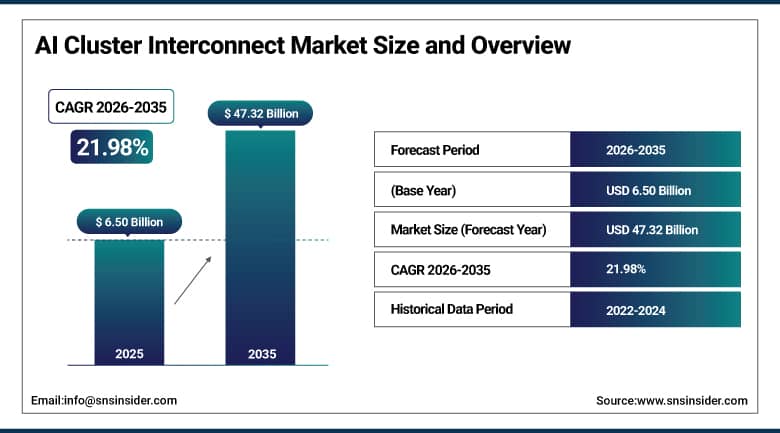
The AI Cluster Interconnect Market was valued at USD 6.50 Billion in 2025 and is expected to reach USD 47.32 Billion by 2035, growing at a CAGR of 21.98% from 2026–2035.
The AI Cluster Interconnect Market is experiencing consistent growth due to increasing demand for high-bandwidth, low-latency, and reliable connectivity infrastructure for AI computing clusters. The expansion of artificial intelligence, generative AI, hyperscale data centers, cloud computing, and high-performance computing is driving demand for high-speed interconnect solutions that enable efficient communication and data movement across GPUs, CPUs, accelerators, and storage systems. Investments in Ethernet, InfiniBand, PCIe/CXL, NVLink/NVSwitch, optical interconnects, and advanced networking components are enhancing cluster performance, scalability, bandwidth efficiency, and power efficiency. Companies are focusing on higher data rates, lower latency, congestion management, network scalability, and efficient data transfer to optimize AI workloads.
In January 2026, the NET4EXA project advanced development of next-generation interconnect technology for large-scale HPC and AI systems, targeting the increasing communication requirements of large language model training and exascale computing. The initiative is developing the BXIv3 interconnect, including high-performance switches and network interface components, with planned evaluation across scalable scientific and AI workloads. The development is expected to support the growing need for high-bandwidth, low-latency, and scalable interconnect infrastructure for large AI clusters.
To Get More Information On AI Cluster Interconnect Market - Request Free Sample Report
AI Cluster Interconnect Market Trends
-
Growing demand for high-performance AI computing is driving the adoption of high-speed cluster interconnect technologies to support large-scale GPU and accelerator clusters, increasing data movement requirements, and intensive AI workloads.
-
Rising deployment of artificial intelligence, generative AI, hyperscale data centers, cloud computing, and high-performance computing is increasing demand for low-latency, high-bandwidth interconnect solutions that enable efficient communication between GPUs, CPUs, accelerators, and storage systems.
-
Increasing adoption of Ethernet, InfiniBand, PCIe/CXL, NV Link/NV Switch, optical interconnects, and advanced network components is supporting the development of scalable and high-performance AI cluster architectures.
-
Growing focus on improving bandwidth, low latency, scalability, power efficiency, congestion management, and communication efficiency is creating opportunities for AI cluster interconnect technology providers.
-
Advancements in high-speed switching, optical transceivers, network interface cards, accelerator interconnects, high data-rate connectivity, and software-defined network management are improving cluster performance and supporting the adoption of AI cluster interconnect solutions.
U.S. AI Cluster Interconnect Market Outlook
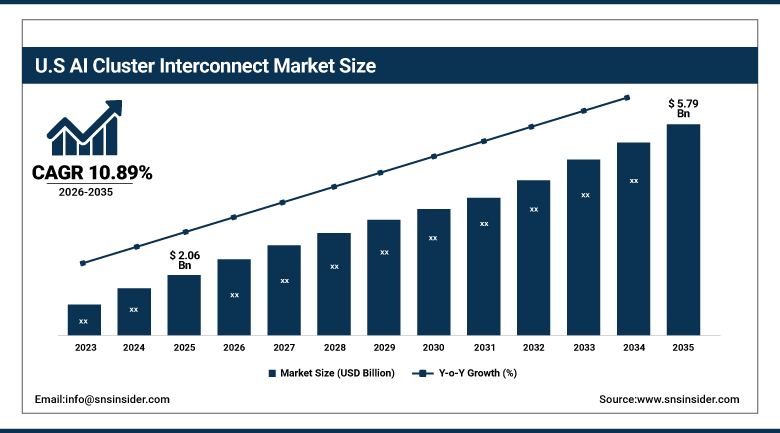
The U.S. AI Cluster Interconnect Market was valued at USD 2.06 Billion in 2025 and is expected to reach around USD 5.79 Billion by 2035, growing at a CAGR of 10.89% from 2026–2035.
The U.S. AI cluster interconnect market is growing steadily due to rising demand for high-bandwidth, low-latency, and reliable connectivity infrastructure for AI computing clusters. The expansion of artificial intelligence, generative AI, hyperscale data centers, cloud computing, and high-performance computing is driving demand for high-speed data transmission and efficient communication between GPUs, CPUs, accelerators, and storage systems. Investments in next-generation cluster networking infrastructure and high-speed interconnect upgrades are improving bandwidth, scalability, performance, and power efficiency. The expansion of hyperscale AI data centers, cloud services, and large-scale computing clusters is supporting market demand. Companies are focusing on Ethernet, InfiniBand, PCIe/CXL, NVLink/NVSwitch, optical interconnects, advanced switches, network interface cards, and high-speed optical transceivers to improve data transfer efficiency and network flexibility.
In March 2026, NVIDIA showcased networking innovations for giga-scale AI systems at GTC San Jose, highlighting next-generation Quantum-X InfiniBand, Spectrum-X Ethernet with co-packaged optics, ultra-high-radix switches, and AI-optimized SuperNICs. The technologies are designed to connect hundreds of thousands and eventually millions of GPUs while providing high bandwidth, predictable latency, resilience, and efficient scaling for large AI training and inference workloads. The developments are expected to strengthen adoption of advanced cluster interconnect solutions across U.S. AI data centers and hyperscale infrastructure.
AI Cluster Interconnect Market Segment Analysis
-
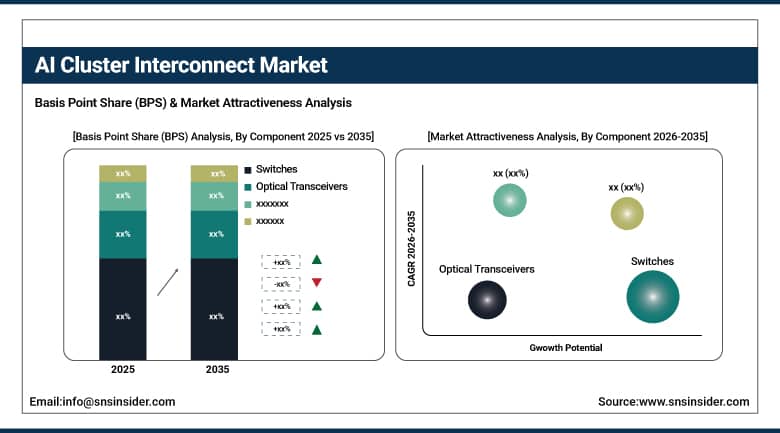
By Component, switches dominated the AI cluster interconnect market with a 38.00% share in 2025, while optical transceivers are projected to be the fastest-growing segment, registering a 26.64% CAGR during 2026–2035.
-
By Interconnect Type, ethernet dominated the AI Cluster Interconnect Market with a 42.00% share in 2025, while other interconnects are projected to be the fastest-growing segment, registering a 27.69% CAGR during 2026–2035.
-
By Data Rate, 400 Gbps dominated the AI cluster interconnect market with a 39.00% share in 2025, while 1.6 Tbps and above is projected to be the fastest-growing segment, registering a 38.20% CAGR during 2026–2035.
-
By Cluster Scale, large-scale clusters dominated the AI cluster interconnect market with a 38.00% share in 2025, while hyperscale AI clusters are projected to be the fastest-growing segment, registering a 29.22% CAGR during 2026–2035.
-
By End Use, AI training dominated the AI cluster interconnect market with a 42.00% share in 2025, while generative AI is projected to be the fastest-growing segment, registering a 30.36% CAGR during 2026–2035.
By Component, switches dominated the AI cluster interconnect market, while optical transceivers are expected to grow fastest.
Switches held the leading position in the AI cluster interconnect market in 2025, supported by their critical role in connecting GPUs, CPUs, accelerators, and storage systems within large-scale AI clusters. Increasing AI workloads, rising GPU deployment, and growing requirements for high-bandwidth and low-latency communication are driving demand for advanced AI networking switches. The adoption of high-speed Ethernet, InfiniBand, and next-generation switching technologies is further supporting the deployment of scalable AI cluster infrastructure.
Optical transceivers are anticipated to register the highest CAGR during the forecast period from 2026 to 2035. Their ability to support high-speed, low-latency data transmission across AI cluster networks is encouraging adoption in hyperscale data centers and large-scale computing environments. Growing AI training and inference workloads, increasing data rates, and the expansion of GPU clusters are expected to accelerate demand for 400 Gbps, 800 Gbps, and emerging 1.6 Tbps optical transceiver technologies.
By Interconnect Type, Ethernet dominated the AI cluster interconnect market, while other interconnects are expected to grow fastest.
Ethernet held the dominant position in the AI Cluster Interconnect Market in 2025, supported by its scalability, interoperability, cost efficiency, and increasing adoption in AI data center networking. The growing deployment of Ethernet-based AI fabrics is enabling high-bandwidth communication between GPUs, servers, accelerators, and storage systems. Advances in AI-optimized Ethernet, RDMA, congestion management, and high-speed switching are further supporting Ethernet adoption across large-scale AI clusters.
Other Interconnects are projected to register the highest CAGR during the forecast period from 2026 to 2035. The development of emerging accelerator and cluster connectivity technologies is creating opportunities for next-generation interconnect architectures that can improve bandwidth, latency, scalability, and communication efficiency. Increasing deployment of heterogeneous AI computing systems and increasingly complex GPU clusters is expected to accelerate adoption of emerging interconnect solutions.
By Cluster Scale, large-scale clusters dominated the AI cluster interconnect market, while hyperscale AI clusters are expected to grow fastest.
Large-scale clusters held the leading position in the AI cluster interconnect market in 2025, supported by increasing deployment of GPU-accelerated computing infrastructure for AI training, generative AI, machine learning, and high-performance computing. The growing need for high-bandwidth, low-latency communication between GPUs, CPUs, accelerators, and storage systems is driving demand for scalable interconnect solutions across large AI clusters. Increasing adoption of high-speed Ethernet, InfiniBand, advanced switches, network interface cards, and optical transceivers is further supporting the expansion of large-scale AI computing environments.
Hyperscale AI clusters are anticipated to register the highest CAGR during the forecast period from 2026 to 2035. The rapid expansion of hyperscale data centers, AI factories, foundation model development, and large-scale generative AI workloads is increasing demand for highly scalable cluster interconnect infrastructure. The deployment of increasingly dense GPU and accelerator clusters is driving requirements for higher bandwidth, lower latency, efficient congestion management, and reliable node-to-node communication. The adoption of 800 Gbps, 1.6 Tbps, and higher-speed interconnect technologies is expected to further accelerate the deployment of hyperscale AI clusters.
Regional Analysis
|
Region |
Major Country |
Share within Region, 2025(%) |
|---|---|---|
|
North America |
United States |
82.40% |
|
Europe |
Germany |
34.30% |
|
Asia Pacific |
China |
48.54% |
|
Middle East & Africa |
Saudi Arabia |
23.50% |
|
Latin America |
Brazil |
23.00% |
North America AI cluster interconnect market insights
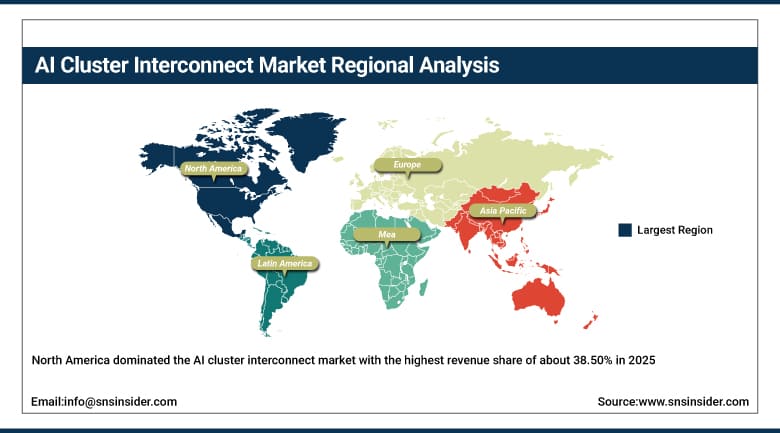
North America dominated the AI cluster interconnect market with the highest revenue share of about 38.50% in 2025, supported by its strong presence of hyperscale cloud providers, AI data centers, advanced computing infrastructure, and leading technology companies. Significant investments in artificial intelligence, generative AI, accelerated computing, and high-performance computing are increasing demand for high-bandwidth, low-latency interconnect technologies that enable efficient communication between GPUs, CPUs, accelerators, and storage systems.
The region's advanced data center ecosystem, established networking infrastructure, and strong research and development capabilities are further strengthening its market position. Growing deployment of large-scale and hyperscale AI clusters is driving demand for high-speed Ethernet, InfiniBand, advanced switches, network interface cards, optical transceivers, and next-generation interconnect technologies.
Get Customized Report as Per Your Business Requirement - Enquiry Now
Europe AI cluster interconnect market insights
The AI cluster interconnect market in Europe is expected to witness steady growth over the forecast period, supported by increasing investments in artificial intelligence, cloud computing, high-performance computing, and data center infrastructure. The expansion of AI workloads and growing deployment of GPU-accelerated computing environments are increasing demand for high-bandwidth and low-latency connectivity between computing nodes.
Germany is anticipated to remain one of the key national markets in Europe, driven by its strong industrial computing ecosystem, expanding data center infrastructure, enterprise digitalization, and growing adoption of AI technologies. Investments in AI-enabled computing, cloud infrastructure, high-performance computing, and large-scale data centers are encouraging deployment of advanced cluster interconnect technologies
Asia Pacific AI cluster interconnect market insights
Asia Pacific is expected to grow at the fastest CAGR of about 24.40% from 2026–2035, driven by rapid expansion of AI computing infrastructure, hyperscale data centers, cloud platforms, and high-performance computing environments. Countries including China, Japan, South Korea, India, Singapore, and other Southeast Asian economies are increasing investments in AI data centers and GPU-accelerated computing infrastructure to support growing demand for artificial intelligence, generative AI, machine learning, and advanced computing workloads. The expansion of large-scale and hyperscale AI clusters is creating substantial demand for high-bandwidth, low-latency communication between GPUs, accelerators, servers, and storage systems.
Increasing adoption of Ethernet, InfiniBand, PCIe/CXL, NVLink/NVSwitch, and optical interconnect technologies is supporting the development of advanced AI cluster architectures. The growing deployment of 400 Gbps, 800 Gbps, and 1.6 Tbps and above connectivity is expected to further accelerate regional market growth through 2035.
Middle East & Africa and Latin America AI cluster interconnect market insights
The AI cluster interconnect market in the Middle East & Africa and Latin America is expected to witness consistent growth from 2026 to 2035, supported by increasing investments in artificial intelligence, cloud computing, data centers, digital infrastructure, and high-performance computing. The development of new AI and cloud computing facilities is creating demand for high-bandwidth, low-latency connectivity between GPUs, accelerators, servers, and storage systems. Growing adoption of advanced Ethernet, optical interconnects, high-speed switches, and network interface technologies is further supporting opportunities across emerging AI computing environments.
Saudi Arabia is expected to remain an important market in the Middle East & Africa, supported by investments in AI infrastructure, cloud computing, data centers, digital transformation, and large-scale computing capabilities. The country's expanding technology infrastructure is creating opportunities for advanced AI cluster networking and high-speed interconnect solutions. In Latin America, Brazil is anticipated to remain a key country-level market due to its expanding data center ecosystem, cloud infrastructure, enterprise AI adoption, and increasing investment in high-performance computing. Other Latin American countries are also expected to contribute to regional growth through investments in AI infrastructure, cloud platforms, data centers, and advanced computing networks.
Growth Driver: Increasing demand for high-bandwidth and low-latency AI cluster connectivity is driving market growth
One of the key factors driving the growth of the global AI cluster interconnect market is the rapid expansion of AI workloads, GPU-accelerated computing, hyperscale data centers, and large-scale AI clusters. The increasing adoption of generative AI, machine learning, high-performance computing, and foundation models is creating substantial demand for high-bandwidth, low-latency, and reliable connectivity between GPUs, CPUs, accelerators, and storage systems. As AI clusters become larger and more computationally intensive, organizations are adopting advanced interconnect technologies capable of supporting 400 Gbps, 800 Gbps, 1.6 Tbps, and higher data rates to enable efficient data movement and cluster communication.
In addition, advancements in high-speed Ethernet, InfiniBand, PCIe/CXL, NVLink/NVSwitch, optical interconnects, network interface cards, switches, and optical transceivers are improving bandwidth, latency, scalability, congestion management, and communication efficiency across AI clusters. Increasing investments in hyperscale AI data centers, cloud-based AI infrastructure, accelerated computing systems, and high-performance computing environments are further supporting the deployment of advanced AI cluster interconnect solutions.
Restraint: High deployment costs and technological complexity can limit market adoption
The high cost and technical complexity associated with deploying advanced AI cluster interconnect infrastructure can restrict market adoption, particularly among smaller enterprises and organizations with limited infrastructure budgets. High-performance switches, network interface cards, optical transceivers, high-speed cables, accelerator interconnects, and supporting networking equipment require significant capital investment and specialized infrastructure. Upgrading existing computing environments to support 800 Gbps, 1.6 Tbps, and higher-speed connectivity may also require substantial modifications to network architecture, data center infrastructure, power systems, and network management platforms.
Moreover, managing large AI clusters requires specialized expertise in high-performance networking, congestion management, traffic optimization, and cluster communication. Compatibility challenges between different networking technologies and accelerator platforms, evolving interconnect standards, power consumption, and the need for continuous infrastructure upgrades can further increase deployment complexity. These factors may delay AI cluster modernization projects and limit adoption among cost-sensitive organizations.
Opportunity: Rapid expansion of hyperscale AI clusters and accelerated computing infrastructure creates new market opportunities
The rapid expansion of artificial intelligence infrastructure, hyperscale data centers, and accelerated computing systems presents significant opportunities for AI cluster interconnect solution providers. Increasing deployment of large-scale GPU clusters, AI factories, generative AI infrastructure, and high-performance computing environments is generating substantial demand for high-bandwidth and low-latency connectivity within AI clusters. As AI workloads require rapid movement of large datasets between GPUs, CPUs, accelerators, and storage systems, advanced interconnect technologies are becoming increasingly important for supporting scalable and efficient AI computing architectures.
Furthermore, the growing adoption of 400 Gbps, 800 Gbps, 1.6 Tbps, and future higher-speed connectivity creates opportunities for manufacturers of high-performance switches, network interface cards, optical transceivers, cables, adapters, connectors, and interconnect software. The expansion of cloud-based AI infrastructure, hyperscale computing, distributed AI training, and large-scale inference workloads is expected to further increase demand. Investments in next-generation Ethernet, InfiniBand, PCIe/CXL, NVLink/NVSwitch, optical interconnects, and advanced network management technologies will create additional opportunities for AI cluster interconnect providers through 2035.
Recent Developments
-
2026: NVIDIA Corporation continued expanding its AI networking portfolio with advanced Spectrum-X Ethernet, Quantum-X InfiniBand, ConnectX networking, BlueField DPUs, and NVLink technologies to support large-scale and hyperscale AI clusters, high-bandwidth GPU connectivity, and AI factory infrastructure.
-
2026: Broadcom Inc. continued advancing high-speed Ethernet switching and networking silicon for AI data centers, supporting large-scale GPU clusters, high-bandwidth connectivity, and next-generation AI networking architectures.
-
2026: Arista Networks, Inc. continued expanding its high-performance Ethernet switching and network management solutions for AI and cloud data centers, supporting large-scale AI clusters, high-speed GPU connectivity, and scalable data center networks.
-
2026: Cisco Systems, Inc. continued strengthening its AI-ready networking portfolio, including high-performance Ethernet switching, data center networking, and network management technologies designed to support AI clusters, accelerated computing, and hyperscale data center infrastructure.
-
2026: Marvell Technology, Inc. continued developing AI infrastructure connectivity solutions, including high-speed interconnect, networking, and optical technologies to support scalable AI clusters, custom accelerators, and next-generation data center architectures.
AI Cluster Interconnect Market Key Players are:
-
NVIDIA Corporation
-
Broadcom Inc.
-
Arista Networks, Inc.
-
Marvell Technology, Inc.
-
Advanced Micro Devices, Inc. (AMD)
-
Intel Corporation
-
Hewlett Packard Enterprise (HPE)
-
Juniper Networks, Inc.
-
Astera Labs, Inc.
-
Coherent Corp.
-
InnoLight Technology
-
Eoptolink Technology Inc.
-
Celestica Inc.
-
Dell Technologies Inc.
-
Huawei Technologies Co., Ltd.
-
Lenovo Group Limited
-
Super Micro Computer, Inc. (Supermicro)
-
Qualcomm Technologies, Inc.
AI Cluster Interconnect Market Report Scope:
| Report Attributes | Details |
|---|---|
| Market Size in 2025 | USD 6.50 Billion |
| Market Size by 2035 | USD 47.32 Billion |
| CAGR | CAGR of 21.98% From 2026 to 2035 |
| Base Year | 2025 |
| Forecast Period | 2026-2035 |
| Historical Data | 2022-2024 |
| Report Scope & Coverage | Market Size, Segments Analysis, Competitive Landscape, Regional Analysis, DROC & SWOT Analysis, Forecast Outlook |
| Key Segments | • By Component (Switches, Network Interface Cards (NICs), Optical Transceivers, Cables, Adapters & Connectors, Software) • By Interconnect Type (Ethernet, InfiniBand, PCIe/CXL, NVLink/NVSwitch, Optical Interconnect, Other Interconnects) • By Data Rate (Up to 100 Gbps, 200 Gbps, 400 Gbps, 800 Gbps, 1.6 Tbps and Above) • By Cluster Scale (Small-Scale Clusters, Medium-Scale Clusters, Large-Scale Clusters, Hyperscale AI Clusters) • By End Use (AI Training, AI Inference, High-Performance Computing (HPC), Generative AI, Machine Learning, Other Applications) |
| Regional Analysis/Coverage | North America (US, Canada), Europe (Germany, UK, France, Italy, Spain, Russia, Poland, Rest of Europe), Asia Pacific (China, India, Japan, South Korea, Australia, ASEAN Countries, Rest of Asia Pacific), Middle East & Africa (UAE, Saudi Arabia, Qatar, South Africa, Rest of Middle East & Africa), Latin America (Brazil, Argentina, Mexico, Colombia, Rest of Latin America) |
| Company Profiles | NVIDIA Corporation, Broadcom Inc., Arista Networks, Inc., Cisco Systems, Inc., Marvell Technology, Inc., Advanced Micro Devices, Inc. (AMD), Intel Corporation, Hewlett Packard Enterprise (HPE), Juniper Networks, Inc., Astera Labs, Inc., Coherent Corp., Lumentum Holdings Inc., InnoLight Technology, Eoptolink Technology Inc., Celestica Inc., Dell Technologies Inc., Huawei Technologies Co., Ltd., Lenovo Group Limited, Super Micro Computer, Inc. (Supermicro), Qualcomm Technologies, Inc. |

Frequently Asked Questions
Key players include NVIDIA Corporation, Broadcom Inc., Arista Networks, Inc., Cisco Systems, Inc., Marvell Technology, Inc., AMD, Intel Corporation, HPE, Juniper Networks, Inc., Astera Labs, Inc., and Coherent Corp.
Key opportunities include expanding hyperscale AI clusters, AI data centers, generative AI, accelerated computing, cloud infrastructure, and 800 Gbps, 1.6 Tbps, and higher-speed interconnect technologies.
Switches dominated the market with approximately 38.00% share in 2025, supported by increasing deployment of high-performance AI cluster networking infrastructure.
North America dominated with approximately 38.50% share in 2025, supported by strong AI infrastructure, hyperscale data centers, and advanced computing investments.
