
Ambient Commerce Market Report Scope & Overview:
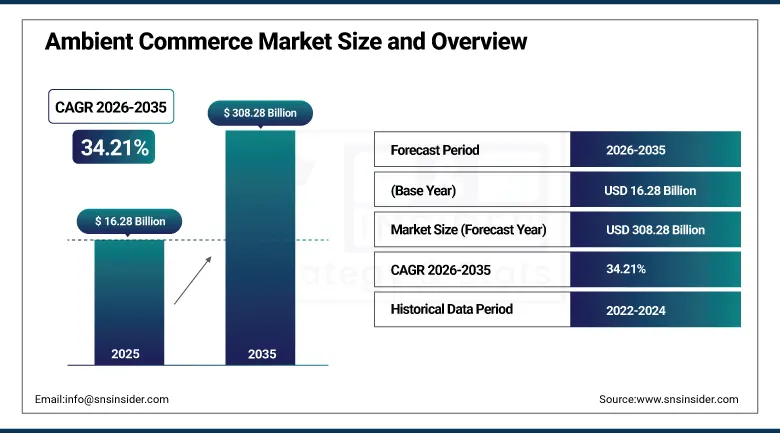
The Ambient Commerce Market was valued at USD 16.28 Billion in 2025 and is projected to reach USD 308.28 Billion by 2035, expanding at a CAGR of 34.21% during the forecast period 2026–2035.
There is an increasing adoption of ambient commerce all around the world because of technological advancement in artificial intelligence, connected device technology, contextual computing, and self-service purchasing technology. The ambient commerce system makes it possible for the consumers to effortlessly connect with the brand and its product using voice assistants, intelligent devices, internet of things (IoT), wearable’s, and commerce platform without having to use any conventional shopping platform. Companies have been using AI-based recommendation engines, predictive analytics tools, and contextual communication capabilities to improve user experience and automate the process of purchase. Digital transformation efforts, smart devices, and frictionless commerce have fueled growth in the market.
To Get more information On Breast Ambient Commerce Market - Request Free Sample Report
Ambient Commerce Market Trends
-
Increasing deployment of AI-powered personalized shopping ecosystems.
-
Growing integration of IoT-enabled devices into commerce platforms.
-
Expansion of autonomous and embedded commerce experiences.
-
Rising adoption of voice-assisted purchasing technologies.
-
Increasing use of contextual analytics to enable frictionless transactions.
U.S. Ambient Commerce Market Size Outlook
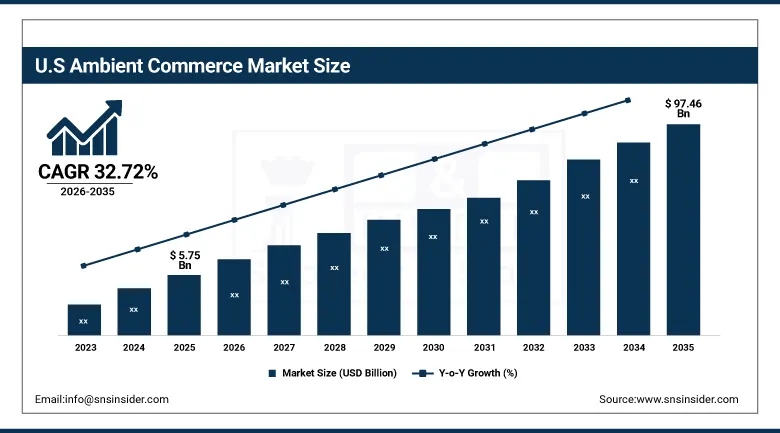
The U.S. Ambient Commerce Market was valued at USD 5.75 billion in 2025 and is expected to reach approximately USD 97.46 billion by 2035, expanding at a CAGR of 32.72% during 2026–2035.
The US continues to hold the largest share of the ambient commerce market worldwide owing to the existence of an advanced digital ecosystem, high use of smart devices, and the presence of numerous technology firms that help in developing ambient commerce through AI. The deployment of contextual commerce by businesses from various industries including retail, consumer electronics, automotive, and finance has increased to help improve customer engagement and automate purchases. The increasing acceptability of voice commerce, connected devices, and predictive shopping experience among consumers keeps on supporting market growth. Increasing investment in AI, cloud computing, and intelligent automation technologies also boosts its position in the global ambient commerce market.
In 2026, large technology firms enhanced their AI-enabled commerce offerings to personalize, predict, and engage consumers in the connected ecosystem.
Ambient Commerce Market Segment Analysis
-
By Technology, artificial intelligence & machine learning dominated the market with 29.00% share in 2025, and is projected to witness the fastest growth with 35.05% CAGR during the forecast period.
-
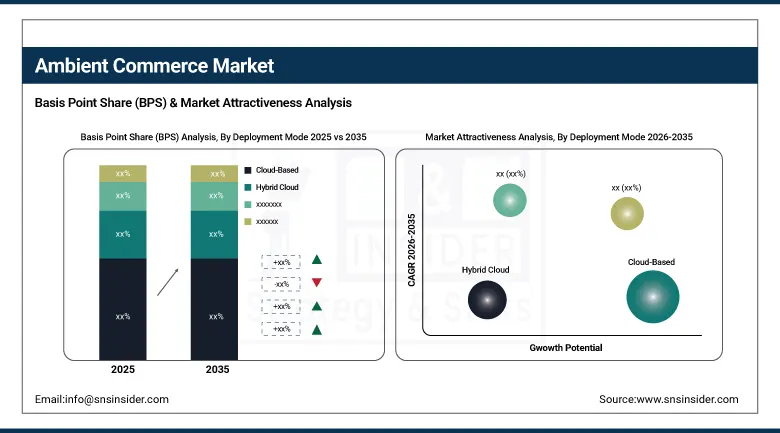
By Deployment Mode, cloud-based dominated the market with 46.00% share in 2025, while hybrid cloud is projected to witness the fastest growth with 35.93% CAGR during the forecast period.
-
By Commerce Channel, smart device commerce dominated the market with 26.00% share in 2025, while embedded commerce platforms are projected to witness the fastest growth with 38.91% CAGR during the forecast period.
-
By Industry Vertical, retail & e-commerce dominated the market with 21.28% share in 2025, while automotive & mobility is projected to witness the fastest growth with 35.72% CAGR during the forecast period.
By Technology, artificial intelligence & machine learning dominated the market and is the fastest-growing segment.
Artificial Intelligence & Machine Learning captured the maximum market share of 29.00% in 2025 due to their key importance in facilitating decision-making, predictive recommendations, and personalization of consumer interactions in ambient commerce ecosystems. Increasing use of AI-based algorithms by businesses in analyzing the behavior of consumers, automating purchases, and providing highly personalized shopping experiences through connected devices has been driving the demand for AI technologies. In pursuit of better consumer engagement and process optimization, the investments made by businesses in AI-based commerce technology have been growing at a rapid pace worldwide.
In 2026, Leading technology firms launched advanced generative AI and predictive commerce solutions aimed at enhancing contextual interactions and automation of purchase experiences for customers. artificial intelligence & machine learning is expected to witness the highest CAGR of 35.11% during the forecast period due to rising use of generative AI, autonomous decision-making systems, and intelligent commerce platforms.
By Deployment Mode, cloud-based dominated the market, while hybrid cloud is the fastest-growing segment.
Cloud-based segment had the highest market share of 46.00% in 2025 because of its capability to offer scalable, flexible, and efficient infrastructure for ambient commerce solutions. Enterprises are increasingly adopting cloud computing to facilitate the management of huge amounts of data from consumers, develop AI-based recommendation systems, and ensure seamless connectivity across connected devices and commerce systems. Cloud-based deployment helps enterprises to analyze data in real time, manage intelligent commerce solutions centrally and deploy them swiftly, thus making cloud computing highly attractive for enterprises undergoing digital transformation. Increasing adoption of cloud-native platforms and software as a service (SaaS) commerce platforms are expected to drive the market dominance of this segment.
Hybrid cloud segment is anticipated to record the highest CAGR of 35.93% throughout the forecast period driven by increasing demands from enterprises for flexible infrastructure that enables the use of both public and private clouds. Increasing adoption of hybrid cloud architecture by businesses will be driven by the requirement to optimize data security, regulatory compliance, operational efficiency, and scalability of ambient commerce solutions. 2025, Enterprises increasingly invested in hybrid cloud strategies to support AI-powered commerce platforms and improve customer experience management.
Regional Insights
|
Region |
Major Country |
Share within Region, 2025 (%) |
|---|---|---|
|
North America |
United States |
93.00% |
|
Europe |
Germany |
25.00% |
|
Asia Pacific |
China |
28.00% |
|
Middle East & Africa |
UAE |
5.00% |
|
Latin America |
Brazil |
4.00% |
North America Ambient Commerce Market Insights
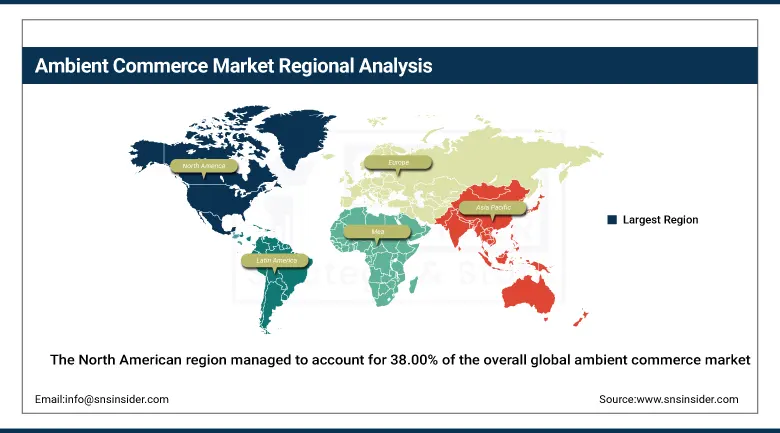
The North American region managed to account for 38.00% of the overall global ambient commerce market share in 2025 and emerged as the largest market within the industry. The region has been defined by widespread use of smart devices along with robust digital infrastructure, along with investments in artificial intelligence and cloud computing technologies. Ambient commerce solutions are being adopted by businesses operating in retail, financial services, healthcare, and consumer electronics segments to enhance consumer experiences and make processes more efficient. Availability of major technology players, increasing consumer acceptance of intelligent shopping systems, and increased adoption of AI-enabled commerce solutions drive regional market growth over the forecast period.
In 2026, Major technology companies in the region made increased investments in commerce ecosystems enabled by artificial intelligence.
Get Customized Report as per Your Business Requirement - Enquiry Now
Europe Ambient Commerce Market Insights
Europe had a market share of around 25.00% in 2025 in terms of the global ambient commerce market share owing to successful digital transformation processes, widespread use of smart devices, and requirement of customer engagement solutions. The businesses that are working in industries such as retail, automotive, financial services, and telecom are using AI-driven commerce solutions to engage with their customers. Digitalization and implementation of cloud technologies are expected to create favorable growth opportunities in the region. Growing investment in intelligent automation systems, contextual commerce, and customer experience solutions will further drive adoption of ambient commerce in Europe.
In 2025: European companies have ramped up their adoption of AI-based commerce solutions to boost Omni channel engagement and personalization of consumers.
Asia Pacific Ambient Commerce Market Insights
The Asia Pacific region is expected to grow at the highest CAGR of 37.62% in the forecasted period because of factors such as digitalization, high internet connectivity, and increasing use of smart devices among developing countries. Countries like China, India, Japan, South Korea, and Australia have seen a huge increase in the deployment of artificial intelligence, smart commerce ecosystem, and digital payment solutions. Enterprises are investing in intelligent commerce solutions in order to cater to changing consumer demands and engage customers. The growing e-commerce industry, increasing smartphone adoption, and supportive government policies in favor of digital innovation in the region are opening up many opportunities for ambient commerce solution providers.
In 2026: A number of Asia Pacific economies rolled out initiatives in favor of artificial intelligence innovation and digital commerce ecosystem.
Middle East & Africa and Latin America Ambient Commerce Market Insights
Middle East & Africa region is experiencing a stable market growth due to growing investments in smart cities initiatives, digital transformation initiatives, and connected tech ecosystems. Enterprises are employing ambient commerce solutions to better engage their customers and deliver quality services across various sectors. Penetration of the internet and usage of digital payment solutions have facilitated market growth.
Latin America region held around 5.00% share in the global market in 2025 due to the increasing use of e-commerce operations, growing use of smartphones, and digital infrastructure development. Companies are using intelligent commerce solutions to create an improved customer experience and implement Omni channel approach. The demand for personalization and streamlined purchase experience from consumers is likely to drive regional market growth. 2025: Enterprises in both regions enhanced their investment in digital commerce solutions, AI-driven engagement solutions, and connected consumer ecosystems.
Growth Drivers: Increasing usage of artificial intelligence and connected consumer ecosystems.
Increased usage of artificial intelligence technology and connected consumer ecosystems is greatly propelling the ambient commerce market around the world. Various companies are making use of AI-driven recommendation systems, predictive analysis, and intelligent automation tools to provide better customer experiences. With the help of connected devices like smartphones, wearable’s, smart speakers, and IoT-enabled gadgets, there is constant interaction between customers and commerce solutions. Companies are using context-based data to predict needs of the customers and make automated purchases. With the acceleration of digital transformation programs, the need for ambient commerce solutions that enable frictionless customer engagement is expected to grow tremendously.
In 2026, Technology vendors have made increased investments in context-based commerce solutions enabled by AI for better predictive purchasing and customer experience personalization.
Restraints: Issues of data privacy and complex regulatory requirements.
Despite having great opportunities for expansion, questions related to the privacy of consumer data and shifts in the regulatory environment continue to represent considerable challenges for the ambient commerce sector. Ambient commerce technologies rely heavily on the continuous collection and processing of consumer data in order to provide tailored services and recommendations. In light of emerging problems associated with data privacy, consumer consent, and data transparency, the implementation of ambient commerce technologies by certain consumer segments may become difficult. Moreover, organizations are required to comply with a number of various data privacy and cyber security regulations depending on the geographic location.
In 2025: Regulatory authorities have developed new digital privacy regulations.
Opportunities: Expanding the autonomous commerce and embedded purchase technologies.
The rising use of autonomous commerce and embedded purchase technologies represents some major opportunities for players in the market. Companies are now adopting their commerce functions as an integral part of connected devices, digital platforms, and services, thus creating seamless purchase experiences. With the rise of technologies like artificial intelligence, machine learning, and predictive analysis, these technologies are now able to understand customer requirements and automate the purchase process with minimum human effort. Embeddable commerce solutions have become quite popular in industries such as automotive, health care, retail, and consumer electronics. As customers now prefer convenient and personalized experiences, there can be immense opportunities in the future for the autonomous commerce.
2026: Several global companies launched their embedded commerce solutions aimed at making purchases more convenient and automated.
Recent Developments
-
2026: Amazon expanded its AI-powered commerce ecosystem by introducing enhanced predictive shopping capabilities across connected devices, enabling consumers to receive contextual product recommendations and frictionless purchasing experiences.
-
2026: Microsoft strengthened its ambient commerce portfolio through new generative AI integrations designed to improve conversational commerce, intelligent product discovery, and personalized customer engagement across enterprise platforms.
-
2025: Google announced advancements in contextual commerce technologies that leverage artificial intelligence and smart device connectivity to improve consumer interactions and automated purchasing workflows.
-
2025: Alibaba expanded investments in smart retail infrastructure and embedded commerce capabilities to support seamless online-to-offline shopping experiences and intelligent consumer engagement.
Ambient Commerce Market Key Players
-
Amazon.com, Inc.
-
Apple Inc.
-
Microsoft Corporation
-
Meta Platforms, Inc.
-
Alibaba Group Holding Limited
-
Tencent Holdings Limited
-
Salesforce, Inc.
-
Shopify Inc.
-
SAP SE
-
Oracle Corporation
-
IBM Corporation
-
Samsung Electronics Co., Ltd.
-
Adobe Inc.
-
Stripe, Inc.
-
PayPal Holdings, Inc.
-
Block, Inc.
-
Qualcomm Incorporated
-
Intel Corporation
Ambient Commerce Market Report Scope:
| Report Attributes | Details |
|---|---|
| Market Size in 2025 | USD 16.28 Billion |
| Market Size by 2035 | USD 308.23 Billion |
| CAGR | CAGR of 34.21% From 2026 to 2035 |
| Base Year | 2025 |
| Forecast Period | 2026-2035 |
| Historical Data | 2022-2024 |
| Report Scope & Coverage | Market Size, Segments Analysis, Competitive Landscape, Regional Analysis, DROC & SWOT Analysis, Forecast Outlook |
| Key Segments | • By Technology (Artificial Intelligence & Machine Learning, Internet of Things (IoT), Computer Vision, Natural Language Processing (NLP), Blockchain & Smart Contracts) • By Deployment Mode (Cloud-Based, Hybrid Cloud, Edge-Based Commerce Platforms, On-Premise, Distributed Commerce Infrastructure) • By Commerce Channel (Voice Commerce, IoT Commerce, Smart Device Commerce, Autonomous Commerce, Embedded Commerce Platforms) • By Industry Vertical (Retail & E-Commerce, Consumer Electronics, Automotive & Mobility, Healthcare, Hospitality & Travel, Others) |
| Regional Analysis/Coverage | North America (US, Canada), Europe (Germany, UK, France, Italy, Spain, Russia, Poland, Rest of Europe), Asia Pacific (China, India, Japan, South Korea, Australia, ASEAN Countries, Rest of Asia Pacific), Middle East & Africa (UAE, Saudi Arabia, Qatar, South Africa, Rest of Middle East & Africa), Latin America (Brazil, Argentina, Mexico, Colombia, Rest of Latin America). |
| Company Profiles | Amazon.com, Inc., Alphabet Inc., Apple Inc., Microsoft Corporation, Meta Platforms, Inc., Alibaba Group Holding Limited, Tencent Holdings Limited, Salesforce, Inc., Shopify Inc., SAP SE, Oracle Corporation, IBM Corporation, Samsung Electronics Co., Ltd., NVIDIA Corporation, Adobe Inc., Stripe, Inc., PayPal Holdings, Inc., Block, Inc., Qualcomm Incorporated, Intel Corporation. |
Frequently Asked Questions
The Ambient Commerce Market was valued at USD 16.28 billion in 2025.
The market is expected to expand at a CAGR of 34.21% during the forecast period.
Asia Pacific is expected to register the fastest CAGR during the forecast period.
North America dominated the market in 2025.
The market is projected to reach USD 308.23 billion by 2035.
