
Antibody Therapeutics Market Report Scope & Overview:
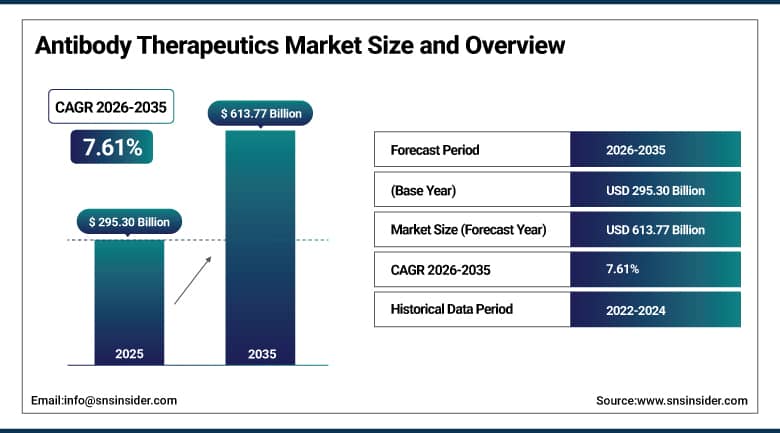
The Antibody Therapeutics Market was valued at USD 295.30 billion in 2025 and is expected to reach USD 613.77 billion by 2035, growing at a CAGR of 7.61% from 2026-2035.
The Antibody Therapeutics Market is witnessing steady growth Due to the increasing need for customized medicines for cancer, autoimmune diseases, infectious diseases, and other chronic diseases. Antibodies provide very specific medications through targeting antigens associated with diseases, thus leading to improved therapy. The use of monoclonal antibodies, antibody-drug conjugates, bispecific antibodies, and immune checkpoints is increasingly becoming common and thus contributing to more uses of these therapies in various diseases. Increased investments in biopharmaceuticals research and development, along with increased numbers of biologics being developed and approved, is leading to product innovation. There are many developments in the field of antibody engineering, recombinant DNA technology, and protein optimization.
⮞WHO’s cancer agency, IARC, estimated 20.6 million new cancer cases worldwide in 2024, supporting the need for effective oncology treatments, including antibody-based therapies.
To Get More Information On Antibody Therapeutics Market - Request Free Sample Report
Antibody Therapeutics Market Trends:
-
Rising prevalence of cancer and autoimmune diseases is driving demand for targeted antibody-based treatments.
-
Increasing adoption of monoclonal antibodies is expanding treatment options across oncology, immunology, and infectious diseases.
-
Growing development of bispecific antibodies is improving targeted immune responses and creating new therapeutic opportunities.
-
Advancements in antibody engineering are enhancing treatment specificity, efficacy, and safety across clinical applications.
-
Increasing investments in biologics research are accelerating antibody discovery, clinical trials, and therapeutic development.
U.S. Antibody Therapeutics Market Outlook:
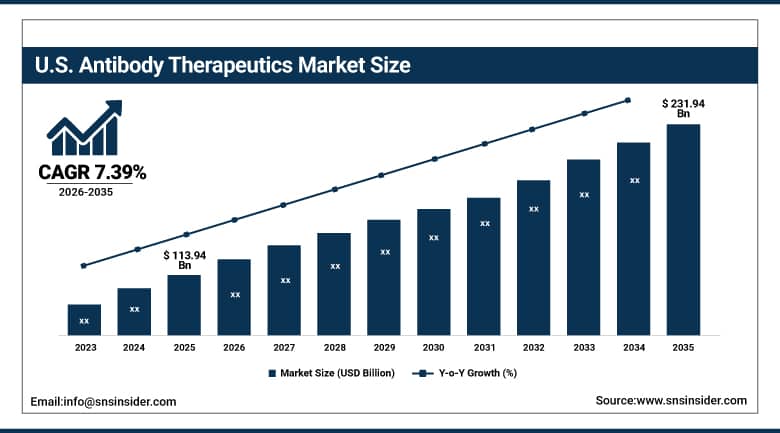
The U.S. Antibody Therapeutics Market was valued at USD 113.94 billion in 2025 and is expected to reach USD 231.94 billion by 2035, growing at a CAGR of 7.39% from 2026-2035.
The U.S. Antibody Therapeutics Market is witnessing steady growth as a result of growing demands for specific therapeutics for the management of cancer, autoimmune diseases, infections, and other chronic diseases. Antibody therapies provide higher specificity in the targeting of disease-related antigens, which promotes better therapeutic results and the personalized medicine approach. The use of monoclonal antibodies, antibody drug conjugates, bispecific antibodies, and immune checkpoint inhibitors is growing and contributing to new therapeutic uses in the U.S. Moreover, significant developments in biopharmaceutical research and clinical trials and the development of biologic drugs have resulted in rapid innovations. Improvements in antibody engineering, recombinant DNA techniques, and proteins optimizations are increasing the effectiveness and safety of drugs and the manufacturing process of biologic drugs.
⮞The National Cancer Institute estimated 2,041,910 new cancer cases and 618,120 cancer deaths in the United States for 2025, supporting the broader need for advanced oncology treatments.
Antibody Therapeutics Market Segment Analysis:
-
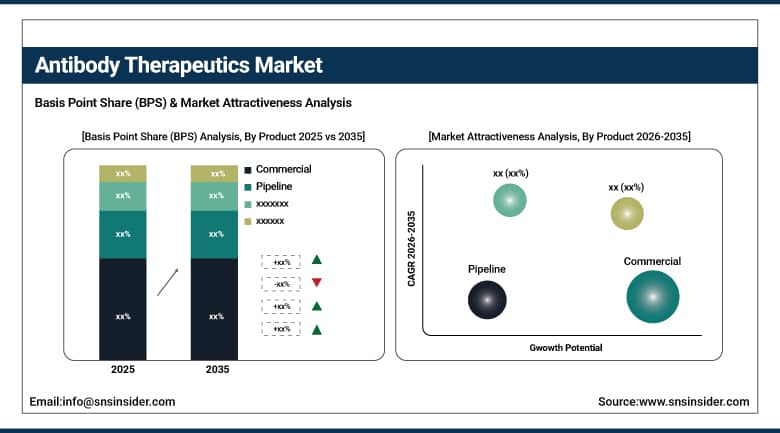
By Product, Commercial dominates the Antibody Therapeutics Market with 92% share in 2025; Pipeline is expected to grow at the fastest CAGR of 9.57% from 2026–2035.
-
By Format, Monoclonal Antibodies (mAbs) dominate the Antibody Therapeutics Market with 64% share in 2025; Antibody-Drug Conjugates (ADCs) are expected to grow at the fastest CAGR of 8.32% from 2026–2035.
-
By Target, PD-L1 dominates the Antibody Therapeutics Market with 35% share in 2025; PD-L1 is expected to grow at the fastest CAGR of 8.39% from 2026–2035.
-
By Therapy Area, Oncology dominates the Antibody Therapeutics Market with 49% share in 2025; Neurology is expected to grow at the fastest CAGR of 10.26% from 2026–2035.
-
By Route of Administration (ROA), Intravenous (IV) dominates the Antibody Therapeutics Market with 69% share in 2025; Subcutaneous (SC) is expected to grow at the fastest CAGR of 8.09% from 2026–2035.
By Product, Commercial dominates the Antibody Therapeutics Market, Pipeline grows fastest.
Commercial dominated the Antibody Therapeutics Market with the highest revenue share of about 92% in 2025, motivated by successful antibody-based drugs which have been yielding significant revenues in oncology, autoimmune diseases, and many other indications. Marketed drugs will gain an advantage due to their proven efficacy, reimbursement, and physician familiarity. The high demand for commercially available biologics along with the uptake of therapies will favor their dominant share in the market.
Pipeline is expected to grow at the fastest CAGR of 9.57% from 2026–2035, due to increasing investments in research, increased number of clinical trials, and antibody engineering innovations. Pharmaceutical and biotech companies have created new candidates that can address diseases which were considered difficult and are creating highly specific treatments. Increasing interest in next generation antibodies, combination therapy, and unmet medical needs is set to help in this regard.
By Format, Monoclonal Antibodies (mAbs) dominate the Antibody Therapeutics Market, Antibody-Drug Conjugates (ADCs) grow fastest.
Monoclonal Antibodies (mAbs) dominated the Antibody Therapeutics Market with the highest revenue share of about 64% in 2025, These have been supported by their proven effectiveness in cancer, autoimmune disease, and inflammatory conditions. The targeted mechanisms, the vast clinical evidence base, and wide-ranging treatments make them more likely to be adopted by doctors. Manufacturing facilities and high demand for biologics ensure that the segment holds its market leadership.
Antibody-Drug Conjugates (ADCs) are expected to grow at the fastest CAGR of 8.32% from 2026–2035, driven by an increase in the need for effective cancer therapies, which can deliver drugs directly into cancer cells. Developments in the selection of antibodies, linkers and payloads have been enhancing the precision and developmental potential of these medicines. Growth in the pipeline of clinical trials and funding is likely to encourage the use of these medications.
By Target, PD-L1 dominates the Antibody Therapeutics Market and grows fastest.
PD-L1 dominated the Antibody Therapeutics Market with the highest revenue share of about 35% in 2025, backed by the proven utility of PD-1/PD-L1 pathway inhibition in cancer immunotherapy. The approved therapies targeting the said pathway are applied in a variety of cancer types, as per clinical proof and approved therapeutic guidelines. The need for the immune checkpoint inhibitors, as well as combination treatments, fuels the revenue leadership of the segment.
PD-L1 is expected to grow at the fastest CAGR of 8.39% from 2026–2035, motivated by continuous research in the field of immune checkpoint blockade and broader applications in various cancers. Clinical trials are underway using PD-L1 antibodies in combination with chemotherapy, targeted therapy, and other forms of immunotherapy. Further research on biomarkers, earlier lines of treatment, and means of increasing efficacy of treatment should help fuel more demand for these drugs.
By Therapy Area, Oncology dominates the Antibody Therapeutics Market, Neurology grows fastest.
Oncology dominated the Antibody Therapeutics Market with the highest revenue share of about 49% in 2025, due to the widespread application of therapeutic antibodies in the treatment of cancer. Monoclonal antibodies, immune check point inhibitors, and antibody drug conjugates contribute to targeted therapies in various types of cancer. The growing incidence of cancer, increasing indications, and the continuing research efforts in developing novel drugs for oncology biologics further enhance the dominance of this segment.
Neurology is expected to grow at the fastest CAGR of 10.26% from 2026–2035, Driven by developments in the field of antibodies used to treat neurological disorders along with the growing focus on research in neuroscience. The development of therapies based on the involvement of disease-specific proteins and inflammation pathways opens up new avenues in the treatment space. Progress in clinical trials and research on the mechanism of diseases like Alzheimer’s will drive segment growth.
By Route of Administration, Intravenous (IV) dominates the Antibody Therapeutics Market, Subcutaneous (SC) grows fastest.
Intravenous (IV) administration dominated the Antibody Therapeutics Market with the highest revenue share of about 69% in 2025, Justified by the proven track record in administering biological agents in hospitals and infusion centers. IV administration ensures controlled administration and monitoring throughout the process, thereby making it appropriate for various oncological and specialty therapies. Clinical guidelines, infrastructure, and experience in the medical community have ensured that IV route remains popular.
Subcutaneous (SC) administration is expected to grow at the fastest CAGR of 8.09% from 2026–2035, motivated by demand for treatment delivered with convenience and decreased reliance on prolonged infusions. Subcutaneous formulations may allow treatment to be administered from an outpatient or even home environment, if applicable. The development of formulation technology, patient interest in minimizing treatment burden, and health care initiatives toward more efficient treatment will all lead to the increased use of subcutaneous antibodies.
Regional Analysis:
|
Region |
Major Country |
Share within Region, 2025 (%) |
|---|---|---|
|
North America |
United States |
91.0% |
|
Europe |
Germany |
24.0% |
|
Asia Pacific |
China |
38.0% |
|
Middle East & Africa |
UAE |
18.0% |
|
Latin America |
Brazil |
35.0% |
North America Antibody Therapeutics Market Insights
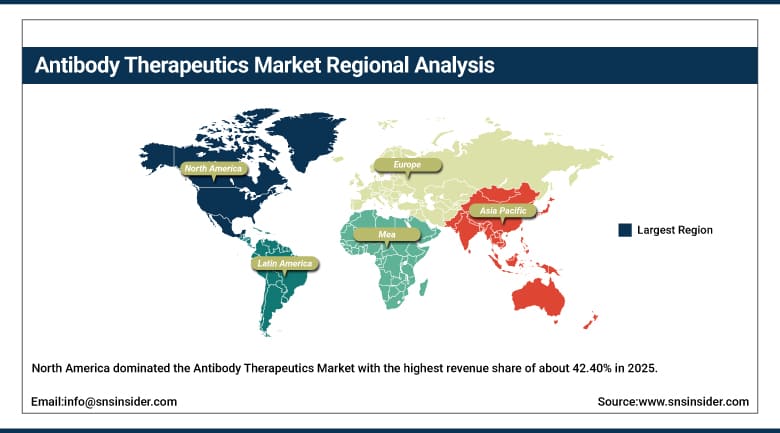
North America dominated the Antibody Therapeutics Market with the highest revenue share of about 42.40% in 2025, due to state-of-the-art biotechnology facilities, significant pharmaceutical research and development expenditure, and adoption of biological drugs. Presence of key biopharmaceutical companies, well-developed clinical trials network, favorable reimbursement policies, and strong need for personalized therapies in cancer, autoimmune, and other diseases is another factor contributing to regional market dominance.
The U.S. Antibody Therapeutics Market accounted for a market share of 91.0% within North America in 2025, backed by robust biotechnology facilities, pharmaceutical research & development, and the rising demand for biotherapy products. Leading biopharmaceutical firms, established clinical trial networks, and good access to new medicines are other important factors that boost the market. Increasing applications in oncology and autoimmune disorders are other aspects that bolster adoption.
Get Customized Report as Per Your Business Requirement - Enquiry Now
Europe Antibody Therapeutics Market Insights
Europe’s Antibody Therapeutics Market is supported by established biopharmaceutical research capabilities, advanced healthcare infrastructure, and growing demand for targeted biologic treatments. Effective clinical trials, regulatory frameworks, and investment in oncology and immunology research spur antibody research and utilization. Moreover, greater adoption of monoclonal antibodies in autoimmune disorders and cancer, coupled with greater availability of novel treatments, drives regional growth.
The Germany Antibody Therapeutics Market accounted for a market share of 24.0% within Europe in 2025, Backed by an established pharmaceutical sector, robust healthcare facilities, and efficient biotechnology research, the growth is supported by increasing adoption of monoclonal antibodies in cancer and autoimmune diseases. Clinical research expenditure, availability of specialized treatments, and cooperation between the pharmaceutical sector and research institutions are other key factors driving the market forward.
Asia Pacific Antibody Therapeutics Market Insights
Asia Pacific is expected to grow at the fastest CAGR of about 9.22% from 2026–2035, driven by the increase in cancer and autoimmune diseases incidences, increased accessibility to healthcare and increased investment in biotechnology. Increased capability of pharmaceutical production, increased level of clinical research, and increased use of biologic drugs in countries such as China, India, Japan, and South Korea will drive the market demand.
The China Antibody Therapeutics Market accounted for a market share of 38.0% within Asia Pacific in 2025, backed by a larger patient pool, high rates of cancer incidence, and increased use of biologics. Biotech innovations have been greatly supported by the government and the emergence of local pharmaceutical research leading to the development of antibodies. In addition, high levels of clinical trials and local manufacturing processes have led to market growth.
Middle East & Africa and Latin America Antibody Therapeutics Market Insights
The Middle East & Africa and Latin America Antibody Therapeutics Market is expanding as healthcare infrastructure improves and access to advanced biologic treatments increases. The increasing incidence of cancer and auto-immune diseases is driving the need for targeted therapies. Further, government investment in health care, increased diagnostic capability, collaboration with global drug companies, and the growing ability to reimburse and offer specialized treatments are contributing to this uptake.
The UAE Antibody Therapeutics Market accounted for a market share of 18.0% within the Middle East in 2025, It is fueled by the improvements in healthcare infrastructure, rising demand for sophisticated treatments for cancer, and increased availability of specialty drugs. Public sector involvement in updating its healthcare system and building specialized treatment centers is contributing to the uptake of the technology. Moreover, collaboration with international drug manufacturers is contributing to market growth.
Market Dynamics:
Growth Drivers: Rising prevalence of chronic diseases is increasing demand for antibody therapeutics.
Increasing prevalence of cancer, autoimmune disorders, inflammatory diseases, and other chronic conditions is driving demand for antibody-based treatments. Therapeutic antibodies may be designed to selectively interact with proteins that are responsible for disease development, immune responses, and cell surface receptors, thus allowing for a targeted treatment approach in several medical disciplines. Monoclonal antibodies are commonly applied in oncology, rheumatology, immunology, and various other medical fields; meanwhile, scientists continue to explore the possibilities of applying these antibodies to new uses. Increasing amounts of clinical data and the development of new antibody medications are prompting healthcare specialists to use these drugs in therapy. At the same time, expanded indications for existing drugs are driving an additional demand for antibodies.
Restraints: High treatment costs can restrict patient access to antibody-based medicines.
There is usually a significant cost involved in the research, development, manufacture, and quality control of antibody medications due to the nature of these biological medications. Due to the complex molecular structure and living cell systems required for the manufacture of these medications, the cost of manufacture may be higher than many small molecule drugs. Such cost considerations could lead to expensive treatments for which there are difficulties in access by the patients, providers, and payers due to the cost involved. It is even more challenging where the reimbursement is low in the health care system. While biosimilars would help bring competition to the market for some antibody medications, it is an expensive process.
Opportunities: Expanding therapeutic applications create opportunities beyond traditional oncology treatments.
There are emerging prospects of antibodies for treatment in autoimmune diseases, inflammatory disorders, infectious diseases, neurological conditions, ophthalmic diseases, and rare diseases. The ongoing exploration of disease-related targets has allowed scientists to study the application of antibodies for diseases other than cancers, which are already being addressed through antibody therapy. Improvements in the technology of antibody engineering have also provided the scope for the development of bispecific and multispecific antibodies, which can bind to more than one target or exert effects through different biological pathways. Pharmaceutical firms can explore new development opportunities by addressing diseases with unmet medical needs and distinct therapeutic strategies. While existing antibody platforms can be explored for various diseases, each indication will need proper evidence and approval.
Recent Developments:
-
2026 : Johnson & Johnson received U.S. FDA Priority Review for RYBREVANT FASPRO™, a subcutaneous amivantamab formulation targeting EGFR and MET for recurrent or metastatic head and neck squamous cell carcinoma.
-
2026 : F. Hoffmann-La Roche Ltd. received U.S. FDA acceptance of its application for Lunsumio VELO™ (mosunetuzumab) plus Polivy® (polatuzumab vedotin), a subcutaneous antibody-based combination for relapsed or refractory large B-cell lymphoma.
-
2026 : AbbVie Inc. reported positive Phase III results for Epkinly® (epcoritamab) plus lenalidomide, demonstrating significant progression-free survival improvement in patients with relapsed or refractory diffuse large B-cell lymphoma.
-
2025 : AstraZeneca plc and Daiichi Sankyo received U.S. FDA approval for DATROWAY® (datopotamab deruxtecan), an antibody-drug conjugate for previously treated advanced EGFR-mutated non-small cell lung cancer.
Antibody Therapeutics Market key players are:
-
F. Hoffmann-La Roche Ltd.
-
AbbVie Inc.
-
Johnson & Johnson
-
Amgen Inc.
-
Bristol Myers Squibb Company
-
Merck & Co., Inc.
-
Novartis AG
-
Pfizer Inc.
-
AstraZeneca plc
-
GSK plc
-
Sanofi S.A.
-
Eli Lilly and Company
-
Regeneron Pharmaceuticals, Inc.
-
Biogen Inc.
-
Takeda Pharmaceutical Company Limited
-
Genmab A/S
-
UCB S.A.
-
Daiichi Sankyo Company, Limited
-
Gilead Sciences, Inc.
-
Astellas Pharma Inc.
Antibody Therapeutics Market Report Scope:
| Report Attributes | Details |
|---|---|
| Market Size in 2025 | USD 295.30 Billion |
| Market Size by 2035 | USD 613.77 Billion |
| CAGR | CAGR of 7.61% From 2026 to 2035 |
| Base Year | 2025 |
| Forecast Period | 2026-2035 |
| Historical Data | 2022-2024 |
| Report Scope & Coverage | Market Size, Segments Analysis, Competitive Landscape, Regional Analysis, DROC & SWOT Analysis, Forecast Outlook |
| Key Segments | • By Product (Commercial, Pipeline) • By Format (Monoclonal Antibodies (mAbs), Antibody-Drug Conjugates (ADCs), Antibody Fragments) • By Target (PD-L1, Cytokines, Others) • By Therapy Area (Oncology, Neurology, Inflammatory Diseases) • By Route of Administration (ROA) (Intravenous (IV), Subcutaneous (SC)) |
| Regional Analysis/Coverage | North America (US, Canada), Europe (Germany, UK, France, Italy, Spain, Russia, Poland, Rest of Europe), Asia Pacific (China, India, Japan, South Korea, Australia, ASEAN Countries, Rest of Asia Pacific), Middle East & Africa (UAE, Saudi Arabia, Qatar, South Africa, Rest of Middle East & Africa), Latin America (Brazil, Argentina, Mexico, Colombia, Rest of Latin America). |
| Company Profiles | F. Hoffmann-La Roche Ltd., AbbVie Inc., Johnson & Johnson, Amgen Inc., Bristol Myers Squibb Company, Merck & Co., Inc., Novartis AG, Pfizer Inc., AstraZeneca plc, GSK plc, Sanofi S.A., Eli Lilly and Company, Regeneron Pharmaceuticals, Inc., Biogen Inc., Takeda Pharmaceutical Company Limited, Genmab A/S, UCB S.A., Daiichi Sankyo Company, Limited, Gilead Sciences, Inc., and Astellas Pharma Inc. |

Frequently Asked Questions
Key players in the Antibody Therapeutics Market include F. Hoffmann-La Roche Ltd., AbbVie Inc., Johnson & Johnson, Amgen Inc., and Merck & Co., Inc., among others.
Key opportunities in the Antibody Therapeutics Market include growing development of antibody-drug conjugates, increasing adoption of bispecific antibodies, and expanding applications in personalized medicine and targeted cancer therapies.
The market is driven by rising prevalence of cancer and autoimmune diseases, increasing demand for targeted biologics, and advancements in antibody engineering and immunotherapy.
The Commercial segment dominated the Antibody Therapeutics Market, accounting for approximately 92.00% market share.
The North America region dominated the Antibody Therapeutics Market in 2025 with a 42.40% share, driven by strong R&D investment and growing adoption of antibody-based therapies.
