
Application Container Market Report Scope & Overview:
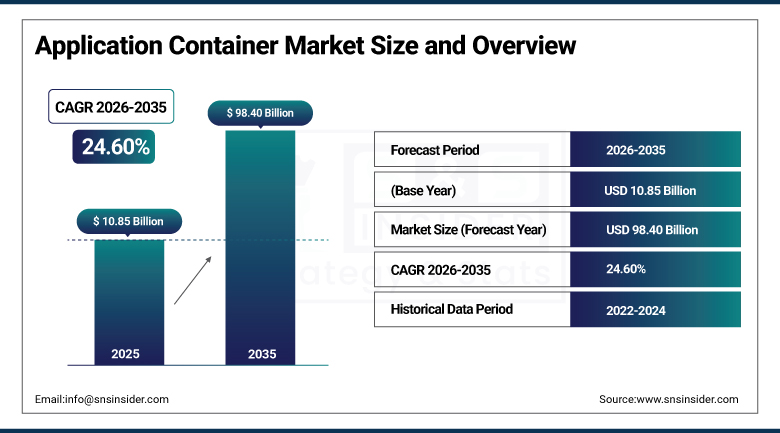
The Application Container Market was valued at USD 10.85 Billion in 2025 and is expected to reach USD 98.40 Billion by 2035, growing at a CAGR of 24.60% from 2026 to 2035.
The application container market is growing rapidly as enterprises transition from monolithic approaches towards microservices and cloud-native applications. Application containerization provides an easy way to package applications along with their dependencies as isolated and portable units, ensuring that deployment of applications is done consistently across on-premises, cloud, or hybrid environments, thus speeding up release cycles and reducing costs. Increased usage of Kubernetes to manage containers, increased investments in DevOps and CI/CD, as well as increased need for multi-cloud portability are some of the factors that will drive market expansion and help firms become less dependent on vendors. Containers are also becoming more popular in the area of artificial intelligence applications, edge computing and secure runtime environments.
In 2026, Docker expanded its platform with a unified Docker VMM virtualization layer designed to deliver more consistent Docker Desktop performance across macOS, Windows, and eventually Linux, reducing cross-platform inconsistencies while improving startup times and memory efficiency.
To Get more information On Application Container Market - Request Free Sample Report
Application Container Market Trends:
-
Enterprises are rapidly migrating monolithic workloads to Kubernetes-orchestrated microservices architectures.
-
AI-powered container assistants are being embedded directly into developer workflows for troubleshooting and optimization.
-
Security-hardened, vulnerability-shielded container images are becoming a standard enterprise procurement requirement.
-
Hybrid and multi-cloud container portability is emerging as a top priority to avoid vendor lock-in.
-
Serverless container platforms are gaining traction for event-driven and bursty enterprise workloads.
U.S. Application Container Market Outlook:
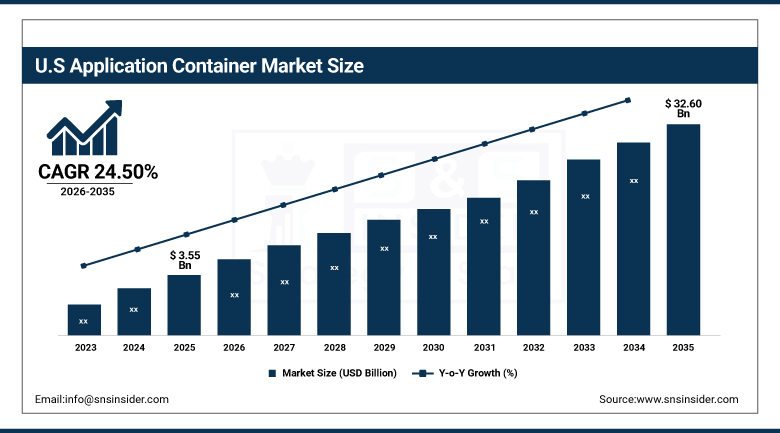
The U.S. Application Container Market was valued at USD 3.55 Billion in 2025 and is projected to reach USD 32.60 Billion by 2035, growing at a CAGR of 24.50% during 2026–2035.
The U.S. leading status is further ensured by the presence of dominant hyperscale cloud players, container orchestration innovators, and enterprise DevOps tools companies that consistently keep setting the pace for global platform innovation. Big American companies from banks, tech firms, healthcare, and retail industries are pushing to revamp their legacy IT assets via containers to enable quicker software deployment and better resource optimization in hybrid cloud infrastructures. Increasing government and business spending on cloud-native initiatives together with an advanced open source development community based on Kubernetes and container security tools is helping maintain the country’s leading share of the global market for container platforms.
In February 2026, Red Hat released OpenShift 4.21, extending its enterprise Kubernetes container platform with full-stack automated operations for managing applications across hybrid cloud, multi-cloud, and edge deployments.
Application Container Market Segment Analysis:
-
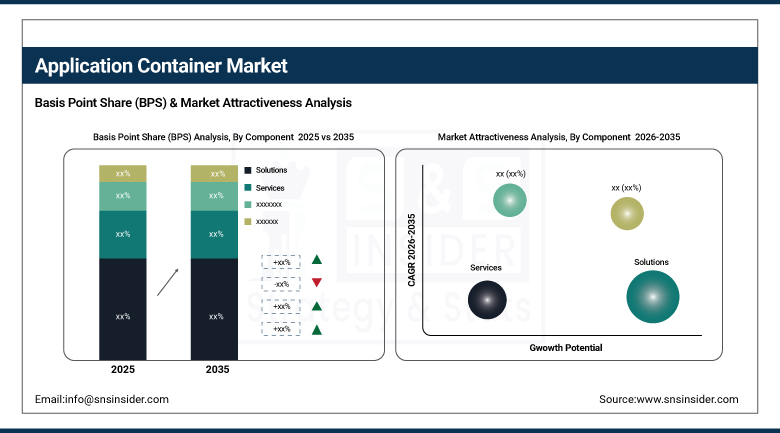
By Component, Solutions dominated the Application Container Market with a 68.40% share in 2025, while Services is the fastest-growing component segment with a CAGR of 27.90% from 2026–2035.
-
By Deployment Mode, Public Cloud dominated the Application Container Market with a 61.50% share in 2025, while Hybrid is the fastest-growing deployment segment with a CAGR of 28.60% from 2026–2035.
-
By Organization Size, Large Enterprises dominated the Application Container Market with a 63.70% share in 2025, while Small & Medium Enterprises is the fastest-growing segment with a CAGR of 27.40% from 2026–2035.
-
By Application, IT & Telecom dominated the Application Container Market with a 27.80% share in 2025, while Healthcare is the fastest-growing application segment with a CAGR of 28.90% from 2026–2035.
By Component, Solutions leads while Services grows fastest.
The Solutions segment held the leading position in the Application Container Market in 2025. Enterprises’ investments are focused primarily on platform-based container products, orchestration engines, and runtime management systems which constitute the core technological architecture of the containers. The focus of vendors on providing advanced security scanning, policy enforcement and observability capabilities within container platforms has further solidified the leadership of this segment due to preference of consolidated approach over a point solution among customers.
The Services segment is expected to register the highest CAGR during 2026-2035. With the transition of enterprises from containerization of limited applications to full-scale container implementation across the organization, the demand for specialized migration, integration, training, and managed services for working with sophisticated multi-cluster environment rises significantly. Moreover, the lack of skilled staff trained in Kubernetes creates an additional impetus for hiring managed service providers.
By Deployment Mode, Public Cloud leads while Hybrid grows fastest.
The Public Cloud segment accounted for major share of the Application Container Market in 2025. The scalability, pay-as-you-go economics, and native managed Kubernetes offerings provided by major hyperscale cloud providers continue to make public cloud the preferred deployment environment for organizations seeking to minimize infrastructure management overhead while rapidly scaling containerized workloads.
Hybrid is estimated to be the fastest growing segment. Companies belonging to regulated sectors or having significant on-premise infrastructure are using the hybrid container architecture model for workloads that can run seamlessly in both private data center environments and public clouds to satisfy data residency and regulatory demands while enjoying cloud-like scalability.
By Organization Size, Large Enterprises lead while SMEs grow fastest.
Large Enterprises held major market share for Application Containers in 2025. The highly complex nature of IT infrastructures, significant presence of older applications that need to be upgraded, and the availability of specialized platform engineering teams remain as key factors which favor large enterprises as the main users of enterprise-scale container management and security solutions.
Small & Medium Enterprises are expected to witness the fastest CAGR up to 2035. Reduction in prices for Kubernetes services, increased availability of low-effort container platforms, and increased competitive pressure from larger enterprises are fueling adoption of containers by smaller enterprises with limited budgets and staff.
By Application, IT & Telecom leads while Healthcare grows fastest.
The IT & Telecom segment led the Application Container Market revenue share in 2025. IT firms and telecommunications continue to be among the first to adopt application containers as they utilize microservice architecture to deliver their features rapidly and enable network function virtualization, along with distributed services across their vast infrastructure networks.
The Healthcare segment is projected to expand at the fastest CAGR during 2026-2035. The growing need for containerized solutions to facilitate modernization of electronic health records, telemedicine solutions and AI-powered diagnostics is boosting the adoption of container-based solutions as they provide flexible and secure infrastructures to handle unpredictable data load requirements.
Regional Insights:
|
Region |
Major Country |
Share within Region, 2025 (%) |
|
North America |
United States |
84.60% |
|
Europe |
Germany |
23.80% |
|
Asia Pacific |
China |
36.90% |
|
Middle East & Africa |
UAE |
26.50% |
|
Latin America |
Brazil |
34.20% |
North America Application Container Market Insights
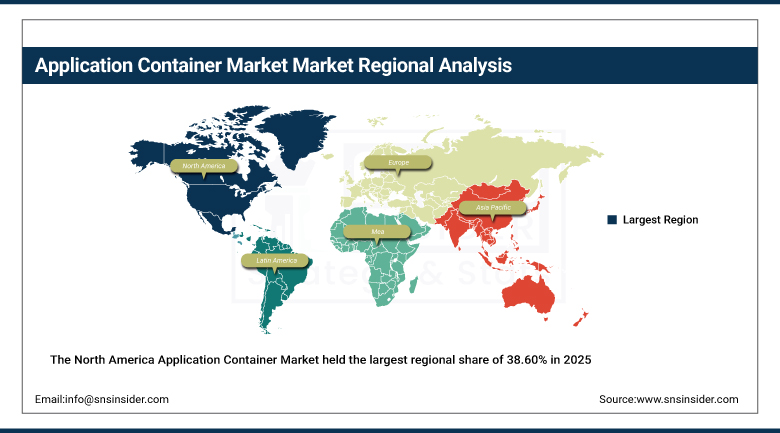
The North America Application Container Market held the largest regional share of 38.60% in 2025, mainly due to the high density of major hyperscale cloud companies, leaders in container orchestration solutions, and DevOps tools providers who are driving platform innovation on a global scale. Companies operating in this region are rapidly modernizing their legacy systems with the help of container technologies, owing to their well-developed cloud data center facilities and a highly advanced open source developer ecosystem based on Kubernetes platforms. Favorable innovation conditions for enterprise software in the region along with abundant funding for modernization have been driving demand from large companies as well as growing mid-market players.
The United States was the leading country within the North America Application Container Market in 2025 of the regional market, driven by the dominance of cloud and container platform providers, huge expenditure on IT modernization and rapid uptake of Kubernetes orchestration solutions in banking, technology, and healthcare industries. Canada is playing an active role in boosting regional growth through the increased use of managed container solutions in the mid-market enterprises and cloud modernization programs in the government sector.
Get Customized Report as per Your Business Requirement - Enquiry Now
Europe Application Container Market Insights
The Europe region remained a significant contributor to the Application Container Market in 2025 and is expected to register steady growth for compliance-oriented, data-sovereign container deployments during the forecast period. This is attributed to the region's stringent data protection regulations, well-established enterprise IT base, and rising demand among multinational organizations for container platforms that can be deployed within regionally hosted infrastructure while meeting evolving cross-border data governance requirements.
Germany is one of the major markets in Europe owing to its large manufacturing and financial-services enterprise base actively modernizing legacy applications through containerization, along with the presence of strong regional systems-integration partners. Other countries such as the United Kingdom, France, and the Netherlands, home to sizable financial and technology sectors, are also contributing to market growth through expanding enterprise cloud adoption and growing investment in DevOps transformation programs.
Asia Pacific Application Container Market Insights
The Asia Pacific Application Container Market is expected to register the fastest growth rate during the forecast period 2026-2035, supported by rapidly expanding enterprise cloud adoption, large-scale digital-transformation programs across both established and emerging economies, and rising investment by regional technology conglomerates in proprietary container and orchestration platforms tailored to local infrastructure requirements. Growing government-led initiatives promoting cloud-native adoption across public and private enterprises are further accelerating regional uptake of containerization technology.
China is one of the main growth drivers in the Asia Pacific Application Container Market, owing to its expansive enterprise technology ecosystem and rapidly growing domestic development of cloud-native infrastructure serving both large state-owned enterprises and a fast-expanding private sector. India and Japan, both major global technology and services hubs, are also contributing to regional growth through expanding IT services exports that increasingly embed container-based delivery models and rising domestic enterprise demand for scalable application infrastructure across banking, manufacturing, and telecom sectors.
Middle East & Africa and Latin America Application Container Market Insights
Middle East & Africa and Latin American regions are gradually expanding container adoption as enterprise digital-transformation investment grows across both regions, supported by increasing government-led smart-economy initiatives and growing multinational corporate presence requiring standardized, cloud-native infrastructure across regional offices.
Brazil is set to be a prominent Latin American market fueled by its large financial-services and telecommunications sectors requiring scalable, resilient application infrastructure and growing domestic enterprise cloud adoption. The Middle East & Africa region has the UAE and Saudi Arabia investing heavily in national digital economy strategies and smart-government programs that are gradually increasing enterprise demand for container platforms across banking, energy, and public-sector organizations.
Market Dynamics
Growth Drivers: Rising cloud-native adoption and DevOps automation demand driving market growth
The ongoing migration from monolithic application architectures to microservices, along with the increased adoption of DevOps methodologies and CI/CD by enterprises, represent some of the key factors fuelling the growth of the Application Container Market. The technology provides the capability of packing up applications and dependencies into portable packages that help in eliminating deployment errors while improving time-to-market for software updates and innovations.
Other significant factors driving the global demand for containers are the continued development of the Kubernetes orchestrator, increased enterprise investments in multi-cloud/hybrid cloud solutions that help in mitigating the vendor lock-in concerns, and increasing integration of containers with AI and machine learning deployments. The ongoing efforts by enterprises towards optimizing their IT infrastructure expenses via efficient use of resources, increasing availability of managed Kubernetes solutions from leading cloud vendors, and increasing use of serverless container platforms for event-driven computing are contributing to the widening addressable market of containers.
Restraints: Security vulnerabilities and orchestration complexity limiting market expansion
One of the most critical obstacles to market growth is the persistent concern surrounding container security, including vulnerabilities within container images, misconfigured runtime environments, and inadequate isolation between workloads sharing the same underlying infrastructure. Enterprises operating within regulated industries such as banking, healthcare, and government remain cautious about large-scale container adoption without mature security scanning, policy enforcement, and compliance monitoring capabilities in place across their orchestration environments.
Moreover, the technical complexity of deploying and managing large-scale Kubernetes clusters, coupled with a persistent shortage of skilled container and platform engineering talent, continues to slow enterprise-wide rollout timelines. Organizations must also invest considerably in training and change-management to transition legacy application teams toward containerized workflows, while the operational overhead of managing multi-cluster, multi-cloud environments adds further friction to large-scale deployment, particularly for organizations lacking dedicated platform engineering functions.
Opportunities: Edge computing and AI-native container platforms creating new growth avenues
The growing demand for lightweight container solutions designed for edge computing and IoT use cases, increased focus on developing AI-native container solutions which would be able to run machine learning inference tasks, and more investments being done by enterprises in the modernization of their cloud native infrastructures, there is certainly a lot of growth potential in the Application Container Market. The need for security-focused, policy-driven container solutions which will allow regulated workloads in the banking, healthcare, and government sectors to operate will definitely ensure future growth in the industry.
There is considerable potential for growth in AI-based container assistants, which will make the job of the platform engineers easier by automatically handling troubleshooting, optimizing, and enforcing the security policies of the organization. The adoption of cloud and container infrastructures across the emerging economies of Asia Pacific and Latin America along with the increased focus of governments on transforming their digital economies will further increase the demand for application container platforms.
Recent Developments:
-
2026: AWS expanded its container ecosystem with AWS Transform, enabling organizations to replatform applications into containerized architectures during cloud migration and modernization initiatives.
-
2026: Docker joined NVIDIA's Open Secure AI Alliance and introduced Docker AI Governance, providing a searchable record of policy decisions triggered by AI agents streamed directly to enterprise SIEM platforms.
-
2025: Google Cloud, AWS, and Microsoft collaborated on Kube Resource Orchestrator (kro), providing a Kubernetes-native, cloud-agnostic framework for packaging multiple resources into reusable application units.
Application Container Market Key Players:
-
Docker, Inc.
-
Red Hat, Inc. (IBM)
-
Microsoft Corporation
-
Google LLC
-
International Business Machines Corporation (IBM)
-
Oracle Corporation
-
VMware, Inc. (Broadcom)
-
SUSE S.A. (Rancher)
-
HashiCorp, Inc. (IBM)
-
Alibaba Group Holding Limited
-
Hewlett Packard Enterprise Development LP
-
Pure Storage, Inc. (Portworx)
-
D2iQ, Inc.
-
Platform9 Systems, Inc.
-
Sysdig, Inc.
-
Aqua Security Software Ltd.
-
Weaveworks Ltd.
-
Mirantis, Inc.
Application Container Market Report Scope:
| Report Attributes | Details |
|---|---|
| Market Size in 2025 | USD 10.85 Billion |
| Market Size by 2035 | USD 98.40 Billion |
| CAGR | CAGR of 24.60% From 2026 to 2035 |
| Base Year | 2025 |
| Forecast Period | 2026-2035 |
| Historical Data | 2022-2024 |
| Report Scope & Coverage | Market Size, Segments Analysis, Competitive Landscape, Regional Analysis, DROC & SWOT Analysis, Forecast Outlook |
| Key Segments | • By Component (Solutions, Services) • By Deployment Mode (Public Cloud, Private Cloud, Hybrid) • By Organization Size (Large Enterprises, Small & Medium Enterprises) • By Application (IT & Telecom, BFSI, Healthcare, Retail & E-commerce) |
| Regional Analysis/Coverage | North America (US, Canada), Europe (Germany, UK, France, Italy, Spain, Russia, Poland, Rest of Europe), Asia Pacific (China, India, Japan, South Korea, Australia, ASEAN Countries, Rest of Asia Pacific), Middle East & Africa (UAE, Saudi Arabia, Qatar, South Africa, Rest of Middle East & Africa), Latin America (Brazil, Argentina, Mexico, Colombia, Rest of Latin America). |
| Company Profiles | Docker, Inc., Red Hat, Inc. (IBM), Amazon Web Services, Inc., Microsoft Corporation, Google LLC, International Business Machines Corporation (IBM), Oracle Corporation, VMware, Inc. (Broadcom), SUSE S.A. (Rancher), HashiCorp, Inc. (IBM), Cisco Systems, Inc., Alibaba Group Holding Limited, Hewlett Packard Enterprise Development LP, Pure Storage, Inc. (Portworx), D2iQ, Inc., Platform9 Systems, Inc., Sysdig, Inc., Aqua Security Software Ltd., Weaveworks Ltd., Mirantis, Inc. |
Frequently Asked Questions
The market is driven by the rising shift from monolithic architectures to microservices, growing enterprise adoption of DevOps and CI/CD automation, and expanding integration of containers with AI and edge computing workloads.
The IT & Telecom segment dominated the Application Container Market in 2025, accounting for approximately 27.80% market share.
The North America region dominated the Application Container Market in 2025 with a 38.60% market share, driven by the region's dense concentration of leading cloud and container platform vendors.
