
Application Transformation Market Report Scope & Overview:
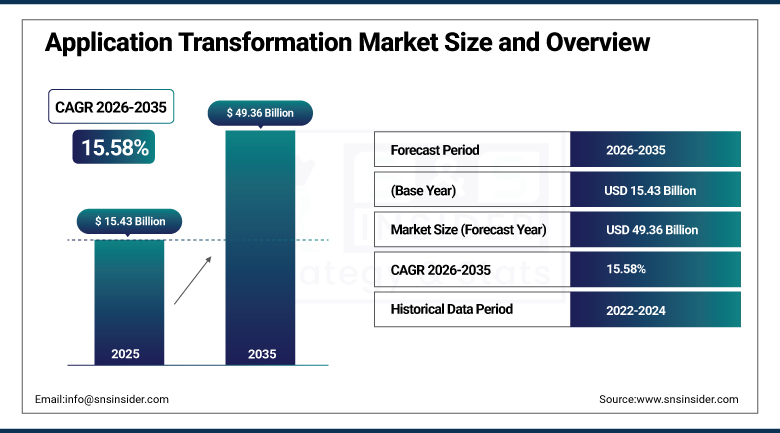
The Application Transformation Market was valued at USD 15.43 Billion in 2025 and is expected to reach USD 49.36 Billion by 2035, growing at a CAGR of 15.58% from 2026 to 2035.
Application transformation market includes a range of techniques and technologies that enterprises adopt for modifying, transforming, or moving legacy applications onto the new technology platform. The current report discusses the trends of the market, such as automation integration, the influence of AI and machine learning, issues related to cybersecurity, downtime and disruption of applications, and application customization and personalization. Automation helps to improve the efficiency of operations, whereas AI helps in making smarter decisions. In addition, there is an increased demand for the protection of applications through cybersecurity. The current report discusses all these aspects, but focuses on the efforts taken by the business organizations to reduce downtime and have highly customizable applications.
In 2024, Cloud4C introduced Oracle Application Management Services on Oracle Cloud Infrastructure, enhancing cloud management, performance, and application modernization with automated patching and 24/7 support. The service launch reflects the application transformation market's progressive shift toward managed service delivery models, where enterprises increasingly outsource ongoing application maintenance and modernization responsibility to specialist providers whose platform expertise and scale economics deliver superior reliability relative to internal IT team management of complex legacy modernization programmes.
Market Size and Forecast
-
Market Size in 2026E: USD 17.84 Billion
-
Market Size by 2035: USD 49.36 Billion
-
CAGR: 15.58% from 2026 to 2035
-
Fastest Growing Region: Asia Pacific
-
Largest Region: North America
To Get more information On Application Transformation Market - Request Free Sample Report
Application Transformation Market Trends
-
AI-powered automation is enhancing application transformation by enabling intelligent workflows, predictive analytics, and automated business processes.
-
Cloud-native application modernization is accelerating through adoption of microservices, containers, and serverless architectures.
-
Security-by-design practices are increasingly integrated into application transformation projects to strengthen cybersecurity and regulatory compliance.
-
Low-code and no-code platforms are expanding application modernization opportunities for organizations with limited development resources.
-
Industry-specific transformation frameworks are reducing implementation time and improving modernization outcomes across BFSI, healthcare, and manufacturing sectors.
The U.S. Application Transformation Market Outlook
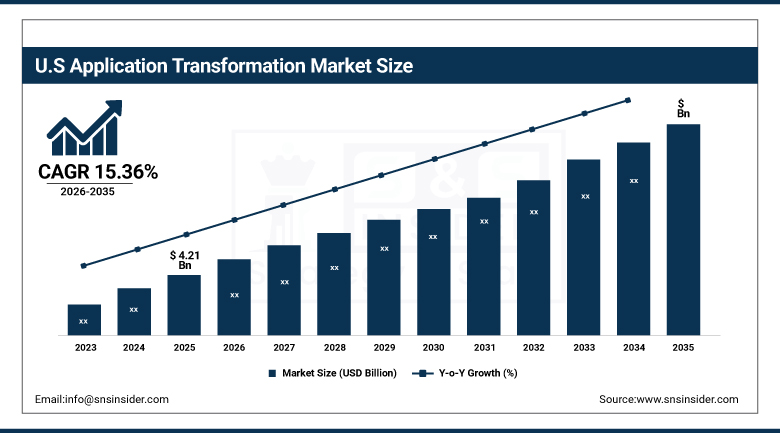
The U.S. Application Transformation Market was valued at approximately USD 4.21 Billion in 2025 and is expected to reach approximately USD 13.65 Billion by 2035, growing at a CAGR of approximately 15.36%.
There are a number of significant reasons behind the growth witnessed in the application transformation market in the USA. These include growing usage of automation and artificial intelligence to drive operational efficiency and smart business processes. There has been an increase in demand for better cybersecurity due to the need for securing applications and data, and there has also been an emphasis on minimizing any disruption in the applications. There has been an increase in the demand for custom or personalized solutions that will cater to individual customer requirements in the technologically advanced enterprise IT environment of the world.
The IBM acquisitions of Application Modernization from Advanced in 2024, which bolsters IBM Consulting Hybrid Cloud Strategies with Watsonx Code Assistant for z to enable faster mainframe modernization projects, shows that the commercial industry is moving towards the adoption of AI-assisted code transformation tooling, where the ability of automation of code analysis and code transformation saves the time that would traditionally be spent on manual engineering, giving service providers an edge over competitors who leverage the AI tooling to transform their clients more quickly.
Application Transformation Market Segment Analysis
-
By Type, the application integration segment dominated the application transformation market with approximately 29.8% share in 2025, while the cloud application migration segment is the fastest growing.
-
By Application, the enterprise resource planning (ERP) applications segment dominated the application transformation market with approximately 34.5% share in 2025, while the custom business applications segment is the fastest growing.
-
By Enterprise Size, the large enterprises segment dominated the application transformation market with approximately 67% share in 2025, while the small and medium enterprises segment is the fastest growing at approximately 16.82% CAGR.
-
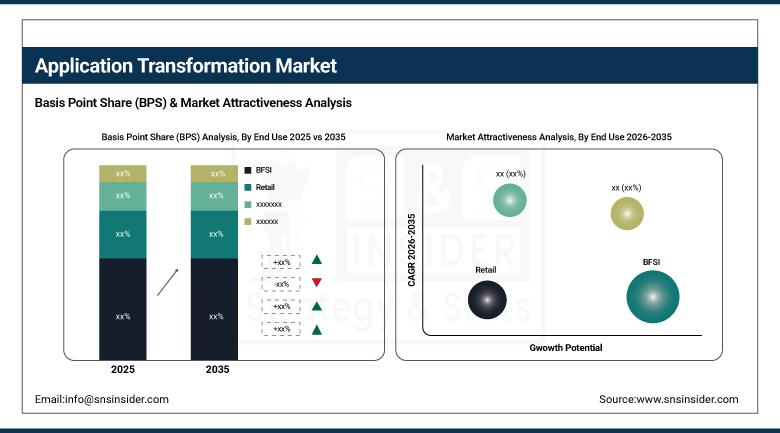
By End Use, the BFSI segment dominated the application transformation market with approximately 27% share in 2025, while the manufacturing segment is the fastest growing at approximately 17.90% CAGR.
By Enterprise Size, large enterprises dominate, SMEs grow fastest
Large enterprises retained the dominant position with approximately 67% of the application transformation market in 2025. Such domination is attributed to their large IT infrastructures and large business operations in which they have the capacity and the need to implement state-of-the-art applications transformation processes in order to increase efficiency and gain an advantage in the competition. Large enterprises have large business operations and thus require integration of new technologies, which leads to substantial investments in transformation processes making up the major share of the market revenue. Each multinational organization whose legacy application portfolio spans dozens or hundreds of business-critical systems create transformation procurement whose scope and complexity substantially exceeds equivalent small business modernization requirements, sustaining large enterprises' commanding commercial position.
Small and medium enterprises are the fastest growing segment at approximately 16.82% CAGR as these businesses increasingly recognize the need for application transformation to stay competitive. Small and medium-sized enterprises are utilizing efficient tools like cloud-based software to make themselves efficient in the modern era. Digitalization initiatives, coupled with the requirement for process optimization, play an important role in the rapid expansion of this market segment. Every small enterprise that faces competition from modernized companies forces itself to become more modernized, which is aided by the decreasing costs of cloud-based transformation tools, and this helps sustain the continued growth of this market segment.
By End Use, BFSI dominates, manufacturing grows fastest
BFSI retained the dominant end use position with approximately 27% of the application transformation market in 2025. This dominance is because of the need for innovation and compliance within the sector. The BFSI industry is a major investor in changing existing processes to provide better customer service and comply with the regulatory frameworks put in place. The BFSI segment has the largest revenue share because of its requirement for transformation owing to increased dependence of financial institutions on digital media and technology like AI and blockchain.
The manufacturing industry has the highest CAGR of about 17.90%, as manufacturers are adopting smart technologies for increasing efficiency and improving supply chain management. With the rise of Industry 4.0, manufacturers are investing in automation, predictive analytics, and IoT enabled systems to modernize their applications. Each manufacturing facility whose production planning, quality management, and supply chain visibility systems require integration with modern IoT sensor networks and predictive maintenance platforms creates application transformation procurement whose technical complexity and operational value sustain manufacturing's accelerating growth trajectory as the sector's digital transformation programmes mature beyond early adopter stages into mainstream industrial practice.
Regional Analysis
|
Region |
Major Country |
Share within Region, 2025 (%) |
|---|---|---|
|
North America |
United States |
87.4% |
|
Europe |
Germany |
22.3% |
|
Asia Pacific |
China |
44.8% |
|
Middle East & Africa |
UAE |
31.2% |
|
Latin America |
Brazil |
44.2% |
North America Application Transformation Market Insights
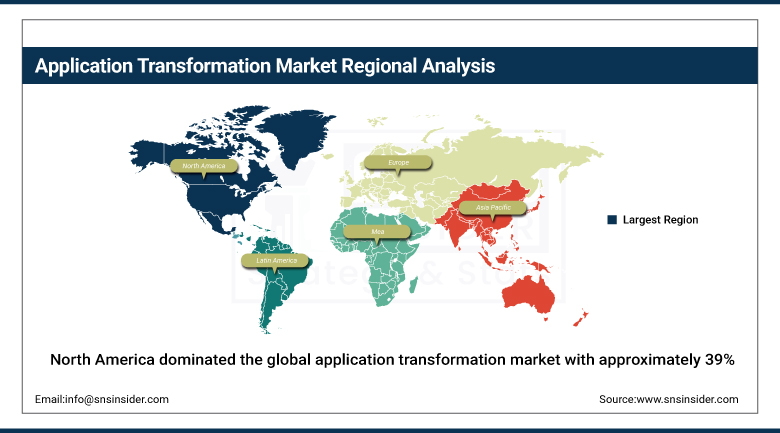
North America dominated the global application transformation market with approximately 39% revenue share in 2025. This is due to the advanced technology infrastructure in the region, large investments in IT, and the presence of leading players in the market. Digital transformation is becoming a priority for North American firms as it helps in improving efficiency, providing better customer experience, and sustaining a competitive advantage. The use of cloud computing solutions, AI, IoT, and automation is increasing very fast and is driving the market forward. Technological superiority and innovation of the region are among the major contributors to its dominance, as the U.S. constitutes about 87.4% of North American revenues.
Canada contributes complementary North American revenue through its growing technology sector and financial services industry's consistent demand for application modernizations services, supporting cross border enterprise IT transformation initiatives across major North American organisations.
Get Customized Report as per Your Business Requirement - Enquiry Now
Europe Application Transformation Market Insights
Europe is a technically sophisticated application transformation market where stringent data protection regulations under GDPR and the financial services sector's digital transformation compliance requirements create structured institutional demand. Germany accounts for approximately 22.3% of European revenues through its strong manufacturing sector's Industry 4.0 application modernizations investment alongside the country's financial services and automotive industry transformation programmes.
United Kingdom and France make important secondary markets due to the existence of regulatory requirements in the BFSI sector and emerging technology services industry resulting in regular procurement. The Europe operations of big global system integrators ensure continuous business supply in the application transformation environment.
Asia Pacific Application Transformation Market Insights
Asia Pacific is expected to grow at the fastest CAGR of approximately 17.87% from 2026 to 2035. This rapid growth is driven by increasing digitalization, significant IT investments, and high demand for cloud-based solutions in the region. Countries like China, India, and Japan are modernizing their legacy applications to stay competitive. China accounts for approximately 44.8% of Asia Pacific revenues through its extraordinary digital economy scale and enterprise IT investment growth across both domestic technology champions and multinational corporation regional operations.
India represents the most commercially dynamic emerging market within Asia Pacific where the IT services industry's domestic application transformation capability and the rapidly expanding enterprise digitalization programme create above average regional market growth, with major Indian IT services firms increasingly delivering application transformation engagements for both domestic and global enterprise customers.
MEA & Latin America Application Transformation Market Insights
The UAE leads MEA revenues through its smart city infrastructure investment and financial services sector's digital transformation programme, driven by government led digitalization initiatives across the Gulf region. Saudi Arabia's Vision 2030 digital economy programme adds complementary regional demand.
Brazil dominates Latin American revenues because of its growing technology and BFSI industries, which have been investing in application modernization. The manufacturing sector in Mexico and the technology services industry in Argentina will together drive the growth of the regional market up to 2035.
Market Dynamics
Growth Drivers: Cloud adoption acceleration and rising demand for AI integrated applications
The rising shift towards cloud technologies significantly drives the application transformation market. Cloud-based applications help firms upgrade their IT infrastructure in terms of scalability and flexibility. The cloud allows integration of different applications, and helps in managing information and collaborating. With the growing adoption of digital transformation by organizations to streamline their processes and improve the experience of customers, there are cost-effective, efficient, and secure ways provided by cloud applications. Another advantage offered by cloud platforms is that they keep providing continuous updates, which reduces costs incurred in maintaining software, thus giving the organization an edge over its competitors in the market.
The increasing demand for artificial intelligence and automation presents significant growth momentum for the application transformation market. The use of AI technologies enables companies to add new abilities to their applications like predictive analysis, intelligent decision-making, and automation of routine activities. Companies that use AI in application transformation projects have the potential to become more efficient in their operations, make fewer mistakes made by humans, and develop more intelligent processes. As companies seek new ways of improving the experience of users and resource management, AI and automation used in application transformation will keep fueling the market growth above average levels.
Restraints: Integration complexity and resistance to organizational change
The difficulty associated with the implementation of these applications with the current systems as well as the migration of large volumes of data from the legacy systems is one of the constraints that limit the growth of the application transformation market. This is because companies use multiple legacy systems which do not integrate with each other, and it becomes hard to integrate with new systems. Furthermore, moving data to new platforms can be a daunting task which requires a lot of planning and caution to ensure the data is protected.
The staff and the management may resist the implementation of new systems, processes, and technologies owing to the fear of disruption or lack of familiarity with the changes. Such a cultural barrier may affect the success of the transformation initiative since the employees may feel overwhelmed with the new technologies. Proper change management is essential to overcome these obstacles during the process of transformation.
Opportunities: AI embedded application development
The increasing demand for artificial intelligence and automation presents significant opportunities in the application transformation market. AI technology enables firms to improve applications with functionalities like predictive analysis, intelligent decision-making, and automated processes for repetitive tasks. Through the integration of AI in application transformation, firms can increase efficiencies, minimize errors, and develop more efficient workflows, and such an integration has emerged as one of the focal areas in future development plans worldwide.
Industry specific transformation acceleration represents a commercially significant opportunity as vendors develop pre-configured modernization pathways tailored to sector specific requirements including BFSI compliance frameworks, healthcare interoperability standards, and manufacturing Industry 4.0 integration patterns. Each pre built transformation accelerator that reduces implementation timeline and de risks complex legacy modernization creates competitive differentiation for service providers capable of demonstrating sector specific expertise beyond generic transformation methodology.
Recent Developments:
-
2026: Accenture plc expanded its AI-powered application transformation services by integrating generative AI capabilities into enterprise modernization programs to accelerate legacy application modernization and cloud migration.
-
2026: IBM Corporation enhanced its application modernization portfolio with new AI-assisted transformation tools on IBM Consulting and Hybrid Cloud platforms, enabling faster refactoring of legacy enterprise applications.
-
2026: Microsoft Corporation introduced advanced AI-driven capabilities across Azure for application modernization, helping enterprises automate code migration, application replatforming, and cloud-native development.
-
2026: Tata Consultancy Services Limited (TCS) expanded its enterprise application transformation offerings with industry-specific AI and cloud modernization frameworks designed to accelerate digital transformation across BFSI, manufacturing, and healthcare sectors.
Application Transformation Market key players are:
-
IBM Corporation
-
Accenture plc
-
Capgemini SE
-
Tata Consultancy Services Ltd.
-
Infosys Limited
-
Wipro Limited
-
Cognizant Technology Solutions Corp.
-
DXC Technology Company
-
Atos SE
-
HCLTech
-
Kyndryl Holdings Inc.
-
Deloitte Touche Tohmatsu Limited
-
NTT DATA Corporation
-
Microsoft Corporation
-
Amazon Web Services Inc.
-
Oracle Corporation
-
SAP SE
-
Google LLC (Google Cloud)
-
Cloud4C Services Pvt. Ltd.
-
Mphasis Limited
Application Transformation Market Report Scope:
| Report Attributes | Details |
|---|---|
| Market Size in 2025 | USD 15.43 Billion |
| Market Size by 2035 | USD 49.36 Billion |
| CAGR | CAGR of 15.58% From 2026 to 2035 |
| Base Year | 2025 |
| Forecast Period | 2026-2035 |
| Historical Data | 2022-2024 |
| Report Scope & Coverage | Market Size, Segments Analysis, Competitive Landscape, Regional Analysis, DROC & SWOT Analysis, Forecast Outlook |
| Key Segments | • By Type (Application Integration, Cloud Application Migration, Application Portfolio Assessment, Application Replatforming, UI Modernization, Others) • By Application (Enterprise Resource Planning Applications, Customer Relationship Management Applications, Supply Chain Management Applications, Custom Business Applications) • By Enterprise Size (Large Enterprises, Small and Medium Enterprises) • By End Use (BFSI, Retail, Healthcare, IT and Telecom, Government, Manufacturing, Others) |
| Regional Analysis/Coverage | North America (US, Canada), Europe (Germany, UK, France, Italy, Spain, Russia, Poland, Rest of Europe), Asia Pacific (China, India, Japan, South Korea, Australia, ASEAN Countries, Rest of Asia Pacific), Middle East & Africa (UAE, Saudi Arabia, Qatar, South Africa, Rest of Middle East & Africa), Latin America (Brazil, Argentina, Mexico, Colombia, Rest of Latin America). |
| Company Profiles | IBM Corporation, Accenture plc, Capgemini SE, Tata Consultancy Services Ltd., Infosys Limited, Wipro Limited, Cognizant Technology Solutions Corp., DXC Technology Company, Atos SE, HCLTech, Kyndryl Holdings Inc., Deloitte Touche Tohmatsu Limited, NTT DATA Corporation, Microsoft Corporation, Amazon Web Services Inc., Oracle Corporation, SAP SE, Google LLC (Google Cloud), Cloud4C Services Pvt. Ltd., Mphasis Limited |
Frequently Asked Questions
The market is expected to grow at a CAGR of 15.58% from 2026 to 2035.
The market was valued at USD 15.43 Billion in 2025.
The rising shift towards cloud technologies enabling businesses to modernize IT infrastructure with scalability and flexibility.
Large Enterprises dominated the market with approximately 67% share in 2025.
North America dominated the market with approximately 39% revenue share in 2025.
