
Automotive Chip Market Report Scope & Overview:
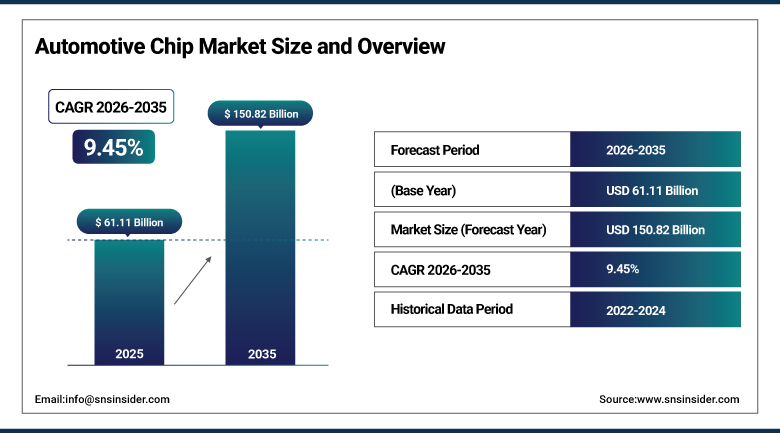
The Automotive Chip Market was valued at USD 61.11 Billion in 2025 and is expected to reach USD 150.82 Billion by 2035, growing at a CAGR of 9.45% from 2026-2035.
Automotive chips encompass the range of semiconductors that power a modern vehicle's electrical and electronic systems, from microcontrollers coordinating engine and body functions through power semiconductors managing battery and motor energy, analog ICs handling sensor signals, and increasingly powerful logic chips running advanced driver assistance and infotainment software. The count of chips per vehicle continues to climb as electrification, autonomous driving features, and software-defined vehicle architectures replace mechanical systems with electronic ones and consolidate control into more powerful zonal computers. Growth is reinforced by rising electric vehicle production, expanding ADAS regulation mandating collision avoidance and driver monitoring hardware, and continued migration toward wide-bandgap materials such as silicon carbide and gallium nitride that improve power efficiency in traction inverters.
In March 2025, NXP Semiconductors introduced its S32K5 microcontroller family, designed as the company’s first automotive microcontrollers based on 16-nanometre FinFET technology with embedded magnetoresistive random-access memory. The new family extends NXP’s S32 automotive platform and supports advanced vehicle electrical architectures, including zonal and electrification applications. The S32K5 devices are designed to provide increased computing performance, memory capacity, functional integration, and energy efficiency for automotive systems. The launch strengthens NXP’s portfolio for next-generation vehicle architectures requiring higher levels of processing and electronic integration.
To Get more information Automotive Chip Market - Request Free Sample Report
Automotive Chip Market Trends
- Rising adoption of zonal electrical architectures consolidating control into fewer, more powerful chips.
- Growing migration toward silicon carbide and gallium nitride devices improving EV power efficiency.
- Expanding chip content per vehicle as software-defined vehicle platforms replace mechanical systems.
- Increasing deployment of advanced compute nodes at or below 10 nanometres for ADAS processing.
- Rising regulatory mandates for collision avoidance and driver monitoring expanding safety chip demand.
U.S. Automotive Chip Market Overview
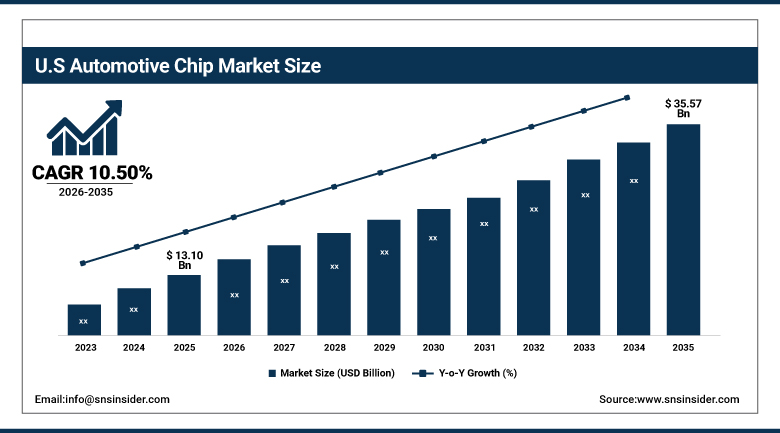
The U.S. Automotive Chip Market was valued at USD 13.10 Billion in 2025 and is expected to reach USD 35.57 Billion by 2035, growing at a CAGR of 10.50% from 2026-2035.
The U.S. Automotive Chip Market benefits from software-defined vehicle programs led by U.S. automakers, growing semiconductor manufacturing capacity, and rapid adoption of electric powertrains that require substantially higher chip content than combustion vehicles. Leading chip designers headquartered in the country continue to expand automotive-qualified product portfolios spanning microcontrollers, power semiconductors, and advanced driver assistance processors, while automakers increasingly favour suppliers offering integrated hardware and software platforms over discrete component purchasing. Continued investment in national wafer fabrication capacity, reinforced by CHIPS Act-related funding, is expanding the country's ability to manufacture automotive-grade chips onshore rather than relying entirely on overseas foundries, a shift that continues to matter for supply security following the industry's well-documented chip shortage of recent years.
In June 2025, onsemi announced the use of PowerTrench MOSFET technology in Top-Cool packages for automotive use, which includes 12V electric power steering and other power systems in vehicles. This technology offers better thermal management, power density, and switching characteristics, which can be used in motor control and DC-DC converters. This is important for U.S. vehicle electrification and automotive manufacturing, where there is an increasing need for power management components in electric and electronic vehicle systems.
Automotive Chip Market Segment Analysis
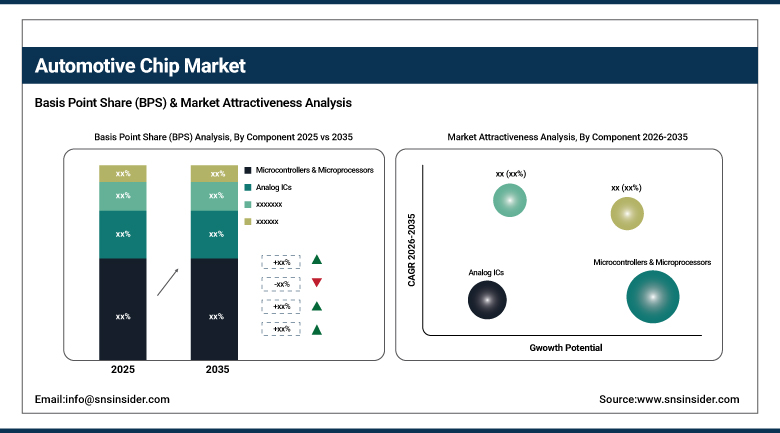
- By Component, the Microcontrollers & Microprocessors segment dominated the market with a 36.60% share in 2025, while the Power Semiconductors segment is the fastest growing with a CAGR of 11.20% during 2026-2035.
- By Semiconductor Material, the Silicon segment dominated the market with a 74.60% share in 2025, while the Gallium Nitride segment is the fastest growing with a CAGR of 12.60% during 2026-2035.
- By Propulsion Type, the Battery Electric Vehicles segment dominated the market with a 40.60% share in 2025, while the Battery Electric Vehicles segment is the fastest growing with a CAGR of 11.80% during 2026-2035.
- By Application Domain, the ADAS & Safety segment dominated the market with a 32.60% share in 2025, while the ADAS & Safety segment is the fastest growing with a CAGR of 12.20% during 2026-2035.
By Component, Microcontrollers & Microprocessors Dominates the Market and Power Semiconductors Grows Fastest
Microcontrollers and microprocessors dominated the market in 2025. These chips coordinate an enormous range of vehicle functions, from engine management and body control through increasingly centralised zonal computing architectures, and their presence across virtually every vehicle system continues to anchor this component category as the largest single share of overall automotive chip spending.
Power semiconductors are projected to be the fastest-growing component over the forecast period. Rising electric vehicle production continues to require substantially more power semiconductor content per unit than combustion vehicles, spanning traction inverters, onboard chargers, and battery management systems, and continued migration toward wide-bandgap materials capable of higher efficiency and thermal performance continues to drive above-market growth for this component category.
By Semiconductor Material, Silicon Dominates the Market and Gallium Nitride Grows Fastest
Silicon dominated the market in 2025. This established material continues to serve the overwhelming majority of automotive chip production, offering mature, well-understood manufacturing processes and cost efficiency across the broad range of microcontroller, analog, and logic applications that do not require the extreme power handling silicon carbide or gallium nitride provide.
Gallium nitride is projected to be the fastest-growing semiconductor material over the forecast period. Rising onboard charger and power conversion efficiency requirements continue to favour gallium nitride's superior switching speed and reduced energy loss relative to silicon alternatives, and as electric vehicle platforms continue proliferating, this material continues to capture increasing specification activity relative to the broader silicon-dominated material mix.
By Propulsion Type, Battery Electric Vehicles Dominates the Market and Battery Electric Vehicles Grows Fastest
Battery electric vehicles dominated the market in 2025. These vehicles carry substantially higher chip content per unit than combustion vehicles, spanning traction inverters, battery management systems, onboard chargers, and motor controllers that combustion platforms simply do not require, and continued global electric vehicle production growth continues to anchor this propulsion type as the largest source of automotive chip demand.
Battery electric vehicles are also expected to grow fastest over the forecast period. Continued adoption of 800-volt architectures, which require additional power semiconductor content to manage higher voltage safely and efficiently, continues to reinforce this propulsion type's already dominant position even further, as automakers extend high-voltage platforms across an expanding range of vehicle segments and price points.
By Application Domain, ADAS & Safety Dominates the Market and ADAS & Safety Grows Fastest
ADAS and safety applications dominated the market in 2025. Expanding regulatory mandates for collision avoidance, driver monitoring, and automatic emergency braking continue to require increasingly sophisticated sensor fusion and compute hardware across a growing share of new vehicles, sustaining this application domain's position as the largest category within the broader automotive chip market.
ADAS and safety is also projected to grow fastest over the forecast period. Continued broadening of regulatory scope covering advanced driver assistance features, combined with rising consumer expectation of higher levels of driving automation, continues to drive sustained above-market investment in the increasingly powerful compute nodes these systems require, extending this domain's lead over infotainment and powertrain applications even further.
Regional Analysis
|
Region |
Major Country |
Share within Region, 2025 |
|---|---|---|
|
Asia Pacific |
China |
41.60% |
|
North America |
United States |
80.60% |
|
Europe |
Germany |
29.60% |
|
Latin America |
Brazil |
27.60% |
|
Middle East & Africa |
United Arab Emirates |
24.60% |
Asia Pacific Automotive Chip Market Insights
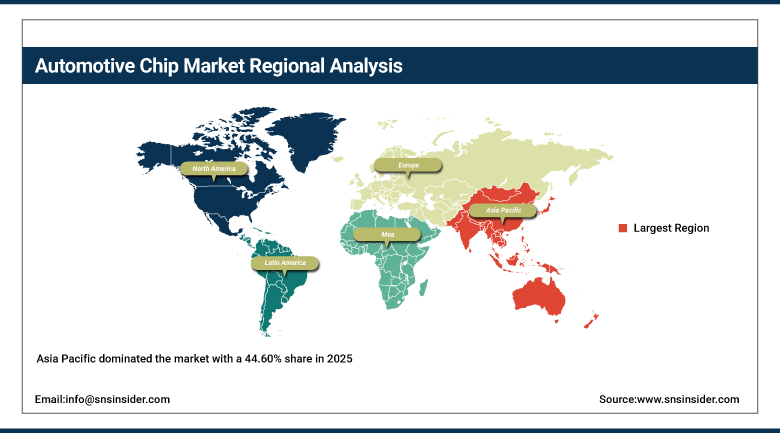
Asia Pacific dominated the market with a 44.60% share in 2025, and is also projected to grow fastest over the forecast period, registering a CAGR of approximately 11.60%. The region's position as the world's largest vehicle production base, combined with its concentration of leading semiconductor foundries and rapidly expanding domestic electric vehicle manufacturing, continues to anchor this leadership position across both chip demand and supply.
China forms the bedrock of regional demand owing to its status as the world’s largest market for electric vehicles as well as its burgeoning auto semiconductor sector that seeks to attain self-reliance. The additional depth of regional demand comes from Japan and South Korea in terms of electronics and memory supplies as well as the fast-growing auto production in India.
Get Customized Report as per Your Business Requirement - Enquiry Now
North America Automotive Chip Market Insights
North America holds a significant share of the global market, supported by software-defined vehicle programs, growing domestic semiconductor manufacturing capabilities, and rapid adoption of electric powertrains. The United States represents the substantial majority of regional demand, reflecting both its automotive production scale and its concentration of leading chip design companies.
Canada contribute additional regional demand through automotive manufacturing and assembly operations closely integrated with U.S. supply chains. Continued CHIPS Act-supported investment in domestic wafer fabrication capacity is expected to strengthen North America's position in both chip design and manufacturing through the forecast period.
Europe Automotive Chip Market Insights
Europe represents a substantial share of the global market, anchored by Germany, France, the United Kingdom, and Italy, home to some of the world's largest automotive manufacturers and a deep automotive semiconductor design and manufacturing base. The region's early leadership in emission regulation and vehicle safety standards continues to drive sustained chip content growth across European vehicle platforms.
Germany anchors regional demand through its substantial automotive manufacturing base and concentration of leading automotive semiconductor companies. France, Italy, and Spain contribute additional regional demand as national automakers continue extending electrification and ADAS feature adoption across their model lineups.
MEA & Latin America Automotive Chip Market Insights
The Middle East & Africa region is supported by growing automotive assembly and import activity across the United Arab Emirates and Saudi Arabia, where rising vehicle ownership and government economic diversification programs continue to gradually expand regional automotive electronics demand.
Brazil provides a core element of Latin America. This is due to the presence of domestic manufacturing capacity of automobiles, which in turn generates constant demand for chips. Mexico also adds to incremental growth because of its significant involvement with North American auto-supply chains.
Market Dynamics
Growth Drivers: Electrification and Autonomous Driving Technology
Rising electric vehicle production stands as the primary growth driver, as EV platforms require substantially more semiconductor content per unit than combustion vehicles, spanning traction inverters, battery management systems, and onboard chargers that combustion vehicles simply do not need. Continued global EV production growth across every major automotive market continues to translate directly into sustained automotive chip demand growth.
Advancement of autonomous driving and connectivity technologies represents a second major driver, as increasing digital cockpit sophistication, zonal architecture adoption, and connected mobility features continue to require greater semiconductor content per vehicle. Regulatory mandates for advanced driver assistance features continue to reinforce this trend across an expanding range of vehicle segments and price points.
Restraints: Supply Chain Complexity and Qualification Timelines
Supply chain complexity remains a genuine restraint, as automotive-qualified semiconductors require extensive testing and certification processes that can extend product qualification timelines well beyond those typical of consumer electronics, adding cost and delay that continues to complicate rapid scaling of new chip technologies into vehicle production.
Geopolitical and trade policy uncertainty presents a further restraint, as concentration of advanced semiconductor manufacturing capacity within a small number of countries continues to expose automakers and chip suppliers to potential supply disruption, a vulnerability the industry's well-documented chip shortage of recent years made starkly apparent across the global automotive sector.
Opportunities: Wide-Bandgap Materials and Zonal Architecture Consolidation
Continued adoption of silicon carbide and gallium nitride materials represents a substantial opportunity, as chip suppliers that can deliver reliable, cost-competitive wide-bandgap devices stand to capture growing demand from automakers pursuing higher efficiency power electronics for increasingly high-voltage electric vehicle platforms.
Continued consolidation toward zonal electrical architectures offers a further avenue for growth, as automakers increasingly favour fewer, more powerful compute domains over dozens of discrete electronic control units, positioning chip suppliers capable of delivering integrated, software-capable platforms to capture disproportionate value as vehicle electrical architecture continues to evolve.
Recent Developments:
- 2026: Renesas Electronics Corporation developed three automotive SoC technologies featuring AI processing, chiplet capabilities, functional safety, and advanced power control for multi-domain ECUs.
- 2026: STMicroelectronics N.V. introduced the Stellar P3E automotive microcontroller with integrated AI acceleration, targeting real-time edge intelligence, hybrid and EV systems, and zonal vehicle architectures.
- 2026: Infineon Technologies AG partnered with MediaTek to qualify Infineon’s automotive-grade 512 Mb Quad SPI NOR Flash for MediaTek’s Dimensity Auto Cockpit platform, supporting next-generation smart cockpit systems.
Automotive Chip Market Key Players are:
- NXP Semiconductors N.V.
- Infineon Technologies AG
- Texas Instruments Incorporated
- STMicroelectronics N.V.
- Renesas Electronics Corporation
- Robert Bosch GmbH
- onsemi
- Qualcomm Incorporated
- NVIDIA Corporation
- Intel Corporation
- Microchip Technology Incorporated
- Analog Devices, Inc.
- ROHM Co., Ltd.
- Denso Corporation
- Samsung Electronics Co., Ltd.
- Mobileye Global Inc.
- Wolfspeed, Inc.
- Marvell Technology, Inc.
- Broadcom Inc.
- Skyworks Solutions, Inc.
Automotive Chip Market Report Scope :
| Report Attributes | Details |
|---|---|
| Market Size in 2025 | USD 61.11 Billion |
| Market Size by 2035 | USD 150.82 Billion |
| CAGR | CAGR of 9.45% From 2026 to 2035 |
| Base Year | 2025 |
| Forecast Period | 2026-2035 |
| Historical Data | 2022-2024 |
| Report Scope & Coverage | Market Size, Segments Analysis, Competitive Landscape, Regional Analysis, DROC & SWOT Analysis, Forecast Outlook |
| Key Segments | • By Component (Microcontrollers & Microprocessors, Analog ICs, Power Semiconductors, Logic ICs, Sensors, Others) • By Semiconductor Material (Silicon, Silicon Carbide, Gallium Nitride, Others) • By Propulsion Type (Battery Electric Vehicles, Internal Combustion Engine, Plug-in Hybrid, Hybrid Electric Vehicles) • By Application Domain (ADAS & Safety, Infotainment & Connectivity, Powertrain & Body Electronics, Chassis, Telematics, Others) |
| Regional Analysis/Coverage | North America (US, Canada), Europe (Germany, UK, France, Italy, Spain, Russia, Poland, Rest of Europe), Asia Pacific (China, India, Japan, South Korea, Australia, ASEAN Countries, Rest of Asia Pacific), Middle East & Africa (UAE, Saudi Arabia, Qatar, South Africa, Rest of Middle East & Africa), Latin America (Brazil, Argentina, Mexico, Colombia, Rest of Latin America). |
| Company Profiles | NXP Semiconductors N.V., Infineon Technologies AG, Texas Instruments Incorporated, STMicroelectronics N.V., Renesas Electronics Corporation, Robert Bosch GmbH, onsemi, Qualcomm Incorporated, NVIDIA Corporation, Intel Corporation, Microchip Technology Incorporated, Analog Devices, Inc., ROHM Co., Ltd., Denso Corporation, Samsung Electronics Co., Ltd., Mobileye Global Inc., Wolfspeed, Inc., Marvell Technology, Inc., Broadcom Inc., Skyworks Solutions, Inc. |

Frequently Asked Questions
Key players include NXP Semiconductors N.V., Infineon Technologies AG, Texas Instruments Incorporated, STMicroelectronics N.V., and Renesas Electronics Corporation, among other semiconductor manufacturers.
Continued adoption of silicon carbide and gallium nitride materials and continued consolidation toward zonal electrical architectures represent the primary opportunities.
Growth is primarily driven by rising electric vehicle production, combined with advancement of autonomous driving and connectivity technologies.
By Component, Microcontrollers & Microprocessors dominated the market with a 36.60% share in 2025, reflecting their presence across virtually every vehicle electronic system.
Asia Pacific dominated the market with a 44.60% share in 2025, supported by the region's position as the world's largest vehicle production base.
