
Multi-Mode Chipset Market Report Scope & Overview:
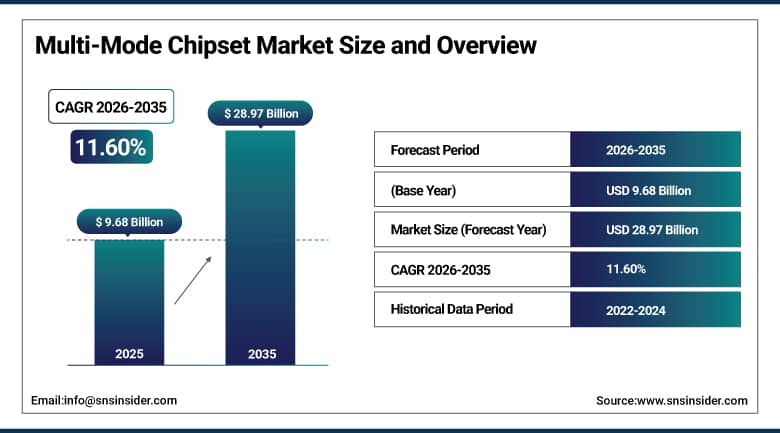
The Multi-Mode Chipset Market was valued at USD 9.68 billion in 2025 and is expected to reach USD 28.97 billion by 2035, growing at a CAGR of 11.60% from 2026–2035.
The multi-mode chipset market is witnessing robust growth in the global market owing to expanding 5G network deployments. Rising demand for seamless multi-network connectivity is accelerating chipset adoption across connected devices. Increasing smartphone, automotive, and Industrial IoT applications are supporting market expansion. Manufacturers are focusing on advanced multi-standard integration and power-efficient chipset architectures. Growing investments in next-generation wireless communication technologies are further driving market innovation and adoption.
As per the International Telecommunication Union Facts & Figures Report of 2025, there were around 8.2 billion mobile broadband subscriptions worldwide, with 5G networks offering coverage to 55% of the population. The growing network eco-system creates a robust need for a multi-mode chipset that can support 2G, 3G, 4G LTE, and 5G capabilities. The current technology has been enabled through 3GPP Release 17 and 18 standards and allows for multi-band connectivity.
To Get More Information On Multi-Mode Chipset Market - Request Free Sample Report
Multi-Mode Chipset Market Trends
-
The fast rollout and densification of 5G networks are facilitating the adoption of multi-mode chipsets in smartphones, automobiles, and IoTs all over the world.
-
Integration of satellite-based communications with ground-based networks is helping to ensure complete global coverage and adding to the complexity of chipset architectures significantly.
-
Growing usage of AI-powered edge computing devices is increasing the need for advanced chipsets all over the globe.
-
The growth of smart cities and connected ecosystems is making use of low-latency high-performance multi-mode communication technology more necessary.
-
Demand for multi-device communication is forcing companies to design highly integrated and energy-efficient chipsets that can scale easily.
-
The continuous development of wireless technology standards such as 3GPP Release 17 and 18 is influencing future multi-band communications technology all over the world.
The U.S. Multi-Mode Chipset Market Outlook
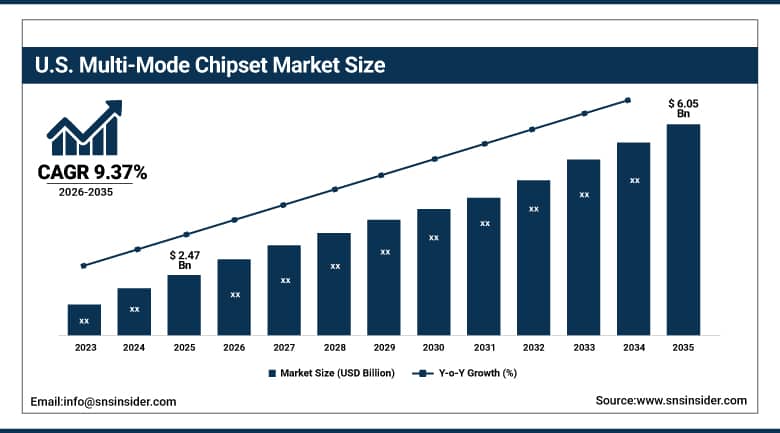
The U.S. Multi-Mode Chipset Market was valued at USD 2.47 billion in 2025 and is expected to reach around USD 6.05 billion by 2035, growing at a CAGR of 9.37% from 2026–2035.
The U.S. multi-mode chipset market is expanding steadily owing to strong demand for advanced wireless connectivity. Increasing adoption of 5G-enabled smartphones and IoT devices is supporting market growth. Rising deployment of connected automotive systems is driving chipset demand across industries. Growth in cloud and edge computing applications is further accelerating adoption. Manufacturers are focusing on high-performance, low-latency, and power-efficient chipset architectures for next-generation communication networks.
The FCC and NTIA reports reveal that 5G network penetration in the US is now at 99%, with more than one operator offering the service. Through the CHIPS and Science Act, the nation’s semiconductor production capacity is being enhanced through fabrication and packaging facilities. According to ITU, the number of mobile broadband subscriptions worldwide is 8.2 billion. For interoperability, there are multi-mode chipsets in more than 90% of operational handsets capable of connecting to 2G, 3G, 4G LTE, and 5G networks globally.
Multi-Mode Chipset Market Segment Analysis
-
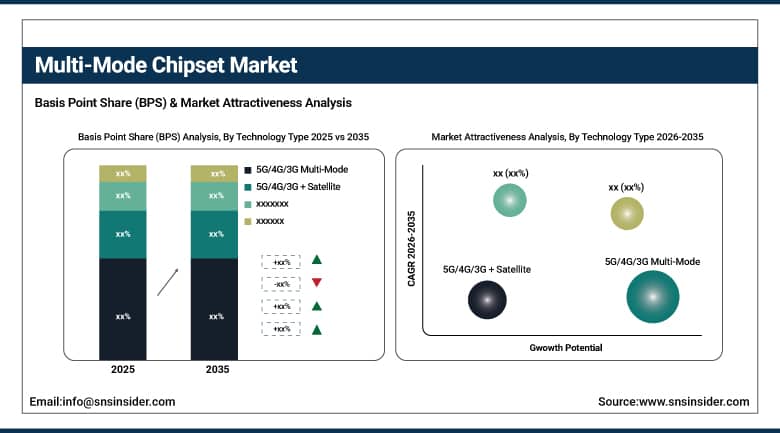
By Technology Type, 5G/4G/3G multi-mode dominated the market with 45.80% share in 2025; while 5G/4G/3G + satellite is the fastest growing segment with CAGR of 20.03% during 2026 to 2035.
-
By Application, smartphones dominated the market with 35.80% share in 2025; while industrial IoT is the fastest growing segment with CAGR of 15.66% during 2026 to 2035.
-
By Communication Generation, 5G / NR dominated the market with 57.80% share in 2025 and is also the fastest-growing segment with a CAGR of 15.51% during 2026–2035.
-
By End User, OEMs dominated the market with 38.70% share in 2025; while industrial IoT providers is the fastest growing segment with CAGR of 16.98% during 2026 to 2035.
By Technology Type, 5G/4G/3G multi-mode dominated the market, while 5G/4G/3G + satellite is the fastest growing segment.
The 5G/4G/3G multi-mode was the market leader in the multi-mode chipset market by capturing the dominating revenue share in 2025. The segment's growth will be led by extensive adoption in smartphones and compatibility with legacy networks. It provides connectivity over multiple networks. Good adoption by Original Equipment Manufacturers (OEMs) and telecommunication providers ensures stable demand. Increased incorporation into consumer electronics and industrial devices will further cement its dominant position worldwide.
The 5G/4G/3G + satellite segment is predicted to have the fastest growth rate during the forecast period of 2026-2035 due to growing demand for reliable global coverage. Its increasing adoption in remote areas, aviation, maritime, and defense applications will drive its growth. Increased demand for satellite communications including IoT and direct communication will fuel growth. Increased investments in non-terrestrial communications and advanced communication technologies will improve performance capabilities.
By Application, smartphones dominated the market, while industrial IoT is the fastest growing segment.
Smartphone segment held the leading position in the multi-mode chipset market based on the dominating revenue share in 2025. The dominance can be attributed to the widespread penetration of smartphones across the world coupled with consistent demand for fast connectivity. Further increase in the adoption of 5G-ready devices and multi-nets compatibility increases the application scope of chipsets. Consumer preference for enhanced features, smooth switching, and improved performance continues to drive the growth. High OEM manufacturing volume and device upgrades also aid the dominant position of the smartphone segment in the market.
The industrial IoT segment is projected to experience the fastest CAGR during 2026-2035 owing to rapid growth of connected ecosystems in the industrial sector. Increasing adoption of smart factories and Industry 4.0 along with automation is driving the demand for advanced multi-mode solutions. The rising demand for real-time processing, machine-to-machine communication, and low latency networks further boosts the growth. Increasing use of edge computing and artificial intelligence-based solutions in the industrial sector fuels the integration of chipsets.
By Communication Generation, 5G / NR dominated the market and is also the fastest growing segment.
The 5G / NR segment was the leader of the multi-mode chipset market in terms of revenue in 2025. The leadership of this segment is justified by the fast implementation of 5G technology around the world along with the increased use of devices that provide high-speed connectivity. The growing demand for this product from smartphone, automotive, and Industrial IoT sectors has increased its usage. Network operators are extending their networks. It is preferred by manufacturers for superior performance, low latency, and better multi-network connectivity.
The 5G / NR segment is expected to record the fastest CAGR during the period of 2026-2035 owing to the continued development of next-gen wireless infrastructure and the growing consumption of data. The rising number of deployments of smart cities, autonomous cars, and edge computing solutions is fueling the demand for this product. The rising penetration of AI-driven and IoT solutions is adding further momentum to the market.
By End User, OEMs dominated the market, while industrial IoT providers is the fastest growing segment.
The OEM segment dominated the multi-mode chipset market by holding the maximum revenue share in 2025 because of extensive integration of chipsets in smartphones, consumer electronics, and automotive applications. OEMs have significant buying power along with long-term supply agreements with semiconductor companies. They help in the manufacture of numerous connected devices with multi-mode connectivity requirements. The demand for 5G-enabled devices and the innovations in device architecture contribute towards OEMs' dominant position in the worldwide market.
The industrial IoT providers segment will witness the fastest CAGR from 2026 to 2035 because of rapid growth in the number of connected industrial ecosystems and smart manufacturing systems. There is increasing demand for advanced multi-mode connectivity solutions on account of increasing usage of Industry 4.0 technologies. There is increasing use of edge computing, automation, and real-time data analytics, which contributes towards chipset adoption. The requirement of low-latency communication in industrial environments further propels market growth.
Regional Analysis
|
Region |
Major Country |
Share within Region, 2025(%) |
|---|---|---|
|
North America |
United States |
78.65% |
|
Europe |
Germany |
24.80% |
|
Asia Pacific |
China |
42.30% |
|
Middle East & Africa |
UAE |
16.40% |
|
Latin America |
Brazil |
45.10% |
North America Multi-Mode Chipset Market Insights.
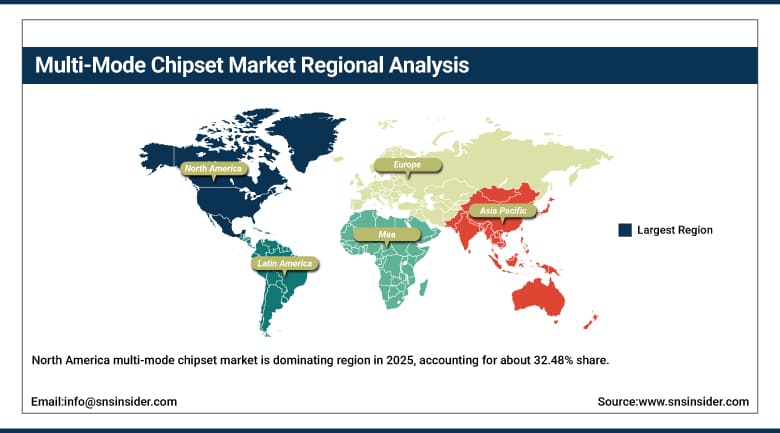
North America multi-mode chipset market is dominating region in 2025, accounting for about 32.48% share, driven by strong demand from smartphones and automotive connectivity. The region benefits from advanced semiconductor ecosystem and early 5G deployment. Increasing adoption of IoT and connected devices is significantly strengthening chipset penetration. Expansion of cloud and edge computing applications is accelerating demand. Strong focus on innovation in wireless communication technologies further reinforces dominant market position.
As per FCC and NTIA’s criteria, 5G network coverage had reached 96% of the U.S. population. This network coverage is very dependent on chipsets that offer 4G LTE, 5G, WiFi, and Satellite communication capabilities. As per OECD Digital Outlook data, over 90% of North American mobile subscriptions use multi-network enabled handsets. Meanwhile, the CHIPS Act programs of Department of Commerce are working towards local production of these radio frequency front ends for smartphones, cars, and IoT applications.
Get Customized Report as Per Your Business Requirement - Enquiry Now
Europe Multi-Mode Chipset Market Insights.
Europe multi-mode chipset market is characterized by stable growth in 2025 owing to strong demand from automotive and industrial applications. Key countries include Germany, France, United Kingdom, and Italy. Rising focus on connected mobility and smart manufacturing is driving adoption. Increasing emphasis on energy efficient communication systems is boosting demand. Growth in IoT enabled industrial automation is further supporting market expansion. Strict regulatory standards are encouraging innovation in advanced chipset technologies.
As stated by the framework for the State of the Digital Decade by the European Commission, the 5G coverage in the EU is 96.8%. As per the ETSI standards, majority of the new mobile devices have multi-mode capability to connect on 4G LTE and 5G NR frequencies. According to ITU, the penetration rate of mobile broadband is 92% in Europe. All of this has ensured that the multi-mode chipsets find widespread application in phones, telematics, and industrial IoT in Europe.
Asia Pacific Multi-Mode Chipset Market Insights.
Asia Pacific is the fastest growing region in the multi-mode chipset market, registering a CAGR of about 13.52% during 2026–2035. Rapid urbanization and large-scale electronics manufacturing are driving strong demand across China, India, Japan, South Korea, and Southeast Asia. Expanding smartphone production and IoT device penetration are boosting market growth. Increasing adoption of 5G infrastructure is further accelerating chipset deployment. Strong semiconductor manufacturing base supports large scale supply expansion.
As reported by regional telecom regulatory authorities, average population coverage by 5G in the Asia-Pacific region is 70%, whereas advanced economies such as South Korea, China, India, and Japan consistently achieve coverage levels of more than 90%. Additionally, given that 50% of worldwide semiconductor production capacity is present within this region, it serves as the key platform for launching silicon for the production of multi-mode chipsets.
Middle East & Africa and Latin America Multi-Mode Chipset Market Insights.
The Middle East & Africa along with Latin America regions are witnessing steady growth due to rising digital transformation and telecom expansion. Key contributing countries include Brazil, Mexico, UAE, Saudi Arabia, and South Africa. Increasing demand for affordable smartphones and IoT devices is driving adoption. Growth in telecom infrastructure development is further supporting market expansion. Rising smart city initiatives and industrial connectivity projects are boosting regional chipset demand.
Based on the tracking measures of the ITU and GSMA, mobile broadband penetration exceeds 78% in Latin America and is higher than 55% in Sub-Saharan Africa, leading to increased subscribers. In advanced economies of the Middle East such as Saudi Arabia and UAE, the World Bank report shows that 5G coverage is above 90% of the population. Multi-mode chipsets continue to be important in emerging economies as 30% of the global network is still dependent on 2G/3G networks.
Market Dynamics
Growth Drivers: Rapid Expansion of 5G Networks and Multi-Device Connectivity Driving Chipset Adoption Globally
The quick expansion of 5G networks across the developed as well as emerging economies is resulting in a marked increase in the demand for multi-mode chipsets. The growing requirement of seamless connectivity in phones, tablets, cars, and IoT devices is leading to the adoption of multi-standard technology. Growth in data usage and dependency on high-speed wireless networks is also driving chipset adoption. The demand from expanding smart cities and ecosystems is growing. The continuous evolution of wireless standards is helping the industry grow.
Based on ITU Facts and Figures statistics, there are currently 3 billion subscriptions of 5G across the world, which is one-third of all mobile broadband subscriptions. Data from GSMA states that smartphone penetration has crossed 70% and more than one device per person usage average is prevalent in the developed countries. Mid-band 5G spectrum deployment is expanding at a fast pace. This has increased the need for chipsets which will provide compatibility for 2G, 3G, and 4G along with high-speed 5G connectivity.
Restraints: High Design Complexity and Integration Challenges in Multi-Mode Chipsets Limiting Market Expansion
The growing complexity that comes from incorporating different types of communication technologies into one chipset is becoming a very challenging task for the manufacturers. Compatibility of LTE, 5G, Wi-Fi, Bluetooth, and satellite communications is quite difficult to maintain, which demands highly sophisticated engineering with massive R&D expenses. The cooling and energy efficiency becomes a more complicated process due to increased integration. The continuous updates of technology make development time longer. Moreover, high level of design complexity is associated with performance trade-offs.
Opportunities: Advancement in Satellite Connectivity and AI Enabled Edge Devices Unlocking New Market Potential
Adoption of satellite-based communications technology and AI-enabled edge devices is bringing about new possibilities for multimode chipset integration. The rise in the need for connectivity in remote areas is pushing the need for solutions through satellites. The growth in AI-enabled applications in consumer electronic devices and industrial systems is increasing the need for processing. Intelligent connectivity integration is improving the performance of the devices. Increased adoption in the defense and aerospace industry among others is promising future growth prospects.
In accordance with ITU Facts and Figures, the mobile broadband network currently covers more than 95% of the world’s population, with 5G covering 55% of the world and 84% of high-income countries. The data from FCC and ESA indicates fast-growing NGSO satellites, which allow for direct-to-device connectivity. OECD indicates that AI usage rate among large businesses is more than 52%. Such convergence leads to high requirements for hybrid multi-mode chipsets combining cellular, Wi-Fi, and satellite connectivity technologies.
Recent Developments
-
2026: Intel advanced its product roadmap, tracking toward the release of Nova Lake desktop processors featuring up to 52 cores.
-
2025: MediaTek launched the Dimensity 9500 mobile platform engineered to deliver advanced local generative AI capabilities for flagship smartphones.
-
2025: Samsung Semiconductor introduced the Exynos 2500 mobile processor utilizing three nanometer GAA process architecture for improved power efficiency.
-
2024: Broadcom jointly partnered with Comcast and Charter Communications to develop unified DOCSIS chipsets capable of 25Gbps speeds.
Multi-Mode Chipset Market Key Players are:
-
Qualcomm Technologies Inc.
-
MediaTek Inc.
-
Samsung Electronics Co. Ltd.
-
Huawei Technologies Co. Ltd.
-
Intel Corporation
-
Broadcom Inc.
-
UNISOC Shanghai Technologies Co. Ltd.
-
NXP Semiconductors N.V.
-
STMicroelectronics N.V.
-
Infineon Technologies AG
-
Renesas Electronics Corporation
-
Marvell Technology Inc.
-
Texas Instruments Incorporated
-
Analog Devices Inc.
-
Qorvo Inc.
-
Skyworks Solutions Inc.
-
ASR Microelectronics Co. Ltd.
-
GCT Semiconductor Holding Inc.
-
Realtek Semiconductor Corp.
-
Silicon Laboratories Inc.
Multi-Mode Chipset Market Report Scope:
| Report Attributes | Details |
|---|---|
| Market Size in 2025 | USD 9.68 Billion |
| Market Size by 2035 | USD 28.97 Billion |
| CAGR | CAGR of 11.60% From 2026 to 2035 |
| Base Year | 2025 |
| Forecast Period | 2026-2035 |
| Historical Data | 2022-2024 |
| Report Scope & Coverage | Market Size, Segments Analysis, Competitive Landscape, Regional Analysis, DROC & SWOT Analysis, Forecast Outlook |
| Key Segments | • By Technology Type (5G/4G/3G Multi-Mode, 5G/4G/3G + Wi-Fi, 5G/4G/3G + Satellite, Software-Defined / Programmable Chipsets) • By Application (Smartphones, Tablets, Wearable Devices, Automotive, Industrial IoT) • By Communication Generation (2G / 3G, 4G / LTE, 5G / NR) • By End User (OEMs, Telecom Module Manufacturers, Automotive Tier-1 Suppliers, Industrial IoT Providers) |
| Regional Analysis/Coverage | North America (US, Canada), Europe (Germany, UK, France, Italy, Spain, Russia, Poland, Rest of Europe), Asia Pacific (China, India, Japan, South Korea, Australia, ASEAN Countries, Rest of Asia Pacific), Middle East & Africa (UAE, Saudi Arabia, Qatar, South Africa, Rest of Middle East & Africa), Latin America (Brazil, Argentina, Mexico, Colombia, Rest of Latin America). |
| Company Profiles | Qualcomm Technologies Inc., MediaTek Inc., Samsung Electronics Co. Ltd., Huawei Technologies Co. Ltd., Intel Corporation, Broadcom Inc., UNISOC Shanghai Technologies Co. Ltd., NXP Semiconductors N.V., STMicroelectronics N.V., Infineon Technologies AG, Renesas Electronics Corporation, Marvell Technology Inc., Texas Instruments Incorporated, Analog Devices Inc., Qorvo Inc., Skyworks Solutions Inc., ASR Microelectronics Co. Ltd., GCT Semiconductor Holding Inc., Realtek Semiconductor Corp., Silicon Laboratories Inc. |

Frequently Asked Questions
The major growth factors include rapid 5G expansion, multi-network connectivity demand, smartphone and IoT adoption, automotive connectivity growth, AI edge devices, and advancements in 3GPP Release 17 and 18 wireless communication standards globally.
The Smartphones dominated the market in 2025 due to high penetration, 5G demand, and multi-network connectivity requirements across global devices.
North America dominated the multi-mode chipset market in 2025.
