
Automotive Intelligence Park Assist System Market Report Scope & Overview:
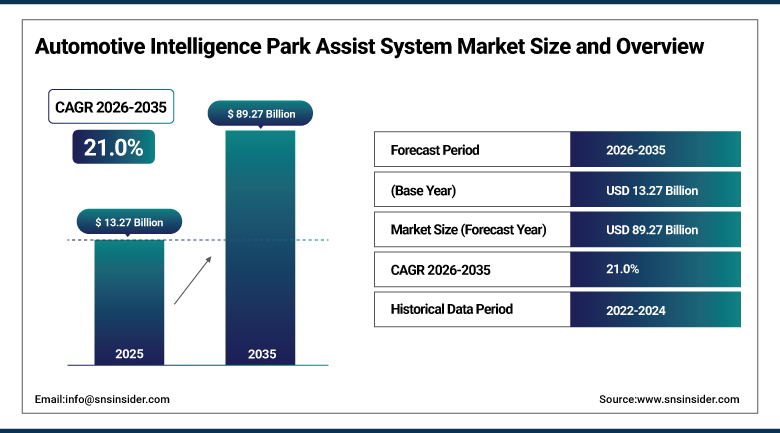
The Automotive Intelligence Park Assist System Market was valued at USD 13.27 Billion in 2025 and is expected to reach USD 89.27 Billion by 2035, growing at a CAGR of 21.0% from 2026-2035.
The Automotive Intelligence Park Assist System can be considered as an innovative technology that has revolutionized the way vehicles move through ever-growing urban areas. This highly developed system helps drivers in parking their cars automatically with minimal efforts and stress, which are usually required to park a vehicle manually. The use of sensors, cameras, and computers helps the system identify parking spots and park vehicles in a safe manner. What makes the system more innovative is the fact that it caters to different kinds of parking scenarios. With increasing demands for vehicle safety, there has been a growing need for Advanced Driver Assistance Systems, which in turn helps in the growth of the intelligence park assist system market.
In 2025, Continental AG introduced a cost-optimized ultrasonic-camera park assist module enabling semi-automated parking for mid-range vehicle segments across European and Asian markets. This launch reflects a broader industry trend of established Tier-1 suppliers working to extend intelligent park assist capability beyond the premium and luxury vehicle segments where the technology first gained meaningful adoption, into genuinely mass-market vehicle price points where cost-optimized sensor and camera combinations can deliver a meaningfully similar user experience at a fraction of the component cost that earlier-generation, radar-and-LiDAR-equipped systems required.
To Get more information Automotive Intelligence Park Assist System Market - Request Free Sample Report
Automotive Intelligence Park Assist System Market Trends
- Rising adoption of Automated Valet Parking platforms enabling vehicles to park autonomously without a driver present.
- Growing integration of AI-based sensor fusion combining cameras, ultrasonic sensors, and radar for improved parking precision.
- Expanding development of 360-degree surround-view camera systems supporting increasingly complex parking scenarios.
- Increasing adoption of V2X connectivity enabling automated parking systems to communicate with smart parking infrastructure.
- Rising deployment of deep learning algorithms improving self-parking accuracy and safety across diverse parking environments.
- Growing manufacturer localization of component sourcing in response to evolving international trade and tariff conditions.
U.S. Automotive Intelligence Park Assist System Market Outlook
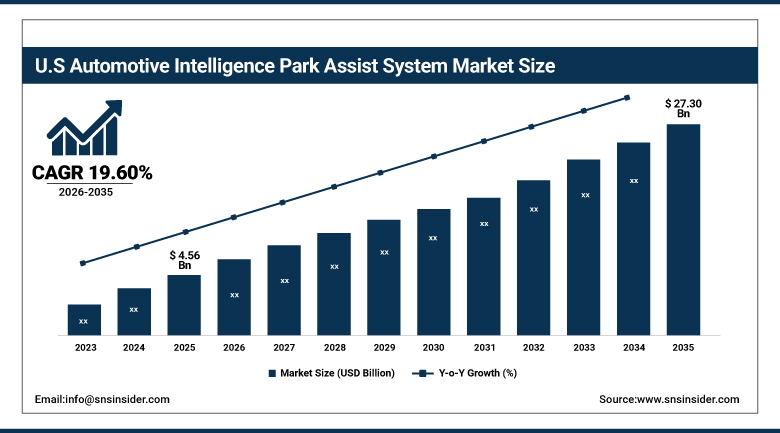
The U.S. Automotive Intelligence Park Assist System Market was valued at USD 4.56 Billion in 2025 and is expected to reach USD 27.30 Billion by 2035, growing at a CAGR of 19.60% from 2026-2035.
The U.S. Automotive Intelligence Park Assist System Market continues to benefit from strong domestic demand for premium vehicle features, sustained original equipment manufacturer investment in autonomous parking capability, and a regulatory and consumer environment increasingly favorable toward advanced driver assistance technology adoption. Domestic automakers and technology partners continue pursuing increasingly sophisticated intelligent parking capability as a genuine competitive differentiator, particularly as consumer expectations for vehicle technology sophistication continue rising alongside broader smartphone and connected device experience benchmarks that shape how consumers evaluate in-vehicle technology quality. The introduction of United States tariff measures has prompted manufacturers and suppliers to reassess global sourcing strategies, production footprints, and inventory planning in ways that continue to materially affect park assist system component supply chains.
In 2025, Ford, Bedrock, and Bosch jointly tested an advanced valet parking system in the U.S., at the Detroit Assembly Garage. This is the system of automatic parking that is made for the Ford Escape test cars and employs smart technology infrastructure of Bosch. The system is based on vehicle-to-infrastructure communication and infrastructure sensing for the location, guiding to parking spots, pedestrian detection, etc. The driver leaves the car in the specified zone and starts the parking process via the smartphone app. It is an example of developing automated parking solutions with the help of infrastructure in the U.S.
Automotive Intelligence Park Assist System Market Segment Analysis
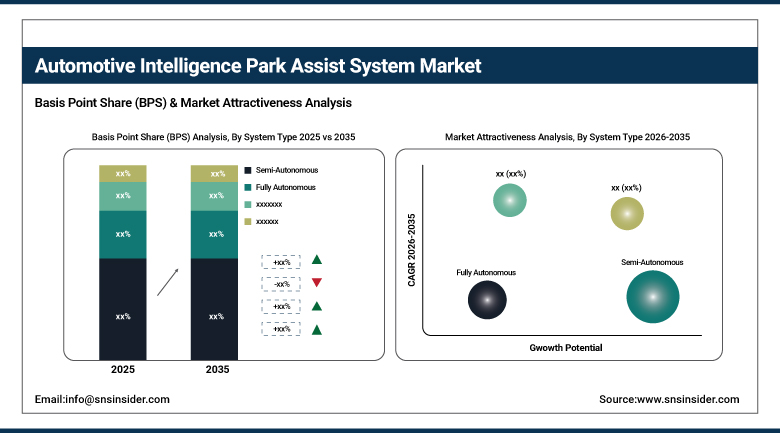
- By System Type, the Semi-Autonomous segment dominated the Automotive Intelligence Park Assist System Market with approximately 64.60% share in 2025, while the Fully Autonomous segment is the fastest growing with a CAGR of approximately 23.60%.
- By Vehicle Type, the Passenger Vehicles segment dominated the Automotive Intelligence Park Assist System Market with approximately 72.60% share in 2025, while the Commercial Vehicles segment is the fastest growing with a CAGR of approximately 22.60%.
- By Vehicle Class, the Mid-Priced segment dominated the Automotive Intelligence Park Assist System Market with approximately 42.60% share in 2025, while the Luxury segment is the fastest growing with a CAGR of approximately 26.20%.
- By Sensor Type, the Ultrasonic segment dominated the Automotive Intelligence Park Assist System Market with approximately 44.60% share in 2025, while the Camera-Based segment is the fastest growing with a CAGR of approximately 24.20%.
By System Type, Semi-Autonomous Dominates the Automotive Intelligence Park Assist System Market and Fully Autonomous Grows Fastest
Semi-autonomous systems hold the largest share of the market, reflecting the genuine technological and regulatory maturity stage that the vast majority of commercially deployed intelligent park assist systems have thus far achieved, where the vehicle handles steering and speed control during the parking maneuver while the driver remains present and retains ultimate override authority. This configuration continues to represent a meaningfully lower regulatory and liability bar to clear than genuinely fully autonomous parking, while still delivering the core consumer value proposition of reduced parking stress and improved precision, making semi-autonomous systems the practical default configuration across the overwhelming majority of current-generation vehicle offerings equipped with intelligent parking capability.
Fully autonomous systems represent the fastest-growing system type, driven by continued technological advancement in sensor fusion, AI-based decision-making, and increasingly sophisticated Automated Valet Parking platforms capable of completing entire parking maneuvers without any driver presence in the vehicle. Major suppliers continue launching new platforms specifically targeting this advanced autonomy level, with recent product introductions demonstrating measurable improvements in parking efficiency and reliability relative to earlier-generation systems. As regulatory frameworks in key markets continue evolving to accommodate genuinely driverless parking operation, and as consumer and manufacturer confidence in the underlying AI and sensor technology continues building, fully autonomous parking systems continue capturing an increasing share of new vehicle technology investment even from their currently smaller overall base relative to semi-autonomous alternatives.
By Vehicle Type, Passenger Vehicles Dominates the Automotive Intelligence Park Assist System Market and Commercial Vehicles Grows Fastest
Passenger vehicles represent the largest vehicle type segment, reflecting both the sheer scale of global passenger vehicle production and the technology's origins as a premium passenger vehicle feature that has since progressively extended down through mid-priced and increasingly entry-level vehicle segments. The passenger car segment continues to benefit from sustained original equipment manufacturer fitment rate growth as intelligent parking capability increasingly moves from an exclusive luxury differentiator toward a genuinely mainstream expected feature across a widening range of passenger vehicle price points and body styles.
Commercial vehicles represent the fastest-growing vehicle type, as fleet operators and commercial vehicle manufacturers increasingly recognize the genuine operational value that intelligent parking capability delivers within logistics, delivery, and urban commercial fleet applications where tight parking spaces and time-constrained delivery schedules make efficient, low-stress parking maneuvers particularly valuable. As commercial fleet electrification and broader technology modernization continues advancing in parallel with intelligent parking system adoption, this vehicle type category continues to capture an increasing share of new intelligent park assist system deployment relative to its historically smaller overall base within the broader passenger-car-dominated market.
By Vehicle Class, Mid-Priced Dominates the Automotive Intelligence Park Assist System Market and Luxury Grows Fastest
The mid-priced vehicle class holds the largest vehicle class share, reflecting the technology's successful extension beyond its original luxury vehicle origins into the substantially larger mid-market vehicle segment that represents the bulk of overall global vehicle sales volume. As cost-optimized sensor and camera module combinations, including recently introduced offerings specifically engineered for mid-range vehicle segments, continue reducing the component cost required to deliver credible intelligent parking capability, mid-priced vehicles continue to represent the single largest addressable market for intelligent park assist system suppliers by overall unit volume and corresponding revenue contribution.
The luxury vehicle class represents the fastest-growing vehicle class, as premium automakers continue pursuing increasingly sophisticated fully autonomous parking capability, advanced sensor fusion architectures, and cutting-edge AI-based parking algorithms as genuine competitive differentiators within an intensely competitive luxury vehicle segment. Luxury vehicle buyers continue demonstrating strong willingness to pay premium pricing for the most advanced available intelligent parking technology, reinforcing luxury automakers' continued investment in pushing the technological frontier of intelligent parking capability even as the broader market's volume center of gravity continues shifting toward mid-priced vehicle segments.
By Sensor Type, Ultrasonic Dominates the Automotive Intelligence Park Assist System Market and Camera-Based Grows Fastest
Ultrasonic sensors continue to hold the largest sensor type share within intelligent park assist system architectures, reflecting the technology's established manufacturing base, proven reliability, and favorable cost structure that continues to make it the foundational sensing technology within the majority of current-generation intelligent parking system designs. Even as intelligent park assist systems increasingly incorporate additional sensing modalities including cameras and radar, ultrasonic sensors typically continue serving as the primary short-range proximity detection technology that underpins core parking maneuver safety and precision across virtually every system configuration and price tier.
Camera-based systems represent the fastest-growing sensor type, as suppliers increasingly invest in 360-degree surround-view camera technology and AI-based image processing capability that enables substantially more sophisticated parking space detection and navigation than ultrasonic sensing alone can achieve. Major suppliers continue emphasizing camera technology investment as a core competitive differentiator, developing increasingly sophisticated computer vision algorithms capable of accurately identifying available parking spaces, obstacles, and pedestrians across an expanding range of lighting and weather conditions, positioning camera-based sensing for sustained above-market growth as intelligent park assist systems continue advancing toward genuinely comprehensive environmental awareness.
Regional Analysis
|
Region |
Major Country |
Share within Region, 2025 (%) |
|---|---|---|
|
North America |
United States |
84.60% |
|
Europe |
Germany |
29.60% |
|
Asia Pacific |
China |
39.60% |
|
Latin America |
Brazil |
27.60% |
|
Middle East & Africa |
United Arab Emirates |
24.60% |
North America Automotive Intelligence Park Assist System Market Insights
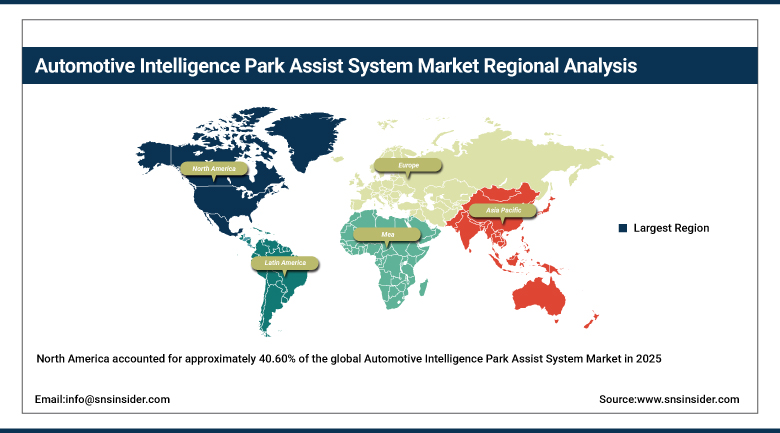
North America accounted for approximately 40.60% of the global Automotive Intelligence Park Assist System Market in 2025, making it the largest regional market, supported by strong consumer demand for premium vehicle technology, sustained automaker investment in autonomous parking capability, and a favorable regulatory environment for advanced driver assistance system deployment. The United States anchors regional demand through its concentration of leading technology suppliers and automakers continuing to push the technological frontier of both semi-autonomous and fully autonomous parking capability across an expanding range of vehicle segments.
Canada is contributing incremental regional demand as its own automotive market continues adopting increasingly sophisticated vehicle technology. Continued domestic investment in Automated Valet Parking platforms and sensor fusion technology, combined with ongoing supply chain localization in response to evolving trade policy, is expected to sustain North America's leading position through the forecast period, even as growth in percentage terms moderates relative to faster-expanding Asia Pacific markets.
Get Customized Report as per Your Business Requirement - Enquiry Now
Asia Pacific Automotive Intelligence Park Assist System Market Insights
Asia Pacific is the fastest-growing regional market, registering a CAGR of approximately 24.8% from 2026 to 2035. This is driven by rapidly expanding vehicle production, intensifying urbanization creating genuine parking space scarcity in major cities, and sustained government and manufacturer investment in advanced driver assistance technology across China, Japan, and South Korea. China's substantial domestic automotive manufacturing base and rapidly growing technology sector continue to drive significant regional demand, with several domestic technology companies actively deploying Automated Valet Parking systems across an expanding number of Chinese cities.
Japan's established automotive technology leadership, exemplified by its historical role in pioneering early intelligent parking assist system technology, continues contributing meaningful regional scale alongside South Korea's increasingly sophisticated domestic automotive technology sector. India's rapidly expanding passenger vehicle market continues to contribute incremental regional growth as rising vehicle ownership and urbanization create sustained demand for parking assistance technology, reinforcing Asia Pacific's position as the fastest-growing market for intelligent park assist systems through the forecast period.
Europe Automotive Intelligence Park Assist System Market Insights
Europe represents the second-largest regional market for automotive intelligence park assist systems, anchored by Germany's substantial automotive manufacturing base and the region's deep expertise in advanced driver assistance system technology development. European automakers and Tier-1 suppliers continue leading global innovation in sensor fusion and camera-based parking technology, with recently introduced cost-optimized modules specifically targeting mid-range vehicle segments across both European and Asian markets.
The United Kingdom, France, and Italy contribute significant regional demand as national automakers continue extending intelligent park assist system adoption across their vehicle lineups. Regional suppliers continue investing in increasingly sophisticated automated parking capability, including multi-story garage navigation and enhanced space detection technology, to maintain the region's traditionally strong competitive position within the global intelligent parking system supplier landscape.
MEA & Latin America Automotive Intelligence Park Assist System Market Insights
The Middle East & Africa market is supported by growing luxury and premium vehicle demand across the United Arab Emirates and Saudi Arabia, where consumer purchasing power and appetite for advanced vehicle technology continue supporting gradual intelligent park assist system adoption. Regional automotive markets continue evaluating advanced parking technology investment as part of broader vehicle technology modernization.
Latin America's market remains comparatively modest, with Brazil contributing incremental growth as regional vehicle technology adoption continues expanding gradually. Regional automakers continue evaluating intelligent park assist system integration as part of broader competitive positioning, though commercial-scale adoption across the region remains considerably earlier-stage relative to more established global automotive technology markets.
Market Dynamics
Growth Drivers: ADAS Investment and Urban Parking Congestion
Growing demand for vehicle safety and convenience represents the primary driver of Automotive Intelligence Park Assist System Market growth, as governments across the globe continue enforcing strict safety standards while consumers increasingly demand improved driving comfort, prompting manufacturers to embed increasingly sophisticated smart parking solutions into vehicles. Growing issues of traffic congestion and parking space scarcity in developed cities continue playing a vital role in shaping sustained demand for intelligent parking technology capable of helping drivers navigate increasingly constrained urban parking environments efficiently and safely.
Technological advancement in sensors, cameras, and AI-based automation represents a second major growth driver, as increasing ADAS usage continues fueling development across virtually every component of intelligent park assist system architecture, resulting in ever-greater market penetration of smart parking assist systems across an expanding range of vehicle segments. Integration of advanced driver assistance features has surged substantially in recent periods, highlighting the growing reliance on intelligent parking solutions as both a genuine convenience feature and a meaningful safety technology reducing collision risk during parking maneuvers.
Restraints: Component Cost Pressure and Regulatory Fragmentation
Component cost pressure represents a meaningful restraint on market growth, as fully autonomous parking systems in particular continue requiring substantial investment in premium sensors, cameras, and computing hardware that can meaningfully increase overall vehicle cost, potentially limiting adoption pace among more price-sensitive vehicle segments and markets despite continued efforts toward cost optimization.
Regulatory fragmentation across different international markets represents a further restraint, as varying national and regional regulatory frameworks governing autonomous and semi-autonomous vehicle operation continue creating genuine complexity for suppliers and automakers seeking to deploy consistent intelligent park assist system technology across multiple global markets simultaneously, occasionally requiring market-specific system configuration and certification that adds cost and complexity to global product development programs.
Opportunities: Automated Valet Parking Scaling and Cost-Optimized Mid-Market Expansion
Continued scaling of Automated Valet Parking platforms represents a substantial opportunity, as suppliers that can successfully deploy genuinely reliable, fully autonomous parking capability across an expanding number of cities and parking facilities are positioned to capture demand from both consumers and commercial fleet operators increasingly seeking driverless parking convenience. Several suppliers have already demonstrated measurable deployment expansion, increasing both automaker partnerships and geographic coverage as this technology continues moving from pilot programs toward genuine commercial scale.
The continued development of cost-optimized sensor and camera combinations specifically engineered for mid-market vehicle segments offers a further substantial avenue for growth, as suppliers that can successfully extend credible intelligent parking capability into genuinely mass-market vehicle price points are positioned to capture significant new volume beyond the technology's traditional luxury and premium vehicle stronghold. Manufacturers that can balance genuine performance with meaningful cost reduction are well positioned to capture demand from automakers seeking to democratize intelligent parking capability across their broader vehicle lineups.
Recent Developments:
- 2025: Valeo Group launched an updated automated parking system featuring enhanced space detection and multi-story garage navigation capability. The updated platform is designed to improve parking precision across increasingly complex urban parking environments, including multi-level parking structures.
- 2026: ZF and Qualcomm announced a scalable ADAS collaboration combining ZF ProAI with Snapdragon Ride, supporting parking assistance, automated garage parking, and broader autonomous-driving functions.
- 2026: Valens Semiconductor secured a 4 A-PHY connectivity design win with a premium carmaker serving the Chinese market, supporting next-generation ADAS and parking assist connectivity architecture. The design win reinforces the A-PHY standard's growing adoption for high-bandwidth automotive sensor connectivity applications.
Automotive Intelligence Park Assist System Market Key Players are:
- Robert Bosch GmbH
- Continental AG
- Valeo SE
- ZF Friedrichshafen AG
- Aptiv PLC
- Denso Corporation
- Hyundai Mobis Co., Ltd.
- Magna International Inc.
- Hella GmbH & Co. KGaA (Forvia)
- Panasonic Corporation
- Texas Instruments Incorporated
- NXP Semiconductors N.V.
- Infineon Technologies AG
- Visteon Corporation
- Aisin Corporation
- LG Innotek Co., Ltd.
- Mitsubishi Electric Corporation
- Valens Semiconductor Ltd.
- Parkopedia Ltd.
- Autoliv Inc.
Automotive Intelligence Park Assist System Market Report Scope :
| Report Attributes | Details |
|---|---|
| Market Size in 2025 | USD 13.27 Billion |
| Market Size by 2035 | USD 89.27 Billion |
| CAGR | CAGR of 21.0% From 2026 to 2035 |
| Base Year | 2025 |
| Forecast Period | 2026-2035 |
| Historical Data | 2022-2024 |
| Report Scope & Coverage | Market Size, Segments Analysis, Competitive Landscape, Regional Analysis, DROC & SWOT Analysis, Forecast Outlook |
| Key Segments | • By System Type (Semi-Autonomous, Fully Autonomous) • By Vehicle Type (Passenger Vehicles, Commercial Vehicles) • By Vehicle Class (Economy, Mid-Priced, Luxury) • By Sensor Type (Ultrasonic, Camera-Based, Radar, LiDAR) |
| Regional Analysis/Coverage | North America (US, Canada), Europe (Germany, UK, France, Italy, Spain, Russia, Poland, Rest of Europe), Asia Pacific (China, India, Japan, South Korea, Australia, ASEAN Countries, Rest of Asia Pacific), Middle East & Africa (UAE, Saudi Arabia, Qatar, South Africa, Rest of Middle East & Africa), Latin America (Brazil, Argentina, Mexico, Colombia, Rest of Latin America). |
| Company Profiles | Robert Bosch GmbH, Continental AG, Valeo SE, ZF Friedrichshafen AG, Aptiv PLC, Denso Corporation, Hyundai Mobis Co., Ltd., Magna International Inc., Hella GmbH & Co. KGaA (Forvia), Panasonic Corporation, Texas Instruments Incorporated, NXP Semiconductors N.V., Infineon Technologies AG, Visteon Corporation, Aisin Corporation, LG Innotek Co., Ltd., Mitsubishi Electric Corporation, Valens Semiconductor Ltd., Parkopedia Ltd., Autoliv Inc. |
Frequently Asked Questions
Key players include Robert Bosch GmbH, Continental AG, Valeo SE, ZF Friedrichshafen AG, Aptiv PLC, Denso Corporation, and Hyundai Mobis Co., Ltd., among other automotive technology suppliers.
Continued scaling of Automated Valet Parking platforms and continued development of cost-optimized sensor combinations for mid-market segments represent the primary opportunities.
Growth is primarily driven by growing demand for vehicle safety and convenience combined with technological advancement in sensors, cameras, and AI-based automation.
By System Type, Semi-Autonomous dominated the market with approximately 64.60% share in 2025, reflecting the current technological and regulatory maturity stage of most commercial deployments.
North America dominated the market with approximately 40.60% share in 2025, supported by strong consumer demand for premium vehicle technology and favorable regulatory conditions.
