
Bio-based Carbon Black Market Report Scope & Overview:
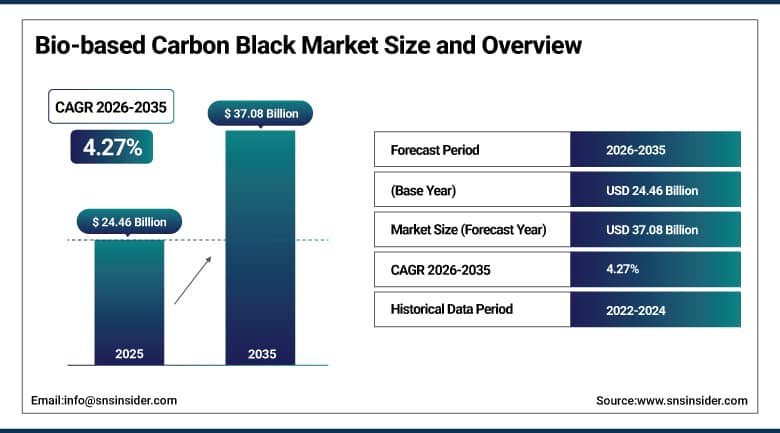
The Bio-based Carbon Black Market was valued at USD 24.46 Billion in 2025 and is expected to reach USD 37.08 Billion by 2035, growing at a CAGR of 4.27% from 2026–2035.
The global Bio-based Carbon Black Market are the increasing use of AI, demand for energy efficiency and process optimization, growing interest in green hydrogen and industrial electrification, growing use of carbon capture, utilization, and storage (CCUS), and investments in low-carbon technology. The increasing requirement to cut down greenhouse gas emissions from energy intensive industries like steel, cement, chemical and manufacturing is driving the adoption of industrial decarbonization.
In addition to this, environmental regulations, carbon pricing, corporate sustainability initiatives, and renewable energy adoption are also accelerating investment in industrial decarbonization.
In July 2026, the European Commission advanced efforts to accelerate carbon capture and storage (CCS) deployment across Europe by bringing industry stakeholders together to identify practical solutions for scaling CO₂ capture, transport, and storage. The EU is targeting 50 million tonnes of annual CO₂ injection capacity in European geological storage sites by 2030, supporting the decarbonization and competitiveness of energy-intensive industries.
To Get More Information On Bio-based Carbon Black Market - Request Free Sample Report
Bio-based Carbon Black Market Trends:
-
Growing demand for sustainable and low-carbon alternatives to conventional petroleum-based carbon black is driving the growth of the bio-based carbon black market.
-
Rising adoption of biomass-derived materials, including wood-based and industrial hemp-based feedstocks, is supporting the development and commercialization of bio-based carbon black.
-
Increasing demand for sustainable materials in tire rubber, other rubber products, plastics, and inks and coatings is accelerating the adoption of bio-based carbon black.
-
Growing emphasis on reducing the carbon footprint of tires, rubber products, and other carbon black-intensive applications is strengthening demand for bio-based alternatives.
-
Expanding investments in circular economy initiatives, renewable feedstock utilization, and sustainable material technologies are supporting the production and adoption of bio-based carbon black across various end-use industries.
U.S. Bio-based Carbon Black Market Outlook:
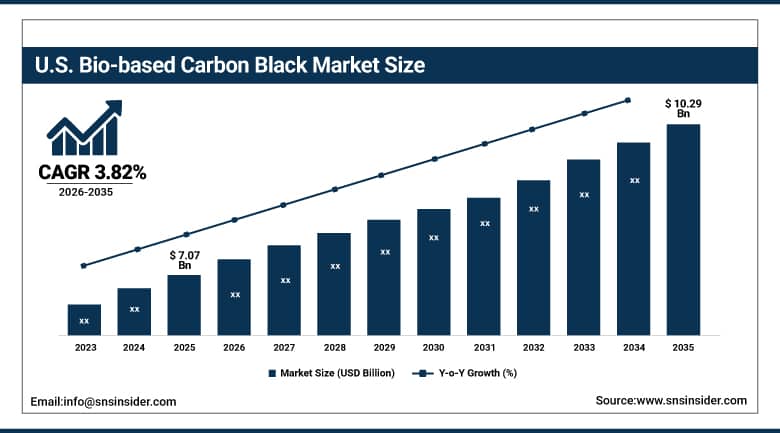
The U.S. Bio-based Carbon Black Market was valued at USD 7.07 Billion in 2025 and is expected to reach around USD 10.29 Billion by 2035, growing at a CAGR of 3.82% from 2026–2035.
Adoption of sustainable materials and low-carbon manufacturing practices is expected to support the growth of the bio-based carbon black market in the United States during the forecast period. Increasing demand for alternatives to conventional petroleum-derived carbon black is encouraging manufacturers to explore renewable biomass feedstocks, including wood residues and industrial hemp, for carbon black production. The growing emphasis on reducing the environmental footprint of tires, rubber products, plastics, inks, and coatings is further creating opportunities for bio-based carbon black adoption.
Apart from this, increasing investments in sustainable tire manufacturing, circular economy initiatives, biomass utilization, and renewable material technologies are supporting market development in the United States. Growing regulatory and corporate focus on reducing greenhouse gas emissions and improving the sustainability of material supply chains is encouraging manufacturers to evaluate bio-based carbon materials as alternatives to fossil-derived products. Advancements in biomass conversion, pyrolysis, carbonization, and material processing technologies are also expected to improve product consistency, performance, and commercial scalability, strengthening the adoption of bio-based carbon black across key end-use applications during the forecast period.
In June 2026, Origin Materials reported continued progress in its sustainable carbon black program, highlighting the development of bio-based carbon black derived from sustainable wood residues for automotive tires and mechanical rubber goods. The company stated that its carbon black development has demonstrated performance comparable with or exceeding fossil-based N660 carbon black in relevant applications, supporting its potential as a lower-carbon alternative for rubber reinforcement. The company is also continuing product development and customer qualification activities to expand the potential applications of its bio-based carbon black across tires, rubber goods, plastics, and other material applications.
Bio-based Carbon Black Market Segment Analysis
-
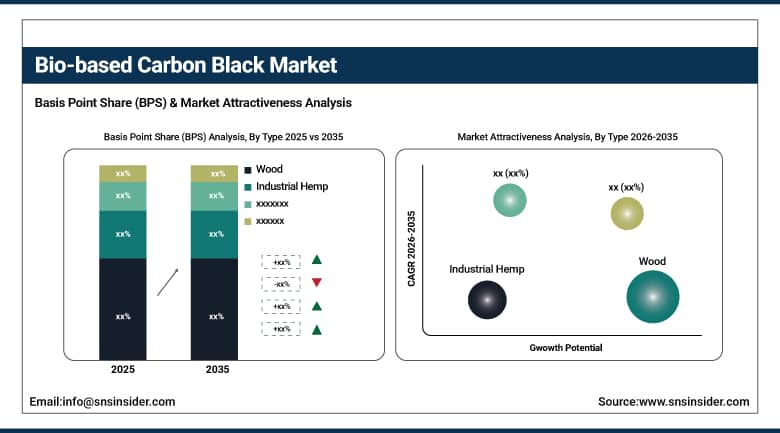
By Type, wood dominated the bio-based carbon black market with a 58.43% share in 2025, while industrial hemp is projected to be the fastest-growing segment, registering a 8.49% CAGR during 2025–2035.
-
By Application, tire rubber dominated the bio-based carbon black market with a 42.73% share in 2025, while plastic is projected to be the fastest-growing segment, registering a 8.31% CAGR during 2025–2035.
By Type, wood dominated the bio-based carbon black market, while industrial hemp is expected to grow fastest.
The wood segment dominated the bio-based carbon black market in 2025, supported by the availability of wood residues and their suitability as biomass feedstock for bio-based carbon black production. Growing utilization of forestry residues, wood waste, and other sustainable biomass resources is encouraging manufacturers to explore renewable alternatives to conventional fossil-derived carbon black. The availability of wood-based feedstocks, established biomass processing infrastructure, and increasing interest in reducing the carbon footprint of carbon black production are supporting segment growth.
Industrial hemp is expected to be the fastest-growing type segment during the forecast period. Increasing interest in agricultural residues and rapidly renewable biomass resources is creating opportunities for hemp-based carbon materials. Advancements in biomass conversion, carbonization, and pyrolysis technologies are expected to improve the scalability and consistency of industrial hemp-derived carbon black, while growing demand for sustainable materials across rubber, plastics, inks, and coatings is supporting its adoption.
By Application, tire rubber dominated the bio-based carbon black market, while ink and coating is expected to grow fastest.
The tire rubber segment dominated the bio-based carbon black market in 2025, driven by the large-scale consumption of carbon black as a reinforcing material in tire manufacturing. Increasing pressure on tire manufacturers to reduce the environmental footprint of raw materials and production processes is encouraging the evaluation of bio-based carbon black as a sustainable alternative to conventional fossil-derived grades. Growing investments in sustainable tire materials, circular manufacturing, and lower-carbon automotive supply chains are expected to support segment demand.
Ink and coating is projected to be the fastest-growing application segment during the forecast period. Increasing demand for sustainable printing inks, coatings, and specialty formulations is encouraging manufacturers to incorporate renewable carbon-based materials. Bio-based carbon black can provide pigmentation and functional properties while helping formulators reduce reliance on fossil-derived raw materials. Growing sustainability requirements across packaging, printing, industrial coatings, and consumer products are expected to create additional opportunities for bio-based carbon black during the forecast period.
Regional Analysis
|
Region |
Major Country |
Share within Region, 2025(%) |
|---|---|---|
|
North America |
United States |
82.64% |
|
Europe |
Germany |
27.84% |
|
Asia Pacific |
China |
42.42% |
|
Middle East & Africa |
Saudi Arabia |
25.24% |
|
Latin America |
Brazil |
47.58% |
North America Bio-based Carbon Black Market Insights
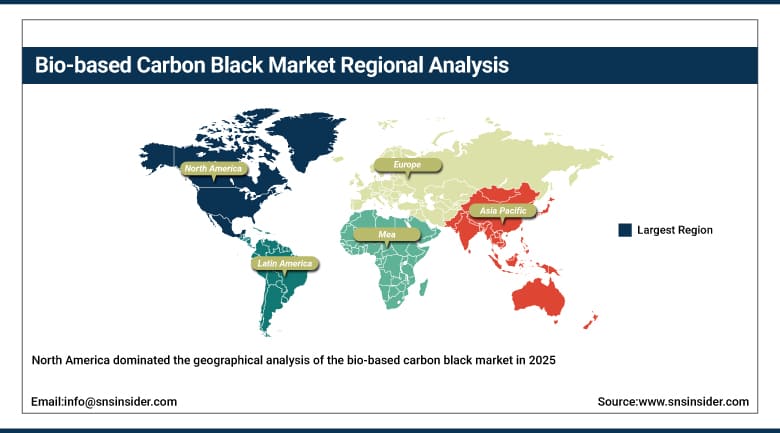
North America dominated the geographical analysis of the bio-based carbon black market in 2025, accounting for a 35.00% share of the global market. The region’s leading position is supported by growing demand for sustainable carbon materials, increasing focus on reducing the carbon footprint of tire and rubber manufacturing, and rising investments in biomass utilization and low-carbon material technologies. The presence of established automotive, tire, plastics, and specialty materials industries is creating favorable opportunities for bio-based carbon black adoption.
In terms of country-level demand, the United States held the leading position in the North American bio-based carbon black market in 2025. The country’s large automotive and manufacturing base, strong research and development capabilities, and growing corporate focus on sustainable materials are supporting market development. Canada is also witnessing increasing interest in biomass-derived materials, circular economy initiatives, and low-carbon manufacturing, which is expected to create additional opportunities during the forecast period.
Get Customized Report as Per Your Business Requirement - Enquiry Now
Europe Bio-based Carbon Black Market Insights
Europe represented a significant share of the bio-based carbon black market in 2025, supported by stringent environmental regulations, sustainability targets, and increasing demand for lower-carbon raw materials across automotive, rubber, plastics, and coatings industries. The region’s emphasis on circular economy principles, renewable feedstocks, sustainable manufacturing, and reduction of fossil-based material consumption is encouraging manufacturers to evaluate bio-based carbon black alternatives. Germany held the leading position in the European bio-based carbon black market in 2025, supported by its strong automotive and manufacturing industries, advanced materials research capabilities, and growing adoption of sustainable production practices. Investments in renewable feedstocks and low-carbon manufacturing technologies are expected to further strengthen regional demand.
Asia Pacific Bio-based Carbon Black Market Insights
Asia Pacific is expected to register the fastest growth in the bio-based carbon black market during the forecast period, with a projected CAGR of 6.94%. Rapid industrialization, expanding automotive and tire manufacturing, growing plastics production, and increasing demand for sustainable materials are supporting regional market development. Countries such as China, Japan, South Korea, and India are increasingly focusing on resource efficiency, circular economy practices, biomass utilization, and lower-carbon manufacturing.
China held the leading position in the Asia Pacific bio-based carbon black market in 2025 due to its extensive manufacturing base, large automotive and rubber industries, growing investments in sustainable materials, and increasing focus on reducing industrial emissions. The region’s expanding industrial capacity is expected to create significant opportunities for bio-based carbon black manufacturers.
Middle East & Africa and Latin America Bio-based Carbon Black Market Insights
The Middle East & Africa bio-based carbon black market is expected to witness steady growth, supported by increasing interest in sustainable materials, biomass utilization, circular economy initiatives, and low-carbon industrial development. Saudi Arabia held the largest share of the regional market in 2025, supported by its substantial industrial base, growing sustainability initiatives, and investments aimed at diversifying material and manufacturing value chains. The development of renewable resources and sustainable industrial practices is expected to create additional opportunities for bio-based carbon black applications.
Latin America is also witnessing increasing interest in bio-based materials due to its abundant biomass resources, expanding manufacturing activities, and growing emphasis on sustainable production. Brazil dominated the Latin American bio-based carbon black market in 2025, supported by its established agricultural and industrial base, extensive biomass availability, and growing adoption of renewable and circular production practices. Increasing availability of biomass feedstocks and demand for sustainable materials across rubber, plastics, inks, and coatings are expected to support regional market expansion.
Market Dynamic
Growth Driver: Rising demand for sustainable and low-carbon carbon black alternatives driving market growth
Growing emphasis on reducing the environmental impact of fossil-derived carbon black is a key driver of the bio-based carbon black market. Carbon black is widely used in tires, rubber products, plastics, inks, and coatings, creating a significant opportunity for renewable alternatives that can help reduce dependence on petroleum-based feedstocks. Increasing sustainability commitments among tire manufacturers, automotive companies, plastics producers, and specialty materials manufacturers are encouraging the evaluation of bio-based carbon black as a lower-carbon material option.
In addition, growing adoption of circular economy practices, renewable biomass utilization, and sustainable manufacturing is supporting market development. The availability of wood residues, industrial hemp, and other biomass resources provides opportunities to produce carbon-based materials through pyrolysis, carbonization, and related conversion processes. Increasing investments in sustainable tire materials, biomass conversion technologies, and low-carbon manufacturing infrastructure across North America, Europe, and Asia Pacific are expected to remain important growth drivers for the bio-based carbon black market.
Restraint: High production costs and limited commercial scalability may restrict market growth
Despite the environmental advantages of bio-based carbon black, relatively high production costs and limited commercial-scale availability may constrain market development. Producing consistent bio-based carbon black requires specialized biomass conversion, pyrolysis, carbonization, and purification processes, while variations in feedstock composition can affect product quality and performance. These factors can increase manufacturing costs compared with established petroleum-based carbon black production.
Furthermore, bio-based carbon black manufacturers face challenges related to feedstock availability, supply-chain consistency, production scalability, and achieving uniform technical specifications required by demanding applications such as tires and rubber products. Limited production capacity and the need for additional investments in processing infrastructure can also slow commercialization. The established supply chains and mature manufacturing infrastructure of conventional carbon black producers may further increase competitive pressure on emerging bio-based alternatives.
Opportunity: Growing investments in biomass conversion and sustainable materials creating new growth opportunities
Increasing investments in biomass conversion, renewable feedstocks, circular economy initiatives, and sustainable material technologies are creating significant opportunities for the bio-based carbon black market. Manufacturers are increasingly exploring wood residues, industrial hemp, and other biomass resources to develop carbon-based materials with lower environmental impacts than conventional fossil-derived carbon black. Advancements in pyrolysis, carbonization, feedstock processing, and material engineering are expected to improve product consistency, performance, and production scalability.
Growing demand for sustainable tires, rubber products, plastics, inks, and coatings is creating additional opportunities for bio-based carbon black suppliers. Automotive and tire manufacturers are increasingly evaluating lower-carbon raw materials as part of broader supply-chain sustainability initiatives. In addition, partnerships between biomass processors, material manufacturers, and end-use industries can support technology commercialization and customer qualification. Expanding circular economy programs and corporate sustainability targets across North America, Europe, and Asia Pacific are expected to further strengthen opportunities for market expansion.
Recent Developments
-
2026: Origin Materials continued advancing its bio-based carbon black program using sustainable wood residues, with ongoing product development and commercialization efforts targeting tires, rubber products, plastics, and other applications.
-
2026: Envigas continued developing biomass-based carbon materials and renewable carbon solutions, supporting the substitution of fossil-derived materials with sustainable alternatives across industrial applications.
-
2026: Nature Coatings continued expanding its bio-based carbon black and natural pigment technologies, targeting sustainable alternatives for inks, coatings, and other color-intensive applications.
-
2026: Hemp Black continued developing hemp-derived carbon materials and sustainable material solutions, supporting applications that require lower-carbon alternatives to conventional fossil-based inputs.
-
2026: Tokai Carbon Co., Ltd. continued strengthening its carbon materials capabilities and research activities, supporting the development of advanced carbon products for industrial and specialty applications.
Bio-based Carbon Black Market Key Players are:
-
Origin Materials
-
Envigas
-
Nature Coatings
-
Hemp Black
-
Tokai Carbon Co., Ltd.
-
Bolder Industries
-
Living Ink Technologies
-
Aymium
-
CarbonScape
-
Black Bear Carbon
-
Monolith
-
Mirova Materials
-
EcoCarbon
-
Circtec
-
Pyrolysis Plant Technologies
-
Birla Carbon
-
Cabot Corporation
-
Orion Engineered Carbons
-
Denka Company Limited
-
Mitsubishi Chemical Corporation
Bio-based Carbon Black Market Report Scope:
| Report Attributes | Details |
|---|---|
| Market Size in 2025 | USD 24.46 Million |
| Market Size by 2035 | USD 37.08 Million |
| CAGR | CAGR of 4.27% From 2026 to 2035 |
| Base Year | 2025 |
| Forecast Period | 2026-2035 |
| Historical Data | 2022-2024 |
| Report Scope & Coverage | Market Size, Segments Analysis, Competitive Landscape, Regional Analysis, DROC & SWOT Analysis, Forecast Outlook |
| Key Segments | • By Type (Wood, Industrial Hemp, Others) • By Application (Tire Rubber, Other Rubber Products, Non-Tire Rubber, Ink and Coating, Plastic, Others) |
| Regional Analysis/Coverage | North America (US, Canada), Europe (Germany, UK, France, Italy, Spain, Russia, Poland, Rest of Europe), Asia Pacific (China, India, Japan, South Korea, Australia, ASEAN Countries, Rest of Asia Pacific), Middle East & Africa (UAE, Saudi Arabia, Qatar, South Africa, Rest of Middle East & Africa), Latin America (Brazil, Argentina, Mexico, Colombia, Rest of Latin America) |
| Company Profiles | Origin Materials, Envigas, Nature Coatings, Hemp Black, Tokai Carbon Co., Ltd., Bolder Industries, Living Ink Technologies, Aymium, CarbonScape, Black Bear Carbon, Monolith, Mirova Materials, EcoCarbon, Circtec, Pyrolysis Plant Technologies, Birla Carbon, Cabot Corporation, Orion Engineered Carbons, Denka Company Limited, Mitsubishi Chemical Corporation |
Frequently Asked Questions
The bio-based carbon black market is expected to grow at a CAGR of approximately 4.27% from 2026 to 2035.
The bio-based carbon black market was valued at approximately USD 24.46 million in 2025.
The market is driven by increasing demand for sustainable alternatives to petroleum-derived carbon black, growing adoption of biomass-based feedstocks, and rising sustainability requirements across tire rubber, other rubber products, plastics, inks, and coatings.
Wood dominated the bio-based carbon black market in 2025, accounting for a 58.43% share,
North America dominated the bio-based carbon black market in 2025 with a 35.00% share.
