
BOPP Films Market Report Scope and Overview
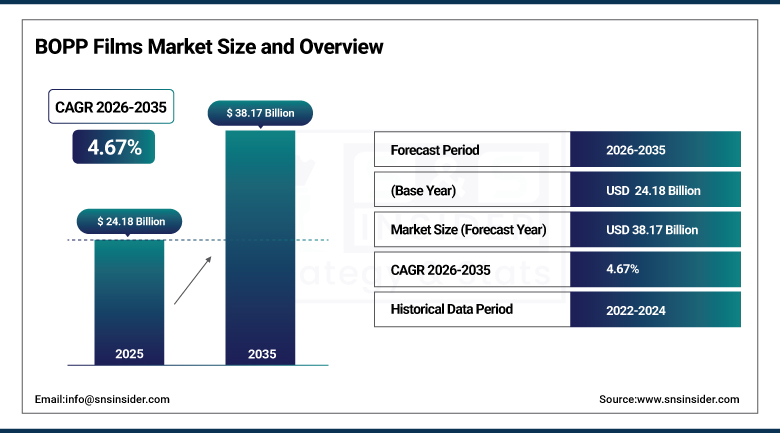
The BOPP Films Market was valued at USD 24.18 Billion in 2025 and is estimated at USD 25.31 Billion in 2026. The market is forecast to reach USD 38.17 Billion by 2035, registering a CAGR of 4.67% from 2026 to 2035. Growth reflects the wide use of biaxially oriented polypropylene in food, label, and tape applications, together with a shift toward recyclable mono-material packaging, rising packaged food consumption, and demand for metalized and capacitor grade films. Asia Pacific accounted for the largest regional share at 51.27% in 2025, while the Middle East and Africa is expected to register the fastest regional growth as new film lines and packaging plants open across the region.
To Get more information On BOPP Films Market - Request Free Sample Report
Key Market Trends & Insights
-
By type: Bags and pouches held the largest market share of 53.62% in 2025.
-
By thickness: Films of 15–30 microns held the largest market share of 41.62% in 2025.
-
By application: Food held the largest market share of 28.73% in 2025.
-
Asia Pacific accounted for the largest regional share of 51.27% in 2025.
-
The Middle East and Africa is projected to register the fastest regional CAGR of 6.41% from 2026 to 2035.
-
Producers are launching mono-polypropylene barrier films that replace multi-material laminates, along with films free of PFAS, thin gauge films, and capacitor grade films.
Growth Outlook
BOPP films are clear, stiff, light, and low in cost, and they print and laminate well, which makes them a standard material for snack packs, bakery wraps, labels, and tapes. Packaged food output keeps rising with urban incomes, and e-commerce raises demand for adhesive tapes and shipping labels. Metalized and coated grades add oxygen and moisture barriers that extend shelf life without the use of aluminum foil or mixed layers. Thin gauge and high speed grades also let converters raise output without new equipment, and the low density of polypropylene gives more packs per kilogram of film than many alternatives.
The EU Packaging and Packaging Waste Regulation began to apply on 12 August 2026 and pushes brand owners toward recyclable packaging and away from hard to recycle laminates and certain chemicals. Mono-polypropylene structures built on high barrier BOPP films suit these rules, and film makers are launching new ranges to replace polyester, PVDC, and foil layers while keeping line speeds and shelf life. Capacitor grade films add a separate demand line, since electric vehicles, solar inverters, and power electronics use thin metalized films with strict electrical properties, and producers are adding clean room slitting and metalizing capacity to serve this field.
Market Dynamics
Driver: Packaged Food Growth and Recyclable Mono-Material Packaging Support Demand
Snacks, confectionery, bakery, and instant foods are growing quickly in Asia, Africa, and Latin America, and BOPP is the main film for flow wrap and pouch packs in these categories. It offers clarity, stiffness, printability, and heat seal range at a lower price than many other films, and converters can run it at high speed on existing lines. Retailers and quick service chains also favor clear, glossy packs that show the product, and BOPP supports bright print with low ink use, which helps brands win shelf appeal in crowded snack aisles.
Brand owners are also redesigning packs toward a single polymer to meet recycling rules, and mono-polypropylene laminates that use BOPP for both outer and inner layers fit this goal. Labels, adhesive tapes, and capacitor films add steady volume, since they rely on the strength, thin gauge, and electrical properties of the film, which supports demand across many industries. Rising incomes in India, Southeast Asia, and Africa raise per person use of packaged goods, and new local converters and film lines shorten supply chains, which lowers freight cost and helps film makers win orders from regional food brands.
Restraint: Polypropylene Price Swings, Overcapacity, and Recycling Limits Weigh on Margins
BOPP film prices follow polypropylene resin prices, which move with crude oil, propylene supply, and plant outages. Film makers often cannot pass on cost swings quickly, and new lines in China, India, Turkey, and the Middle East have led to periods of oversupply that pressure prices and utilization. Anti-dumping duties and trade measures in some markets also change flows of film between regions and can disrupt supply contracts. Smaller producers with older lines face higher energy and labor cost per ton, and some have cut output or closed plants during weak periods.
Rules and brand goals that favor recycled content, reuse, and paper based packaging also create pressure, and collection systems for flexible films remain weak in many countries. Metalized and multi-layer structures can be hard to recycle, and producers must invest in new barrier coatings and testing to keep customers who are changing their packaging. Competition from polyethylene based mono-material films, paper laminates, and compostable films also affects some applications, and brand owners may delay switching while recycling rules and design standards continue to evolve in different regions. Energy cost also adds pressure.
Opportunity: High Barrier Mono-Material Films, Capacitor Grades, and Emerging Market Capacity Open New Revenue
High barrier BOPP films with thin water based or inorganic coatings can replace polyester, PVDC, and aluminum foil layers in many dry food and liquid food packs, and suppliers with approved structures can win long supply contracts with large brand owners. Films free of PFAS and with recycled content add further options as rules tighten in Europe and North America. Pharmaceutical, medical device, and personal care packaging add steady demand for clean, high clarity films, and thin gauge grades help brand owners meet material reduction goals. Suppliers can also earn higher margins through coating technology and customer co-development.
Capacitor grade and metalized films for electric vehicles, renewable power, and electronics offer higher value than packaging films, and several producers are adding specialized lines. Demand in Africa, the Middle East, and Southeast Asia is also growing faster than local supply, which opens room for new plants and for imports from larger producers. Joint ventures with local converters and brand owners, and investment in recycled content programs, offer further routes to growth in regions where demand is growing faster than local supply. Local plants also reduce freight cost and delivery time for food brands.
Market Characteristics & Concentration
The BOPP Films Market is Moderately Consolidated. A group of global and regional producers from Europe, India, Turkey, China, and the United States hold a major share through large line capacity, resin purchasing scale, and close ties with converters and brand owners, while smaller producers serve local markets. Scale, line speed, and the ability to supply coated and metalized grades shape competitive position.
The level of merger and acquisition activity is moderate. Ownership changes, restructurings, and site relaunches occur as producers adjust to resin costs and overcapacity, and larger groups add lines through expansion rather than takeovers. Customer approvals for food contact and high barrier structures create barriers for new entrants. Smaller producers often rely on long term resin supply agreements and local customers to remain competitive.
Regional expansion is led by Indian and Middle Eastern producers adding lines near growing demand, and by European firms that focus on specialty and recyclable films. Direct supply to converters and brand owners, together with distributors for smaller buyers, shapes access to the market. Technical service, rapid sampling, and short lead times help suppliers keep customers.
Analyst Perspective
BOPP films remain a workhorse of flexible packaging, but the basis of competition is changing. Price per kilogram still matters, yet buyers now ask whether a film can replace a multi-material laminate, pass recycling design rules, and run at high line speed. Producers with approved high barrier mono-material structures, controlled raw material costs, and capacity close to demand will take a larger share of new volume through 2035. Asia will remain the production center, while Africa and the Middle East offer the fastest growth. An SNS Insider Analyst, Santosh Bhul, commented, "BOPP films are no longer chosen only for cost. Buyers want recyclable, high barrier structures that run on existing lines, and the producers that deliver them will lead the next phase of growth."
Segment Analysis
Type Insights
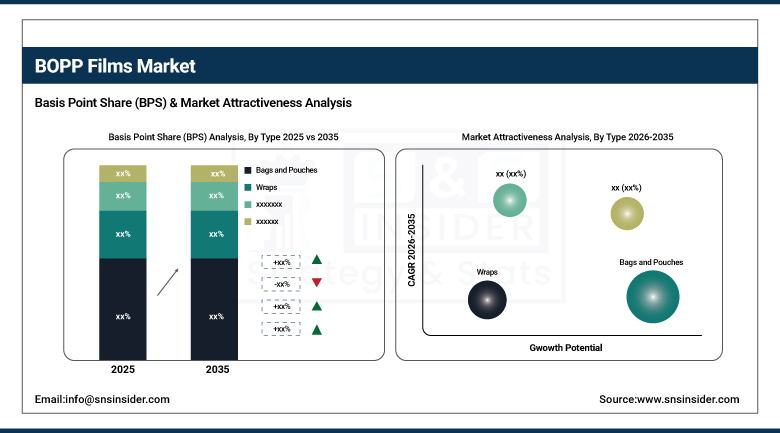
Bags and pouches accounted for the largest share of 53.62% in 2025. BOPP is the standard film for snack, biscuit, bakery, and confectionery packs, and for laminated pouches that hold dry and liquid foods, because it combines clarity, stiffness, printability, and a wide heat seal range. Growth in packaged food, along with the move to mono-material laminates, keeps this type at the center of purchases across all regions. Wraps, tapes, and other types follow, and tapes in particular rely on the strength and low cost of the film.
Labels are expected to register the highest CAGR of 6.27% between 2026 and 2035. BOPP labels can be used for beverages, personal care items, household products, and packaging. They provide a transparent no label look, moisture resistance, and high printability. E-commerce, private labels, and shrink and wrap around labels are contributing to faster growth than other varieties. Wrapping flowers, books, and consumer products also contribute to demand, and manufacturers of tapes find it useful due to its strength, minimal stretching capacity, and adhesive compatibility.
Thickness Insights
Films of 15–30 microns held the largest share of 41.62% in 2025. This range balances stiffness, barrier, and cost for the main flexible packaging uses, including snack and bakery wraps, laminates, and tapes, and it runs well on high speed packing machines. Wide supply from many producers and well known converting practices keep these grades in steady demand. Films above 30 microns serve heavier duty uses such as tapes and thick laminates. Converters value consistent gauge control from supplier lines, since small variation can cause jams and waste on fast packing machines.
Films below 15 microns are projected to expand at the fastest CAGR of 6.34% from 2026 to 2035. Thin gauge films cut material use per pack, support source reduction goals, and suit capacitors, cigarette overwrap, and thin laminates. Capacitor grade films of only a few microns add higher value, and brand owners are lowering film weight to meet packaging reduction targets. Producers are also investing in thinner and stiffer grades. Tighter gauge control and stiffer resins make these films more practical on fast lines, and several producers have launched downgauged lines.
Application Insights
The largest share belonged to food, which occupied 28.73%, including snacks, bakery, confectionery, dairy, frozen, and ready meals. BOPP is used in food due to its clarity, printability, and moisture resistance; while metalized and coated BOPP extends shelf life. The growth of packaged and convenient food in Asia, Africa, and Latin America will be a factor for constant demand through the forecast period. Next in line will be the personal care, cosmetic, and electrical applications, which include capacitor films in volumes with higher value. Printing performance, odour control, and food contact are buying criteria in this application.
Pharmaceutical and healthcare is predicted to have the highest CAGR of 7.03% between 2026 and 2035. Blister lidding, sachets, strip packing, and medical device wrapping require BOPP for its cleanliness, moisture resistance, and printability; the growth in generics production in India and Southeast Asia will drive the demand for the material. Higher demands on safety and traceability in pharmaceutical packaging will be a factor that increases the use of premium grades. Also, e-commerce and personal care products will increase the scope of print and clear film applications.
Regional Insights
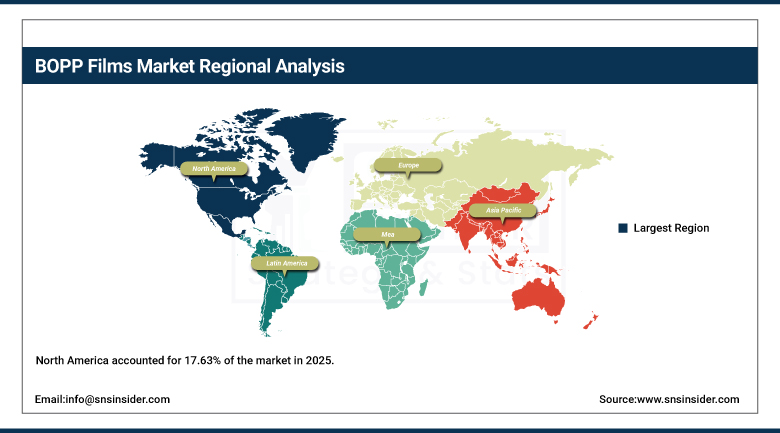
North America accounted for 17.63% of the market in 2025. The region has a mature flexible packaging sector, large snack and consumer goods companies, and a strong label and tape industry, and it relies on both local production and imports of specialty films. Demand is led by food packaging, labels, and tapes. Canada adds demand from food processing and packaging converters, and Mexico is reported within Latin America. Demand for recyclable and PFAS-free grades is rising.
Get Customized Report as per Your Business Requirement - Enquiry Now
U.S. BOPP Films Market
The U.S. BOPP Films Market size stood at USD 3.50 billion in 2025 and is estimated to grow at a CAGR of 3.96% between 2026 and 2035. Consumer demand from packaging applications such as snacks, bakeries, confectioneries, labeling, and tapes is driving this growth, with converters increasingly opting for recyclable laminations driven by both state regulations in packaging and the ambitions of brands. Imports from Asian and Middle Eastern regions pose competition to the U.S.-produced materials, as well as new rules in extended producer responsibility regulations.
Europe BOPP Films Market
Europe is responsible for the share of 16.82% in 2025. Germany, Italy, France, Turkey, and United Kingdom have high demand for the material within the region. Europe is the regional leader in design for recyclability, with Packaging and Packaging Waste Regulation coming into effect on 12 August 2026. European manufacturers are focusing on mono-material barrier films, non-PFAS grades, specialty films, capacitor films, as well as relaunching their Neunkirchen production site under the Polyopt name.
Asia Pacific BOPP Films Market
Asia Pacific held the largest regional share of 51.27% in 2025. China is the largest producer and consumer, with many film lines serving food, tape, and label makers, and India has become a major producer and exporter as local firms add capacity. Government support for packaging and chemicals manufacturing also draws investment in new lines. Local resin supply supports low cost output.
Southeast Asia and Japan add demand from packaged food and electronics, and Indian producers are adding lines for specialty and capacitor films. The region is also the main source of exports to Africa, the Middle East, and Europe, and high local competition keeps prices under pressure. Large capacity additions across the region keep competition high. Exports to Africa and the Middle East continue to grow.
Latin America BOPP Films Market
Latin America held 6.94% of the market in 2025, led by Brazil, Mexico, and Argentina. Demand comes from snack, bakery, and beverage packaging, and the region relies on both local lines and imports. Currency swings and resin costs affect margins, although rising packaged food consumption and local converting capacity support steady growth in the region. Local converters are adding barrier laminates.
Middle East & Africa BOPP Films Market
The Middle East and Africa accounted for 7.34% of the market in 2025 and is projected to register the fastest regional CAGR of 6.41% from 2026 to 2035. Demand is led by Turkey, Saudi Arabia, the United Arab Emirates, Egypt, and South Africa, where packaged food, population growth, and new converting plants lift consumption. Gulf and Turkish producers are adding BOPP lines near resin supply, and Africa imports a large share of its film.
Key BOPP Films Market Company Insights
Companies in the BOPP films market are focusing on high barrier mono-material films, PFAS-free grades, capacitor and metalized films, and added line capacity close to demand. Large producers compete on scale, coating technology, and customer approvals, while smaller firms compete on price and service.
Key BOPP Films Companies:
-
Cosmo First Limited
-
Taghleef Industries
-
Jindal Films Europe
-
UFlex Limited
-
SRF Limited
-
Innovia Films
-
Polyplex Corporation Limited
-
Toray Plastics (America), Inc.
-
Nan Ya Plastics Corporation
-
Chiripal Poly Films Limited
-
Polibak Plastik Film Sanayi ve Ticaret A.S.
Recent Developments
-
In August 2026, the EU Packaging and Packaging Waste Regulation began to apply across member states, pushing flexible packaging users toward recyclable mono-material structures and limiting certain substances such as PFAS in food-contact packaging.
-
In May 2026, Jindal Films Europe launched an expanded range of BOPP print, barrier, and sealing films at Interpack in Düsseldorf, designed to replace non-recyclable multi-material laminates with mono-polypropylene structures.
-
In February 2026, Taghleef Industries announced a move to raw materials with no intentionally added PFAS across its BOPP film portfolio for flexible packaging and labels.
-
In January 2026, the former Treofan site in Neunkirchen, Germany, was relaunched as Polyopt after AGP Holdco took full operational control, with plans to restore capacitor film production and strengthen specialty BOPP supply.
-
In June 2025, Cosmo First commissioned a new BOPP line at its Aurangabad facility in India, adding 81,200 metric tons of annual capacity and raising total BOPP capacity by about 40.00%.
Scope and Research Methodology
The study defines the BOPP Films Market as the revenue generated by the sale of biaxially oriented polypropylene films produced by the tenter or tubular processes, including transparent, white, metalized, and coated grades, sold to converters, brand owners, and electrical component makers for packaging, labels, tapes, and capacitors. Cast polypropylene films, polyester and polyethylene films, and finished packaging are outside the scope. The base year is 2025, the forecast period runs from 2026 to 2035, and all values are expressed in USD. The segmentation covers type, thickness, application, and region, along with leading countries in each region. Mexico is reported within Latin America.
The research program combines secondary and primary research. Secondary research draws on company annual reports and filings, polypropylene resin and film trade statistics, packaging and food production data, regulator releases, patent filings, and industry publications. Primary research consists of structured interviews and surveys with film producers, resin suppliers, converters, brand owners, label and tape makers, and distributors. These discussions validate assumptions on line capacity and utilization, price per kilogram, grade mix, and adoption of recyclable structures, and responses are weighted by the seniority and relevance of each respondent. Multiple cross checks are run before any figure is released.
Market engineering follows a bottom-up build from film capacity, utilization, and prices by region, cross-checked top-down against packaged food output, label and tape consumption, and producer revenues. Triangulation across both approaches narrows differences before values are finalized. Forecasts reflect drivers such as packaged food growth, recycling rules, resin costs, and new line capacity, and every estimate passes through an analyst quality review that tests consistency across segments, regions, and years. Sensitivity checks test the effect of changes in polypropylene prices, line utilization, and adoption of mono-material packaging, and regional estimates are aligned so that country values add to regional totals and regional totals add to the global value.
BOPP Films Market Report Scope:
| Report Attributes | Details |
|---|---|
| Market Size in 2025 | USD 24.18 Billion |
| Market Size by 2035 | USD 38.17 Billion |
| CAGR | CAGR of 4.67% From 2026 to 2035 |
| Base Year | 2025 |
| Forecast Period | 2026-2035 |
| Historical Data | 2022-2024 |
| Report Scope & Coverage | Market Size, Segments Analysis, Competitive Landscape, Regional Analysis, DROC & SWOT Analysis, Forecast Outlook |
| Key Segments | • By Type (Bags and Pouches, Wraps, Tapes, Labels, and Others) • By Thickness (Below 15 Microns, 15–30 Microns, and Above 30 Microns) • By Application (Food, Personal Care and Cosmetics, Pharmaceutical and Healthcare, Electrical and Electronics, and Others) |
| Regional Analysis/Coverage | North America (US, Canada), Europe (Germany, UK, France, Italy, Spain, Russia, Poland, Rest of Europe), Asia Pacific (China, India, Japan, South Korea, Australia, ASEAN Countries, Rest of Asia Pacific), Middle East & Africa (UAE, Saudi Arabia, Qatar, South Africa, Rest of Middle East & Africa), Latin America (Brazil, Argentina, Mexico, Colombia, Rest of Latin America). |
| Company Profiles | Cosmo First Limited, Taghleef Industries, Jindal Films Europe, UFlex Limited, SRF Limited, Innovia Films, Polyplex Corporation Limited, Toray Plastics (America), Inc., Nan Ya Plastics Corporation, Chiripal Poly Films Limited, Polibak Plastik Film Sanayi ve Ticaret A.S. |

Frequently Asked Questions
The market was valued at USD 24.18 Billion in 2025 and is projected to reach USD 38.17 Billion by 2035.
The market is expected to register a CAGR of 4.67% from 2026 to 2035.
Asia Pacific led the market with a 51.27% share in 2025.
The Middle East and Africa is expected to grow the fastest, at a CAGR of 6.41% from 2026 to 2035.
Bags and pouches led the type segment with a 53.62% share in 2025, and food led the application segment.
