
Bromobenzene Market Report Scope & Overview:
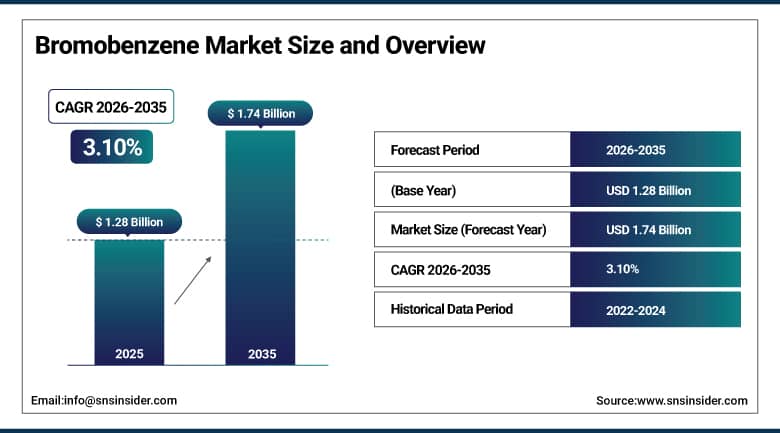
The Bromobenzene Market was valued at USD 1.28 Billion in 2025 and is expected to reach USD 1.74 Billion by 2035, growing at a CAGR of 3.10% from 2026-2035.
The Bromobenzene Market is anticipated to experience growth owing to the rising demand for bromobenzene as a chemical intermediate in the production of pharmaceuticals, agrochemicals, and specialty chemicals. Being used in Grignard reactions and other synthetic chemical processes, the product receives demand from research laboratories and chemical manufacturers. Growth in the pharmaceutical sector and the production of active pharmaceutical ingredients can lead to increased consumption of the chemical. The growth of the agrochemical sector is also expected to drive the demand for bromobenzene in the production of crop protection chemicals. In addition, rising applications in dyes, specialty chemicals, and fine chemicals can further aid in market growth. Improvements in the chemical manufacturing industry and growing investments in specialty chemicals are expected to fuel market growth.
⮞New intermediate capacity is coming online in India. In April 2025, Harana Organics began commercial production at Phase-I of its Saykha unit in Gujarat, with capacity of about 6,000 metric tons per year. The plant makes chemical intermediates, including bromobenzene-related products, reflecting the push by Indian producers to serve pharmaceutical and agrochemical customers.
To Get More Information On Bromobenzene Market - Request Free Sample Report
Bromobenzene Market Trends
-
Growing use of bromobenzene as a Grignard reagent precursor in active pharmaceutical ingredient synthesis
-
Capacity expansion by Indian and Chinese intermediate producers
-
Rising demand for high-purity grades in research, OLED and electronic materials
-
Backward integration with bromine supply by large specialty chemical companies
-
Stricter environmental and handling standards for brominated chemicals
U.S. Bromobenzene Market Outlook:
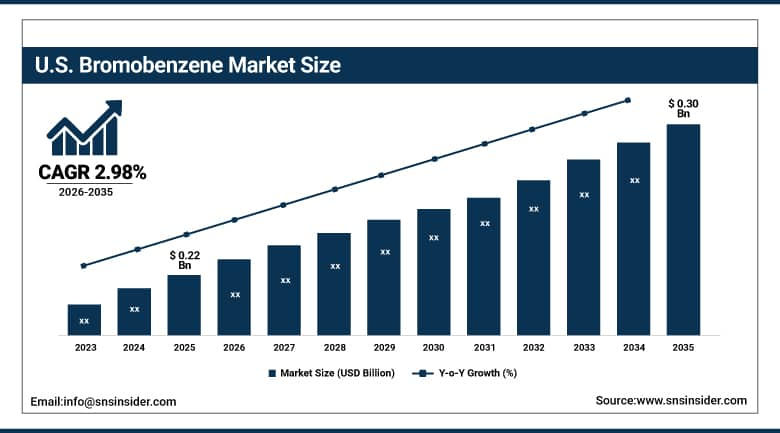
The U.S. Bromobenzene Market was valued at USD 0.22 Billion in 2025 and is expected to reach USD 0.30 Billion by 2035, growing at a CAGR of 2.98% from 2026-2035.
The U.S. Bromobenzene Market is anticipated to expand due to increased demand for specialty chemicals and pharmaceutical intermediates throughout the country. Bromobenzene finds application in organic synthesis reactions, specifically Grignard reactions and preparation of intermediates for pharmaceuticals, agrochemicals, and fine chemicals. Further research in pharmaceuticals, drug development, and domestic chemical manufacture will drive the demand for the product. There are existing chemical manufacturers, research organizations, and advanced manufacturing units in the country, which would aid in market growth. Moreover, increasing demand for specialty chemicals and applications in chemical synthesis will create prospects for bromobenzene producers. However, environmental regulations, safety at workplace, and volatile prices of raw materials can act as barriers to market growth.
⮞Isotope-labeled grades are tied to electronics demand. In 2020, Cambridge Isotope Laboratories expanded its benzene and bromobenzene capacity in Xenia, Ohio, to meet demand for bromobenzene-d5 driven by OLED production. The expansion illustrates how local specialty capacity serves high-value research and display applications.
Bromobenzene Market Segment Analysis
-
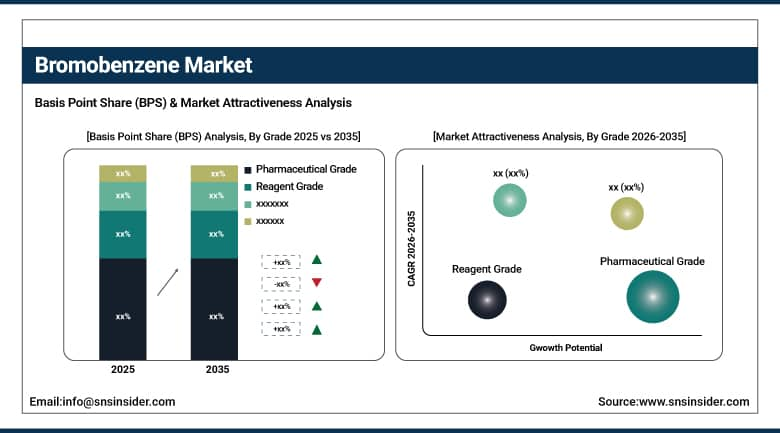
By Grade, pharmaceutical grade segment dominated the Bromobenzene Market in 2025 with 44.80% share; reagent grade segment is the fastest-growing segment, with an estimated CAGR of 5.60% during 2026–2035.
-
By Application, solvent segment dominated the Bromobenzene Market in 2025 with 36.10% share; Grignard reagent segment is the fastest-growing segment, with an estimated CAGR of 4.50% during 2026–2035.
-
By End Use, pharmaceuticals segment dominated the Bromobenzene Market in 2025 with an estimated 41.00% share, and is also the fastest-growing segment, with an estimated CAGR of 5.40% during 2026–2035.
By Grade, Pharmaceutical Grade Dominates Bromobenzene Market; Reagent Grade to Register Fastest Growth.
Pharmaceutical grade dominates the Bromobenzene Market because drug makers require tightly specified, high-purity material for the synthesis of active ingredients and intermediates. Buyers qualify suppliers through audits, impurity profiling and documentation, which creates long-term relationships and supports premium pricing. Contract development and manufacturing organizations in India, China and Europe purchase most of this grade, and regulatory expectations for traceability favor established producers with consistent batch quality. Manufacturers also benefit from the ability to supply the same intermediate to several customers from a single qualified plant, which spreads fixed quality costs across larger volumes.
Reagent grade is projected to register the fastest growth as research laboratories, academic institutions and specialty chemical developers expand synthesis work that relies on Grignard chemistry. Small-volume, high-purity packages sell at much higher prices per kilogram than bulk material and are supplied by catalog companies such as Merck KGaA, Tokyo Chemical Industry and Spectrum Chemical. Industrial grade serves agrochemical, dye and polymer producers where cost matters more than ultra-high purity. Online catalog sales and stocking agreements with distributors help smaller buyers obtain consistent material without long lead times.
By Application, Solvent Dominates Bromobenzene Market; Grignard Reagent to Register Fastest Growth.
Solvent use accounts for the largest share of the Bromobenzene Market because the compound dissolves a wide range of organic substances and is used as a high-boiling reaction medium in laboratories and chemical plants. Its stability and relatively low reactivity make it suitable for processes that run at elevated temperatures, and it is used in extraction and in the preparation of organometallic compounds. Established process knowledge keeps volumes steady across fine chemical producers. Specialty suppliers also package the material in stabilized, moisture-controlled containers for laboratory customers, adding value beyond the raw chemical. Producers with captive bromine can offer more stable pricing, which strengthens relationships with large buyers.
Grignard reagent production is projected to register the fastest growth because phenylmagnesium bromide is a key building block for carbon-carbon bond formation in pharmaceuticals, agrochemicals and fragrances. Rising drug synthesis activity, including active ingredients for oncology and central nervous system therapies, increases consumption. Chemical intermediate applications for dyes, resins and flame retardants provide additional stable demand, while specialty uses in electronics and isotope-labeled compounds add small but high-value volumes. Process developers are working to recycle bromide streams to reduce waste and improve economics for large users. Specialty reagent suppliers also sell ready-made Grignard solutions, which broadens the use of bromobenzene in smaller laboratories.
By End Use, Pharmaceuticals Dominate Bromobenzene Market and Are Also the Fastest-Growing End Use.
Pharmaceuticals dominate the Bromobenzene Market because the compound is a versatile intermediate in the synthesis of many active ingredients, and drug manufacturing consumes it in large, regular volumes. Growth in generic drug production, outsourcing of synthesis to contract manufacturers and rising global demand for medicines supports steady purchasing. Producers in India and China have invested in multi-purpose plants that can switch between products, giving them flexibility to serve pharmaceutical customers. Regulatory filings for drugs name specific suppliers and routes, so changes in sourcing can take months of validation, which protects incumbent producers.
Pharmaceuticals are also expected to be the fastest-growing end use as innovator companies move more small-molecule work to Asia and as supply chain diversification programs add regional capacity. Agrochemicals remain the second major outlet, supported by herbicide and fungicide intermediates, while dyes, polymers and specialty chemicals provide diversified demand. Electronic materials, including OLED precursors, create a small but fast-expanding premium segment for very high purity grades. The move toward continuous manufacturing in pharmaceuticals could further favor suppliers with reliable bulk deliveries and consistent quality.
Regional Insights
|
Region |
Major Country |
Share within Region, 2025 (%) |
|
Asia Pacific |
China |
48.00% |
|
North America |
United States |
78.00% |
|
Europe |
Germany |
30.00% |
|
Latin America |
Brazil |
46.00% |
|
Middle East & Africa |
Saudi Arabia |
27.00% |
Asia Pacific Bromobenzene Market Insights
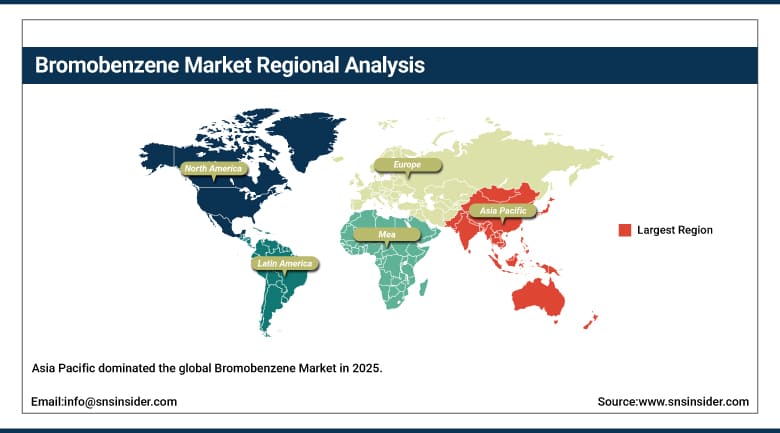
Asia Pacific dominated the global Bromobenzene Market in 2025 and is projected to remain the fastest-growing region during the forecast period. Regional growth is driven by expanding pharmaceutical and agrochemical manufacturing, rising demand for specialty chemicals, and increasing investments in chemical production facilities. China benefits from its extensive chemical manufacturing infrastructure and strong industrial supply chains, while India is experiencing growing demand for pharmaceutical intermediates and fine chemicals. Japan and South Korea contribute through advanced chemical applications and high-purity reagent demand.
Low production costs, access to bromine and benzene feedstocks, and large pharmaceutical and agrochemical manufacturing bases support regional leadership. In April 2025, Harana Organics started commercial production at its Saykha unit in Gujarat, adding capacity of about 6,000 metric tons per year. Environmental inspections in China and the need to meet global quality standards are encouraging consolidation toward larger, better-equipped producers. Government support for pharmaceutical and fine chemical clusters in India, including production-linked incentives, further encourages new plants and upgrades to existing facilities.
Get Customized Report as Per Your Business Requirement - Enquiry Now
North America Bromobenzene Market Insights
North America is the second-largest region. The United States accounts for about 78.00% of regional demand, supported by pharmaceutical research, fine chemical manufacturing and a strong base of laboratory suppliers such as Spectrum Chemical, Albemarle and Cambridge Isotope Laboratories. Canada and Mexico add demand through pharmaceutical and agrochemical production. Canada contributes through its pharmaceutical contract research sector, and Mexico adds demand from agrochemical formulation and generic drug production serving the wider region.
Regional buyers emphasize supply security, documentation and compliance with environmental and workplace safety rules, which favors qualified suppliers. Many commodity intermediates are imported from Asia, but manufacturers are exploring regional sourcing for strategic compounds. Demand for isotope-labeled and ultra-high-purity grades used in research and electronics provides higher-value opportunities that partly offset slower volume growth. Local manufacturing initiatives for critical medicines in the United States could, over time, lead to more regional demand for intermediates and for qualified local suppliers.
Europe Bromobenzene Market Insights
Europe is a mature region because Germany, United Kingdom, France and Switzerland host significant pharmaceutical and specialty chemical production, and companies such as LANXESS, Merck KGaA and Manchester Organics supply bromine-based intermediates and research chemicals. Strong regulatory oversight shapes the market and supports high quality standards. Switzerland, Belgium and the Netherlands add demand through pharmaceutical and fine chemical plants, while Eastern European countries are growing as lower-cost production locations. Ireland also hosts pharmaceutical plants.
The REACH framework and wider chemical safety rules add compliance cost, encouraging producers to focus on high-value grades and to optimize processes for lower emissions. Pharmaceutical customers value European supply for reasons of traceability and short lead times, although cost competition from Asia limits volume growth. Investment in custom synthesis and research chemicals continues to anchor regional demand. Manufacturers also face rising energy costs, which have encouraged investment in more efficient distillation and in heat recovery to protect margins. Producers also stress safety performance.
MEA & Latin America Bromobenzene Market Insights
In Latin America, Brazil leads on the strength of its agrochemical and pharmaceutical industries, followed by Argentina and Mexico. Agricultural expansion and generic drug manufacturing support steady consumption. Argentina and Colombia contribute demand through crop protection formulation and growing pharmaceutical production, and regional distributors play a key role in connecting international producers with local formulators. The Gulf countries continue to invest in industrial zones that attract chemical processing, and Egypt and Turkey are growing as regional hubs for pharmaceutical and agrochemical production.
In the Middle East and Africa, Saudi Arabia, the United Arab Emirates and South Africa are building pharmaceutical and chemical capacity, supporting growth of about 3.10% annually. Dependence on imports, limited local fine chemical capabilities and smaller end markets restrict volumes, but investment programs aimed at diversifying away from hydrocarbons are creating selective opportunities. Currency volatility and import dependence can affect purchasing patterns in several countries, but long-term growth in agricultural exports and drug manufacturing supports demand. Imports from Asia and Europe remain the main supply source, and training programs for chemical engineers are expected to support gradual expansion of local capabilities.
Market Dynamics
Growth Drivers: Pharmaceutical Synthesis, Agrochemicals and Specialty Applications
Expansion of pharmaceutical manufacturing is the main driver of the Bromobenzene Market. Many active ingredients are made through Grignard and coupling reactions that start from aromatic bromides, so growth in generic drugs and contract manufacturing translates directly into higher consumption. Outsourcing of synthesis to Asia and diversification of supply chains broaden the buyer base for qualified producers. Growth in global healthcare spending and generic drug approvals reinforces this trend. Rising investment in research and development by pharmaceutical firms keeps demand for reaction intermediates growing.
Agrochemical production adds a second source of demand, as herbicides, fungicides and insecticides rely on aromatic intermediates, and rising food production needs support steady output. Emerging uses in OLED materials, isotope-labeled compounds and specialty polymers create higher-value demand for very high purity grades and give producers room to improve margins. Higher demand from electronic materials producers, who need very pure aromatic compounds for display and semiconductor chemistry, provides an additional growth path for specialty suppliers over the coming decade. Rapid growth in contract research and custom synthesis in Asia further expands the number of buyers of small and mid-sized lots.
Restraints: Environmental Regulation, Raw Material Costs and Handling Risks
The product is labeled as a dangerous chemical, and regulation of brominated products, emissions, and waste streams increases compliance costs for manufacturers. Environmental inspection in major manufacturing nations may reduce production activity, and stringent shipping and storing regulations increase costs, especially for small manufacturers lacking sophisticated safety systems. Liability and worker protection issues further increase operational costs and need continuous investment in monitoring systems. Logistics companies' and small distributors' cost for insurance and liability for transporting brominated products further complicate the situation.
Product prices are dependent on benzene and bromine, both of which face cyclical fluctuations, and manufacturers find it difficult to pass increased costs quickly to consumers. The competition of the product with substitute products and alternative reagents in certain applications also restrains growth, along with overcapacity in commodity products. Regulated industries' demand for detailed information about contamination and source further increases burden for small manufacturers.
Opportunities: High-Purity Grades, Capacity Investment and Process Innovation
Grades for pharmaceuticals, electronics, and research purposes are highly profitable, are less affected by commodity fluctuations, and have an attractive margin. Manufacturers who are willing to spend money on purification and documentation can secure long-term contracts with pharma companies and laboratory suppliers. Digital process monitoring and automation can help to increase yields, decrease waste, and be more consistent, providing manufacturers with competitive advantage over low-cost foreign competitors. Partnership with universities and contract research organizations will help to develop new applications and generate demand for specialty grades.
Increasing capacity, like building the Saykha facility in 2025, and decreasing waste and energy consumption will increase competitiveness. Backward integration to bromine and cooperation with contract manufacturers are other ways to assure supply and higher profitability during the forecast period. Cooperation between Indian and Chinese manufacturers and global pharma companies will help to establish joint ventures with separate production lines, securing volumes and utilization rate.
Recent Developments
-
In May 2025, Albemarle highlighted an expanded range of synthesis tools for pharmaceutical production and chemical research. The extension supports its position as a bromine-based specialty chemical supplier.
-
In 2025, Aarti Industries added multi-purpose manufacturing facilities and research-based product development programs. The investments strengthen its position in pharmaceutical and agrochemical intermediates.
-
In 2025, LANXESS continued investing in its bromine production network, technology centers and custom synthesis capabilities. The activity supports supply of bromine-derived intermediates to specialty chemical customers.
-
In 2025, Merck KGaA continued expanding its specialty research chemicals and laboratory reagent portfolio. The expansion supports availability of high-purity reagent grades for research customers.
Bromobenzene Companies are:
-
Chemcon Speciality Chemicals Limited
-
Chemical Systems and Control Products Limited (CSCPL)
-
Sinochem Nanjing Corporation
-
Hangzhou Leap Chem Co., Ltd.
Bromobenzene Market Report Scope:
| Report Attributes | Details |
|---|---|
| Market Size in 2025 | USD 1.28 Billion |
| Market Size by 2035 | USD 1.74 Billion |
| CAGR | CAGR of 3.10% From 2026 to 2035 |
| Base Year | 2025 |
| Forecast Period | 2026-2035 |
| Historical Data | 2022-2024 |
| Report Scope & Coverage | Market Size, Segments Analysis, Competitive Landscape, Regional Analysis, DROC & SWOT Analysis, Forecast Outlook |
| Key Segments | • By Grade (Pharmaceutical Grade, Industrial Grade, and Reagent Grade) • By Application (Solvent, Chemical Intermediate, Grignard Reagent, and Others) • By End Use (Pharmaceuticals, Agrochemicals, Dyes and Polymers, and Others) |
| Regional Analysis/Coverage | North America (US, Canada), Europe (Germany, UK, France, Italy, Spain, Russia, Poland, Rest of Europe), Asia Pacific (China, India, Japan, South Korea, Australia, ASEAN Countries, Rest of Asia Pacific), Middle East & Africa (UAE, Saudi Arabia, Qatar, South Africa, Rest of Middle East & Africa), Latin America (Brazil, Argentina, Mexico, Colombia, Rest of Latin America). |
| Company Profiles | Chemcon Speciality Chemicals Limited, Manas Petro Chem, Chemical Systems and Control Products Limited (CSCPL), Sinochem Nanjing Corporation, Yancheng Longshen Chemical Co., Ltd., Hangzhou Leap Chem Co., Ltd. |

Frequently Asked Questions
Key players include Chemcon Speciality Chemicals Limited, Manas Petro Chem, Chemical Systems and Control Products Limited (CSCPL), Sinochem Nanjing Corporation, Yancheng Longshen Chemical Co., Ltd., Hangzhou Leap Chem Co., Ltd.
Key players include Chemcon Speciality Chemicals Limited, Manas Petro Chem, Chemical Systems and Control Products Limited (CSCPL), Sinochem Nanjing Corporation, Yancheng Longshen Chemical Co., Ltd., Hangzhou Leap Chem Co., Ltd.
Key opportunities include high-purity grades for pharmaceuticals and electronics, capacity expansion in India and China, and backward integration with bromine supply.
The major growth factor is rising pharmaceutical and agrochemical synthesis, where bromobenzene serves as an intermediate and Grignard reagent precursor.
By Grade, the Pharmaceutical Grade segment dominated the market in 2025, supported by demand for high-purity intermediates in drug synthesis.
