
Advanced Semiconductor Materials Market Report Scope & Overview:
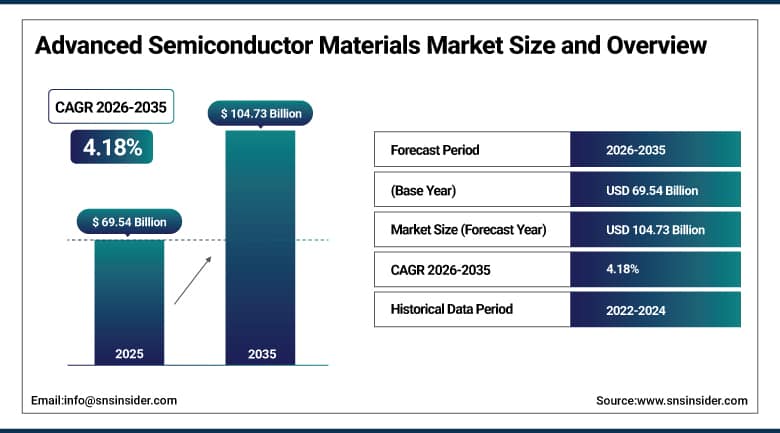
The Advanced Semiconductor Materials Market was valued at USD 69.54 Billion in 2025 and is expected to reach USD 104.73 Billion by 2035, growing at a CAGR of 4.18% from 2026-2035.
The Advanced Semiconductor Materials Market covers the specialized materials used to make and package chips, including silicon and compound semiconductor wafers, photoresists, high-purity chemicals, specialty gases, polishing slurries, deposition precursors and packaging materials. Demand follows chip output, which is being lifted by artificial intelligence, data centers, electric vehicles and connected devices. Smaller transistor sizes and three-dimensional chip designs raise the material content of each wafer. Supply concentration, export controls and the cyclical nature of chip demand shape the market. Governments are funding local supply chains. Materials suppliers are investing in purity, new chemistries and regional plants.
⮞In May 2026, SEMI reported that global semiconductor materials revenue reached a record USD 73.2 billion in 2025, up 6.8%, with packaging materials rising 9.3%. The record shows the strong base from which advanced materials are growing.
To Get More Information On Advanced Semiconductor Materials Market - Request Free Sample Report
Advanced Semiconductor Materials Market Trends:
-
Rising material content from AI accelerators and high-bandwidth memory
-
Growth of advanced packaging materials such as substrates, underfills and bonding films
-
Expansion of silicon carbide and gallium nitride for power electronics
-
Local material plants supported by government incentives in the U.S., Europe and Japan
-
Capacity expansion for EUV photoresists and ultra-high-purity chemicals
U.S. Advanced Semiconductor Materials Market Outlook:
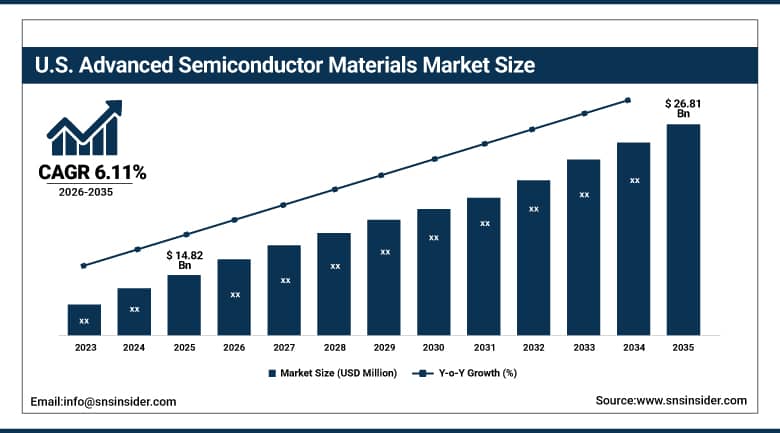
The U.S. Advanced Semiconductor Materials Market was valued at USD 14.82 Billion in 2025 and is expected to reach USD 26.81 Billion by 2035, growing at a CAGR of 6.11% from 2026-2035.
The U.S. Advanced Semiconductor Materials Market is the largest national market in the Americas, supported by new fabrication plants, advanced packaging projects and the strong pull of AI demand. Chipmakers building in Arizona, Texas, Ohio and New York need steady supplies of wafers, chemicals and gases. Federal incentives are encouraging materials suppliers to produce inside the country. Dependence on imported gallium, germanium and other inputs is a concern. Export controls and trade tensions shape sourcing. Universities and national labs support research on new materials.
⮞In July 2026, the Congressional Research Service reported that the CHIPS Act appropriated USD 39 billion in manufacturing incentives, with materials awards including USD 406 million to GlobalWafers and USD 325 million to Hemlock Semiconductor. Federal funds are directly supporting local materials supply.
Advanced Semiconductor Materials Market Segment Analysis:
-
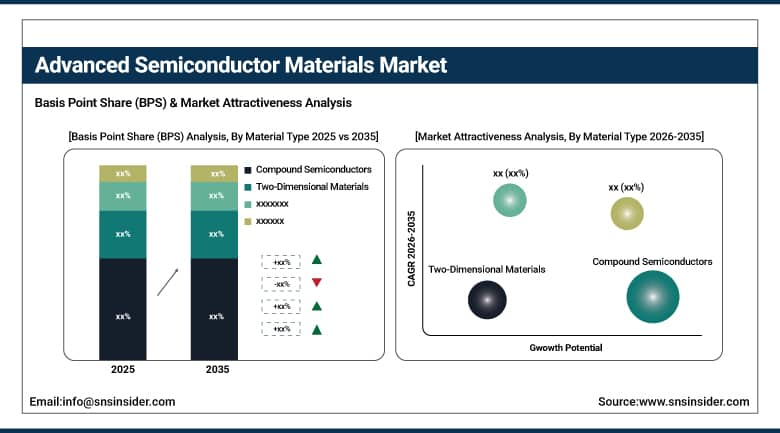
By Material Type, compound semiconductors segment dominated the Advanced Semiconductor Materials Market in 2025 with an estimated 35% share; two-dimensional materials segment is projected to be the fastest-growing segment, with a CAGR of 11.20% from 2026 to 2035.
-
By Application, the Wafer Fabrication segment dominated the Advanced Semiconductor Materials Market with approximately 59.95% share in 2025, while the Advanced Packaging segment is the fastest growing with a CAGR of approximately 8.81%.
-
By End Use, the Consumer Electronics segment dominated the Advanced Semiconductor Materials Market with approximately 36.50% share in 2025, while the Automotive segment is the fastest growing with a CAGR of approximately 7.66%.
By Material Type, Compound Semiconductors Dominate Advanced Semiconductor Materials Market; Two-Dimensional Materials to Register Fastest Growth
The compound semiconductors segment dominates owing to its applications in the manufacture of high-performance electronic and optoelectronic devices. Gallium nitride, silicon carbide, and gallium arsenide provide high power efficiency, high-frequency capability, and thermal stability when compared with silicon in specialized applications. The growing need for electric cars, renewable energy sources, telecommunication networks, and high-speed electronic components is driving the use of these materials. In addition, there is substantial investment in semiconductor fabrication and power devices manufacturing by the companies.
The two-dimensional materials segment is expected to grow rapidly as semiconductor manufacturers seek materials for future electronic devices. Graphene, molybdenum disulfide, and other transition metal dichalcogenides present excellent electrical, optical, and mechanical properties in ultra-small dimensions. There is increasing interest in transistors with new architectures, flexible electronics, wearables, and highly sensitive sensors. Moreover, the limitations of scaling down silicon technology is prompting efforts to investigate the potential of atomically thin materials. Further improvements in fabrication techniques and material integration may lead to faster adoption, but large-scale commercial implementation will be difficult.
By Application, Wafer Fabrication Dominates the Advanced Semiconductor Materials Market and Advanced Packaging Grows Fastest
Wafer fabrication leads because making a chip involves hundreds of steps that consume wafers, photoresists, etchants, gases and slurries. Every new wafer started requires a full set of materials, so demand tracks fab output. Wet chemicals, deposition precursors and cleaning agents are used repeatedly, and purity requirements are very strict. Fabrication therefore accounts for the larger part of material spending, and long qualification cycles keep supplier relationships stable.
Advanced packaging is the fastest growing application as chip designers combine several dies in one package to boost performance. Substrates, bonding films, underfills, thermal materials and interconnect metals are needed in greater amounts for AI processors and high-bandwidth memory. Packaging materials grew faster than fabrication materials in recent years, and capacity additions at packaging houses are lifting orders for specialized resins and films.
⮞In August 2026, Tokyo Ohka Kogyo reported that its first-half sales rose 25.1%, led by electronic functional materials. The results show strong demand for photoresists and high-purity chemicals.
By End Use, Consumer Electronics Dominates the Advanced Semiconductor Materials Market and Automotive Grows Fastest
Consumer electronics leads because smartphones, laptops, tablets, televisions and wearables use large numbers of chips. Each device contains processors, memory, sensors and power chips, and annual product refreshes keep wafer starts high. AI features in phones and personal computers are raising chip content further. Because the volume of consumer devices is so large, this end use consumes the biggest share of materials across fabrication and packaging.
Automotive is the fastest growing end use as vehicles add power electronics, sensors, displays and driver assistance computers. Electric vehicles use silicon carbide and gallium nitride devices in inverters and chargers, which require specialized substrates and epitaxial materials. Software-defined vehicles need more computing, and carmakers are securing long-term chip supply. Industrial automation and energy systems also add demand for power semiconductors.
⮞In August 2026, Applied Materials reported that its semiconductor systems sales were split 67% to foundry and logic, 26% to DRAM and 7% to flash. The mix shows where chipmakers are directing spending.
Regional Analysis:
|
Region |
Major Country |
Share within Region, 2025 (%) |
|---|---|---|
|
North America |
U.S. |
88.00 |
|
Europe |
Germany |
36.52 |
|
Asia Pacific |
China |
28.47 |
|
Latin America |
Brazil |
46.35 |
|
Middle East & Africa |
Saudi Arabia |
31.89 |
Asia Pacific Advanced Semiconductor Materials Market Insights
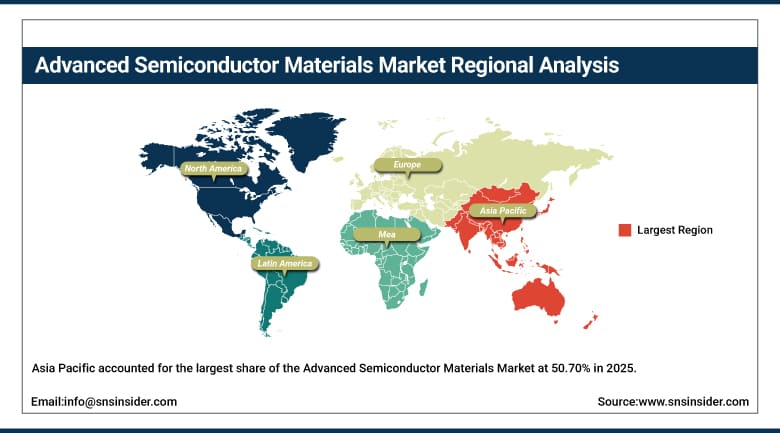
Asia Pacific accounted for the largest share of the Advanced Semiconductor Materials Market at 50.70% in 2025. Taiwan, China, South Korea, Japan and Southeast Asia lead. The region is home to most of the world's foundries, memory makers and packaging houses, as well as leading wafer, photoresist and chemical suppliers. Taiwan alone was the largest single materials market, followed by China and South Korea.
Growth is supported by heavy capital spending on AI chips, memory and advanced packaging. Japan is a global leader in photoresists, wafers and specialty chemicals, and its government is funding next-generation logic production. China is expanding local supply of materials to reduce reliance on imports. South Korea and Taiwan are investing in packaging capacity. Geopolitical tension and export controls are the main risks.
⮞In September 2026, Taiwan's Ministry of Finance reported that August exports reached USD 82.4 billion, up 41.0%, with electronic components up 58.0%. The surge shows the scale of regional chip activity.
Get Customized Report as Per Your Business Requirement - Enquiry Now
North America Advanced Semiconductor Materials Market Insights
North America held about 24.21% of the Advanced Semiconductor Materials Market in 2025 and is projected to be the fastest growing region, led by the United States. New fabs for leading-edge logic, memory and advanced packaging are under construction, and the region hosts major chip designers, equipment makers and materials suppliers. Canada and Mexico add smaller demand through assembly and mineral supply.
Federal incentives under the CHIPS Act are encouraging local production of wafers, chemicals and gases. Companies are weighing new plants in Arizona, Texas, Ohio and New York to serve nearby fabs. Dependence on imported inputs such as gallium and germanium remains a concern, and export controls influence sourcing. Skilled labor and permitting timelines are the main constraints on speed.
⮞In February 2026, the Semiconductor Industry Association reported that Americas semiconductor sales rose 30.5% in 2025, within global sales of USD 791.7 billion, up 25.6%. Strong chip sales are lifting regional materials demand.
Europe Advanced Semiconductor Materials Market Insights
Europe held about 14.07% of the Advanced Semiconductor Materials Market in 2025 and is led by Germany, France, the Netherlands, Italy and Belgium. The region has strong strengths in power semiconductors, automotive chips, equipment and research centers, and several global wafer and chemical suppliers are based there. Demand follows the automotive and industrial sectors closely.
The European Chips Act supports new fabs and pilot lines, and a second package has been proposed to deepen the program. Energy cost and slow permitting weigh on competitiveness. Europe was the only major region where semiconductor materials revenue declined in 2025, reflecting weak automotive and industrial demand. A recovery in those sectors would lift orders.
⮞In July 2026, Siltronic reported that first-half sales fell 6.9% and expected 2026 sales to decline slightly. The results show the soft conditions facing European wafer producers.
MEA & Latin America Advanced Semiconductor Materials Market Insights
Latin America and the Middle East and Africa together hold about 11.02% of the Advanced Semiconductor Materials Market. In Latin America, Brazil, Mexico and Costa Rica lead, mostly through assembly, test and packaging operations that use imported materials. Brazil is trying to build local chip capacity through incentive programs.
In the Middle East and Africa, Israel, Saudi Arabia, the United Arab Emirates and South Africa lead. Israel has a strong semiconductor sector with major fabs, while Gulf countries are exploring chip and materials projects as part of economic diversification plans. Africa supplies raw minerals but has limited local processing. Most demand across both regions is met by imports.
⮞In July 2026, Brazil issued a decree regulating its Brasil Semicon program, extending semiconductor tax incentives through 2029. The decree supports efforts to build local chip activity.
Market Dynamics:
Growth Drivers: AI Chip Demand and Advanced Packaging Drive Growth in the Advanced Semiconductor Materials Market
Artificial intelligence chip demand is the main driver. Training and running AI models needs large numbers of advanced processors and high-bandwidth memory, which are made on leading-edge nodes with intensive material use. Each new wafer consumes more photoresist, chemicals and gases than older chips, and packaging adds further materials. Chipmakers are raising capital spending, and suppliers see multi-year orders.
Electrification and local supply programs add momentum. Electric vehicles and renewable energy use silicon carbide and gallium nitride devices, which require specialized substrates. Governments in the United States, Europe, Japan and India fund local fabs and materials plants to reduce supply risks. Customers also want multiple suppliers, which opens room for new entrants and capacity additions.
⮞In August 2026, Merck KGaA reported that its semiconductor solutions business grew 17.3% organically in the second quarter, citing sustained expansion of the industry. The growth shows how closely materials sales follow chip demand.
Restraints: Supply Concentration and Export Controls Restrain Growth in the Advanced Semiconductor Materials Market
Supply concentration restrains growth. Key inputs such as gallium, germanium, high-purity quartz and certain specialty gases come from a small number of countries or producers. Disruptions from export limits, accidents or trade disputes can raise prices and delay production. Chipmakers hold inventory buffers and look for second sources, but qualification takes many months.
Cyclical demand and cost pressures add further limits. Chip demand rises and falls, and weak periods in consumer, automotive or industrial markets cut wafer starts quickly, hurting materials sales. New plants take years to build and require heavy investment. Environmental rules on certain fluorinated chemicals also force reformulation, and rising energy costs affect producers in some regions.
⮞In February 2026, the U.S. Geological Survey reported that China produced 99% of primary low-purity gallium and the United States was fully import reliant, with 2025 gallium import prices up about 30%. The figures show the exposure of critical inputs.
Opportunities: Local Supply Chains and Next-Generation Materials Create Opportunities in the Advanced Semiconductor Materials Market
Local supply chains offer a major opportunity. Governments are funding fabs and want nearby sources of wafers, chemicals and gases. Suppliers that build plants close to new fabs in the United States, Europe, Japan and India can win long contracts and qualify early. Joint ventures with local partners and chipmakers help reduce risk.
Next-generation materials offer further potential. Extreme ultraviolet resists, metal-oxide resists, new low-k dielectrics, advanced deposition precursors and glass substrates are entering development and early production. Two-dimensional materials and new compound semiconductors may open future device types. Suppliers with strong research and close ties to foundries can capture premium pricing for these innovations.
⮞In August 2026, Japan's Ministry of Economy, Trade and Industry included support for Rapidus in its fiscal 2027 budget request, as the company targets mass production in fiscal 2027. State backing can pull advanced material suppliers into new production lines.
Recent Developments:
-
In April 2026, Sumitomo Chemical announced a new integrated Osaka Works facility to consolidate photoresist process technology, quality evaluation and analysis. The company said the facility aims to strengthen EUV and ArF photoresist supply and is due for completion by the end of fiscal 2027.
-
In July 2026, Coherent received a letter of intent for up to USD 50 million in CHIPS funding to expand its Sherman, Texas indium phosphide fab. The company said the project would double space and quadruple wafer capacity.
-
In August 2026, Mitsubishi Chemical announced plans to build ultra-high-purity colloidal silica production at its Kyushu plant for wafer polishing and slurries. The company said operations are planned to begin in October 2028.
-
In August 2026, Doosan agreed to acquire a 70.6% stake in SK Siltron for about KRW 2.3 trillion, following board approval on July 31. The company said SK Siltron aims for sales of about KRW 3 trillion by 2031.
Advanced Semiconductor Materials Market Key Players:
-
Shin-Etsu Chemical Co., Ltd.
-
SUMCO Corporation
-
GlobalWafers Co., Ltd.
-
Siltronic AG
-
SK Siltron Co., Ltd.
-
Wolfspeed, Inc.
-
Coherent Corp.
-
Soitec SA
-
Entegris, Inc.
-
Merck KGaA (EMD Electronics)
-
Tokyo Ohka Kogyo Co., Ltd.
-
Sumitomo Chemical Co., Ltd.
-
Resonac Holdings Corporation
-
Air Liquide S.A.
-
Umicore SA
-
Mitsubishi Chemical Group Corporation
-
FUJIFILM Holdings Corporation
-
AXT, Inc.
-
Qnity Electronics, Inc.
Advanced Semiconductor Materials Market Report Scope:
| Report Attributes | Details |
|---|---|
| Market Size in 2025 | USD 69.54 Billion |
| Market Size by 2035 | USD 104.73 Billion |
| CAGR | CAGR of 4.18% From 2026 to 2035 |
| Base Year | 2025 |
| Forecast Period | 2026-2035 |
| Historical Data | 2022-2024 |
| Report Scope & Coverage | Market Size, Segments Analysis, Competitive Landscape, Regional Analysis, DROC & SWOT Analysis, Forecast Outlook |
| Key Segments | • By Material Type (Compound Semiconductors, Two-Dimensional Materials, Nanomaterials, Organic Semiconductors, and Others) • By Application (Wafer Fabrication and Advanced Packaging) • By End Use (Consumer Electronics, Automotive, Communications, Industrial, and Others) |
| Regional Analysis/Coverage | North America (US, Canada), Europe (Germany, UK, France, Italy, Spain, Russia, Poland, Rest of Europe), Asia Pacific (China, India, Japan, South Korea, Australia, ASEAN Countries, Rest of Asia Pacific), Middle East & Africa (UAE, Saudi Arabia, Qatar, South Africa, Rest of Middle East & Africa), Latin America (Brazil, Argentina, Mexico, Colombia, Rest of Latin America). |
| Company Profiles | Shin-Etsu Chemical Co., Ltd., SUMCO Corporation, GlobalWafers Co., Ltd., Siltronic AG, SK Siltron Co., Ltd., Wolfspeed, Inc., Coherent Corp., Soitec SA, Entegris, Inc., Merck KGaA (EMD Electronics), Tokyo Ohka Kogyo Co., Ltd., Sumitomo Chemical Co., Ltd., Resonac Holdings Corporation, Air Liquide S.A., Umicore SA, Mitsubishi Chemical Group Corporation, FUJIFILM Holdings Corporation, AXT, Inc., Qnity Electronics, Inc. |

Frequently Asked Questions
Key players include Shin-Etsu Chemical, SUMCO, GlobalWafers, Siltronic, SK Siltron, Wolfspeed, Coherent, Soitec, Entegris, Merck KGaA, Tokyo Ohka Kogyo, Sumitomo Chemical, Resonac, Air Liquide, Umicore, Mitsubishi Chemical, Fujifilm, AXT and Qnity Electronics.
Key opportunities include local material supply chains near new fabs, next-generation resists and dielectrics, silicon carbide and gallium nitride substrates and advanced packaging materials.
Artificial intelligence chip demand and advanced packaging are the main growth factors, since they raise the amount of material used per wafer and per package.
By Application, the Wafer Fabrication segment dominated the market in 2025 with an estimated 59.95% share, supported by the large number of process steps that consume materials.
Asia Pacific dominated the market with a share of 50.70% in 2025, driven by the concentration of foundries, memory makers and packaging houses.
