
Clinical Knowledge Graph Market Report Scope & Overview:
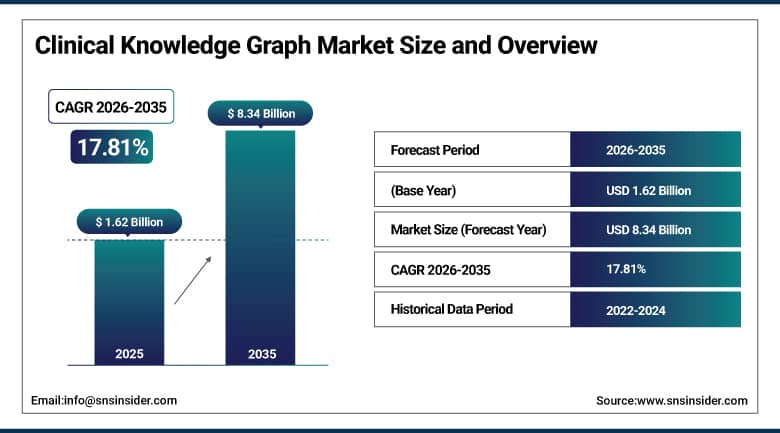
The Clinical Knowledge Graph Market was valued at USD 1.62 Billion in 2025 and is projected to reach USD 8.34 Billion by 2035, expanding at a CAGR of 17.81% during the forecast period 2026–2035.
The worldwide clinical knowledge graph market continues to record high adoption levels as more healthcare providers embrace the use of semantic technologies, graph databases, and artificial intelligence-based analytics platforms to bring together disparate clinical data. Clinical knowledge graphs help the different participants in healthcare build connections among patients, diseases, therapies, genomics, clinical data, and literature, thereby helping to create the basis for precision medicine and clinical intelligence. The rising adoption of digital health infrastructure, real-world evidence development, clinical decision support solutions, and artificial intelligence-based healthcare analytics is fueling the adoption of the solution in the healthcare ecosystem.
In the period 2025–2026, the providers of healthcare technology enhanced their artificial intelligence-based knowledge graph platforms to facilitate clinical reasoning, automated evidence generation, semantic search, patient stratification, and predictive healthcare.
To Get More Information On Clinical Knowledge Graph Market - Request Free Sample Report
Clinical Knowledge Graph Market Trends:
-
Rising deployment of AI-enabled self-checkout and automated billing systems.
-
Expansion of RFID-integrated retail inventory monitoring infrastructure.
-
Increasing adoption of cloud-based retail asset visibility platforms.
-
Growth in smart retail analytics integrated with real-time consumer tracking.
-
Rising investments in contactless NFC-enabled retail transaction systems.
U.S. Clinical Knowledge Graph Market Size Outlook:
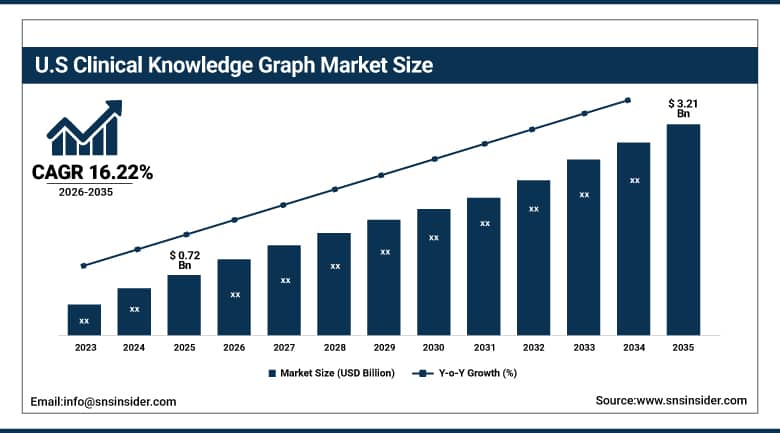
The U.S. Clinical Knowledge Graph Market was valued at USD 0.72 billion in 2025 and is expected to reach approximately USD 3.21 billion by 2035, expanding at a CAGR of 16.22% during 2026–2035.
The USA still dominates the market for clinical knowledge graphs due to extensive digitization of the healthcare sector, the use of electronic health records, increased investments in clinical decision support tools enabled by AI, and the use of precision medicine solutions. There is a rise in the number of graph analytics tools used by healthcare providers, research organizations, and pharma companies to combine structured and unstructured healthcare data for improved clinical outcomes. The focus on value-based care and the creation of real-world evidence further drives the growth of the market.
Generative AI-enabled clinical knowledge graph solutions were launched by several healthcare technology companies based in USA during 2026.
Clinical Knowledge Graph Market Segment Analysis:
-
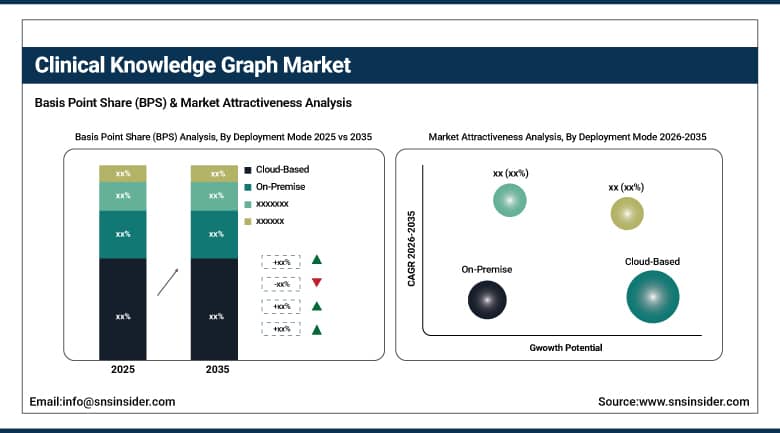
By Deployment Mode, cloud-based dominated the market with 52.00% share in 2025, and is projected to witness the fastest growth with a 20.29% CAGR during the forecast period.
-
By Data Source, electronic health records (EHR) dominated the market with 35.00% share in 2025, while genomics & omics data is projected to witness the fastest growth with a 21.25% CAGR during the forecast period.
-
By Application, clinical decision support dominated the market with 28.00% share in 2025, while precision medicine & genomics is projected to witness the fastest growth with a 20.25% CAGR during the forecast period.
-
By End User, hospitals & health systems dominated the market with 30.00% share in 2025, while pharmaceutical & biotechnology companies are projected to witness the fastest growth with a 23.56% CAGR during the forecast period.
By Deployment Mode, cloud-based dominated, while On-Premise are fastest-growing.
The cloud-based segment accounted for the largest revenue share of 52.00% in 2025 in the Clinical Knowledge Graph Market, driven by the increasing adoption of scalable, AI-enabled healthcare data platforms across hospitals, life sciences organizations, and research institutions. Cloud deployment enables seamless integration of electronic health records (EHRs), genomics, medical literature, and real-world evidence into a unified knowledge graph while reducing infrastructure costs and accelerating implementation. Healthcare organizations are increasingly adopting cloud-based solutions to support interoperability, collaborative research, and real-time clinical decision-making, making cloud deployment the preferred model for modern healthcare ecosystems.
The cloud-based segment is also expected to register the fastest CAGR of 20.29% during the forecast period, fueled by the growing use of artificial intelligence, machine learning, and advanced analytics in precision medicine, drug discovery, and clinical decision support. Rising investments in cloud-native healthcare infrastructure, increasing adoption of Software-as-a-Service (SaaS) platforms, and expanding regulatory support for secure health data exchange are further strengthening market growth. Moreover, cloud-based clinical knowledge graphs provide flexible scalability, continuous software updates, and enhanced accessibility for distributed healthcare networks, positioning them as a critical foundation for next-generation digital healthcare transformation.
By Data Source, electronic health records (EHR) dominated, while genomics & omics data are fastest-growing.
The electronic health records (EHR) market segment constituted the highest revenue share of 35.00% in 2025 due to extensive digitization of patient health records along with increased application of longitudinal clinical data in healthcare analytics powered by AI. Clinicians and healthcare providers are progressively deploying knowledge graph platforms in conjunction with EHR data stores to optimize clinical workflows, diagnose illnesses, analyze patient outcomes, and manage population health programs. The focus on interoperability and real-world clinical evidence is further fueling demand for knowledge graph solutions built around EHR data.
The genomics & omics data segment is projected to witness the highest CAGR of 21.25% during the forecast period driven by developments in precision medicine, genomic sequencing, biomarker identification, and personalized treatments. There is an increased trend of adoption of knowledge graphs by healthcare organizations and life science companies to link genomics data with clinical data and therapy outcomes. Several AI-driven healthcare programs have introduced graph-enabled genomics intelligence platform between 2025-2026.
By Application, clinical decision support dominated, while precision medicine & genomics is fastest-growing.
Clinical decision support was found to have dominated the market in 2025 with a revenue share of 28.00% due to the rise in the use of AI-enabled healthcare intelligence solutions that help doctors in making diagnoses, designing treatments, and evaluating risks. Clinical knowledge graphs help healthcare organizations to form contextual relations between patient histories, diseases, drugs, lab tests, and guidelines. The growing importance of evidence-based medicine and efforts to improve quality of care in healthcare continue to drive the adoption of clinical knowledge graphs in hospitals and integrated healthcare delivery systems.
The fastest CAGR of 20.25% will be exhibited by the precision medicine & genomics segment during the forecast period because of the growing interest in personalized healthcare solutions and biomarker-based therapies. Knowledge graph solutions are increasingly being used to connect genomics data, molecular pathways, clinical outcomes, and scientific literature into intelligence systems. In 2025-2026, healthcare organizations launched more AI-driven precision medicine solutions using graph-based analytics.
Regional Analysis:
|
Region |
Major Country |
Share within Region, 2025 (%) |
|---|---|---|
|
North America |
United States |
94.00% |
|
Europe |
Germany |
25.00% |
|
Asia Pacific |
China |
20.00% |
|
Middle East & Africa |
UAE |
4.00% |
|
Latin America |
Brazil |
4.00% |
North America Clinical Knowledge Graph Market Insights
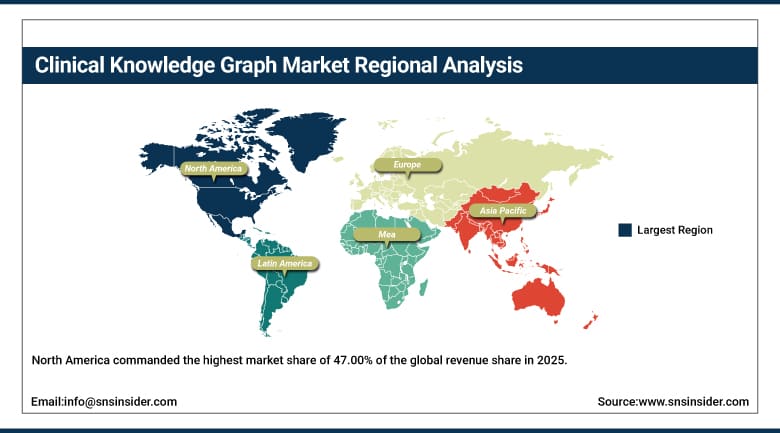
North America commanded the highest market share of 47.00% of the global revenue share in 2025 due to the presence of well-developed infrastructure in the field of healthcare IT, usage of electronic health records, investments made by healthcare organizations in healthcare AI, and precision medicine programs in the United States and Canada. Graph-based analytical methods have been extensively used in improving the decision-making process, stratification of patients, and collection of evidence through the use of graph-based clinical knowledge graph. Continued investments in healthcare interoperability and AI-enabled intelligence are fueling the growth of regional dominance.
Over the period of 2025-2026, many healthcare technology firms introduced clinical knowledge graph platforms using generative AI technologies.
Get Customized Report as Per Your Business Requirement - Enquiry Now
Europe Clinical Knowledge Graph Market Insights
In 2025, Europe contributed nearly 25.00% share in the market owing to healthcare digitalization projects' rising adoption in the region, along with growing use of precision medicine strategies and rising spending on health data interoperability projects. There has been rising use of clinical knowledge graph systems among health care organizations in Germany, the U.K., France, and Nordic nations to combine clinical, genomic, and research data sets for effective health care analytics. Favorable conditions for growth will continue to prevail in the region owing to regulatory emphasis on cross-border health data exchanges and evidence-based health care services delivery.
Health care organizations in Europe increased their use of semantic health data systems in 2025-2026.
Asia Pacific Clinical Knowledge Graph Market Insights
Asia Pacific is forecasted to record the highest growth rate with a CAGR of 22.27%. The factors contributing to the rapid growth rate in the region include the increasing digital transformation of the healthcare industry, investment in healthcare infrastructure based on AI technology, genome research, and the support from the government of China, Japan, South Korea, Singapore, and India for initiatives based on precision medicine. Knowledge graphs have been increasingly used by healthcare companies in their analytics, disease surveillance, patient care, and healthcare research.
In 2026, some of the healthcare organizations in the Asia Pacific region have quickly implemented clinical knowledge graphs in cloud computing alongside AI-powered analytics and genomic intelligence, among other healthcare data management services.
Middle East & Africa and Latin America Clinical Knowledge Graph Market Insights
Market dynamics indicate consistent growth in the Middle East & Africa region, driven by increasing investments in the modernization of healthcare sector, development of digital health infrastructure, and artificial intelligence healthcare analytics. Advanced data integration systems are being used by governments and hospitals to drive their initiatives related to healthcare transformation, disease management, and population health analytics. Increased digitization of the healthcare system is leading to new possibilities for deploying the clinical knowledge graph.
Latin America accounted for about 4.00% of the total market in 2025. Increasing healthcare digitization, rising investment in healthcare research facilities, and increasing use of advanced healthcare analytics solutions have driven the growth of the market in Brazil, Mexico, Argentina, and Chile. There has been increased investment in artificial intelligence healthcare intelligence solutions in the region.
Market Dynamics:
Growth Drivers: Rising utilization of healthcare data integration and clinical intelligence platforms using AI capabilities.
The fast growth of healthcare data in electronic health records, genomics, medical literature, imaging, and real-world evidence is driving the demand for clinical knowledge graph technologies to a significant extent. Graph technologies are being used by healthcare organizations for building semantic relations between the different sets of data and deriving clinical insights from them. The clinical knowledge graphs help in making decisions, personalized treatments, predictive analytics, and optimized healthcare research. The rising interest of healthcare companies in precision medicine, artificial intelligence (AI) diagnostics, and enterprise healthcare interoperability is offering huge business opportunities to vendors in the clinical knowledge graph space.
During 2025-2026, healthcare technology companies have ramped up their commercial offerings of AI-driven clinical knowledge graph technologies for automated clinical reasoning, semantic search, patient cohorts, and evidence creation.
Restraints: Data interoperability and healthcare data governance difficulties.
In spite of robust adoption trend, deployment complexity of integration heterogeneous healthcare datasets is still an important issue for further market growth. Implementation of clinical knowledge graph requires considerable amount of data normalization, semantic modeling, healthcare data governance and interoperability management involving multiple healthcare organizations. Additional complexities regarding regulatory compliance issues relating to patient privacy, data protection in healthcare industry and data transfer are also added to deployment complexity. Small healthcare organizations may encounter operational problems associated with infrastructure modernization and workforce skills necessary for implementing large-scale graph-based healthcare analytics projects.
By 2026, healthcare regulatory and standards organizations paid even more attention to development of healthcare interoperability frameworks, AI governance and data security.
Opportunities: Precision medicine and real-world evidence ecosystems expansion.
With the continued emergence of commercialized applications in the areas of precision medicine and real-world evidence, there is a promising prospect for clinical knowledge graph providers in the coming years. Graph technology is increasingly being used by healthcare organizations to establish connections among genomic profiles, treatment records, clinical outcomes, literature data, and patient-generated information in a comprehensive intelligence system. Thanks to knowledge graphs, medical practitioners would be able to find links between various pieces of information, discover biomarkers quickly, assist in designing clinical trials, and improve their therapeutic decisions. In addition, thanks to the use of generative AI in healthcare analytics applications, knowledge graph platforms would be widely used by the healthcare industry.
During the period from 2025 to 2026, several healthcare and life science companies invested in AI-powered precision medicine solutions based on clinical knowledge graphs.
Recent Developments:
-
2026: Oracle Health expanded AI-enabled healthcare knowledge management capabilities supporting semantic clinical reasoning, healthcare interoperability, and advanced patient analytics.
-
2026: Microsoft strengthened healthcare data intelligence initiatives through expanded graph-based healthcare analytics and AI-driven clinical insight generation capabilities.
-
2025: Google Cloud enhanced healthcare knowledge graph functionality supporting clinical data integration, medical research analytics, and generative AI-powered healthcare search applications.
-
2025: IQVIA expanded deployment of real-world evidence and healthcare analytics platforms utilizing graph-based data models to improve clinical research and patient outcome analysis.
Clinical Knowledge Graph Market Key Players are:
-
Microsoft Corporation
-
Google LLC
-
Oracle Corporation
-
Amazon Web Services, Inc.
-
Neo4j, Inc.
-
Stardog Union, Inc.
-
Ontotext USA, Inc.
-
Cambridge Semantics Inc.
-
Franz Inc.
-
TigerGraph, Inc.
-
IBM Corporation
-
SAP SE
-
Elsevier B.V.
-
IQVIA Holdings Inc.
-
Roche Information Solutions
-
Semantic Web Company GmbH
-
DataStax Inc.
-
PoolParty (Semantic Web Company)
-
Palantir Technologies Inc.
-
Sinequa SAS
Clinical Knowledge Graph Market Report Scope:
| Report Attributes | Details |
|---|---|
| Market Size in 2025 | USD 1.62 Billion |
| Market Size by 2035 | USD 8.34 Billion |
| CAGR | CAGR of 17.81% From 2026 to 2035 |
| Base Year | 2025 |
| Forecast Period | 2026-2035 |
| Historical Data | 2022-2024 |
| Report Scope & Coverage | Market Size, Segments Analysis, Competitive Landscape, Regional Analysis, DROC & SWOT Analysis, Forecast Outlook |
| Key Segments | • By Data Source (Electronic Health Records (EHR), Genomics & Omics Data, Medical Literature & Knowledge Bases, Claims & Administrative Data, Medical Imaging Data) • By Deployment Mode (Cloud-Based, On-Premise, Hybrid) • By Application (Clinical Decision Support, Precision Medicine & Genomics, Drug Discovery & Research Analytics, Population Health Management, Clinical Trial Optimization) • By End User (Hospitals & Health Systems, Pharmaceutical & Biotechnology Companies, Research Institutes & Universities, Healthcare Payers, Government & Public Health Agencies, Others) |
| Regional Analysis/Coverage | North America (US, Canada), Europe (Germany, UK, France, Italy, Spain, Russia, Poland, Rest of Europe), Asia Pacific (China, India, Japan, South Korea, Australia, ASEAN Countries, Rest of Asia Pacific), Middle East & Africa (UAE, Saudi Arabia, Qatar, South Africa, Rest of Middle East & Africa), Latin America (Brazil, Argentina, Mexico, Colombia, Rest of Latin America). |
| Company Profiles | Microsoft Corporation, Google LLC, Oracle Corporation, Amazon Web Services, Inc., Neo4j, Inc., Stardog Union, Inc., Ontotext USA, Inc., Cambridge Semantics Inc., Franz Inc., TigerGraph, Inc., IBM Corporation, SAP SE, Elsevier B.V., IQVIA Holdings Inc., Roche Information Solutions, Semantic Web Company GmbH, DataStax Inc., PoolParty (Semantic Web Company), Palantir Technologies Inc., Sinequa SAS. |
Frequently Asked Questions
The Clinical Knowledge Graph Market was valued at USD 1.62 billion in 2025.
North America dominated the global market with a 47.00% revenue share in 2025, supported by advanced healthcare IT infrastructure and extensive AI adoption.
Asia Pacific is projected to witness the fastest growth with a CAGR of 22.27% during 2026–2035.
The market is projected to reach USD 8.34 billion by 2035.
The market is expected to expand at a CAGR of 17.81% during the forecast period.
