
Collaborative Combat Aircraft Market Report Scope and Overview:
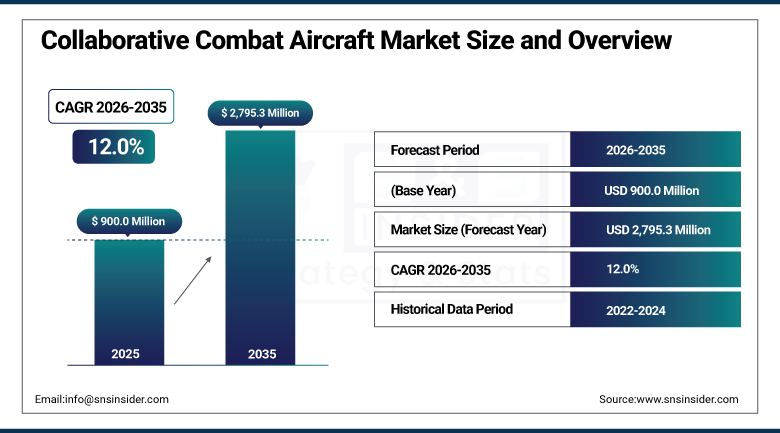
The Collaborative Combat Aircraft Market was valued at USD 900.0 Million in 2025 and is projected to reach USD 2,795.3 Million by 2035, registering a CAGR of 12.0% from 2026-2035.
The Collaborative Combat Aircraft segment consists of autonomous and semi-autonomous aircraft flying either independently or in conjunction with manned fighter aircraft and other combat platforms to carry out various missions like reconnaissance, surveillance, electronic warfare, and strike support. The unmanned aircraft are working as partner machines to the crewed aircraft to minimize the human risks while enhancing the capability and range of operations of the fighters, and through incorporating the use of autonomous systems, artificial intelligence, and secure communication links, these aircraft enhance the operational envelope of manned fighters and build a system ecosystem of man and machine. This new era will lead to mission effectiveness even within challenging conditions for timely and flexible response to the changing situations, and the move from conventional air frames to network-centric systems requires a paradigm shift in terms of strategic thinking by defense planners and procurers around the world.
In August 2025, the U.S. Air Force announced the start of flight testing of the YFQ-42A Collaborative Combat Aircraft to assess its airworthiness and flight autonomy as well as mission system integration.
To Get more information On Collaborative Combat Aircraft Market - Request Free Sample Report
Collaborative Combat Aircraft Market Trends
-
Rising adoption of manned-unmanned teaming concepts and autonomous flight systems continues driving significant market expansion across major air forces.
-
Investments in advanced communication links, data fusion systems, and AI-enabled decision support platforms continue enhancing operational efficiency and situational awareness.
-
Modern air combat systems increasingly rely on advanced sensors, AI coordination, and integrated command networks to support distributed, networked warfare concepts.
-
Growing need for autonomy validation and operational testing continues propelling training, test, and tactics development activity ahead of full-scale CCA deployment.
-
Rising focus on force multiplication and cost-effective solutions continues fueling market expansion as defense budgets prioritize genuinely scalable unmanned capability.
The US Collaborative Combat Aircraft Market Outlook
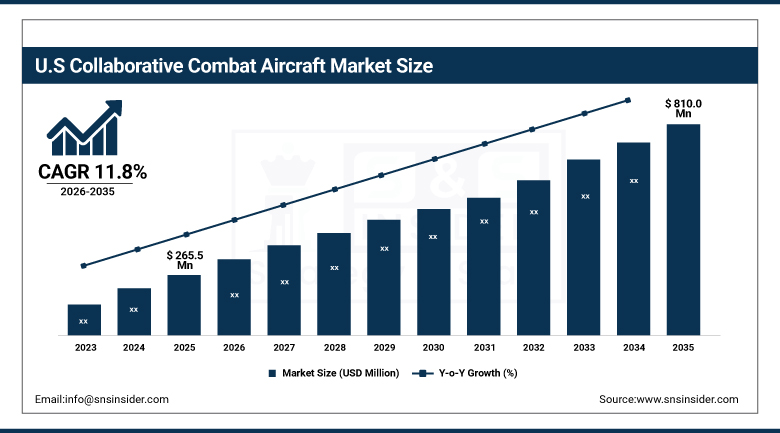
The US Collaborative Combat Aircraft Market was valued at approximately USD 265.5 Million in 2025 and is projected to reach approximately USD 810.0 Million by 2035, registering a CAGR of approximately 11.8% from 2026 to 2035.
Demand in the United States was influenced by sustained investments made by the Department of Defense in the development of such programs as the U.S. Air Force Collaborative Combat Aircraft project. Demand experienced significant growth due to increased defense expenditures for the introduction of new air combat technology solutions and use of artificial intelligence in mission planning and manned-unmanned teaming approaches with autonomous aircraft solutions continuing to drive the growth in demand. Advanced communication, data fusion systems and decision support systems using artificial intelligence continued improving efficiency of operations in domestic defense procurements.
In 2025 the U.S. Department of the Air Force started the ground test of the YFQ-42A and YFQ-44A CCA production representative platforms that would undergo testing of propulsion systems, avionics, autonomy integration and ground control interfaces prior to the entry into the flight testing stage.
Collaborative Combat Aircraft Market Segmentation Analysis
-
By Component, Airframe and Platform Hardware led the market with the largest share in 2025, while Mission Autonomy and AI Software was the fastest-growing component, tracking a projected 19.7% CAGR.
-
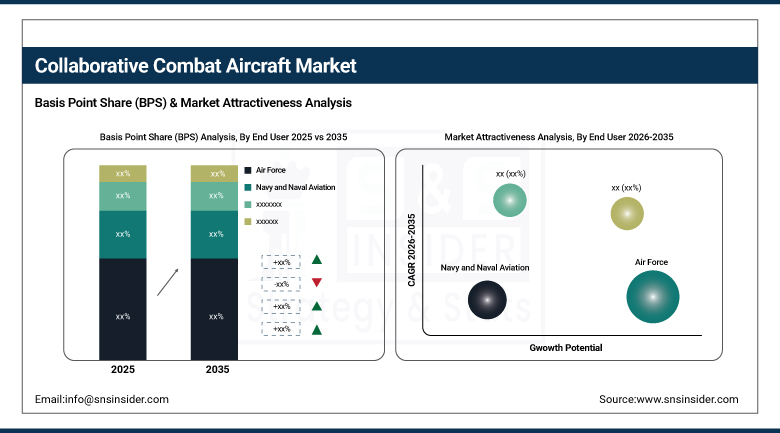
By End User, Air Force led the market with the largest share in 2025, while Navy and Naval Aviation was the fastest-growing end user, tracking a projected 12.7% CAGR.
-
By Mission Role, Training Test and Tactics Development led the market with the largest share in 2025, while Air Superiority and Fighter Escort was the fastest-growing mission role, tracking a projected 20.2% CAGR.
By Component, Airframe and Platform Hardware led the market, Mission Autonomy and AI Software grew fastest
Airframe and Platform Hardware accounted for the largest component share in 2025, reflecting the genuinely substantial engineering and manufacturing investment required to develop and produce the physical aircraft structures, propulsion systems, and avionics hardware underlying every collaborative combat aircraft program. That foundational hardware requirement kept this component category the market's largest by a considerable margin across virtually every CCA platform currently in development.
Mission Autonomy and AI Software is expected to register the fastest CAGR over the forecast period, at approximately 19.7%. Increasing need for autonomy validation and operational testing continues driving this growth, as defense forces require extensive flight testing and tactics development to build genuine trust in autonomous systems, and rising investment in AI-driven mission coordination software keeps this component category's growth rate well ahead of the broader, still-dominant hardware segment.
By End User, Air Force led the market, Navy and Naval Aviation grew fastest
Air Force represented the dominant end-user category in 2025, anchored substantially by the U.S. Air Force's Collaborative Combat Aircraft initiative and comparable programs across allied air forces pursuing manned-unmanned teaming capability. That combination of program maturity and sustained procurement investment kept air force customers the market's largest single end-user category by a considerable margin.
Navy and Naval Aviation is projected to register a CAGR of 12.7% over the forecast period, the fastest growth rate among end-user categories tracked in this market. Rising interest in carrier-based and maritime patrol collaborative combat aircraft applications continues driving this growth, as naval aviation forces increasingly recognize the same manned-unmanned teaming advantages that air forces have already begun validating through active flight testing programs.
By Mission Role, Training Test and Tactics Development led the market, Air Superiority and Fighter Escort grew fastest
Training, Test and Tactics Development is expected to acquire major market share during the early stages of CCA adoption, as defense forces require extensive flight testing, autonomy validation, and tactics development before committing to full operational deployment. That genuine early-stage program necessity kept this mission-role category the market's largest during the current phase of collaborative combat aircraft maturation.
Air Superiority and Fighter Escort is projected to register a CAGR of 20.2% over the forecast period, the fastest growth rate among mission roles tracked in this market. Rising need to build trust in autonomous systems continues supporting human-in-the-loop and human-on-the-loop control segment expansion, and as defense forces increasingly validate CCA reliability through operational testing, procurement is expected to shift meaningfully toward genuine combat-ready air superiority and fighter escort deployment.
Regional Analysis
|
Region |
Major Country |
Share within Region, 2025 (%) |
|---|---|---|
|
North America |
United States |
82.60% |
|
Europe |
United Kingdom |
24.35% |
|
Asia Pacific |
China |
30.75% |
|
Middle East and Africa |
Israel |
27.40% |
|
Latin America |
Brazil |
33.90% |
North America Collaborative Combat Aircraft Market Insights
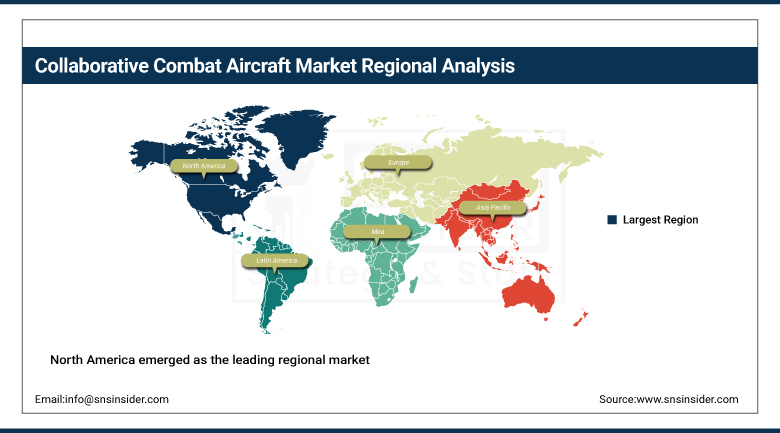
North America emerged as the leading regional market, due to robust investments by the U.S. Department of Defense and continued development of programs such as the U.S. Air Force's Collaborative Combat Aircraft initiative. That combination of sustained procurement investment and program maturity kept the continent the market's clear regional leader by a considerable margin over every other region tracked in this report.
The United States accounted for roughly 82.60% of regional revenue, anchored by active flight testing programs and increased defense spending on next-generation air combat technologies. Canada added further regional demand through its own defense modernization interests, and that combined strength kept the continent the largest addressable market for collaborative combat aircraft vendors through the forecast period.
Get Customized Report as per Your Business Requirement - Enquiry Now
Europe Collaborative Combat Aircraft Market Insights
Europe held a meaningful share of global revenue, supported by growing NATO-aligned interest in manned-unmanned teaming concepts and rising defense modernization spending across the region's major economies. Continued geopolitical tension across the continent kept reinforcing sustained government investment in next-generation air combat technology development.
The United Kingdom led demand at roughly 24.35% of European revenue, supported by its substantial defense industrial base and sustained military modernization investment. Germany and France contributed substantial additional demand, and continued European defense spending increases should keep regional demand for collaborative combat aircraft climbing through the forecast period.
Asia Pacific Collaborative Combat Aircraft Market Insights
Asia Pacific is advancing at the fastest pace among all regions tracked in this report, driven by rising defense expenditure, growing geopolitical tension, and expanding domestic unmanned aircraft manufacturing capability across the region's largest economies. That combination of manufacturing scale and genuine strategic modernization need kept the region's growth trajectory well ahead of every other region tracked in this report.
China led the pack, supported by substantial government investment in domestic unmanned combat aircraft development and broader military modernization programs. Japan and South Korea contributed meaningful additional demand, with both countries' rising defense budgets and ongoing air combat modernization programs continuing to reinforce the region's position as the fastest-growing market tracked in this report.
MEA and Latin America Collaborative Combat Aircraft Market Insights
The Middle East and Africa and Latin America both showed steady growth, driven by expanding defense modernization investment, growing interest in unmanned combat aircraft capability, and rising government focus on next-generation air combat technology across both areas. As these markets continued building out modern defense infrastructure, collaborative combat aircraft adoption grew correspondingly from a considerably smaller base than in more mature defense markets.
Israel led Middle East and Africa demand, supported by the country's advanced defense technology sector and continued investment in unmanned aerial systems development. Saudi Arabia and the UAE contributed further demand through their own defense modernization programs. In Latin America, Brazil accounted for the largest share of regional revenue, with growing defense modernization continuing to anchor regional demand for collaborative combat aircraft technology.
Growth Drivers: Defense Modernization and Manned-Unmanned Teaming Adoption
Market growth continues being primarily driven by the increasing integration of unmanned and optionally piloted aircraft with manned fighter platforms, resulting in distributed lethality, improved survivability, and greater mission flexibility. Growing defense modernization programs and rising demand for integrated manned-unmanned operations continue serving as key factors, as CCA platforms enhance mission efficiency, situational awareness, and operational flexibility in complex combat environments.
Advancements in artificial intelligence, autonomous systems, and network-centric warfare, alongside rising defense budgets globally, continue reinforcing this driver across virtually every major air force pursuing next-generation combat capability. Increasing focus on force multiplication and cost-effective solutions is exactly what keeps demand climbing at such a sustained pace, as collaborative combat aircraft offer genuinely substantial capability gains relative to the cost of expanding traditional manned fighter fleets alone.
Restraints: Autonomy Trust Validation and Program Development Complexity
The rising need to build trust in autonomous systems continues posing a genuine restraint on faster market-wide deployment, as defense forces require extensive flight testing, autonomy validation, and tactics development before committing to full operational deployment. That validation burden keeps early-stage program timelines meaningfully longer than for conventional manned aircraft procurement, even as underlying technology development continues advancing rapidly.
The technical complexity of transitioning from legacy airframes to network-centric architectures continues posing genuine strategic and engineering challenges, as integrating secure data links, AI coordination software, and sensor fusion capability across manned and unmanned platforms requires a profound shift in both technology and procurement mindset. That complexity keeps program development timelines and costs elevated relative to simpler, single-platform defense acquisition programs.
Opportunities: AI Software Maturation and Naval Aviation Expansion
Increasing need for autonomy validation and operational testing represents a genuinely significant opportunity for vendors able to deliver genuinely capable mission autonomy and AI software, as this component category's fastest-growing status among all segments tracked in this market reflects the sheer scale of investment flowing into this specific technology layer. Vendors offering proven, combat-tested autonomy software stand to capture meaningful share as defense forces increasingly prioritize software capability alongside airframe development.
Rising naval aviation interest in collaborative combat aircraft offers a second substantial opportunity, as this end-user category's fastest-growing status reflects genuine strategic interest in extending manned-unmanned teaming concepts beyond air force applications into carrier-based and maritime patrol operations. Vendors with proven, navalized platform capability stand to capture meaningful share of this expanding, technically demanding end-user segment.
Recent Developments:
-
2025: Anduril Industries continued advancing its autonomous defense technology and collaborative combat aircraft programs, developing artificial intelligence and autonomous capabilities intended to enable manned-unmanned teaming and increase mission effectiveness.
-
2025: General Atomics Aeronautical Systems continued developing its collaborative combat aircraft platform offerings, targeting expanded U.S. Air Force and allied nation procurement interest in autonomous wingman capability.
-
2024: Kratos Defense & Security Solutions continued advancing its low-cost, attritable unmanned aircraft technology, positioning the company's platforms as genuinely cost-effective options for expanding collaborative combat aircraft fleet numbers.
Collaborative Combat Aircraft Market key players are:
-
Boeing Defense, Space & Security
-
Kratos Defense & Security Solutions, Inc.
-
Northrop Grumman Corporation
-
RTX Corporation (Collins Aerospace)
-
L3Harris Technologies, Inc.
-
Textron Systems Corporation
-
BAE Systems plc
-
Leonardo S.p.A.
-
Dassault Aviation SA
-
Saab AB
-
Israel Aerospace Industries Ltd.
-
Elbit Systems Ltd.
-
Turkish Aerospace Industries, Inc.
-
Shield AI, Inc.
-
AeroVironment, Inc.
-
Sierra Nevada Corporation
-
QinetiQ Group plc
Collaborative Combat Aircraft Market Report Scope:
| Report Attributes | Details |
|---|---|
| Market Size in 2025 | USD 900 Million |
| Market Size by 2035 | USD 2795.3 Million |
| CAGR | CAGR of 12.00% From 2026 to 2035 |
| Base Year | 2025 |
| Forecast Period | 2026-2035 |
| Historical Data | 2022-2024 |
| Report Scope & Coverage | Market Size, Segments Analysis, Competitive Landscape, Regional Analysis, DROC & SWOT Analysis, Forecast Outlook |
| Key Segments | • By Component (Airframe and Platform Hardware, Mission Autonomy and AI Software, Others) • By End User (Air Force, Navy and Naval Aviation, Others) • By Mission Role (Training Test and Tactics Development, Air Superiority and Fighter Escort, ISR, Electronic Warfare, Strike and Deep Attack) |
| Regional Analysis/Coverage | North America (US, Canada), Europe (Germany, UK, France, Italy, Spain, Russia, Poland, Rest of Europe), Asia Pacific (China, India, Japan, South Korea, Australia, ASEAN Countries, Rest of Asia Pacific), Middle East & Africa (UAE, Saudi Arabia, Qatar, South Africa, Rest of Middle East & Africa), Latin America (Brazil, Argentina, Mexico, Colombia, Rest of Latin America). |
| Company Profiles | Lockheed Martin Corporation, General Atomics Aeronautical Systems, Inc., Anduril Industries, Inc., Boeing Defense, Space & Security, Kratos Defense & Security Solutions, Inc., Northrop Grumman Corporation, RTX Corporation (Collins Aerospace), L3Harris Technologies, Inc., Textron Systems Corporation, BAE Systems plc, Leonardo S.p.A., Dassault Aviation SA, Saab AB, Israel Aerospace Industries Ltd., Elbit Systems Ltd., Turkish Aerospace Industries, Inc., Shield AI, Inc., AeroVironment, Inc., Sierra Nevada Corporation, QinetiQ Group plc |
Frequently Asked Questions
The Collaborative Combat Aircraft Market is expected to grow at a CAGR of approximately 12.0% from 2026 to 2035, based on triangulated secondary research estimates.
The Collaborative Combat Aircraft Market was valued at approximately USD 900.0 Million in 2025, based on triangulation across multiple independent research sources.
The major growth factor is the increasing integration of unmanned and optionally piloted aircraft with manned fighter platforms, combined with rising defense budgets and advancements in artificial intelligence and autonomous systems.
The Airframe and Platform Hardware segment dominated the Collaborative Combat Aircraft Market by component, representing the largest share of revenue in 2025.
North America dominated the Collaborative Combat Aircraft Market in 2025, driven by robust U.S. Department of Defense investment and active flight testing programs.
