
Dermatology Laser Market Report Scope & Overview:
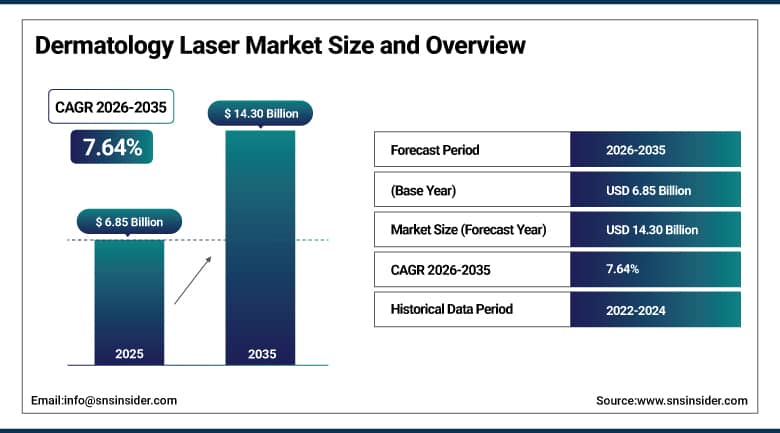
The Dermatology Laser Market was valued at USD 6.85 Billion in 2025 and is projected to reach USD 14.30 Billion by 2035, expanding at a CAGR of 7.64% during the forecast period 2026–2035.
The dermatology laser market is predicted to grow because more aesthetic procedures are getting more popular than before for people’s common dermatology care. Because of more patients choosing minimally invasive cosmetic surgery, and growing incidence of skin disease, cosmetic laser has increased availability and acceptance of procedures more focused in its results, as well as growing cosmetic concerns and improved outcomes and fewer side effects that lasers has over other conventional techniques including vascular lesions treatments, pigment, scars and hair removal. More money on aesthetic care and increasing access and convenience by specialized dermatology clinics will keep procedural volumes on rise in the near future too.
Advanced laser has brought more innovation with fractional technologies, picosecond laser technology, energy intelligently delivery systems with laser and image directed laser treatment or AI as well the development in laser procedures can provide even better and smoother treatments by minimizing effects and increase their benefits in procedures, i.e. More patient satisfying. On January 2026, U.S. Food and Drug Administration (FDA) cleared two more dermatology medical devices that will support growth of innovative devices in this area for more time to come.
To Get More Information On Dermatology Laser Market - Request Free Sample Report
Dermatology Laser Market Trends
-
Increasing adoption of picosecond laser platforms for advanced aesthetic dermatology.
-
Growing preference for minimally invasive laser skin rejuvenation procedures globally.
-
Rising integration of AI-assisted laser treatment planning technologies.
-
Expansion of multi-application dermatology laser systems across specialty clinics.
-
Increasing investments in medical spas and physician-owned aesthetic centers.
The U.S. Dermatology Laser Market Size Outlook
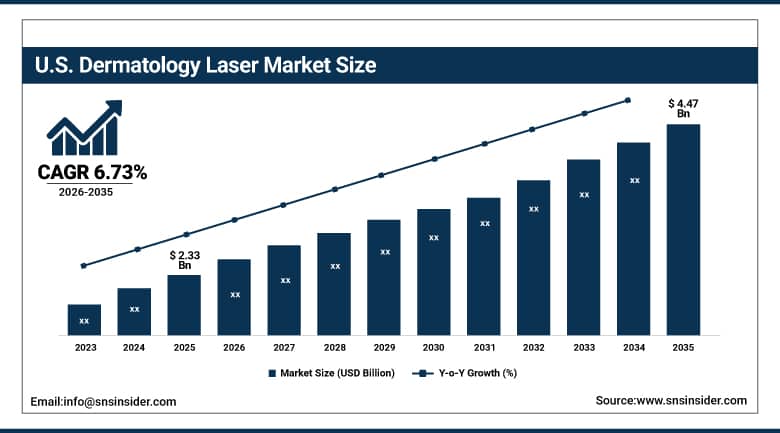
The U.S. Dermatology Laser Market was valued at USD 2.33 billion in 2025 and is expected to reach approximately USD 4.47 billion by 2035, expanding at a CAGR of 6.73% during 2026–2035.
The North America Dermatology Laser Market Trends As a market, the US leads North America on the back of its well-established aesthetic healthcare infrastructure, substantial disposable incomes, extensive procedural volume, and relatively quick adoption of technologically advanced laser systems. Expanding preference for minimally invasive cosmetic procedures, rise in skin cancer detection followed by aesthetic reconstruction, increasing acceptance of anti-aging preventative strategies, and an array of clinical applications within dermatology offices and medical spas are projected to drive growth in the market. Ongoing investment in new fractional, picosecond, and hybrid laser systems for physicians is geared towards increased procedural accuracy, decreased patient downtime, improved patient outcomes and continued business.
In addition, favorable reimbursement in selected dermatology applications, an increase in specialist certification training, a rise in private dermatology practices and greater public awareness regarding cosmetic dermatology should drive a hastened equipment replacement rate. In 2025, Candela Medical has added a new innovative addition to its portfolio of energy-based aesthetic treatment solutions by incorporating expanded efforts within dermatology laser research and development and physician training for treatment protocols for enhanced skin-related therapies.
Dermatology Laser Market Segmentation Analysis
-
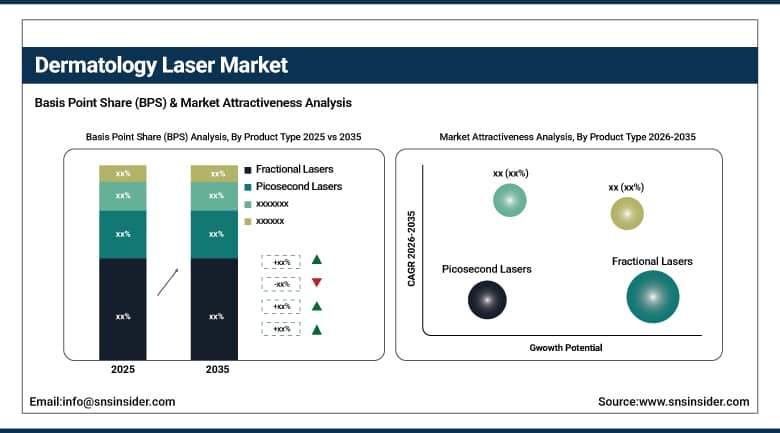
By Product Type, fractional lasers dominated the market with 26.00% share in 2025, while picosecond lasers are projected to witness the fastest growth with 11.12% CAGR during the forecast period.
-
By Technology, ablative lasers dominated the market with 34.00% share in 2025, while picosecond technology is projected to witness the fastest growth with 11.84% CAGR during the forecast period.
-
By Application, skin resurfacing & rejuvenation dominated the market with 31.00% share in 2025, while tattoo removal is projected to witness the fastest growth with 10.22% CAGR during the forecast period.
-
By End User, dermatology clinics dominated the market with 41.00% share in 2025, while medical spas are projected to witness the fastest growth with 8.84% CAGR during the forecast period.
By Product Type, fractional lasers dominated, while picosecond lasers grows fastest.
Fractional lasers captured a market share of 26.00% in the Dermatology Laser Market in 2025. The Fractional Lasers dominated segment owing to widespread clinical applications including skin resurfacing, acne scar revision, wrinkles and fine line treatment, pigmentation corrective treatments, and other photo aging conditions. The ability of fractional lasers to apply controlled micro thermal zone of injury while sparing the collateral healthy skin has enhanced recovery time for patients. In 2025, Lumenis continued to expand adoption of their sophisticated fractional laser portfolios through physician and clinical education programs to increase efficiency and accuracy of treatment procedures.
Picosecond lasers are expected to grow at a CAGR of 11.12% during the period 2026 to 2035 and exhibit the fastest growth rate in 2025. Their effective tattoo removal results, pigmentation correction, acne scar management and skin revitalizing procedures along with minimal thermal damage on account of pulsed energy beam make them effective to conventional nanosecond technology systems. In 2025, Candela Medical's enhanced their offerings through the advancement of sophisticated Picosecond laser technology based on treatment plans for tattoo removal and pigmentation disorders and extended their medical education services for more physicians to use these treatment platforms and technologies.
By Technology, ablative lasers dominated, while picosecond technology grows fastest.
Ablative lasers held the largest revenue share with 34.00% in 2025 on account of their time-tested efficacy in targeting indications including deep wrinkles, advanced photo aging, acne scars, skin resurfacing, and a broad spectrum of dermatologic complexities that require adequate tissue remodeling. Enhanced collagen synthesis combined with highly evident clinical results from their use continue to ensure their popularity with practitioners, even though they require more downtime. In 2025, DEKA introduced the latest generation of dermatologic laser solutions by emphasizing newer technologies including advanced ablative laser products for cosmetic skin resurfacing and scar reduction treatment.
Picosecond technology is poised to grow at the fastest CAGR during the period 2025–2033 due to the ability of picosecond technologies to deliver nanosecond (ns) ultra-short pulse durations that effectively elicit the desired photo acoustic effect, with significantly minimized tissue collateral thermal impact. Picosecond therapies in dermatologic settings are witnessing high demand across tattoo removal, melisma therapy, pigmentary disorder treatments, treatment for acne scars and for complete rejuvenating of the skin as these are providing favorable outcomes and decreasing the recovery time to the patients. In 2026 Cutera continued to focus on the new generation of picosecond ultra-short laser technologies for their aesthetic and cosmetic practice with new physician programs as well as clinical demonstrations.
By Application, skin resurfacing & rejuvenation dominated, while tattoo removal grows fastest.
In 2025, skin resurfacing & rejuvenation held the largest share of the dermatology laser market at 31.00%, as rising global demand for anti-aging solutions, the treatment of wrinkles, skin tightening, pigmentation management, and scar improvement (acne scars) continued to fuel market growth. The rising consumer preference for less invasive cosmetic procedures with shorter healing times, alongside steady technological advancement, including innovative fractional, ablative, and hybrid laser systems, resulted in higher treatment volumes. In 2025, Sciton increased its clinical education programs in order to educate physicians on advanced skin resurfacing procedures utilizing its diverse multi-application laser platforms, providing better treatment outcomes for cosmetic dermatology patients.
The tattoo removal segment is estimated to witness the highest CAGR of 10.22% during the forecast period 2026-2035. This growth is attributable to increasing consumer demand for changing tattoo appearance and removal, rising usage of picosecond laser technology, and increasing consciousness of non-surgical and safe procedures utilizing laser for elimination of pigments. High efficacy laser based treatment with reduced sessions required along with lesser pain have further enhanced the growth of this segment, thanks to advancements in ultra-short pulse laser systems. Cynosure enhanced its diverse portfolio of aesthetic lasers in 2025 with more focus on advanced picosecond platforms used for high efficacy tattoo removal and pigmented lesion treatments in dermatology practices.
Regional Analysis
|
Region |
Major Country |
Share within Region, 2025 (%) |
|---|---|---|
|
North America |
United States |
93.00% |
|
Europe |
Germany |
30.00% |
|
Asia Pacific |
China |
24.00% |
|
Middle East & Africa |
UAE |
4.00% |
|
Latin America |
Brazil |
4.00% |
North America Dermatology Laser Market Insights
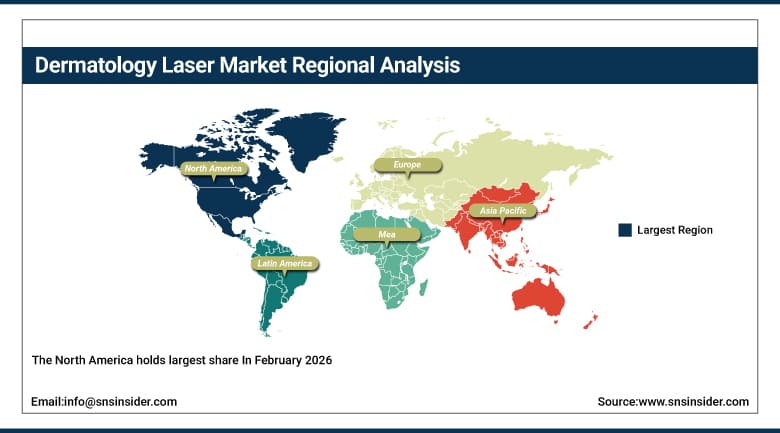
The North America holds largest share In February 2026, Candela medical publicized further enhanced clinical education and advanced medical aesthetics and clinical training and professional services to enable the more expansive use of next-generation dermatology laser systems by providers throughout North America. 37.00% contribution of global market by revenue with robust infrastructure. North America represents the largest regional market and will continue to retain its dominant position on the account of well-established dermatological treatment facilities and strong implementation of sophisticated aesthetic solutions in the region.
High numbers of procedural visits in the region and escalating use of technologically innovative non-invasive or Minimally Invasive medical procedure.
Widespread availability of board-certified skin specialists or dermatologist, higher quality Medical Aesthetics centers, readily available multiple skin therapeutic laser devices are the factors propelling the demand within the North America region. This can also be attributed to factors such as growth of outpatient skin treatment centers, robust need for skin revitalizing treatments and extensive application of Q-switched, ND-YAG and fractional laser-based treatments.
Get Customized Report as Per Your Business Requirement - Enquiry Now
Europe Dermatology Laser Market Insights
Europe remains as one of the biggest geographic market for dermatology laser systems, characterized by developed healthcare infrastructure, rising aesthetic trends and the availability of both dermatology clinics and the cosmetic surgery network. The market for skin rejuvenation laser systems and hyperpigmentation therapy systems is gaining traction in Germany, France, UK, Italy and Spain, which have continued to post substantial rise in demand, particularly across areas such as minimally-invasive skin treatment, scar removal, anti-aging skin treatments.
The implementation of favorable regulatory reforms, significant private investments being allocated in the aesthetic healthcare infrastructure, and increase in the preference over combination dermatological treatments is encouraging medical facilities to invest in advanced laser system upgrade programs across Europe. In 2025, Fotona strengthened the learning experiences provided at European Dermatology as well as Aesthetic Medicine conventions by imparting further extensive knowledge in various laser technologies utilized for skin rejuvenation and scar removal processes.
Asia Pacific Dermatology Laser Market Insights
The Asia Pacific Dermatology Laser Market anticipated to witness the fastest regional CAGR of 9.75% in the projection timeline from 2026 to 2035. Rapid urbanization and soaring disposable income, significant growing middle class population, coupled with rising awareness of cosmetic dermatology procedures are contributing to the high growth across China, Japan, South Korea, India and Southeast Asia.
High expansion of distribution networks of manufacturers coupled with launch of compact and multi-functional laser platforms suitable for high volume outpatient practices, rising medical tourism, significant rise of tattoo and pigmentation removal procedures in demand coupled with high rate of physician training, coupled with increased accessibility to quality services in dermatology practices across the region, continue to cater for increase in demand of the market. In 2025, the expanded commercial presence for Lutronic in the region includes increased physician training and access to advanced dermatology lasers for dermatology practices in key countries across the region.
Middle East & Africa and Latin America Dermatology Laser Market Insights
The Middle East & Africa’s dermatology laser market is growing at a consistent pace with the surging growth of premium healthcare infrastructure, increasing proliferation of Private Dermatology clinics, and booming consumer awareness about minimally invasive aesthetic solutions. Middle East countries like UAE, Saudi Arabia and countries like South Africa are adopting various advanced laser technology for skin resurfacing, treatment of pigmented lesions, vascular lesion treatment, treatment of acne scar & removal of unwanted hair. In 2025, Alma Lasers increased investments for physician education, and distributor support across Middle East enhancing availability of various advanced dermatology laser system in the domain of aesthetic & clinical treatment.
The Latin America market is currently growing well due to increasing awareness among consumer about cosmetic dermatology, enhanced access to aesthetic treatments, and increased investment in advance dermatology clinics in Mexico, Argentina, Brazil, and Chile. Increasing middle income segment across Latin America market, growing acceptance for anti-aging treatment, increasing demand for tattoo removal & wide availability of different Fractional and picosecond laser system are forcing health care providers to make technological advancements in treatment system. In 2025, Candela Medical expanded its commercial presence in Latin America with wider distribution partnerships & enhancing support for physician training programs to perform various advanced dermatology laser treatment.
Growth Drivers: Increasing preference towards minimally invasive aesthetic dermatology treatments.
The inclination towards non-surgical cosmetic procedures is amongst the major factors driving the global dermatology laser market, as consumers prefer effective and efficient treatments for treating various skin indications, leading to desired aesthetical outcomes in relatively short-term with lesser discomfort, recovery time and risk of surgical intervention. Laser procedures provide solutions that are effective for skin resurfacing, acne treatment, pigmentation management,
Advancements in the laser wavelengths, intelligent energy management systems, cooling technologies, customizable settings to manage treatment parameters for targeted indications etc., are helping to increase confidence levels for both doctors and patients alike. In 2026, Lumenis also took initiatives to advance its energy-based portfolio in dermatology by enhancing the physician education and facilitating wider uptake of revolutionary laser treatments among the international aesthetic clinics.
Restraints: Lack of commercial acceptance, in-part attributed to significant investment costs and maintenance practices.
The dermatology laser market, even with significant promise of commercial adoption is restricted by the significant initial investment associated with highly advanced laser platforms as well as maintenance costs. Because of high levels of investment needed to purchase fractional, multi-platform lasers and picosecond based laser devices, as well as maintenance requirements, software updates, consumables costs and skilled technicians required, the access for small clinics/independent centers to this latest technology is limited.
Cost associated with treatments performed with laser can vary, impacting willingness to invest in out-of-pocket costs for the aesthetic procedures performed with the equipment for patients. As early as 2025 Cutera was beginning to institute further flexible financing and practice building services to enable aesthetics practitioners to have more access to cutting-edge technologies.
Opportunities: Intelligent, multi-platform dermatology laser systems are seeing massive growth.
The accelerating preference for individualized, bespoke aesthetic treatments presents enormous opportunities for companies that are building intelligent, multi-application dermatology laser systems that are designed to treat a wide range of skin conditions through single, integrated platforms. AI powered treatment planning, automatic skin analysis, in-the-moment energy optimization, digital patient charting, and combinatorial treatment programs are helping to enhance the consistency of treatments, and thereby improve patient outcomes.
Increasing investment in medical spas, growing prevalence of outpatient dermatology clinics and increasing uptake of hybrid laser technologies that can target resurfacing, pigmentation, vascular lesions and tattoo removal at the same time will likely generate a wealth of commercial opportunities. In 2026, Sciton was continuing its work of developing integrated aesthetic treatment systems that combine smart software with laser application multi-functionality.
Recent Developments
-
2026: Candela Medical expanded its Nordlys multi-application aesthetic platform portfolio with continued investments in physician education and advanced energy-based dermatology solutions, supporting broader adoption of laser treatments for skin rejuvenation, vascular lesions, pigmentation disorders, and scar management.
-
2026: Lumenis continued strengthening its aesthetic laser portfolio through expanded clinical education programs and technology demonstrations highlighting advanced fractional and energy-based laser systems for dermatology practices and aesthetic treatment centers worldwide.
-
2025: Alma Lasers expanded commercialization of its intelligent aesthetic laser technologies by promoting AI-assisted treatment workflows and multi-platform dermatology solutions designed to improve procedural efficiency and personalized skin treatments.
-
2025: Cynosure continued expanding physician training initiatives focused on picosecond laser technologies for tattoo removal, pigmentation correction, and comprehensive skin rejuvenation procedures across global aesthetic medicine markets.
Dermatology Laser Market Key Players are:
-
Candela Medical
-
Cutera, Inc.
-
Lutronic Corporation
-
Sciton, Inc.
-
Fotona d.o.o.
-
DEKA M.E.L.A. S.r.l.
-
Asclepion Laser Technologies GmbH
-
El.En. S.p.A.
-
Venus Concept Inc.
-
Quanta System S.p.A.
-
Aerolase Corporation
-
BISON Medical Co., Ltd.
-
Jeisys Medical Inc.
-
Eclipse Aesthetics, LLC
-
SharpLight Technologies Ltd.
-
WONTECH Co., Ltd.
-
InMode Ltd.
Dermatology Laser Market Report Scope:
| Report Attributes | Details |
|---|---|
| Market Size in 2025 | USD 6.85 Billion |
| Market Size by 2035 | USD 14.30 Billion |
| CAGR | CAGR of 7.64% From 2026 to 2035 |
| Base Year | 2025 |
| Forecast Period | 2026-2035 |
| Historical Data | 2022-2024 |
| Report Scope & Coverage | Market Size, Segments Analysis, Competitive Landscape, Regional Analysis, DROC & SWOT Analysis, Forecast Outlook |
| Key Segments | • By Product Type (Fractional Lasers, Picosecond Lasers, Nd:YAG Lasers, CO₂ Lasers, Others) • By Technology (Ablative Lasers, Non-Ablative Lasers, Picosecond Technology, IPL Systems, Others) • By Application (Skin Resurfacing & Rejuvenation, Hair Removal, Tattoo Removal, Pigmented & Vascular Lesions, Others) • By End User (Dermatology Clinics, Hospitals, Medical Spas, Ambulatory Surgical Centers, Others) |
| Regional Analysis/Coverage | North America (US, Canada), Europe (Germany, UK, France, Italy, Spain, Russia, Poland, Rest of Europe), Asia Pacific (China, India, Japan, South Korea, Australia, ASEAN Countries, Rest of Asia Pacific), Middle East & Africa (UAE, Saudi Arabia, Qatar, South Africa, Rest of Middle East & Africa), Latin America (Brazil, Argentina, Mexico, Colombia, Rest of Latin America). |
| Company Profiles | Candela Medical, Lumenis Ltd., Cynosure LLC, Alma Lasers Ltd., Cutera, Inc., Lutronic Corporation, Sciton, Inc., Fotona d.o.o., DEKA M.E.L.A. S.r.l., Asclepion Laser Technologies GmbH, El.En. S.p.A., Venus Concept Inc., Quanta System S.p.A., Aerolase Corporation, BISON Medical Co., Ltd., Jeisys Medical Inc., Eclipse Aesthetics, LLC, SharpLight Technologies Ltd., WONTECH Co., Ltd., InMode Ltd. |
Frequently Asked Questions
The Dermatology Laser Market was valued at USD 6.85 Billion in 2025.
The market is projected to reach USD 14.30 Billion by 2035.
The market is anticipated to expand at a CAGR of 7.64% during the forecast period.
