
Desiccant Dehumidifier Market Report Scope & Overview:
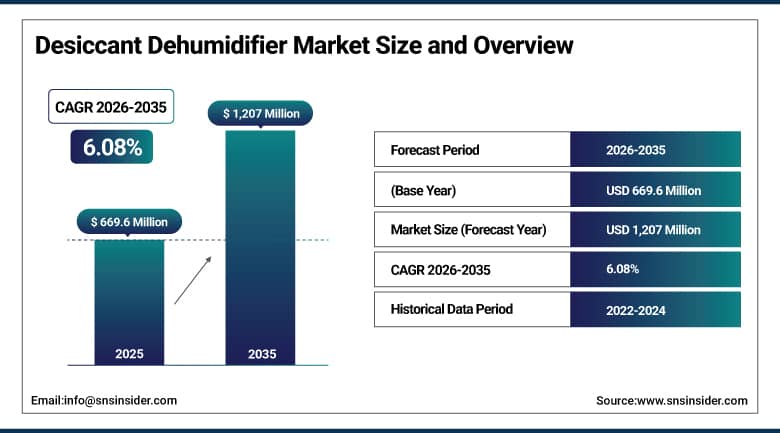
The Desiccant Dehumidifier Market size was USD 669.6 Million in 2025 and is expected to reach USD 1,207 Million by 2035, growing at a CAGR of 6.08% from 2026–2035.
Market growth in the desiccant dehumidifier market is driven by an increase in the demand for accurate humidity control systems in both industrial and commercial sectors. Industries such as pharmaceutical, food processing, electronics, chemicals, and lithium-ion battery manufacturing need desiccant dehumidifiers as it ensures protection of product quality, helps in efficient production processes, and prevents moisture damage. The growth in industrial automation and construction of state-of-the-art manufacturing plants has also fueled the demand for high-performing dehumidification units.
Growing demand for energy-efficient climate control and indoor air quality control systems has emerged as another important factor that is driving the market. Increasing preference for desiccant dehumidifiers over traditional refrigerant dehumidifiers has led to higher market growth, especially in applications where the use of traditional systems is not suitable due to their inefficiency in low temperatures and low humidity. Expansion in cold storage facilities, data centers, hospitals, and commercial buildings is expected to add to the demand.
In electronics manufacturing, IPC reports that relative humidity above 60% can corrode PCBs, while optimal storage requires RH of 40% or below. Desiccant dehumidifiers excel at maintaining these low RH levels even in low-temperature environments where refrigerant-based alternatives struggle.
To Get More Information On Desiccant Dehumidifier Market - Request Free Sample Report
Desiccant Dehumidifier Market Trends
-
EV battery cell manufacturing is emerging as a major new demand driver requiring ultra-low humidity desiccant systems.
-
Data center humidity management keeps expanding as hyperscale and edge data center construction accelerates globally.
-
Pharmaceutical cleanroom humidity control is strengthening as CGMP compliance requirements keep tightening.
-
Hybrid desiccant-refrigerant systems are gaining traction for improved energy efficiency in moderate-humidity environments.
-
Advanced silica gel and molecular sieve rotor materials are improving desiccant dehumidifier performance per unit energy.
-
IoT-connected desiccant systems are enabling remote humidity monitoring and predictive maintenance for industrial operators.
The U.S. Desiccant Dehumidifier Market Outlook
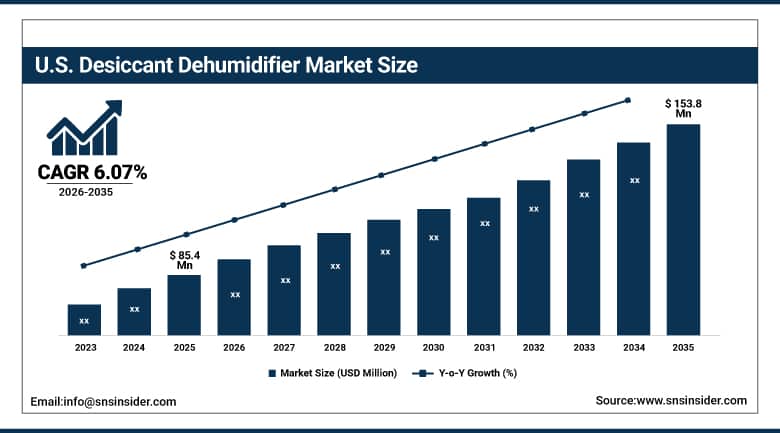
The U.S. Desiccant Dehumidifier Market was valued at approximately USD 85.4 Million in 2025. It is expected to reach approximately USD 153.8 Million by 2035, growing at a CAGR of approximately 6.07%.
U.S. Desiccant Dehumidifier Market will witness high growth due to the rising demand for dehumidifiers in the industries of pharmaceutical, food processing, electronic, data center and warehousing. The industries are implementing efficient dehumidifier systems in order to preserve their products, ensure production quality and maintain stringent environmental regulations.
Moreover, rapid growth in battery manufacturing plants, the rising demand for efficient HVAC systems, and increasing investments in the healthcare sector and cold storage units is further boosting market growth in the United States.
In 2024, Condair acquired US-based evaporative media manufacturer Kuul, expanding its capabilities in evaporative cooling systems. The acquisition strengthens Condair's product offering with Kuul's glass fibre and cellulose media expertise, enhancing its global distribution network and providing sustainable, reliable humidity solutions. Condair is also investing in a new 400,000 ft² production facility in Richmond, Virginia, expected to open in 2025, to better serve the U.S. data center market.
Desiccant Dehumidifier Market Segment Analysis
This section examines performance across each major segmentation dimension covered in this report.
-
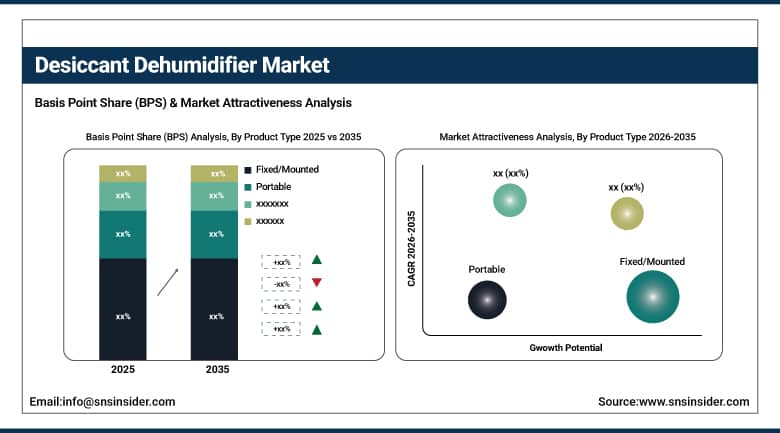
By Product Type, the Fixed/Mounted segment dominated the desiccant dehumidifier market with approximately 66% share in 2025. The Portable segment is expected to register the fastest growth from 2026 to 2035.
-
By Application, the Food & Pharmaceutical segment is expected to dominate the desiccant dehumidifier market in 2025 with approximately 30% of total revenue, and is also expected to register the fastest CAGR through the forecast period.
-
By End User, the Industrial segment dominated the desiccant dehumidifier market with approximately 69% share in 2025. The Commercial segment is expected to witness significant growth through the forecast period.
By Product Type, fixed/mounted dominates, portable grows fastest
The market for fixed and mounted desiccant dehumidifiers accounted for around 66% of the total revenue share for product type during 2025. Applications that involve large industries and require constant capacity of humidity control in industries like pharmaceuticals, food processing, and electronics manufacturing require such stable devices that are integrated. High energy efficiency and integration with current HVAC systems makes fixed and mounted dehumidifiers perfect for such applications where even slight changes in humidity level may result in degradation of product quality or disruption in operation.
The segment of portable desiccant dehumidifiers is anticipated to have the highest CAGR between 2026 and 2035. These units are more flexible and easier to use. They are also mobile in nature. All these factors make them very attractive both for residential and commercial purposes. In particular, they are preferred in places where space is limited and in situations where the setup is temporary in nature like small commercial establishments, construction sites, and rented apartments.
By Application, food & pharmaceutical dominates by 2032 and grows fastest
The Food & Pharmaceutical division is predicted to take the top position among all desiccant dehumidifiers application sectors with about 30% market share in 2025, as well as register the highest CAGR in the forecast period. The reason for this is that there is an urgent need for strict humidity regulation in these markets to ensure the high quality and safety of products. For instance, in the pharmaceutical sector, humidity needs to be regulated in order to preserve drugs' stability and prevent their contamination by bacteria or other microbes. When it comes to the food industry, too much moisture may lead to food deterioration, development of molds, and poor texture and taste.
Moreover, such sectors as Energy, Chemical, Construction, and Electronics are worth paying attention to. Within the Energy segment, EV battery production is developing fast because of the need to have very low humidity less than 1% relative humidity when producing lithium-ion cells. In electronics applications, humidity should not exceed 40%.
By End User, industrial dominates, commercial grows fastest
The industrial sector led the end user segment in 2025, garnering a market share of around 69%. The growing need for the need for accuracy in humidity control in industrial settings where slight moisture variations can have a great effect on productivity accounts for this dominance. Industries such as pharmaceuticals, food processing, electronic industry, and chemical plants make use of dehumidifiers to achieve the best conditions during manufacturing, storage, and packaging.
The commercial sector will register significant gains between 2026 and 2035. There will be an increase in the number of companies requiring dehumidifiers to ensure that there are no moisture problems within the buildings. Offices, restaurants, retail stores, and health care facilities among other commercial buildings need dehumidifiers to ensure proper air quality and to protect against mold formation.
Regional Analysis
|
Region |
Major Country |
Share within Region, 2025 (%) |
|---|---|---|
|
North America |
United States |
82.5% |
|
Europe |
Germany |
24.6% |
|
Asia Pacific |
China |
40.6% |
|
Middle East & Africa |
UAE |
22.8% |
|
Latin America |
Brazil |
43.8% |
Asia Pacific Desiccant Dehumidifier Market Insights
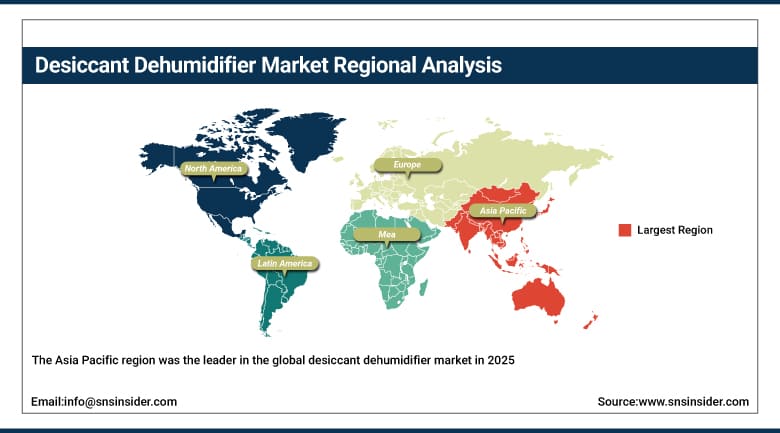
The Asia Pacific region was the leader in the global desiccant dehumidifier market in 2025, accounting for about 40% of the total revenue share. The reasons behind the dominance include rapid industrialization, urbanization, and growth in manufacturing industries in countries like China, Japan, and India. There is increasing demand for electronics, pharmaceuticals, and food processing industries, which require proper humidity control.
The Chinese region holds a revenue share of 40.6% of Asia Pacific. There are significant demands from Japan and South Korea because of the advanced manufacturing of electronics and pharmaceuticals. Due to constant growth in the region's industry, Asia Pacific will be the market leader.
Get Customized Report as Per Your Business Requirement - Enquiry Now
North America Desiccant Dehumidifier Market Insights
North America holds the potential of becoming the fastest-growing regional market for the desiccant dehumidifiers market during the forecast period. Increasing demand from pharmaceuticals, food processing, and electronics industries is driving the regional market. Stringent regulations concerning the environment by the U.S. FDA and USDA are promoting the use of efficient humidity control systems. The increasing trend towards energy efficiency and increased production of EV batteries is also driving the demand.
The United States contributes about 82.5% of the revenue generated in North America. Increasing construction and development of commercial and industrial infrastructure along with technological innovations in the desiccant rotors are contributing to regional market growth.
Europe Desiccant Dehumidifier Market Insights
The European region forms a notable market for the desiccant dehumidifier due to its strong pharmaceutical industry, food processing industry, and industrial manufacturing. Germany is the leader in this market due to its strong pharmaceutical manufacturing and food processing industries. Other countries like France and the United Kingdom also form notable markets due to their strong industrial and health care sectors.
Germany constitutes 24.6% of the total revenues in Europe. EU GMP regulations governing humidity control in pharmaceuticals continue to ensure strong demand for the product.
MEA & Latin America Desiccant Dehumidifier Market Insights
Revenue in the Middle East Africa (MEA) is led by the UAE, which generates around 22.8% of total MEA revenue. Growth in pharmaceuticals, food processing, and data center investments are some factors driving regional demand for desiccant dehumidifiers. The healthcare infrastructure and manufacturing capacity of Saudi Arabia is being expanded.
Brazil accounts for around 43.8% of Latin American region revenue. Food processing, along with pharmaceutical manufacturing, are some factors driving regional demand. There is secondary demand from Mexico and Argentina regions as well.
Market Dynamics
Growth Drivers: Rising industry standards fueling demand for precise humidity control
The increasing focus on accurate humidity management is another crucial driver, particularly for moisture-sensitive industries such as pharmaceuticals, food processing, and electronics, which require very strict environmental conditions to prevent spoilage, contamination by microbes, and damage to equipment. For example, the FDA in the United States regulates humidity management for drugs under CGMP. Humidity management is vital for food products according to USDA and FSIS because it prevents contamination of food products. The desiccant dehumidification system is efficient when it comes to managing humidity at low temperatures where the refrigerant systems cannot function.
Industrial automation and stricter compliance standards increase the global need for accurate moisture management. Furthermore, the creation of new demand verticals like production of batteries for electric vehicles contributes to the development of the market. Therefore, this driver will be sustainable for a long time due to regulatory requirements for pharmaceuticals, food products, and electronics.
Restraints: High energy consumption during regeneration limiting adoption
Even though desiccant dehumidifiers prove to be effective when used at low temperatures, their regeneration process is highly energy-intensive, especially when used continuously. This increased energy requirement causes high costs compared to those of other types of dehumidification systems, which makes them unattractive to energy-conscious facilities. The U.S. Department of Energy says that HVAC dehumidification systems can use up to 30 percent of the total energy consumed in controlled climates.
The increased energy consumption of such dehumidification systems becomes a limitation to them with the current increased energy efficiency regulations. For this reason, it becomes difficult to use them in places where the ISO 50001 standards are required or where it is necessary to reduce greenhouse gas emissions.
Opportunities: Quality standard compliance driving desiccant dehumidifier adoption
The worldwide trend of introducing stringent quality and safety guidelines, such as GMP, HACCP, and ISO, has been greatly increasing the demand for high-quality humidity control technology. For industries like pharma, food processing, and electronic manufacturing, controlled environments are necessary to improve the product quality and pass the audit test. GMP guidelines issued by the FDA of USA specify very strict environmental conditions when pharmaceutical products are being produced.
Cleanroom operation according to ISO 14644 for electronics and semiconductor manufacturing requires a low moisture environment. The high accuracy of desiccant dehumidifiers in controlling low humidity is why they are chosen as a means of complying with such regulations. This market segment will continue to grow with the increased regulatory demands around the world.
Recent Developments:
-
2024: Condair acquired US-based evaporative media manufacturer Kuul in July 2024, expanding its humidity control capabilities and investing in a new 400,000 ft² production facility in Virginia to serve the data center market.
-
2025: Atlas Copco announced expansion of its manufacturing capacity in India with a new factory in Talegaon in February 2025, investing approximately MINR 1,400 to produce air and gas compressor and humidity control systems.
-
2024: Munters AB expanded its manufacturing capacity in North America to meet growing demand for desiccant dehumidification solutions from pharmaceutical, EV battery manufacturing, and data center customers.
Desiccant Dehumidifier Market Key Players are:
These companies span industrial and commercial desiccant dehumidifier specialists, HVAC-integrated humidity control providers, and portable dehumidifier manufacturers.
-
Shandong Jiaxin Electric Appliances
-
OKEAN
-
Hibar Systems
-
Aerial
-
Frigidaire
-
Magic Aire
-
Condair
-
Unico System
-
Zander
-
Trotec
-
Mitsubishi Electric
-
Munters
-
CTL Group
-
Dantherm
-
DeLonghi
-
Bry-Air
-
Cotes
-
Seibu Giken DST
-
KAESER KOMPRESSOREN
-
Atlas Copco AB
Desiccant Dehumidifier Market Report Scope:
| Report Attributes | Details |
|---|---|
| Market Size in 2025 | USD 669.6 Million |
| Market Size by 2035 | USD 1,207 Million |
| CAGR | CAGR of 6.08% From 2026 to 2035 |
| Base Year | 2025 |
| Forecast Period | 2026-2035 |
| Historical Data | 2022-2024 |
| Report Scope & Coverage | Market Size, Segments Analysis, Competitive Landscape, Regional Analysis, DROC & SWOT Analysis, Forecast Outlook |
| Key Segments | • By Product Type (Fixed/Mounted, Portable) • By Application (Energy [EV Battery Manufacturing, Power Plants & Wind Turbines], Chemical, Construction, Electronics, Food & Pharmaceutical) • By End User (Commercial, Industrial) |
| Regional Analysis/Coverage | North America (US, Canada), Europe (Germany, UK, France, Italy, Spain, Russia, Poland, Rest of Europe), Asia Pacific (China, India, Japan, South Korea, Australia, ASEAN Countries, Rest of Asia Pacific), Middle East & Africa (UAE, Saudi Arabia, Qatar, South Africa, Rest of Middle East & Africa), Latin America (Brazil, Argentina, Mexico, Colombia, Rest of Latin America). |
| Company Profiles | Shandong Jiaxin Electric Appliances, OKEAN, Hibar Systems, Aerial, Frigidaire, Magic Aire, Condair, Unico System, Zander, Trotec, Mitsubishi Electric, Munters, CTL Group, Dantherm, DeLonghi, Bry-Air, Cotes, Seibu Giken DST, KAESER KOMPRESSOREN, and Atlas Copco AB. |
Frequently Asked Questions
The Desiccant Dehumidifier Market is expected to grow at a CAGR of 6.08% from 2026 to 2035.
The Desiccant Dehumidifier Market was valued at USD 669.6 Million in 2025.
The Food & Pharmaceutical segment is expected to dominate 2025 with approximately 30% of total revenue, and is also growing at the fastest CAGR through the forecast period.
Rising regulatory standards for humidity control in pharmaceuticals, food processing, and electronics manufacturing, along with growing EV battery manufacturing demand, are the primary growth factors.
Asia Pacific dominated the Desiccant Dehumidifier Market with approximately 40% revenue share in 2025.
