
Dietary Supplements Market Report Scope & Overview:
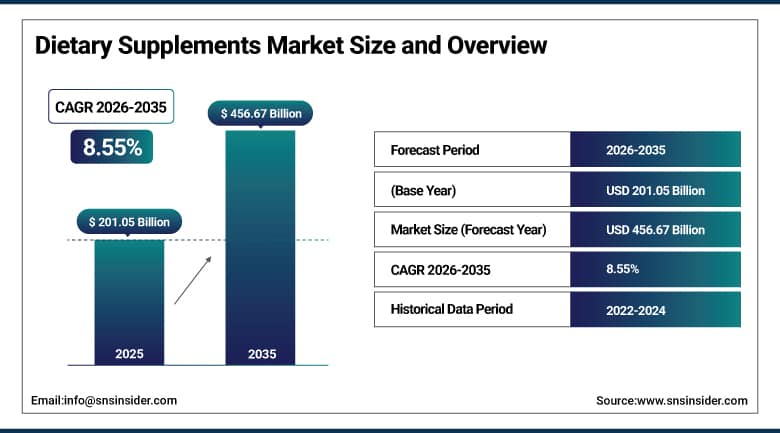
The Dietary Supplements Market was valued at USD 201.05 Billion in 2025 and is expected to reach USD 456.67 Billion by 2035, growing at a CAGR of 8.55% from 2026 to 2035.
Somewhere along the way, taking a daily vitamin stopped being a niche habit and became close to a default behavior for a huge share of adults in developed and increasingly developing markets alike. The World Health Organization projects the share of people over 60 will nearly double globally between 2015 and 2050, and that demographic shift alone explains a meaningful chunk of this market's growth, since older adults are consistently the heaviest supplement users across nearly every product category. What is changing the category now is personalization, genetic testing, biomarker data, and AI-driven formulation tools are turning what used to be a one-size-fits-all multivitamin purchase into something closer to a customized health regimen, and the brands moving fastest on that shift are pulling ahead of competitors still selling standardized formulas.
In 2025 and early 2026, Herbalife Ltd. acquired Bioniq, Pro2col, and Link BioSciences to expand its personalized nutrition capabilities, combining biometric and genetic data with its global distributor network to formulate customized supplements.
To Get More Information On Dietary Supplements Market - Request Free Sample Report
Dietary Supplements Market Trends
-
Personalized supplement formulations based on genetic and biomarker data are moving from niche to mainstream among major brands.
-
Softgel formats are gaining share over traditional tablets as consumers prioritize ease of swallowing and absorption.
-
Subscription-based direct-to-consumer models are expanding as brands look to build predictable repeat purchase behavior.
-
Botanical and plant-based ingredient sourcing is growing faster than synthetic alternatives among health-conscious buyers.
-
Clean-label transparency, third-party testing, and traceable sourcing are becoming baseline expectations rather than premium differentiators.
U.S. Dietary Supplements Market Outlook
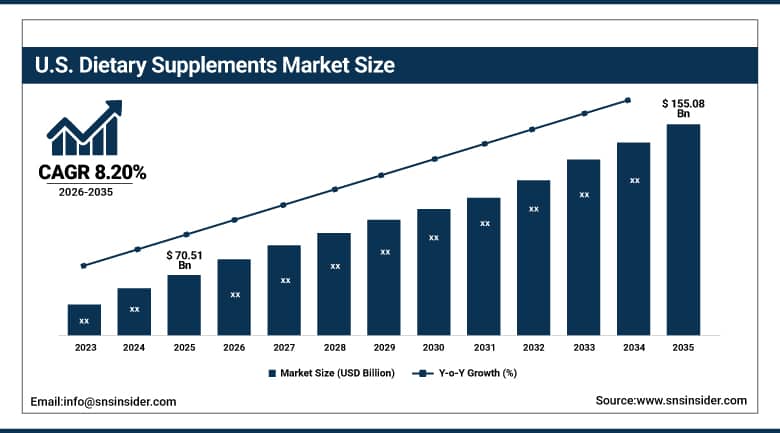
The U.S. Dietary Supplements Market was valued at USD 70.51 Billion in 2025 and is projected to reach USD 155.08Billion by 2035, growing at a CAGR of 8.20% during 2026-2035.
Weight management and energy supplements have become the single largest application category in the U.S. market, capturing more than a fifth of total revenue as GLP-1 medication adoption has, somewhat counterintuitively, expanded rather than shrunk interest in complementary nutrition and metabolic health products. Direct-to-consumer subscription models continue reshaping how supplements reach consumers, with online distribution growing meaningfully faster than traditional pharmacy and retail channels even though offline sales still account for the clear majority of volume. Prenatal health supplements are seeing particularly strong growth as awareness of nutritional needs during pregnancy continues expanding beyond basic prenatal vitamins into more specialized formulations. Regulatory scrutiny around supplement labeling and health claims has also intensified, pushing established brands toward more rigorous clinical substantiation of their marketing claims.
In 2025, Amway Corporation partnered with biotech firm HEM Pharma to advance personalized nutrition research and development across the Asia-Pacific region, building on its established Nutrilite supplement portfolio.
Dietary Supplements Market Segment Analysis
-
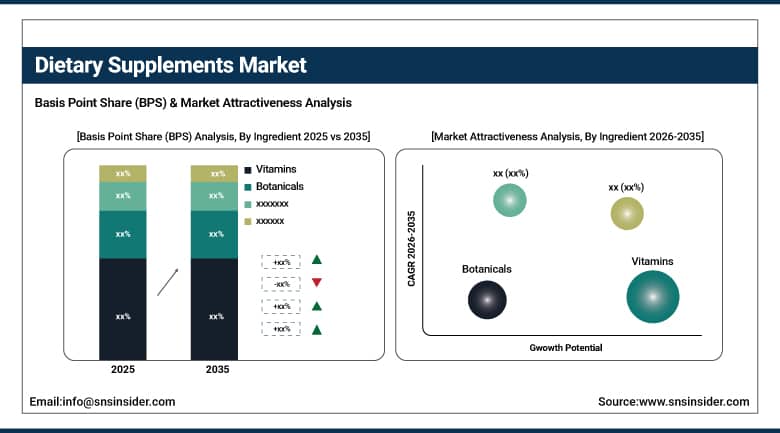
By Ingredient, Vitamins segment dominated the Dietary Supplements Market in 2025 with 30.10% share; Botanicals segment is the fastest-growing segment, registering a CAGR of 10.20% from 2026 to 2035.
-
By Form, Tablets segment dominated the Dietary Supplements Market in 2025 with 32.40% share; Liquid Supplements segment is the fastest-growing segment, registering a CAGR of 10.10% from 2026 to 2035.
-
By Type, OTC segment dominated the Dietary Supplements Market in 2025 with 76.40% share; Prescribed segment is the fastest-growing segment, registering a CAGR of 9.40% from 2026 to 2035.
-
By Distribution Channel, Offline segment dominated the Dietary Supplements Market in 2025 with 66.80% share; Online segment is the fastest-growing segment, registering a CAGR of 10.30% from 2026 to 2035.
By Ingredient, Vitamins Lead the Dietary Supplements Market While Botanicals Gain Ground Fastest
Vitamins hold 30.10% of the Dietary Supplements Market, the largest single ingredient category, and that lead comes down to how deeply embedded vitamin supplementation already is in everyday health habits across virtually every age group and geography. Vitamin D and B-complex products in particular have benefited from growing public awareness of widespread deficiencies, which has turned what used to be a discretionary purchase into something closer to a routine health maintenance habit for a large share of consumers.
Botanicals are growing at a 10.20% CAGR, the fastest pace among ingredients, as consumers increasingly favor plant-derived formulations over synthetic alternatives, drawn by both perceived naturalness and growing scientific interest in specific botanical compounds for cognitive, immune, and stress-related support. Adaptogens and functional mushroom extracts in particular have moved from wellness-niche curiosities to mainstream retail products over just the past few years, reflecting how quickly consumer interest in this category can translate into shelf presence.
By Form, Tablets Dominate While Softgels Emerge as the Fastest-Growing Format
Tablets account for 32.40% of the market by form, remaining the default choice largely because they offer the lowest per-unit manufacturing cost and the longest shelf stability of any common supplement format. Established manufacturing infrastructure across the industry is also built predominantly around tablet compression, which keeps this format the most economical option for high-volume, price-sensitive supplement categories like basic multivitamins.
Softgels are growing fastest, at a 10.10% CAGR, as consumers increasingly favor their easier swallowing experience and the format's suitability for oil-based ingredients like fish oil and vitamin E that do not compress well into standard tablets. Perceived faster absorption, whether or not it holds up precisely to clinical scrutiny in every case, has also become a meaningful part of softgels' appeal relative to tablets among consumers actively comparing formats.
By Type, OTC Dominates While Prescribed Registers the Fastest Growth
OTC supplements hold 76.40% of the market by type, reflecting how most dietary supplements are purchased without any medical oversight at all, driven by consumer self-selection based on perceived health needs, marketing, and word of mouth rather than clinical recommendation. This regulatory category's lighter compliance burden compared to prescribed alternatives also keeps manufacturing and go-to-market costs lower, reinforcing OTC's dominant position across nearly every distribution channel.
Prescribed supplements are growing fastest by type, at a 9.40% CAGR, as physicians increasingly recommend clinically formulated products for specific conditions, prenatal care and post-surgical recovery being common examples, where dosing precision and quality assurance matter more than typical OTC products can guarantee. Growing physician comfort with recommending specific supplement brands, partly driven by improved clinical evidence for certain formulations, is reinforcing this category's above-average growth trajectory.
By Distribution Channel, Offline Dominates While Online Registers the Fastest Growth
The offline channel includes pharmacies, specialty stores, and grocery, which together account for 66.80% of the market share and capitalizes on the consumer preference for shopping for and comparing supplements through the physical stores, especially when making the first-time purchase in a new supplement category. The advice of pharmacists and store salespeople still holds significance for the modern consumer.
Online distribution is growing fastest, at an 10.30% CAGR, as subscription-based reorder models make repeat purchasing effortless and direct-to-consumer brands increasingly bypass traditional retail entirely. Personalized nutrition platforms in particular depend almost entirely on online distribution, since their business model requires collecting biometric or survey data upfront, something that simply does not translate to a traditional retail shelf purchase.
Regional Analysis
|
Region |
Country |
Share (2025) |
|
North America |
United States |
91.00% |
|
Asia Pacific |
China |
38.20% |
|
Europe |
Germany |
24.60% |
|
Middle East & Africa |
UAE |
17.20% |
|
Latin America |
Brazil |
28.40% |
Asia Pacific Dietary Supplements Market Insights
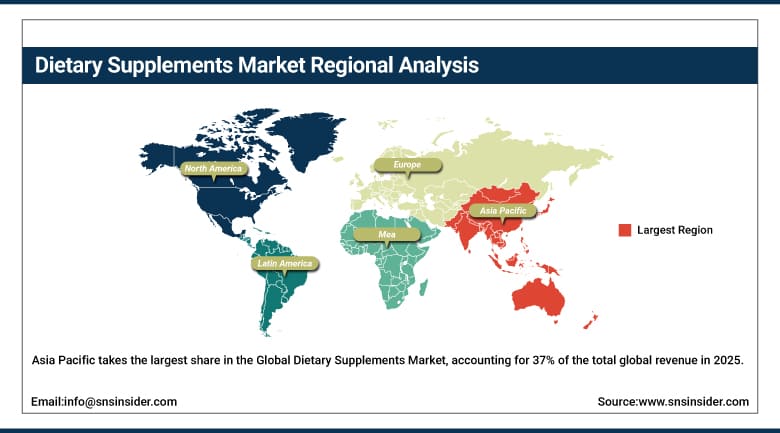
Asia Pacific takes the largest share in the Global Dietary Supplements Market, accounting for 37% of the total global revenue in 2025, driven by China’s huge consumer base, health awareness growth, and the rapid growth in the cross-border e-commerce business, which allows for easier access to dietary supplements from China. During the first half of 2025 itself, China registered nearly one thousand product filings for nutrition supplement products, indicating the sheer volume of domestic demand driving product development.
China accounts for nearly 38.20% of the regional market on account of its large consumer base, disposable incomes, and infrastructure for supplement imports via the e-commerce channel. The Indian and Southeast Asia markets are showing significant growth due to increased health awareness even in smaller towns, and Japan and South Korea make their contributions to the market through their mature nutraceutical sectors.
Get Customized Report as Per Your Business Requirement - Enquiry Now
North America Dietary Supplements Market Insights
North America is a close second to Asia Pacific in overall market size, supported by a highly developed direct-to-consumer supplement industry, widespread consumer adoption of vitamins, minerals, and protein supplements, and a large aging population that consistently drives above-average per-capita supplement spending. What is notable here is less the region's growth rate and more its sheer concentration, a huge share of global supplement brand innovation and marketing spend still originates in the U.S. even as manufacturing and raw material sourcing increasingly happen elsewhere.
The United States accounts for approximately 91.00% of the North American market, reflecting its deeply established supplement retail and e-commerce ecosystem. Canada contributes a smaller but steady share, supported by its own health-conscious consumer base and cross-border access to major U.S. supplement brands.
Europe Dietary Supplements Market Insights
Europe's dietary supplements market is mature and steady, shaped by strong consumer trust in supplement quality and safety alongside comparatively strict regulatory frameworks governing health claims and ingredient approval. That regulatory rigor has, if anything, reinforced consumer confidence in the category, even as it slows how quickly new ingredient innovations can reach the market compared to less regulated regions.
Germany leads the European market with a 24.60% share, supported by its large pharmacy retail network and strong consumer trust in supplement quality. France and the United Kingdom follow, with demand in both countries tied to well-established preventive health and wellness consumption habits.
Middle East & Africa and Latin America Dietary Supplements Market Insights
The Middle East and Africa region is witnessing steady growth due to increasing health awareness and higher disposable incomes in the Gulf nations, backed up by development in the pharmacy and modern retail infrastructure. The Latin American region is showing itself to be the most rapidly developing region, powered by rising disposable incomes, increasing health awareness, and fast growth in the e-commerce delivery system in the key cities of Brazil and Mexico.
The UAE holds the top spot in the Middle East & Africa region with a 17.20% market share as it acts as a regional distributor for retail and wellness products. Brazil accounts for 28.40% market share of the Latin America region due to its huge consumer base and health and wellness culture in the country along with Mexico.
Market Dynamics
Growth Drivers: Aging Populations and Personalized Nutrition Fueling Market Growth
The world's aging population is doing a lot of the heavy lifting behind this market's growth, since older adults consistently supplement at higher rates than younger consumers across nearly every product category, and the global share of people over 60 is set to nearly double by 2050 according to WHO projections. Rising health consciousness more broadly, reinforced by growing access to health information and wearable health tracking, is expanding the addressable market well beyond its traditional older-adult core.
Personalized nutrition, genetic testing, biomarker analysis, and AI-driven formulation, is adding a genuinely new growth vector on top of these established drivers, pulling in consumers who previously found standardized multivitamins unconvincing or unnecessary.
Restraints: Regulatory Scrutiny and Ingredient Cost Volatility Limiting Market Expansion
Growing regulatory pressure on issues like labeling, claims, and ingredient safety has been experienced in major markets in recent years, such that brands have had to spend more on clinical trials than in previous years due to compliance requirements. This is a cost which has been particularly burdensome on smaller brands without a regulatory affairs department. There have been significant fluctuations in raw material costs due to agriculture supply changes and increasing global demand in some specialty ingredient types.
Skepticism from consumers, caused by some public controversies regarding the effectiveness of certain ingredients or contamination, continues to be an issue, with brands having clinical proof in hand being relatively better prepared than brands making claims mainly through marketing.
Opportunities: Personalized Formulations and Emerging Market Expansion Creating New Growth Avenues
Personalized supplement formulations represent the clearest growth opportunity in the category right now, particularly as genetic testing and biomarker analysis costs continue falling to levels that make mass-market personalization increasingly viable rather than a premium niche offering. Brands that can combine credible clinical backing with genuinely individualized formulation stand to capture premium pricing that standardized products simply cannot command.
Expansion into emerging markets with tailored formulations and marketing strategies offers a second substantial opportunity, particularly across Latin America and parts of Asia Pacific where supplement adoption is still meaningfully below levels seen in North America and Europe despite rapidly rising health awareness.
Recent Developments:
-
2025-2026: Herbalife Ltd. acquired Bioniq, Pro2col, and Link BioSciences to expand its personalized nutrition capabilities, combining biometric and genetic data with its global distributor network to formulate customized supplements.
-
2025: Amway Corporation partnered with biotech firm HEM Pharma to advance personalized nutrition research and development across the Asia-Pacific region.
-
2025-2026: Amway Korea launched a personalized gut-health and longevity nutrition platform, extending its earlier life-stage nutrition and myPack by Nutrilite customization programs.
-
April 2025: Seaya Andromeda acquired a majority stake in Baia Food, transitioning the European supplement brand from an online-only model to a multi-channel pharmacy and retail distribution approach.
Dietary Supplements Market key players are:
-
Pfizer Inc.
-
Bayer AG
-
Glanbia plc
-
Abbott Laboratories
-
Archer Daniels Midland Company
-
Herbalife Nutrition Ltd.
-
Haleon plc
-
Himalaya Wellness Company
-
Amway Corporation
-
Nestlé Health Science
-
NOW Health Group, Inc.
-
Reckitt Benckiser Group plc
-
DSM-Firmenich AG
-
BASF SE
-
Kerry Group plc
-
Nutraceutical International Corporation
-
GNC Holdings, LLC
-
Suntory Wellness Ltd.
-
Otsuka Pharmaceutical Co., Ltd.
-
Church & Dwight Co., Inc.
Dietary Supplements Market Report Scope:
| Report Attributes | Details |
|---|---|
| Market Size in 2025 | USD 201.05 Billion |
| Market Size by 2035 | USD 456.67 Billion |
| CAGR | CAGR of 8.55% From 2026 to 2035 |
| Base Year | 2025 |
| Forecast Period | 2026-2035 |
| Historical Data | 2022-2024 |
| Report Scope & Coverage | Market Size, Segments Analysis, Competitive Landscape, Regional Analysis, DROC & SWOT Analysis, Forecast Outlook |
| Key Segments | • By Ingredient (Vitamins, Minerals, Botanicals, Proteins & Amino Acids) • By Form (Tablets, Capsules, Softgels, Powders) • By Type (OTC, Prescribed) • By Distribution Channel (Offline, Online) |
| Regional Analysis/Coverage | North America (US, Canada), Europe (Germany, UK, France, Italy, Spain, Russia, Poland, Rest of Europe), Asia Pacific (China, India, Japan, South Korea, Australia, ASEAN Countries, Rest of Asia Pacific), Middle East & Africa (UAE, Saudi Arabia, Qatar, South Africa, Rest of Middle East & Africa), Latin America (Brazil, Argentina, Mexico, Colombia, Rest of Latin America). |
| Company Profiles | Pfizer Inc., Bayer AG, Glanbia plc, Abbott Laboratories, Archer Daniels Midland Company, Herbalife Nutrition Ltd., Haleon plc, Himalaya Wellness Company, Amway Corporation, Nestlé Health Science, NOW Health Group, Inc., Reckitt Benckiser Group plc, DSM-Firmenich AG, BASF SE, Kerry Group plc, Nutraceutical International Corporation, GNC Holdings, LLC, Suntory Wellness Ltd., Otsuka Pharmaceutical Co., Ltd., Church & Dwight Co., Inc. |
Frequently Asked Questions
Key players include Pfizer Inc., Bayer AG, Glanbia plc, Abbott Laboratories, Archer Daniels Midland Company, Herbalife Nutrition Ltd., Haleon plc, and Amway Corporation, alongside other established supplement and nutraceutical manufacturers.
Key opportunities include personalized supplement formulations based on genetic and biomarker data, expansion into emerging markets with tailored formulations, and growing subscription-based direct-to-consumer distribution models.
The market is driven by rising health consciousness, an aging global population, and growing consumer interest in personalized nutrition solutions.
The Vitamins segment dominated the Dietary Supplements Market in 2025.
The Asia Pacific region dominated the Dietary Supplements Market in 2025, accounting for approximately 37% of global market share.
