
Digital Braille Displays Market Report Scope and Overview:
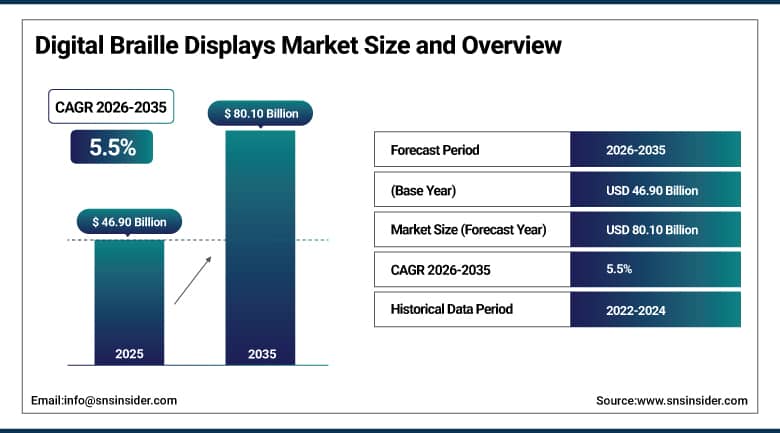
The Digital Braille Displays Market size was valued at USD 46.90 Billion in 2025 and is projected to reach USD 80.10 Billion by 2035, registering a CAGR of 5.5% from 2026 to 2035.
The Digital Braille Displays Market is providing digital accessibility to people with visual impairment using the refreshable Braille cell technology that translates digital text into tactile Braille output. Some of the important factors driving the digital Braille displays market include the increased use of digital Braille displays in mobile phones, tablets, and computers, increased use of multiline and multilingual displays for better reading, and increased government funding programs to support purchase of such devices in educational and work place environments. There is a substantial growth in the adoption of these products for inclusive education, corporate workplace accessibility, and portable devices, as there is huge investment by manufacturers and governments to develop technologies related to refreshable Braille cells.
In 2025, HumanWare and American Printing House for the Blind introduced the Monarch, a digital Braille e-book reader meant to provide better accessibility to learning materials for students.
To Get More Information On Digital Braille Displays Market - Request Free Sample Report
Digital Braille Displays Market Trends
-
Growing integration of digital Braille devices with smartphones, tablets, and computers continues expanding accessibility across mainstream digital platforms.
-
Rising adoption of multi-line and multi-lingual Braille displays continues improving readability and usability for diverse global user bases.
-
Increasing refinement of refreshable Braille cells continues enhancing resolution, refresh speed, and overall tactile reading experience.
-
Expanding government funding programs continue supporting assistive technology procurement across educational institutions and public sector workplaces.
-
Growing emphasis on compact, portable form factors continues driving adoption among students and mobile professional users.
U.S. Digital Braille Displays Market Size Outlook
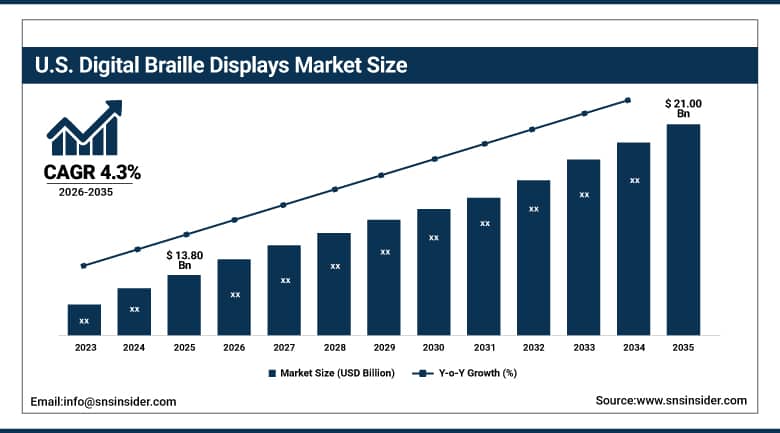
The U.S. Digital Braille Displays Market was valued at approximately USD 13.80 Billion in 2025 and is projected to reach approximately USD 21.00 Billion by 2035, registering a CAGR of approximately 4.3% from 2026 to 2035.
Demand across the United States continued to be shaped by robust regulatory backing under the Americans with Disabilities Act and educational accessibility mandates, sustained government grant funding through the Assistive Technology Act, and a deep concentration of leading Braille display manufacturers and accessibility technology developers. Rising deployment of digitally-enabled, multi-function Braille displays by domestic educational institutions and enterprises continued reinforcing the country's position as both the largest and one of the most established markets tracked in this report. Growing adoption across corporate workplace accessibility compliance, rehabilitation centers, and personal use added further layers of sustained domestic demand well beyond the technology's traditional educational use case.
Help Tech released new firmware for its Activator Braille display throughout 2025, improving automatic Bluetooth switching, memory access, and file menu navigation for enhanced usability among U.S. and global customers.
Digital Braille Displays Market Segment Analysis
-
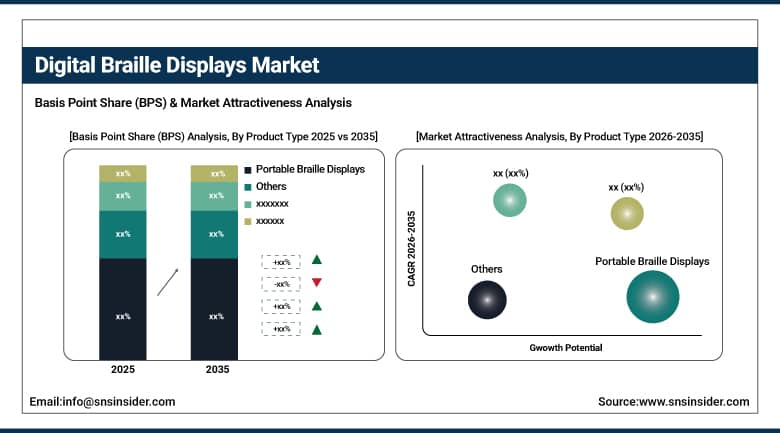
By Product Type, Portable Braille Displays segment dominated the Digital Braille Displays Market in 2025 with 54% share; Others segment is the fastest growing segment.
-
By Display Type, 8-dot Braille Displays segment dominated the market in 2025 with 49% share; 6-dot Braille Displays segment is the fastest growing segment.
-
By Connectivity, USB segment dominated the market in 2025 with 47% share; Bluetooth segment is the fastest growing segment.
-
By End-User, Educational Institutions segment dominated the market in 2025 with 35% share; Enterprises and Workplaces segment is the fastest growing segment.
By Product Type, Portable Leads While Multi-functional and Speech Output-capable Grow Fastest
The Portable Braille Displays segment dominated the Digital Braille Displays Market in 2025 owing to increasing demand for mobile and on-the-go accessibility tools among visually impaired users. Their lightweight design, rechargeable operation, and compatibility with multiple digital platforms make portable displays highly convenient for students, professionals, and daily commuters. Continued integration with screen readers and mainstream operating systems has kept portable displays the largest single revenue contributor within the product type landscape tracked in this report.
The Others segment, consisting of multi-functional and speech output-capable Braille displays, represents the quickest growing segment in the Digital Braille Displays Market due to increasing preference for products that provide more than just Braille display, such as notetaking capabilities and internet connectivity. Consumers are opting for such multi-functional devices in order to combine several assistive technology requirements on one device. Increasing focus by manufacturers in developing such devices is driving their adoption within the market at a faster pace.
By Display Type, 8-dot Dominates While 6-dot Records Fastest Growth
The 8-dot Braille Displays segment dominated the Digital Braille Displays Market in 2025 due to its ability to represent a broader range of characters, including capital letters and symbols, enhancing reading efficiency and digital interaction. Its utility in coding, data entry, and language learning applications makes it especially relevant in academic and professional environments. Sustained demand for expanded character set capability has kept 8-dot displays the largest overall contributor to market revenue.
The 6-dot Braille Displays segment is the fastest growing in the Digital Braille Displays Market owing to rising demand for simpler, more cost-effective devices suited to budget-conscious educational institutions and emerging market users. Manufacturers increasingly develop 6-dot variants to expand affordability and accessibility in developing regions with constrained procurement budgets. Growing emphasis on cost-effective assistive technology continues driving adoption of 6-dot display configurations across price-sensitive market segments.
By Connectivity, USB Leads While Bluetooth Grows Fastest
The USB segment held the largest market share in the Digital Braille Displays Market in 2025 owing to its compatibility with computers, tablets, and assistive gadgets facilitating safe and efficient data transfer. The USB Braille displays provide plug-and-play features, low latencies, and continuous power supply which is critical in office as well as educational environments. Continuous preference for security, speed, and uninterrupted performance have kept USB as the dominant connectivity choice.
The Bluetooth segment is the most rapidly expanding in the market of Digital Braille Displays due to an increasing number of devices that have wireless connectivity capabilities, which ensure simple accessibility and complex coupling with smartphones, tablets, and computers. Consumers are turning more to Bluetooth because of its convenience while using mobile devices. Rapidly growing popularity of smartphones and tablets is driving up the need for Bluetooth Braille displays.
By End-User, Educational Institutions Lead While Enterprises and Workplaces Grow Fastest
The Educational Institutions segment dominated the Digital Braille Displays Market in 2025 due to its critical role in facilitating learning for visually impaired students through innovative Braille technology across schools, colleges, and vocational training centers. Educational institutions continue driving substantial procurement given accessibility mandates and inclusive education program funding. Sustained global investment in inclusive education has kept this end-user segment the largest overall contributor to market revenue.
The Enterprises and Workplaces segment is the fastest growing in the Digital Braille Displays Market owing to increasing recognition of the value in incorporating Braille displays to foster inclusive workplaces while complying with accessibility standards. Employers increasingly integrate Braille displays with computers to facilitate email reading, document editing, and data entry tasks for visually impaired employees. Growing corporate accessibility compliance investment continues accelerating growth in this end-user category.
Regional Analysis
|
Region |
Major Country |
Share within Region, 2025 (%) |
|---|---|---|
|
North America |
United States |
88.00% |
|
Europe |
Germany |
27.00% |
|
Asia Pacific |
China |
42.00% |
|
Middle East and Africa |
UAE |
26.00% |
|
Latin America |
Brazil |
30.00% |
North America Digital Braille Displays Market Insights
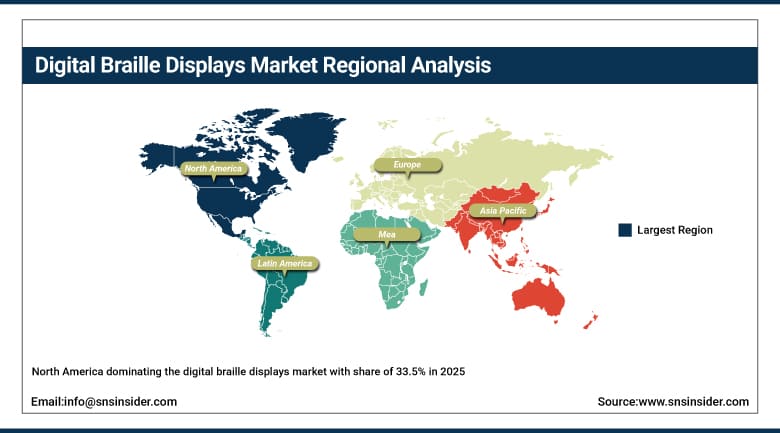
North America dominating the digital braille displays market with share of 33.5% in 2025 Robust regulatory backing under the Americans with Disabilities Act, educational accessibility mandates, and substantial investments in assistive technologies from governmental and private entities continued reinforcing the region’s strong position. Prominent organizations and educational bodies increasingly integrating digital Braille displays to aid the visually impaired, combined with heightened awareness and advocacy for accessibility, further strengthened North America’s standing as a mature, well-established market tracked in this report, with continued grant funding expected to sustain regional demand through the forecast period.
The United States accounted for roughly 88.00% of regional revenue, anchored by its deep concentration of leading Braille display manufacturers and substantial government grant funding for educational accessibility. Canada added further regional demand through its own growing accessibility technology sector, and that combined strength kept the continent a significant addressable market for digital Braille display vendors through the forecast period.
Get Customized Report as Per Your Business Requirement - Enquiry Now
Europe Digital Braille Displays Market Insights
Europe accounted for a significant portion of the global revenue due to the European Accessibility Act, among others, where accessibility is the top priority in integrating the use of assistive technology, especially in education and public sector services. The most developed countries continue to invest a great deal of money in making education more accessible and in making the public sector services more digitally accessible.
Germany accounted for 27.00% of revenue generated in Europe, facilitated by Germany’s Federal Ministry of Labour and Social Affairs programs to improve digital accessibility in government services. The UK and France contributed additional demand through their own accessibility funding programs, and continued European commitment to inclusivity should keep regional demand for digital Braille display technology climbing steadily through the forecast period.
Asia Pacific Digital Braille Displays Market Insights
Asia Pacific is advancing at the fastest pace among all regions, registering a CAGR of 6.6% from 2026 to 2035, driven by heightened emphasis on digital inclusivity and accessibility, expanding government programs promoting assistive technology adoption, and a rising internet user base across the region’s largest economies. That combination of government-backed initiatives and genuine downstream demand across educational and rehabilitation applications kept the region’s growth trajectory well ahead of every other region tracked in this report, with continued digital inclusion investment adding a further, sustained layer of demand.
China led the pack, supported by government programs such as the Internet Plus initiative and large-scale manufacturing of affordable Braille devices. India contributed meaningful additional demand through government programs promoting inclusive education and technology adoption, with Japan’s mature, technology-driven market and South Korea’s advanced infrastructure both reinforcing the region’s position as the fastest-growing digital Braille display market tracked in this report.
MEA and Latin America Digital Braille Displays Market Insights
The Middle East and Africa and Latin America both showed steady growth, driven by expanding awareness of digital accessibility, growing government focus on inclusive education, and rising demand for assistive technology adoption across both regions. As these markets continued building out modern accessibility infrastructure, digital Braille display technology proved a genuinely valuable enabler of increasingly inclusive educational and workplace environments.
The UAE topped the region’s and Africa’s demand for the product due to increasing investments in accessibility infrastructure and inclusive education in the region. The Saudi Arabia market made an additional contribution to the demand due to its own programs on accessibility diversification. Brazil became the biggest contributor to the revenues from the Latin American region due to the continued investments in educational and workplace accessibility.
Market Dynamics
Growth Drivers: Rising Visual Impairment Prevalence and Government Accessibility Funding
Some of the main drivers of the market are the rising prevalence of visual disabilities worldwide, advancements in the technologies of Braille displays, including better refreshable Braille cells and increased resolution, as well as favorable government regulations and subsidies. With growing emphasis being placed on accessibility in schools and places of work, the necessity of expanding the use of digital Braille displays remains one of the key factors pushing investments into the market.
Many governments around the world provide financial aid and incentives for the inclusion of Braille displays in the education sector, workplaces, and public services, which makes it another factor supporting the growth of the market. In addition, more and more platforms become integrated with Braille displays, which creates yet another factor influencing the continuous rise in demand.
Restraints: High Manufacturing Costs and Limited Braille Content Availability
The high cost involved in the development of Braille displays remains a real hindrance in the rapid growth of the product in the market, since the complex process involved in producing Braille cells that integrate well with the digital system is one of the main factors contributing to the high costs. This is a great financial obstacle to overcome, especially by people living in poor countries.
Limited availability of digital content formatted for Braille output continues posing a further restraint, as insufficient infrastructure and resources in developing countries pose obstacles for distribution and maintenance of devices. Rising sophistication of device technology necessitates end-user training, keeping some adoption scenarios more administratively complicated than simpler assistive technology deployment would otherwise require.
Opportunities: Multi-Line Display Innovation and Emerging Market Expansion
Rising development of multi-line Braille displays represents a genuinely significant opportunity, offering enhanced readability and usability by displaying multiple lines of Braille text simultaneously. Vendors positioned early in multi-line, multi-function display technology stand to capture meaningful share as this capability continues expanding from single-line devices into broader, more versatile assistive technology platforms.
Expansion into emerging markets offers a second substantial opportunity, as declining component costs and improving manufacturing efficiency make digital Braille displays increasingly accessible to price-sensitive institutional and individual buyers. Vendors with proven, cost-effective Braille display technology stand to capture meaningful share as global accessibility awareness continues expanding across established and emerging educational and workplace markets alike.
Recent Developments:
-
2025: Help Tech released new firmware for its Activator Braille display, improving automatic Bluetooth switching, memory access, and file menu navigation for enhanced usability.
-
2024: Orbit Research expanded its Braille product lineup with the launch of the Orbit Reader Q20 and Q40, featuring advanced accessibility functions for visually impaired users.
Digital Braille Displays Companies are:
-
Freedom Scientific
-
Vispero
-
Papenmeier GmbH & Co. KG
-
Handy Tech Elektronik GmbH
-
HIMS Inc.
-
Orbit Research
-
American Printing House for the Blind (APH)
-
Dot Incorporation
-
BAUM Retec AG
-
Nippon Telesoft Co., Ltd.
-
Amedia Corporation
-
Eurobraille
-
Harpo Sp. z o.o.
-
Help Tech GmbH
-
Optelec
-
Tobii Dynavox
-
Aroga Technologies
Digital Braille Displays Market Report Scope:
| Report Attributes | Details |
|---|---|
| Market Size in 2025 | USD 46.90 Billion |
| Market Size by 2035 | USD 80.10 Billion |
| CAGR | CAGR of 5.5% From 2026 to 2035 |
| Base Year | 2025 |
| Forecast Period | 2026-2035 |
| Historical Data | 2022-2024 |
| Report Scope & Coverage | Market Size, Segments Analysis, Competitive Landscape, Regional Analysis, DROC & SWOT Analysis, Forecast Outlook |
| Key Segments | • By Product Type (Portable Braille Displays, Desktop Braille Displays, Others) • By Display Type (8-dot Braille Displays, 6-dot Braille Displays, Others) • By Connectivity (USB, Bluetooth, Wi-Fi, Others) • By End-User (Blind and Visually Impaired Individuals, Educational Institutions, Enterprises and Workplaces, Government Organizations, Non-Profit Organizations, Others) |
| Regional Analysis/Coverage | North America (US, Canada), Europe (Germany, UK, France, Italy, Spain, Russia, Poland, Rest of Europe), Asia Pacific (China, India, Japan, South Korea, Australia, ASEAN Countries, Rest of Asia Pacific), Middle East & Africa (UAE, Saudi Arabia, Qatar, South Africa, Rest of Middle East & Africa), Latin America (Brazil, Argentina, Mexico, Colombia, Rest of Latin America). |
| Company Profiles | HumanWare, Freedom Scientific, Vispero, Papenmeier GmbH & Co. KG, Handy Tech Elektronik GmbH, HIMS Inc., Perkins Solutions, Orbit Research, American Printing House for the Blind (APH), Dot Incorporation, BAUM Retec AG, Nippon Telesoft Co., Ltd., Amedia Corporation, Eurobraille, Harpo Sp. z o.o., Help Tech GmbH, Optelec, Tobii Dynavox, Aroga Technologies. |

Frequently Asked Questions
Key players in the Digital Braille Displays Market include HumanWare, Freedom Scientific, Vispero, Papenmeier, and Handy Tech Elektronik, among others.
Key opportunities in the Digital Braille Displays Market include multi-line Braille display innovation and expansion into emerging markets through more affordable assistive technology.
The market is driven by the rising prevalence of visual impairment, advancements in refreshable Braille technology, government accessibility funding, inclusive education initiatives, and workplace accessibility requirements.
The Portable Braille Displays segment dominated the Digital Braille Displays Market, accounting for approximately 54% market share in 2025.
North America dominated the Digital Braille Displays Market in 2025 with a 33.5% share, driven by strong accessibility regulations, government grant funding, inclusive education initiatives, and established assistive technology infrastructure.
