
Drones Market Report Scope & Overview:
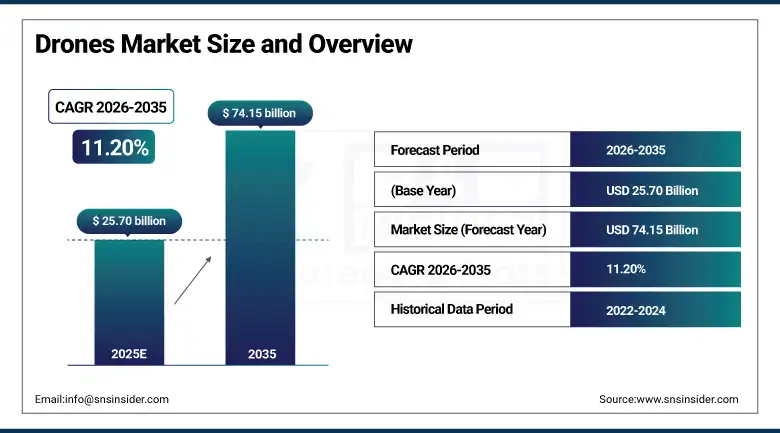
The Drones Market was valued at USD 25.70 billion in 2025 and is expected to reach USD 74.15 billion by 2035, growing at a CAGR of 11.20% from 2026–2035.
The Global Drones Market is rapidly evolving, driven by growing adoption of drones in both business and manufacturing industries along with the rising need for real-time data analysis and monitoring, increased automation in logistical services, enhancements in batteries as well as artificial intelligence solutions. Collection of aerial intelligence can be performed at reduced costs and with minimal human intervention by utilizing drones like fixed-wing, rotary wing, and hybrid UAVs.
Industrial data show that unmanned aerial systems have become essential tools in many industries, such as agriculture; infrastructure and civil domains; or defense - so allow productivity gain, risk reduction, and better resources management through high-resolution images (HR) using remote sensing.
Supporting this growth, studies show that drone-enabled solutions can reduce operational costs by up to 30% to 50% in applications such as infrastructure inspection, crop monitoring, and surveying by minimizing manual labor, downtime, and equipment usage. Government-backed programs continue to promote drone adoption through regulatory frameworks, pilot projects, and incentive schemes that accelerate commercialization across both developed and emerging markets.
Also, regulatory authorities around the globe are establishing common operational guidelines, airspace integration systems and certification requirements for rapid, safe & scalable drone adoption. These changing frameworks, as well as an accelerating commercial market together encourage more acquisition and integration of advanced-generation drone platforms across the investor community.
To Get more information On Drones Market - Request Free Sample Report
Drones Market Trends:
-
Rising demand for faster and cost-efficient logistics, particularly in last-mile delivery and medical supply transport, is driving drone adoption, although their role as a replacement for urban transportation remains in early-stage development.
-
Advancements in autonomous flight systems, AI-based navigation, computer vision, and intelligent control technologies are improving safety, reliability, and operational efficiency across drone operations.
-
Increasing investments in UAV development by aerospace companies, logistics providers, defense organizations, and startups are accelerating the commercialization of drone-based solutions across multiple industries.
-
Growing focus on sustainability is boosting the adoption of electric-powered drones, which offer lower emissions and reduced operating costs compared to conventional fuel-based systems.
-
Expansion of drone ecosystem infrastructure, including landing hubs, charging stations, and unmanned traffic management systems, is gradually supporting scalable deployment, though still in the development phase in many regions.
-
Rising demand for delivery services, emergency response operations, surveillance, precision agriculture, infrastructure inspection, and mapping applications is broadening the commercial use cases of drones.
-
Supportive government regulations, pilot programs, and public-private partnerships are facilitating testing, certification, and controlled deployment of advanced drone technologies, while full airspace integration continues to evolve.
U.S. Drones Market Size Outlook:
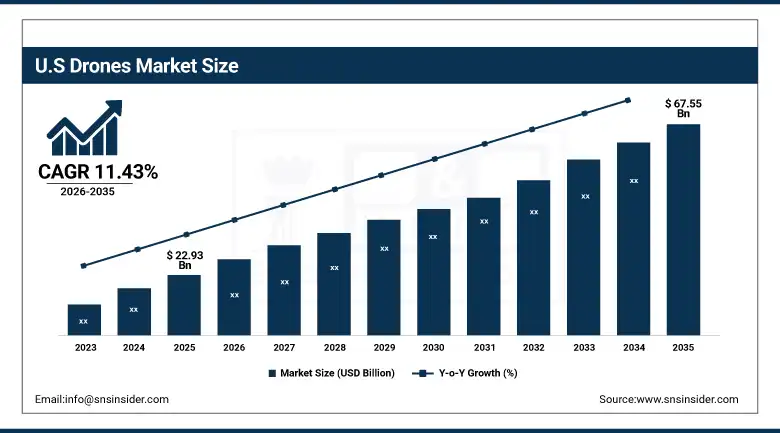
The U.S. Drones Market was valued at USD 22.93 Billion in 2025 and is expected to reach USD 67.55 billion by 2035, growing at a CAGR of 11.43% from 2026–2035. The market is rapidly expanding due to increasing demand for advanced aerial mobility solutions, urbanization and congestion, increase in UAV and autonomous flight technology investments along with upward adoption across commercial, industrial and public sector applications. The market is also expected to witness growth during these next few years due to the increasing umanned systems traffic and Vertiport, unmanned traffic management systems, development of infrastructure supporting various high value segments like logistics, surveillance, infrastructure inspection and emergency response along with drone detection solutions.
Government support and regulatory progress are further driving the market. The Federal Aviation Administration (FAA) is advancing frameworks such as Remote ID and Beyond Visual Line of Sight (BVLOS) operations, enabling broader commercial deployment. Initiatives like the UAS Integration Pilot Program (IPP) and BEYOND program, along with increasing investments and partnerships among companies such as Amazon and UPS, are strengthening innovation in drone delivery, defense, and public safety applications.
Drones Market Segment Highlights
-
By Product Type, Multi-rotor drones held the largest market share of 55% in 2035, while Hybrid VTOL drones are expected to grow at the fastest CAGR of 21.37% during 2026–2035.
-
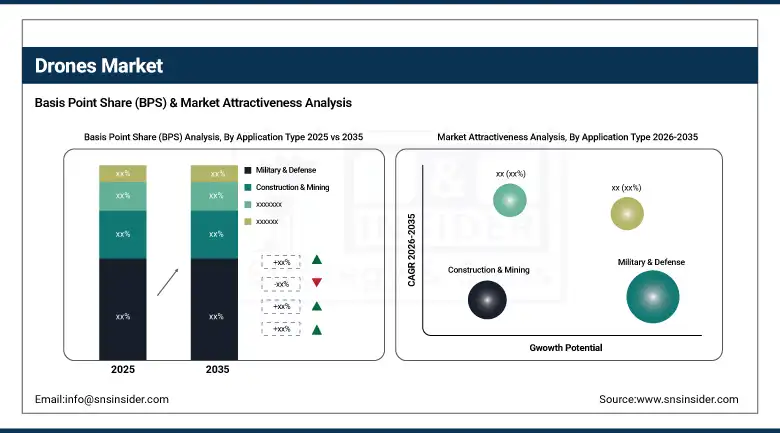
Based on Application, Military & Defense held the the largest share of 32% in 2025 and is expected to be at a growing rate during the forecast period with a highest CAGR of over 21.87%.
-
By Connectivity Technology in 2025, Radio Frequency (RF) / Remote Controller Links held the largest share at 45%, and will be projected to experience the fastest growing CAGR of 22.66% from 2026 through the end of this decade.
-
By End User, Defense & Military was the largest in 2023 with an approximate share of ~30.00% but Industrial & Utility Operators will register highest growth at a CAGR of 18.41% during 2026–2035
-
By Distribution Channel, Direct Sales held the highest share of 35.00 in 2025; System Integrators & Solution Providers & others expected to register the highest CAGR of 17.93% from 2026-2035
By Product Type, Multi-rotor (Rotary Blade) Drones Dominate While Hybrid VTOL Drones Grow Rapidly
The Multi-rotor (Rotary blade) drones segment accounted for the maximum global revenue share owing to its large scale adoption across commercial, industrial and consumer applications fueled by ease of operation, vertical take off and landing property along with cost-effectiveness. Applications of these drones comprise extensive use in surveillance, aerial photography, infrastructure inspection and short-distance delivery applications Their control basis accuracy and operational maneuverability within compact urban environments has contributed to substantial deployment scale and conquer-able market share.
Hybrid VTOL drones are the fastest growing segment as they provide greater operational versatility through the combination of fixed wing endurance and rotary wing flexibility leading to longer range and higher payload efficiency. Rising demand for and precise Long Range mapping, logistics operations and defense surveillance missions is primarily attributed to their increased adoption. Continuous advances in propulsion systems and autonomous flight technology are contributing to increased integration into commercial settings.
By Application, Military & Defense Dominates While Logistics & Delivery Grows Rapidly
Extensive military deployment of UAVs for surveillance, reconnaissance, border monitoring and tactical support applications results in Military & Defense winning the highest share by 2023. Unmanned aerial systems that enhance situational awareness, increase the efficiency of missions and absorb the risk of human assets when on missions in high-threat areas are also capture government investment. You are sampled from a data set of past operations up until October 2023.
One of the major contributors to interest in drone technology is explosive growth in logistics and delivery services. The e-commerce boom, coupled with increased demand for contactless solutions in densely populated urban areas, is forcing companies to bring innovation to last-mile delivery and make it more cost-effective & economical. And this is where drones are starting to come into play really well, enabling rapid delivery rates and getting in to places that are a lot less accessible. At the same time, performance and navigational improvements are streamlining it further, and with regulations gradually becoming more permissive as well, companies keep unearthing new potential applications for drone delivery.
By Connectivity Technology, RF / Remote Controller Links Dominate While Hybrid / Multi-link Systems Grow Rapidly
The Radio Frequency (RF) / Remote Controller Links segment was the biggest revenue contributor in the remote controller and wireless drone market, mainly because of their high dependability, ease, low cost, being widely used for short-range drone activities such as commercial drones for agriculture analysis among others. They are simple and their track record of performance makes these systems the de facto means for communication used by most existing UAVs.
The other segment is Hybrid / Multi-link System. This demand is driving the adoption of beyond visual line of sight (BVLOS) operations and the transmitting of real-time data. The added benefits being that they form redundancy, augmented coverage and also have mission critical communication inherent feature of advanced drone applications.
By End User, Defense & Military Dominates While Industrial & Utility Operators Grow Rapidly
The Defense & Military segment dominates the market owing to high defense budgets of various nations and extensive use of Unmanned Aerial Vehicles for intelligence, surveillance, reconnaissance and combat support missions. Drones are good at providing real-time situational awareness, they help reduce operational risks, and mission effectiveness in complex environments.
Industrial & Utility Operators is the fastest growing segment driven by increasing adoption of drones, for example infrastructure inspection, energy management & distribution, mining and utility maintenance. Access to challenging terrains, visible cost-cutting in operations and ease of operability are driving adoption across sectors. This growth is additionally aided by the development of automation and sensor technologies.
By Distribution Channel, Direct Sales Dominate While System Integrators & Solution Providers Grow Rapidly:
Direct Sales is the largest market as manufacturers aim to reach out directly to end users, where they can provide customized drone solutions, a flexible pricing model, and robust post-sale support. This segment is highly important for defense and enterprise applications in need of customized configurations along with long-term contracts.
System Integrators & Solution Provider is the fastest-growing segment as there increasing requirement to integrate hardware, software and analytics together with service components providing an end-to-end ecosystem for drones. Such providers allow for seamless deployment, scalability and operational efficiency, needed in contemporary complex large-drone applications.
Drones Market Regional Analysis:
|
Region |
Major Country |
Share within Region (%) |
|---|---|---|
|
North America |
United States |
77% |
|
Asia Pacific |
China |
45% |
|
Europe |
Germany |
27% |
|
Middle East & Africa |
Saudi Arabia |
25% |
|
Latin America |
Brazil |
5% |
Asia Pacific Drones Market Insights
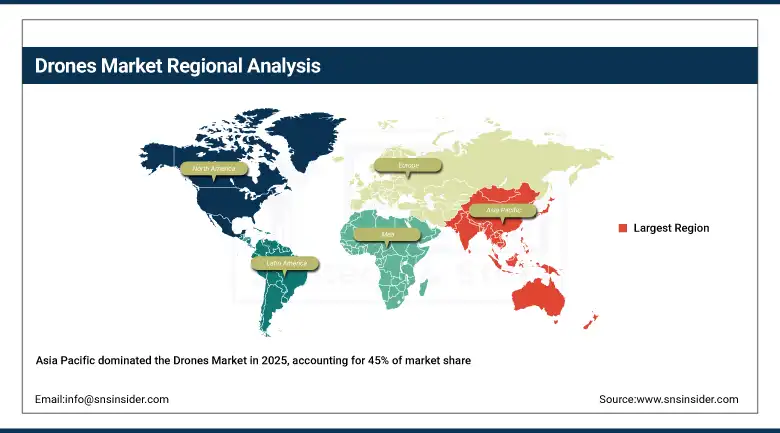
The Asia Pacific region plays a major role in the global drone market, contributing nearly 45% of total production and commercial usage across sectors like agriculture, logistics, surveillance, and industrial inspection. This strong position is supported by rapid adoption of UAVs for improving efficiency and reducing operational costs in both developed and developing countries. The region is also seeing growing use of drones in precision farming, infrastructure monitoring, and delivery services, which continues to expand overall demand and applications.Within this region, China is the clear leader due to its strong manufacturing base, advanced technology ecosystem, and large-scale deployment of drones across multiple industries. It accounts for a significant share of the regional market, driven by widespread use in agriculture, logistics, energy inspection, and smart city projects. Strong government support, continuous innovation in AI-based navigation systems, and a well-established supply chain further strengthen China’s dominance in the Asia Pacific drone market.
Get Customized Report as per Your Business Requirement - Enquiry Now
North America Drones Market Insights
The share of North America in the Global drone market is estimated to account for 43%, due to high defense budgets, and adoption of autonomous unmanned aerial vehicle systems which are carrying out collateral damage but increasing sales in logistic application, infrastructure monitoring, and public safety operations. Due to its faster technology adoption, U.S. is the top country in North America.There is also rapid growth in the drone deliveries mapping and inspection applications, resulting from significant funding at various levels related to AI-enabled navigation/ autonomy and airspace integration. This also enables large-scale deployment of commercial UAV applications in urban and rural areas, the emergence of regulatory frames.
Europe Drones Market Insights
Europe holds around an 18% share in the global drone market, supported by strong regulatory frameworks, structured adoption programs, and increasing integration of drones into industrial automation. The region has been actively promoting the use of UAVs across sectors such as infrastructure inspection, agriculture, defense, and public safety, which is helping to steadily expand market growth. Clear guidelines for drone operations and ongoing efforts to harmonize airspace regulations across countries are also encouraging wider commercial use.Key countries such as Germany, France, the UK, Italy, and Spain are playing a major role in driving this growth. These nations are investing in advanced drone technologies and encouraging their use in both commercial and government applications. With growing demand for efficient monitoring solutions, smart city development, and industrial digitization, Europe continues to strengthen its position as an important market for drone adoption.
Middle East & Africa and Latin America Drones Market Insights
Middle East & Africa region hold 3.5% of global share in the drones market with growing investments in smart city projects, monitoring oil and gas infrastructure, security surveillance and large scale infrastructure inspection. Saudi Arabia, the UAE, and South Africa are among the most prominent players in this space; Saudi Arabia is particularly important due to its massive national transformation initiatives centered on developing digital infrastructure, diversifying industry, and implementing smart mobility. Increase application of drones in energy sector monitoring, construction progress tracking, and security operations is additionally promoting regional market growth and adoption.
Latin America accounts 4% share of the global drones market, boosted by increasing deployment in agriculture, mining, infrastructure inspection and environmental monitoring activities. Brazil remains the dominant market in the region thanks to a large agricultural sector along with progressively rising adoption of precision farming solutions supported by UAV systems. The steady market growth in the region is propelled by the rising emphasis on enhancing agricultural productivity and resource efficiency, along with commercial UAV applications for rural and industrial operations.
Market Growth Drivers: Rising demand for urban air mobility and congestion-free transportation driving adoption of drones across commercial and industrial sectors.
Urbanization, Traffic disorders, and requirement of intra and intercity commercial transportation are key factors driving the Drones Market. Service providers addressing delivery, aerial mapping, monitoring and emergency service operations in logisitcs, surveillance, agriculture and mobility sectors are heavily investing into next generation drone technologies. Rapid market adoption is reinforced by technological innovations like fully electric propulsion, artificial intelligence-based navigation and autonomous flight control systems, among others such as lightweight materials and high-efficiency batteries for improved safety, accuracy and operational efficiency.
In Aug 2025, reports highlighted that AI-powered drones are transforming industries such as mining, utilities, oil & gas, and public safety, with the global drone market reaching around USD 44.3 billion in 2025, driven largely by AI and automation adoption.
Market Restraints: High development costs, regulatory complexities, and infrastructure limitations are restraining widespread adoption of drones across multiple industries.
The drone market is growing, but it still faces several real-world challenges. One of the main issues is the high cost involved in developing advanced drones, especially those equipped with AI, autonomous navigation, and modern sensors. Companies need to invest heavily in research and development, which can be a barrier for smaller players. In addition, the certification and approval process is often complicated and time-consuming due to strict regulations and airspace rules, making it difficult for businesses to scale quickly.
Another major concern is the lack of proper infrastructure, such as charging stations, control hubs, and efficient traffic management systems, which are essential for large-scale drone operations. On top of that, high operational costs, safety risks, and cybersecurity issues continue to create hesitation among users. Public concerns around privacy and misuse of drones also affect acceptance, slowing down their widespread adoption across commercial and industrial sectors.
Market Opportunities: Rapid growth in government-backed drone programs and policies create significant opportunities within the market.
The expansion of favorable regulations, national drone policies, and public sector involvement benefits the drones market significantly. With the increasing deployment of drones for applications including border patrolling, disaster management, law enforcement, and smart governance by governments and defense agencies; urban development authorities; and public safety organizations have been increasingly investing in drone usage. Domestic manufacturing and innovation are nourished through strategic initiatives, such as subsidies, production-linked incentives and dedicated drone corridors. Government-funded R&D programs and public-private partnerships are paving the way for better airspace management, security compliance, and operational scalability. Collaboration between policymakers, aviation regulators, and industry stakeholders is driving rapid standardization while pilot programs, sandbox initiatives and regulatory reform are enabling expedited adoption.
In June 2025, the U.S. issued an executive order to accelerate drone commercialization, strengthen domestic manufacturing, and integrate drones into national airspace for commercial and defense applications. It also promotes BVLOS operations, AI-enabled approvals, and expansion of advanced UAV programs to enhance innovation and security.
Recent Developments:
-
2025: DJI added more robust AI-driven flight automation, enhanced imaging systems and broadened autonomous functionality to its development platforms for strengthened commercial mapping, surveillance and industrial inspection applications.
-
2024: Parrot enhanced its enterprise drone portfolio with improved cybersecurity and AI-generative data analytics, solidifying adoption across public safety, defense, and professional surveying applications.
-
2023: Significant enhancements in autonomous drone capabilities with computer vision, obstacle avoidance systems and navigation systems improvements gaining efficiency for infrastructure inspection and defense use cases.
-
2022: AeroVironment released new long-endurance drone platforms with superior autonomy as well as mission reliability for defense and industrial applications thereby enhancing its presence in unmanned systems portfolio.
Drones Market Companies are:
-
DJI
-
Boeing
-
General Atomics
-
AeroVironment
-
Lockheed Martin
-
Israel Aerospace Industries
-
Parrot
-
Skydio
-
Autel Robotics
-
Teledyne FLIR
-
Delair
-
AgEagle Aerial Systems
-
PrecisionHawk
-
Yuneec
-
Airbus
-
Kratos Defense & Security Solutions
-
Insitu
Drones Market Report Scope:
| Report Attributes | Details |
|---|---|
| Market Size in 2025 | USD 25.70 Billion |
| Market Size by 2035 | USD 74.15 Billion |
| CAGR | CAGR of 11.20% From 2026 to 2033 |
| Base Year | 2025 |
| Forecast Period | 2026-2035 |
| Historical Data | 2022-2024 |
| Report Scope & Coverage | Market Size, Segments Analysis, Competitive Landscape, Regional Analysis, DROC & SWOT Analysis, Forecast Outlook |
| Key Segments | • By Product Type (Multi-rotor (Rotary blade), Fixed-wing drones, Hybrid VTOL drones, Nano / Micro drones, Others) • By Application (Military & Defense, Agriculture, Construction & Mining, Logistics & Delivery, Surveillance & Security, Media & Entertainment, Others) • By Connectivity Technology (Radio Frequency (RF) / Remote Controller Links, Wi-Fi / Bluetooth-based Connectivity, Cellular, Satellite Communication, Hybrid / Multi-link Systems, Others) • By End User (Defense & Military, Commercial Enterprises, Government & Public Safety, Consumer / Individual Users, Industrial & Utility Operators, Others) • By Distribution Channel (Direct Sales, Online Retail / E-commerce Platforms, Specialized Drone Dealers / Distributors, System Integrators & Solution Providers, Government Procurement / Defense Tenders, Subscription / Drone-as-a-Service) |
| Regional Analysis/Coverage | North America (US, Canada), Europe (Germany, UK, France, Italy, Spain, Russia, Poland, Rest of Europe), Asia Pacific (China, India, Japan, South Korea, Australia, ASEAN Countries, Rest of Asia Pacific), Middle East & Africa (UAE, Saudi Arabia, Qatar, South Africa, Rest of Middle East & Africa), Latin America (Brazil, Argentina, Mexico, Colombia, Rest of Latin America). |
| Company Profiles | DJI, Parrot, AeroVironment, Skydio, Northrop Grumman, Lockheed Martin, BAE Systems, General Atomics, Yuneec, Autel Robotics, Teledyne FLIR, Elbit Systems, Israel Aerospace Industries, Boeing, Airbus, Kratos Defense & Security Solutions, PrecisionHawk, AgEagle Aerial Systems, Delair, Insitu. |
Frequently Asked Questions
The Drones Market is expected to grow at a CAGR of 11.20% from 2026 to 2035.
The Drones Market was valued at USD 25.70 billion in 2025.
The market is driven by increasing UAV adoption across agriculture, infrastructure, defense, and logistics, along with rising demand for real-time data analytics, automation in logistics, AI-based navigation, and cost reduction of up to 30–50% in operational applications.
The Multi-rotor drones segment dominated the Drones Market.
Asia Pacific dominated the Drones Market in 2025 with a 45% share.
