
ECG Equipment and Management Systems Market Report Scope & Overview:
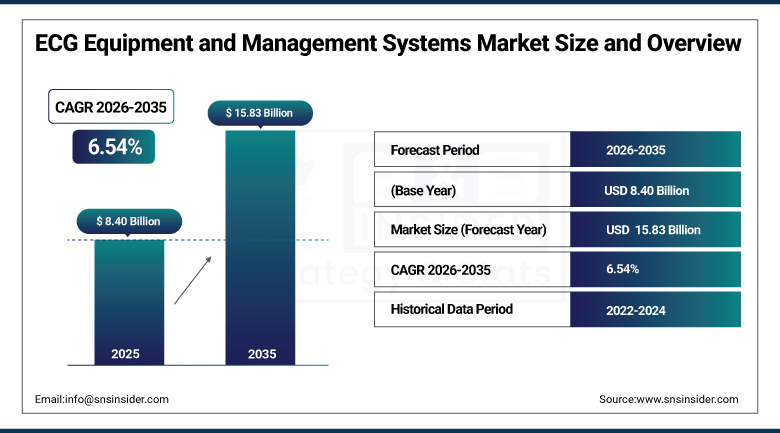
The ECG Equipment and Management Systems Market was valued at USD 8.40 Billion in 2025 and is expected to reach USD 15.83 Billion by 2035, growing at a CAGR of 6.54% from 2026-2035.
Electrocardiography (ECG) devices and management systems represent one of the basic segments of cardiac diagnostics, combining electrodes, leads, recording devices, and software solutions for capturing, analyzing, and distributing information about cardiac conditions throughout the continuum of care. The growing occurrence of cardiovascular diseases, aging of the population in the world, and the rising incidence of risk factors associated with people’s lifestyles are some of the main reasons for the growing number of patients that need regular cardiac assessment. Hospitals, clinics, and other health care facilities use ECG devices in order to identify arrhythmia, follow up after various procedures, and manage the disease. Continuous growth is expected due to the greater adoption of remote and wearable cardiac monitors, electronic health records integration, and ongoing government spending in the area of cardiac care.
In July 2025, Royal Philips opened its ECG AI Marketplace to outside developers, with Anumana becoming the first partner on the platform through its FDA-cleared low ejection fraction algorithm. Philips stated that the initiative supports earlier detection of heart disease and continues extending this open-platform approach across its broader cardiac monitoring portfolio.
To Get more information On ECG Equipment and Management Systems Market - Request Free Sample Report
ECG Equipment and Management Systems Market Trends
-
Rising integration of AI-based diagnostic algorithms supporting earlier detection of arrhythmia and low ejection fraction.
-
Growing adoption of open ECG software marketplaces allowing third-party algorithms onto existing hardware.
-
Expanding use of patch-based, wire-free ambulatory monitors in place of traditional wired Holter systems.
-
Increasing electronic health record integration streamlining cardiac reporting across hospitals and clinics.
-
Rising preference for cloud-hosted ECG management platforms supporting centralized, real-time data access.
-
Growing entry of specialised AI-ECG vendors pursuing regulatory clearance and expanded payer reimbursement.
U.S. ECG Equipment and Management Systems Market Overview
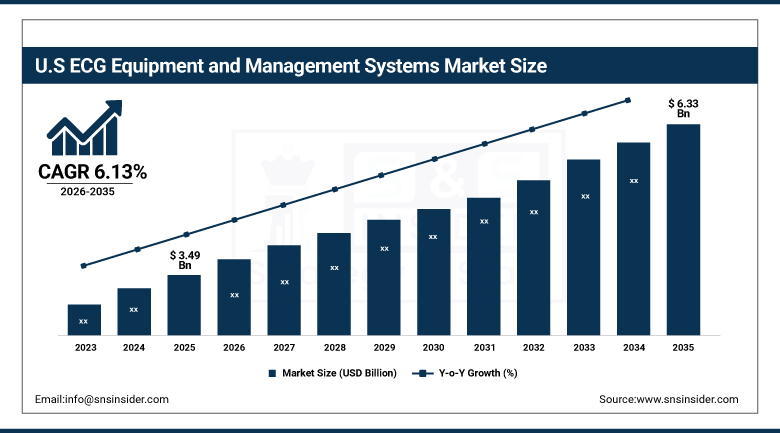
The U.S. ECG Equipment and Management Systems Market was valued at USD 3.49 Billion in 2025 and is expected to reach USD 6.33 Billion by 2035, growing at a CAGR of 6.13% from 2026-2035.
Domestic demand is being fueled by the continuing existence of a large burden of heart disease and the fast adoption of new generation monitoring technology equipment at hospital and outpatient care facilities. The market leaders are continuing to develop more compatibility of their systems with hospital records software, minimizing the delay in report generation for doctors, and wearable and patch monitoring devices are seeing growing uptake among outpatient care providers due to convenience and extended period of monitoring.
In February 2025, iRhythm Technologies secured FDA clearance for two 510(k) submissions tied to its Zio AT device, alongside a technology licensing agreement with BioIntelliSense and expansion into four European markets. The company also initiated the first phase of manufacturing automation for its Zio monitor during the same period.
ECG Equipment and Management Systems Market Segment Analysis
-
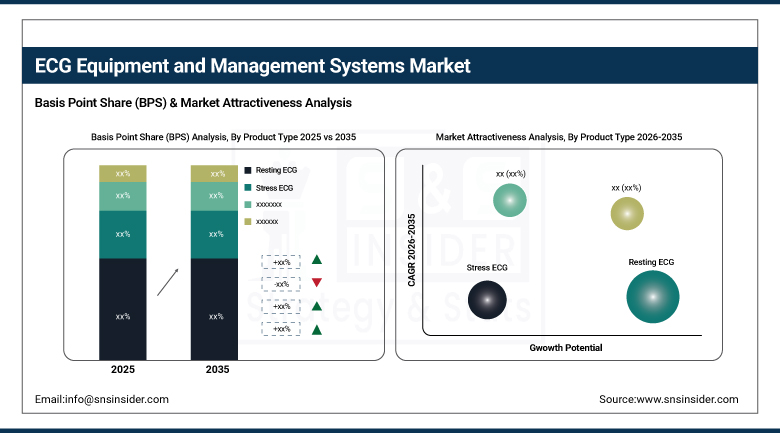
By Product Type, the Resting ECG segment dominated the market with a 43.80% share in 2025, while the ECG Management Systems segment is the fastest growing with a CAGR of 8.34% during 2026-2035.
-
By Component, the Hardware segment dominated the market with a 51.30% share in 2025, while the Software segment is the fastest growing with a CAGR of 9.27% during 2026-2035.
-
By Application, the Diagnostics segment dominated the market with a 53.60% share in 2025, while the Monitoring segment is the fastest growing with a CAGR of 7.84% during 2026-2035.
-
By End-User, the Hospitals & Clinics segment dominated the market with a 46.90% share in 2025, while the Ambulatory Surgical Centers segment is the fastest growing with a CAGR of 7.68% during 2026-2035.
By Product Type, Resting ECG Dominates the Market and ECG Management Systems Grows Fastest
Resting ECG dominated the market in 2025, a position built on simple, well-understood operation and its long-standing role as the first-line test across hospitals, general practice clinics, and pre-operative screening programs. Clinicians favour these systems precisely because they deliver a quick, dependable rhythm read without demanding specialised operator training or extended patient preparation, a combination that keeps the format relevant even as more sophisticated monitoring categories continue to expand around it. This everyday applicability, spanning small community clinics through large tertiary hospitals, keeps resting ECG central to routine cardiac assessment across virtually every healthcare setting worldwide, sustaining recurring procurement even as budgets increasingly shift toward newer technology.
ECG Management Systems is projected to be the fastest-growing product category over the forecast period. Hospitals continue digitising cardiac workflows to cut reporting errors and speed turnaround between test and diagnosis, while AI-assisted interpretation tools embedded within these platforms increasingly flag arrhythmias and other abnormalities before a physician ever opens the file. As more facilities move away from paper-based and siloed recordkeeping toward centralized, searchable cardiac data platforms that connect directly with broader hospital information systems, this segment continues to pull ahead of traditional hardware categories in overall growth.
By Component, Hardware Dominates the Market and Software Grows Fastest
Hardware dominated the market in 2025. Every ECG reading, however sophisticated the downstream analytics eventually become, still starts with an electrode, lead, or recording device physically capturing the heart's electrical activity, and this basic mechanical dependency continues to anchor hardware's leading position across the broader component mix. Hospitals and clinics alike must continue replacing and upgrading this physical infrastructure on a recurring cycle regardless of how advanced their software layer becomes, sustaining steady hardware revenue even as software captures a growing share of new investment dollars industry-wide.
Software is expected to grow fastest among components over the forecast period. Cloud-hosted ECG management adoption climbed sharply across North America in 2025 alone, as hospitals sought easier data access and centralized storage over facility-bound legacy systems that limited remote access and cross-department sharing. Continued rollout of AI-assisted interpretation tools across this software layer, paired with growing demand for platforms that integrate cleanly with existing hospital information systems, keeps reinforcing software's lead over hardware in percentage growth terms even as hardware retains the larger overall revenue base.
By Application, Diagnostics Dominates the Market and Monitoring Grows Fastest
Diagnostics dominated the market in 2025. Initial cardiac assessment, whether performed in an emergency department, during a routine physical, or as part of a specialist consultation, remains the single largest driver of overall ECG procedure volume worldwide. This foundational clinical role, spanning both acute and preventive care contexts across virtually every healthcare system globally, continues to sustain diagnostics as the largest application category by a clear margin, even as monitoring-focused applications continue gaining ground across an expanding range of outpatient and remote care scenarios.
Monitoring is projected to expand fastest over the forecast period. Event monitors and long-wear patches are increasingly favoured for patients with intermittent symptoms that a single office visit would likely miss entirely, giving physicians a genuinely better chance of catching irregular heartbeats that occur unpredictably over days or weeks rather than within a brief clinical appointment window. As comfort and wearability continue improving alongside battery life and data transmission reliability, monitoring continues to close the gap with the diagnostics segment in overall market demand.
By End-User, Hospitals & Clinics Dominates the Market and Ambulatory Surgical Centers Grows Fastest
Hospitals & Clinics dominated the market in 2025. The scale and complexity of cardiac cases handled within hospital cardiology departments and emergency units, spanning acute intervention through post-procedure recovery monitoring and long-term inpatient observation, continues to require the broadest and most comprehensive ECG equipment deployment of any single care setting. This breadth of clinical need, combined with the sheer patient volume that major hospital systems process daily, continues to sustain hospitals and clinics as the clear leading end-user category across the broader market.
Ambulatory Surgical Centers is expected to be the fastest-growing end-user category over the forecast period. A steady shift of lower-acuity cardiac procedures and routine follow-up monitoring toward outpatient settings continues pulling demand away from traditional inpatient care, as both providers and payers increasingly favour the lower cost base these facilities typically offer relative to full hospital admission. This structural shift toward outpatient delivery is expected to continue reshaping end-user demand patterns well beyond the current forecast horizon.
Regional Analysis
|
Region |
Major Country |
Share within Region, 2025 |
|---|---|---|
|
North America |
United States |
85.30% |
|
Europe |
Germany |
27.80% |
|
Asia Pacific |
China |
41.20% |
|
Latin America |
Brazil |
29.60% |
|
Middle East & Africa |
United Arab Emirates |
22.70% |
North America ECG Equipment and Management Systems Market Insights
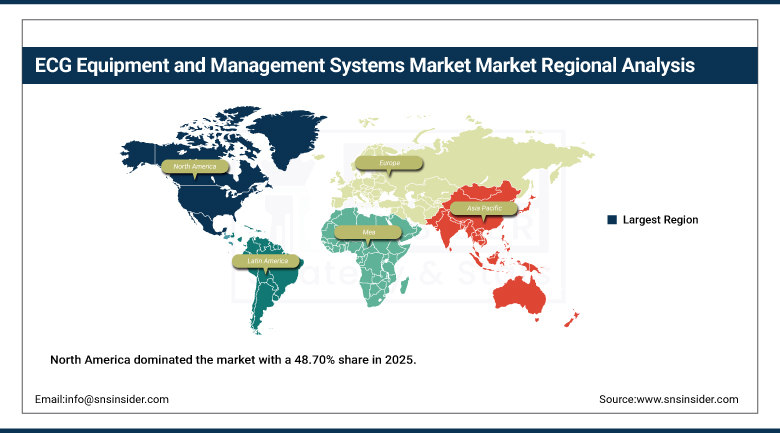
North America dominated the market with a 48.70% share in 2025. High cardiac failure incidence, a dense concentration of leading manufacturers headquartered within the region, and swift regulatory clearance for next-generation monitoring hardware continue to anchor this leadership position across both hospital and outpatient care settings. Wearable device adoption keeps extending well beyond hospital walls into everyday outpatient practice, as consumers and clinicians alike grow increasingly comfortable relying on continuous, app-connected cardiac tracking rather than periodic in-office testing alone, reinforcing the region's position at the technological forefront of this industry.
Canada contributes steady incremental demand as its provincial health systems continue widening cardiac monitoring access across both urban and rural communities. Continued investment in AI-assisted diagnostics and cloud-hosted management platforms across the broader region is expected to keep North America in the lead through the forecast period, even as growth in percentage terms trails faster-scaling Asia Pacific markets that continue building out cardiac care infrastructure from a considerably smaller existing base.
Get Customized Report as per Your Business Requirement - Enquiry Now
Asia Pacific ECG Equipment and Management Systems Market Insights
Asia Pacific is projected to be the fastest-growing region, registering a CAGR of 8.12% during 2026-2035, supported by rising healthcare spending, expanding cardiac care infrastructure, and growing public awareness of cardiovascular risk across an enormous and rapidly ageing population base. China continues to anchor regional demand as hospital networks expand cardiac diagnostic capability across both established urban medical centers and rapidly developing regional healthcare facilities, supported by sustained government investment in modernising the country's broader hospital infrastructure and expanding insurance coverage for cardiac diagnostic procedures.
India's expanding hospital infrastructure and rising cardiovascular disease incidence continue adding meaningful regional growth as domestic providers extend diagnostic capability into previously underserved areas. Japan and South Korea contribute further depth through established, technically advanced healthcare systems, with South Korean vendors notably active in AI-ECG and remote monitoring development, positioning the wider region to sustain the fastest percentage growth of any global market through 2035.
Europe ECG Equipment and Management Systems Market Insights
Europe holds a meaningful share of the global market, underpinned by a dense concentration of established medical device manufacturers and continued advancement in wearable monitors built specifically for ambulatory use. Germany's substantial hospital and manufacturing base anchors regional demand, supported by a well-developed reimbursement framework that continues to favour early adoption of next-generation cardiac monitoring technology across both public and private healthcare providers operating throughout the country and neighbouring markets.
The United Kingdom, France, and other major European markets contribute consistent demand as national health systems keep extending advanced ECG technology into routine clinical practice. Belfast has emerged as something of a hub for AI-ECG development specifically, with regional start-ups pursuing funding rounds and FDA regulatory submissions to compete more directly within the wider global market, reflecting the region's growing role as a genuine innovation centre rather than a purely commercial market for imported technology.
MEA & Latin America ECG Equipment and Management Systems Market Insights
The Middle East & Africa market is supported by growing healthcare infrastructure spending across the United Arab Emirates and Saudi Arabia, where rising cardiovascular disease prevalence continues to lift demand for modern diagnostic and monitoring equipment across both public hospital networks and an expanding private healthcare sector. Regional governments continue channeling substantial investment into expanding cardiac care access, including dedicated cardiology centres designed to reduce reliance on overseas treatment for complex cases.
Latin America's market is anchored by Brazil, where a sizeable domestic healthcare sector sustains steady equipment demand across both public and private hospital systems. Mexico contributes further incremental growth as healthcare access continues to widen across the broader region, though adoption of the most advanced AI-enabled diagnostic systems across Latin America as a whole still lags meaningfully behind more established markets in North America and Europe.
Market Dynamics
Growth Drivers: Rising Cardiovascular Disease Burden and Ageing Population
The increasing occurrence of cardiovascular diseases is the key growth driver, further supplemented by the rising expenditures on health care, aging demographics, and increasing incidences of diabetes and hypertension, which contribute to the enlarging patient base seeking cardiological diagnosis and monitoring treatment. The World Health Organization's forecast concerning the rise of the global population aged over 60 to almost double from 2015 to 2050 plays into the long-lasting growth potential due to the increase in the number of patients seeking cardiac examinations.
Increasing acceptance of telemonitoring technologies is another growth driver, driven by government funding programs and rising demand for cardiac monitoring beyond hospitals to the routine life of the patients. The increasing occurrence of cardiac arrhythmia along with increasing demand for ambulatory monitoring equipment allowing continuous heart monitoring is further contributing to the sustainable market growth.
Restraints: High Equipment Costs and Data Security Concerns
High equipment costs remain a genuine restraint on market growth, as advanced systems built around AI-powered diagnostics and comprehensive cloud management platforms continue to command premium pricing that smaller facilities and price-sensitive markets can struggle to justify against tighter capital budgets. This cost barrier particularly affects smaller clinics and hospitals operating in emerging markets, where the upfront investment required for the most sophisticated available systems can meaningfully exceed what many facilities can reasonably allocate toward cardiac monitoring equipment in any given budget cycle.
Data privacy and cybersecurity concerns present a further restraint, as the continued shift toward cloud-hosted ECG platforms keeps raising genuine questions around patient data protection across differing regulatory regimes worldwide. This requires vendors operating internationally to sustain substantial ongoing compliance investment, spanning encryption standards, cross-border data transfer rules, and jurisdiction-specific patient consent requirements that can meaningfully complicate platform deployment timelines.
Opportunities: AI-Driven Diagnostics and Open Platform Ecosystems
Continued advancement of AI-powered diagnostic algorithms offers a substantial opportunity, as vendors securing regulatory clearance for tools detecting arrhythmia and other cardiac abnormalities at accuracy approaching specialist-level interpretation stand to capture meaningful new demand from providers seeking faster, more consistent diagnosis. Hospitals increasingly view these algorithms not as a novelty feature but as a genuine operational necessity capable of reducing physician workload while catching abnormalities that might otherwise be missed during a routine, time-pressured clinical review.
The continued opening of ECG software ecosystems to third-party developers presents a further avenue for growth, as established hardware manufacturers extend their platforms to outside algorithm providers, giving healthcare facilities broader diagnostic capability without needing to switch underlying equipment vendors entirely. This marketplace-style model continues to lower the barrier for smaller, specialised AI developers to reach hospital customers at genuine commercial scale.
Recent Developments:
-
In October 2025, GE HealthCare received CE mark approval for its Carevance patient monitor, extending accessible, reliable monitoring capability to a broader range of European healthcare facilities.
-
In September 2025, Royal Philips introduced a new telemetry platform aimed at easing staff shortages and improving alarm management within hospital cardiac monitoring departments.
-
In September 2025, Royal Philips entered a national partnership with Optum Healthcare in the United States, deepening its integration with a major domestic healthcare payer and provider network.
-
In January 2026, AccurKardia secured FDA approval and launched AccurECG 2.0, an enterprise-grade, device-agnostic ECG interpretation platform built to work across multiple hardware vendors' equipment.
ECG Equipment and Management Systems Market Key Players
-
Siemens Healthineers AG
-
Mindray Medical International Limited
-
Hillrom (Baxter International)
-
iRhythm Technologies, Inc.
-
Spacelabs Healthcare
-
Welch Allyn (Hillrom/Baxter)
-
Fukuda Denshi Co., Ltd.
-
Schiller AG
-
Cardiac Science Corporation
-
Mortara Instrument (Hillrom)
-
BioTelemetry, Inc. (Philips)
-
CONTEC Medical Systems Co., Ltd.
-
Edan Instruments, Inc.
-
AliveCor, Inc.
-
Bittium Corporation
-
Compumedics Limited
-
AccurKardia
ECG Equipment and Management Systems Market Report Scope:
| Report Attributes | Details |
|---|---|
| Market Size in 2025 | USD 8.40 Billion |
| Market Size by 2035 | USD 15.83 Billion |
| CAGR | CAGR of 6.54% From 2026 to 2035 |
| Base Year | 2025 |
| Forecast Period | 2026-2035 |
| Historical Data | 2022-2024 |
| Report Scope & Coverage | Market Size, Segments Analysis, Competitive Landscape, Regional Analysis, DROC & SWOT Analysis, Forecast Outlook |
| Key Segments | • by Product Type (Resting ECG, Stress ECG, Holter Monitors, Event Monitors, and ECG Management Systems) • by Component (Hardware, Software, and Services) • by Portability (Standalone/Stationary and Portable/Wearable) • by Application (Diagnostics, Monitoring, and Research) • by End-User (Hospitals & Clinics, Ambulatory Surgical Centers, Diagnostic Centers, and Others) |
| Regional Analysis/Coverage | North America (US, Canada), Europe (Germany, UK, France, Italy, Spain, Russia, Poland, Rest of Europe), Asia Pacific (China, India, Japan, South Korea, Australia, ASEAN Countries, Rest of Asia Pacific), Middle East & Africa (UAE, Saudi Arabia, Qatar, South Africa, Rest of Middle East & Africa), Latin America (Brazil, Argentina, Mexico, Colombia, Rest of Latin America). |
| Company Profiles | Koninklijke Philips N.V., GE HealthCare Technologies Inc., Nihon Kohden Corporation, Siemens Healthineers AG, Mindray Medical International Limited, Hillrom (Baxter International), iRhythm Technologies, Inc., Spacelabs Healthcare, Welch Allyn (Hillrom/Baxter), Fukuda Denshi Co., Ltd., Schiller AG, Cardiac Science Corporation, Mortara Instrument (Hillrom), BioTelemetry, Inc. (Philips), CONTEC Medical Systems Co., Ltd., Edan Instruments, Inc., AliveCor, Inc., Bittium Corporation, Compumedics Limited, AccurKardia |

Frequently Asked Questions
Key players include Koninklijke Philips N.V., GE HealthCare Technologies Inc., Nihon Kohden Corporation, Siemens Healthineers AG, Mindray Medical International Limited, and iRhythm Technologies, Inc., among other medical device manufacturers.
Continued advancement of AI-powered diagnostic algorithms and the continued opening of ECG software ecosystems to third-party developers represent the primary opportunities for manufacturers.
Growth is primarily driven by rising cardiovascular disease prevalence and an ageing population, combined with growing adoption of remote monitoring solutions.
By Product Type, Resting ECG dominated the market with a 43.80% share in 2025, reflecting its simplicity and everyday use across healthcare settings.
North America dominated the market with a 48.70% share in 2025, supported by high cardiac failure incidence and a dense concentration of leading manufacturers.
