
Electric Construction Equipment Market Report Scope & Overview:
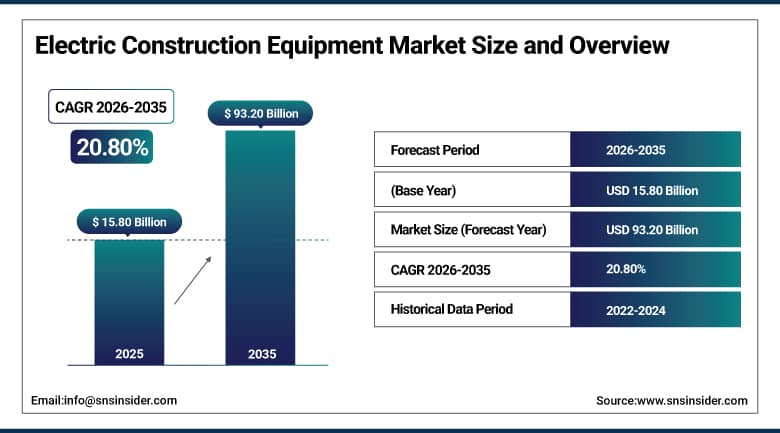
The global Electric Construction Equipment Market was valued at USD 15.80 Billion in 2025 and is expected to reach USD 93.20 Billion by 2035, growing at a CAGR of 20.80% from 2026 to 2035.
Electric construction equipment is transitioning from being piloted to being strategically deployed as contractors, rental companies, and infrastructure asset owners seek to comply with emission standards, quieter work site demands, and increased demands to decrease their dependence on fuel. In urban construction, tunneling, and indoor demolition projects, the use of battery-powered excavators, wheel loaders, and other specialized construction equipment is more meaningful due to the fact that zero-emissions provide more than just regulatory benefits.
Volvo Construction Equipment introduced its very first zero emissions only line-up of machines in the recent Bauma 2025, which included the EC230 Electric Excavator as well as the world’s first serially produced battery-electric articulated haulers, which are the A30 Electric and A40 Electric weighing 29 and 39 tons respectively.
Market Size and Forecast
-
Market Size in 2026E: USD 17.10 Billion
-
Market Size by 2035: USD 93.20 Billion
-
CAGR: 20.80% from 2026 to 2035
-
Fastest Growing Region: North America
-
Largest Region: Asia Pacific
To Get More Information On Electric Construction Equipment Market - Request Free Sample Report
Electric Construction Equipment Market Trends
-
Rapid advancement in battery energy density and fast-charging technology is extending equipment runtime and reducing operational downtime.
-
Growing government emission reduction mandates and infrastructure investment programs are accelerating fleet electrification across major construction markets.
-
Rising adoption of swappable battery systems is addressing charging infrastructure limitations at remote or temporary construction sites.
-
Expanding autonomous and AI-enabled machine control integration is converging with electrification to reshape next-generation construction equipment design.
-
Increasing OEM investment in dedicated electric equipment manufacturing capacity is signaling a structural shift beyond pilot-scale production.
U.S. Electric Construction Equipment Market Outlook
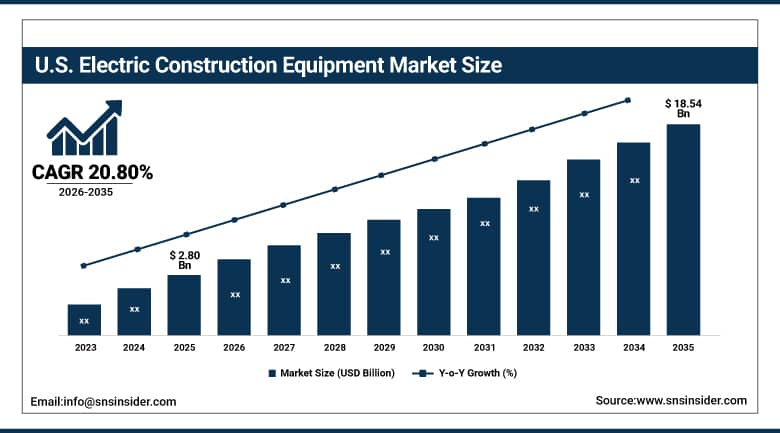
The U.S. Electric Construction Equipment Market was valued at USD 2.80 Billion in 2025 and is projected to reach USD 18.54 Billion by 2035, growing at a CAGR of 20.80% during 2026-2035.
A number of aggressive government regulations at the federal and state level seeking to decrease carbon emissions coupled with considerable investments in infrastructure modernization projects is expected to ensure strong demand for electric construction equipment in the country. The main OEMs such as Caterpillar, John Deere and Volvo are making fast moves towards electrifying their North American product range due to regulatory factors and competitive considerations. There is an increase in the number of infrastructure investments that incentivize the transition to zero emission construction equipment.
Volvo announced plans of global USD 260 million investment in production of electric construction equipment in 2025, out of which USD 40 million will go to its facility in Shippensburg, Pennsylvania owing to confidence of OEMs in the increasing demand for battery electric off-highway equipment in the USA.
Electric Construction Equipment Market Segment Analysis
-
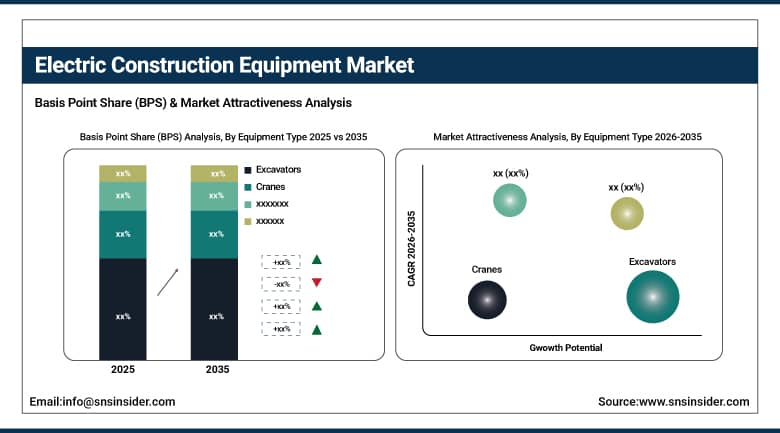
By Equipment Type, Excavators led the Electric Construction Equipment Market with a 34.60% share in 2025, while Cranes is the fastest-growing equipment type segment with a CAGR of 25.20% from 2026-2035.
-
By Battery Type, Lithium-ion led the Electric Construction Equipment Market with a 58.60% share in 2025, while Lead-acid is the fastest-growing battery type segment with a CAGR of 19.80% from 2026-2035.
-
By Power Output, 50-200 kWh led the Electric Construction Equipment Market with a 45.00% share in 2025, while Above 200 kWh is the fastest-growing power output segment with a CAGR of 24.60% from 2026-2035.
-
By Application, Construction led the Electric Construction Equipment Market with a 34.80% share in 2025, while Mining is the fastest-growing application segment with a CAGR of 22.40% from 2026-2035.
By Equipment Type, Excavators Dominated the Market While Cranes Is the Fastest-Growing Segment
Excavators was the leading product type in the Electric Construction Equipment Market with 34.60% revenue share in 2025, due to the wide usage of excavators as the most popular construction machinery category, along with the feasibility of electrification in light of medium power consumption when compared to other machinery categories. The battery-electric excavators manufactured by Volvo, Komatsu, and Caterpillar have demonstrated the highest commercial maturity within the categories of electric construction machinery, thus enabling excavators to remain as market leaders due to the increasing acceptance of electric machines among the contractors.
Crane is expected to be the fastest-growing segment, registering a CAGR of 25.20% during the forecast period 2026-2035, owing to the increasing demand from urban construction projects that necessitate the use of low-noise, emission-free tower and mobile cranes in residential and commercial construction projects in cities. Electric cranes are suitable for electrification due to their predictable cycle of duty and availability of grid connection in fixed site conditions.
By Battery Type, Lithium-ion Dominated the Market While Lead-acid Is the Fastest-Growing Segment
Lithium-ion was the leading segment of the market in 2025, holding a revenue share of 58.60%, owing to the higher energy density, longer life span, and fast charging abilities of lithium-ion batteries compared to other types of batteries. Lithium-ion batteries have become the first choice in most OEMs' electric equipment programs owing to the good ratio of weight to energy storage, which becomes very crucial in order to maintain stability and capacity of the construction equipment compared to diesel equipment.
Lead-acid is expected to exhibit the highest CAGR of 19.80% during the forecast period 2026-2035, primarily due to increasing requirement for inexpensive equipment from price-sensitive buyers in emerging countries, where lithium-ion's high prices are still an adoption hindrance. Lead-acid battery systems have been found to provide a comparatively easier and affordable way to electric equipment adoption for such cost-conscious buyers.
By Power Output, 50-200 kWh Dominated the Market While Above 200 kWh Is the Fastest-Growing Segment
The 50-200 kWh Category held dominance in the Electric Construction Equipment Market with a revenue share of 45.00% in 2025 owing to the suitability of the mentioned category in the power capacity in powering mid-sized construction equipment, including excavators and loaders, which form the highest proportion of the overall fleet of electric construction equipment. This power capacity category has enough operational time to complete daily operations of construction without being a burden on charging infrastructure and weight capacity of the equipment.
The Above 200 kWh Category is forecasted to have the highest CAGR of 24.60% during the forecast period of 2026-2035. The growth in this category is being fueled by the increasing demand for electric systems with high power capacity, which will be used in heavy-duty construction equipment, such as articulated haulers, large excavators, and mining equipment.
By Application, Construction Dominated the Market While Mining Is the Fastest-Growing Segment
The Construction segment led the Electric Construction Equipment Market with a revenue share of 34.80% in 2025, driven by extensive use of electric equipment across infrastructure, residential, and commercial construction projects, particularly in urban areas subject to noise and emission restrictions. Government infrastructure investment programs and green building initiatives continue to reinforce construction sector demand for zero-emission equipment across both public and private development projects worldwide.
The Mining segment is expected to register the fastest CAGR of 22.40% during the forecast period 2026-2035, driven by increasing focus on sustainable mining operations and reduction of carbon emissions across underground and open-pit mining applications. Electric mining equipment offers particular value in underground applications where diesel exhaust ventilation requirements impose substantial operational costs, making electrification an especially compelling proposition for mining operators beyond regulatory compliance alone.
Regional Insights
|
Region |
Major Country |
Share within Region, 2025 (%) |
|---|---|---|
|
Asia Pacific |
China |
41.60% |
|
North America |
United States |
66.70% |
|
Europe |
Germany |
26.40% |
|
Middle East & Africa |
UAE |
24.60% |
|
Latin America |
Brazil |
29.80% |
Asia Pacific Electric Construction Equipment Market Insights
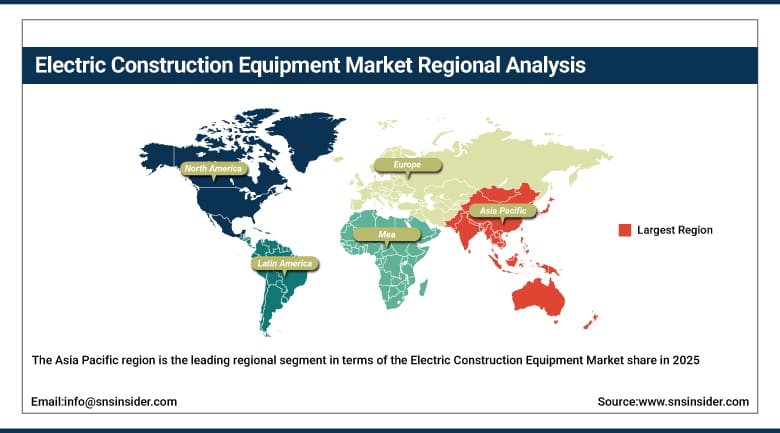
The Asia Pacific region is the leading regional segment in terms of the Electric Construction Equipment Market share in 2025 at 35.40% of global revenue owing to the rapid pace of urbanization, huge investments in infrastructure, emission reduction regulations, and development of local lithium-ion batteries. The ongoing construction work and government efforts in the region to promote electrification make it a dominant manufacturer and consumer of electric construction equipment worldwide.
China was the largest country within the region, holding a share of about 41.60% in the regional market in 2025 thanks to the developing local base for manufacturing of electric equipment and aggressive government electrification efforts. Japan and South Korea are also contributing significantly to regional growth along with India, which has rapidly increasing investments in infrastructure and electric vehicle regulations.
Get Customized Report as Per Your Business Requirement - Enquiry Now
North America Electric Construction Equipment Market Insights
North America is expected to exhibit the highest CAGR during the forecast period 2026-2035 owing to stringent regulations adopted by both federal and state governments for cutting down carbon emissions along with government investment in infrastructure development and green buildings. The region has a well-established manufacturing sector with the presence of OEM players like Caterpillar, John Deere, and Volvo moving towards electrification.
The U.S. accounted for around 66.70% share of the North America market in 2025 due to stringent environmental policies, infrastructure development plans, and sustainability initiatives taken by corporations in the region. Canada is helping in driving regional growth due to its provincial initiatives on emission reductions and adoption of electric machinery in its construction and mining industries.
Europe Electric Construction Equipment Market Insights
Europe represented a meaningful share of the global Electric Construction Equipment Market in 2025, supported by ambitious EU emission reduction targets, strong urban construction noise regulation, and a concentration of leading electric equipment manufacturers headquartered across the region. Growing government incentive programs continue to reinforce steady regional demand for zero-emission construction machinery across major European construction markets.
Germany led the European market with a 26.40% regional share in 2025, supported by its large construction equipment manufacturing base and strong domestic demand for advanced electric machinery. Sweden, France, and the United Kingdom are also contributing meaningfully to regional growth, supported by leading OEMs headquartered in the region and growing municipal electrification mandates.
Middle East & Africa and Latin America Electric Construction Equipment Market Insights
The Middle East & Africa and Latin America are the emerging markets in the industry of electric construction equipment, where the market is showing steady growth because of the development of infrastructure and sustainability measures being taken by their respective governments. In the Middle East countries, electric construction equipment is being utilized in smart cities and giga projects.
The UAE was the top player in the Middle East & Africa market and held a market share of 24.60%. This was mainly due to the heavy government investments in sustainable infrastructure and smart cities. Similarly, Brazil had a market share of 29.80% of the Latin American market in 2025 due to investments in infrastructure, while Mexico was another key market player.
Growth Drivers: Emission Regulations and Operating Cost Savings Driving Market Growth
The Electric Construction Equipment Market is mainly propelled by stricter emissions norms at national as well as municipal levels, government funding for electrification of the equipment, and economic advantages offered through lower maintenance costs as well as fuel costs compared to diesel-run machinery. Electrification has become a must-have for contractors as well as fleet owners in order to remain compliant and gain access to the construction sites especially urban locations where there are stringent noise and emissions restrictions.
Increasing innovations in battery efficiency and fast charging technology have helped overcome the issues related to range and downtimes that plagued previous models of electric construction machinery. Increasing investments from OEMs in production capacity for electric construction equipment show that this trend will be here to stay.
Restraints: High Upfront Costs and Charging Infrastructure Gaps Limiting Market Expansion
Although there is strong fundamental demand, there are a number of constraints faced by the market owing to the high cost premium attached to electric construction equipment over the conventional diesel-run counterparts, which keeps smaller contractors from using such machines as well as rental fleets who find renting out such costly machines unprofitable. The lack of charging facilities in remote construction locations proves to be a hindrance, especially for heavy duty machines that need to charge for longer periods of time.
High battery weight along with low run-time compared to diesel-run machines limits the suitability of electric machines in some heavy duty and constant operation applications such as remote mining and large earthmoving projects. With more and more OEMs competing with each other in the electric construction equipment market, margins for some commoditized compact machines are getting squeezed.
Opportunities: Mining Electrification and Swappable Battery Systems Creating New Growth Avenues
Substantial opportunity exists in continued electrification of mining equipment, where underground applications offer a particularly compelling business case given the substantial ventilation cost savings associated with eliminating diesel exhaust. Manufacturers that successfully develop heavy-duty electric mining equipment stand to capture significant demand from operators seeking both sustainability compliance and measurable operational cost reduction.
Growing adoption of swappable battery systems presents a further significant growth avenue, directly addressing charging infrastructure limitations that have historically constrained electric equipment deployment at remote or temporary job sites. Expanding infrastructure investment and emission reduction mandates across emerging markets in Asia Pacific, the Middle East, and Latin America also represent meaningful untapped opportunity for electric construction equipment manufacturers.
Recent Developments:
-
2025: Volvo Construction Equipment unveiled its first-ever zero-emission-only lineup at Bauma 2025, including the EC230 Electric Excavator and the serial-produced A30 and A40 Electric articulated haulers.
-
2025: Volvo announced a USD 260 million global expansion of electric construction equipment production capacity, including USD 40 million for its Shippensburg, Pennsylvania plant.
-
2025: Komatsu showcased its PC20E, PC26E, and PC33E electric mini excavators at Bauma 2025 and accelerated battery-electric development through its acquisition of ABS battery technology.
-
2026: Caterpillar continued expanding its Cat Battery Electric Machines lineup, including the 301.9 electric mini excavator and 320 electric medium excavator, alongside its autonomy strategy unveiled at CES 2026.
Electric Construction Equipment Companies are:
-
Caterpillar Inc.
-
Volvo Construction Equipment (Volvo AB)
-
Komatsu Ltd.
-
Hitachi Construction Machinery Co., Ltd.
-
Deere & Company (John Deere)
-
Liebherr Group
-
JCB (J.C. Bamford Excavators Ltd.)
-
XCMG Group
-
SANY Group
-
Wacker Neuson SE
-
CNH Industrial N.V.
-
Kubota Corporation
Electric Construction Equipment Market Report Scope:
| Report Attributes | Details |
|---|---|
| Market Size in 2025 | USD 15.80 Billion |
| Market Size by 2035 | USD 93.20 Billion |
| CAGR | CAGR of 20.80% From 2026 to 2035 |
| Base Year | 2025 |
| Forecast Period | 2026-2035 |
| Historical Data | 2022-2024 |
| Report Scope & Coverage | Market Size, Segments Analysis, Competitive Landscape, Regional Analysis, DROC & SWOT Analysis, Forecast Outlook |
| Key Segments | • By Equipment Type (Excavators, Loaders, Cranes, Dozers, Compactors, Others) • By Battery Type (Lithium-ion, Lead-acid, Nickel-Metal Hydride) • By Power Output (Below 50 kWh, 50–200 kWh, Above 200 kWh) • By Application (Construction, Mining, Industrial, Material Handling) |
| Regional Analysis/Coverage | North America (US, Canada), Europe (Germany, UK, France, Italy, Spain, Russia, Poland, Rest of Europe), Asia Pacific (China, India, Japan, South Korea, Australia, ASEAN Countries, Rest of Asia Pacific), Middle East & Africa (UAE, Saudi Arabia, Qatar, South Africa, Rest of Middle East & Africa), Latin America (Brazil, Argentina, Mexico, Colombia, Rest of Latin America). |
| Company Profiles | Caterpillar Inc., Volvo Construction Equipment (Volvo AB), Komatsu Ltd., Hitachi Construction Machinery Co., Ltd., Doosan Infracore, Deere & Company (John Deere), Liebherr Group, JCB (J.C. Bamford Excavators Ltd.), XCMG Group, SANY Group, Wacker Neuson SE, Bobcat Company (Doosan Bobcat), CNH Industrial N.V., Kubota Corporation |
Frequently Asked Questions
The Electric Construction Equipment Market is expected to grow at a CAGR of 20.80% from 2026 to 2035.
The Electric Construction Equipment Market was valued at USD 15.80 Billion in 2025.
The market is driven by tightening emission regulations, government subsidies supporting electrification, and the long-term operating cost benefits of lower maintenance and fuel expenses.
The Excavators segment dominated the Electric Construction Equipment Market in 2025, accounting for approximately 34.60% market share.
The Asia Pacific region dominated the Electric Construction Equipment Market in 2025, accounting for approximately 35.40% market share.
