
Persistent Memory Market Report Scope and Overview:
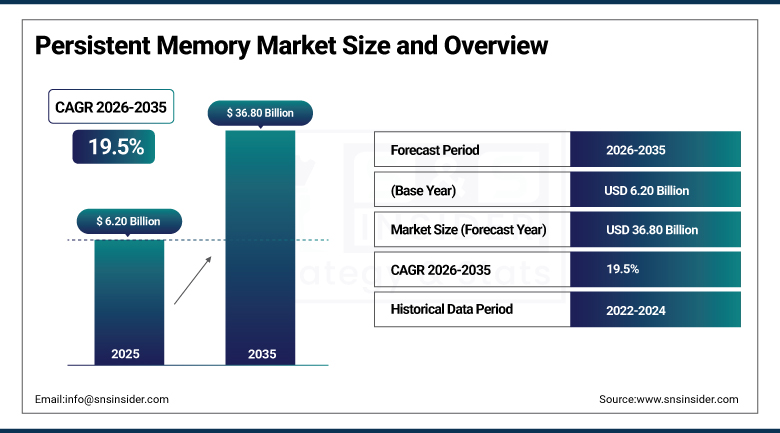
The Persistent Memory Market size was valued at USD 6.20 Billion in 2025 and is projected to reach USD 36.80 Billion by 2035, registering a CAGR of 19.5% from 2026 to 2035.
The Persistent Memory Market is changing the dynamics of enterprise data architecture by addressing the performance divide between volatile DRAM memory and legacy NAND flash storage using new byte-addressable non-volatile memory technologies. Persistent Memory Market features increasing deployment of NVDIMM devices in hyperscale data centers, advancements in MRAM and phase change memory in edge and automotive markets, and increasing adoption of persistent memory to enhance in-memory database and analytics processing capabilities in the data-heavy enterprise environment. Important growth is happening in cloud infrastructure, automotive computer systems, and IIoT implementations as the operators of data centers and original equipment manufacturers of vehicles are making significant investments in low-latency and high-endurance memory products that can preserve data even during unexpected power disruptions.
The EMxxLX STT-MRAM products of Everspin Technologies have been extended to include higher density persistent memory devices aimed at applications in industrial automation, aerospace, and data logging.
To Get more information On Persistent Memory Market - Request Free Sample Report
Persistent Memory Market Trends
-
Growing adoption of NVDIMM modules in hyperscale data centers continues accelerating in-memory database and analytics workload performance.
-
Rising development of MRAM and phase-change memory technologies continues expanding persistent memory adoption into edge and automotive applications.
-
Increasing use of persistent memory to bridge DRAM and NAND flash continues reshaping enterprise storage architecture design.
-
Expanding autonomous vehicle compute platform adoption continues driving demand for low-latency, high-endurance automotive-grade persistent memory.
-
Growing industrial IoT deployment continues broadening persistent memory adoption beyond traditional data center and enterprise storage use cases.
U.S. Persistent Memory Market Size Outlook
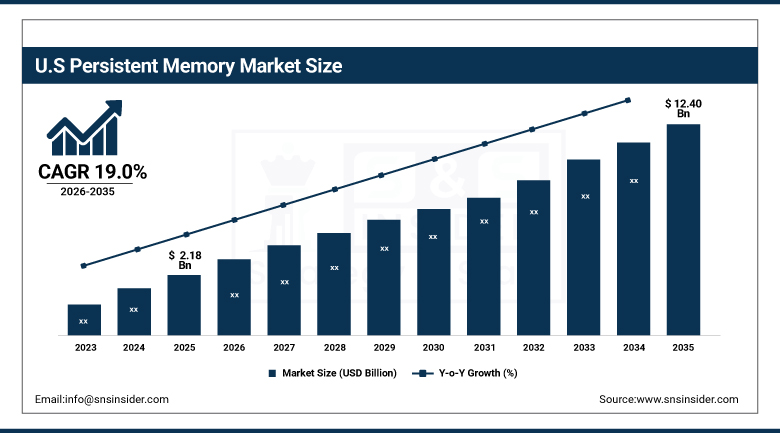
The U.S. Persistent Memory Market was valued at approximately USD 2.18 Billion in 2025 and is projected to reach approximately USD 12.40 Billion by 2035, registering a CAGR of approximately 19.0% from 2026 to 2035.
The United States demand continued to be shaped by sustained hyperscale data center investment in in-memory database acceleration, a deep concentration of leading memory and storage technology developers, and growing enterprise adoption of low-latency persistent memory for mission-critical applications. Rising deployment of NVDIMM and emerging MRAM technologies by domestic cloud service providers continued reinforcing the country's position as both the largest and a genuine innovation-driven market tracked in this report. Growing adoption across autonomous vehicle compute platforms, aerospace data-logging systems, and industrial automation added further layers of sustained domestic demand well beyond the technology's original enterprise server use case.
Micron Technology qualified new low-latency NVDIMM-P modules throughout 2025 for enterprise server customers, designed to accelerate database and in-memory analytics workloads across U.S.-based hyperscale data center deployments.
Persistent Memory Market Segment Analysis
-
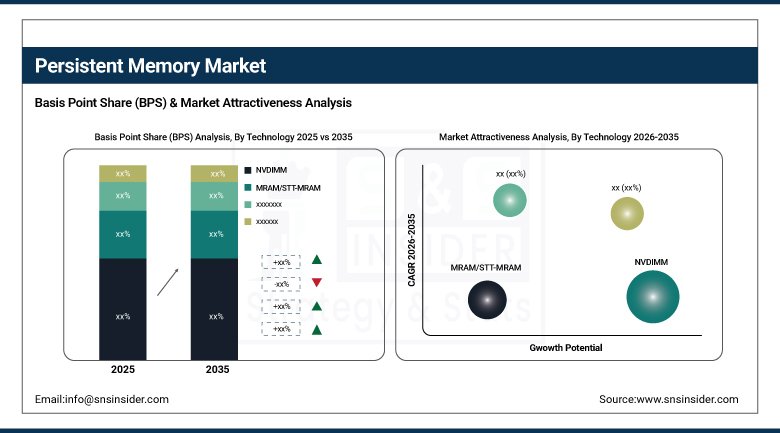
By Technology, NVDIMM dominated the Persistent Memory Market with a 44.00% share in 2025, while MRAM/STT-MRAM is the fastest-growing technology segment with a CAGR of 21.80% from 2026–2035.
-
By Application, Data Center & Enterprise Storage dominated the market with a 52.00% share in 2025, while Automotive is the fastest-growing application segment with a CAGR of 23.40% from 2026–2035.
-
By End-User, Data Centers & Cloud Service Providers dominated the market with a 48.00% share in 2025, while Automotive OEMs is the fastest-growing end-user segment with a CAGR of 22.90% from 2026–2035.
-
By Form Factor, DIMM dominated the market with a 46.00% share in 2025, while Embedded is the fastest-growing form factor segment with a CAGR of 21.60% from 2026–2035.
By Technology, NVDIMM Leads While MRAM/STT-MRAM Grows Fastest
The NVDIMM segment dominated the Persistent Memory Market in 2025 owing to its established maturity, proven reliability, and broad compatibility with existing server memory architectures across enterprise data centers. Data center operators continue relying on NVDIMM modules for their ability to combine DRAM-class performance with non-volatile data retention during unplanned power loss events. Continued volume deployment across hyperscale and enterprise server infrastructure has kept NVDIMM the largest single revenue contributor within the persistent memory technology landscape tracked in this report.
The MRAM/STT-MRAM segment is the fastest growing in the Persistent Memory Market owing to accelerating adoption in automotive, aerospace, and industrial applications requiring extreme endurance, radiation tolerance, and reliable data retention in harsh operating environments. Chip designers increasingly favor MRAM for embedded applications where NAND flash endurance limitations pose genuine reliability concerns. Growing automotive and industrial automation investment continues accelerating the ramp of MRAM production capacity across leading memory suppliers.
By Application, Data Center & Enterprise Storage Dominates While Automotive Records Fastest Growth
The Data Center & Enterprise Storage segment dominated the Persistent Memory Market in 2025 due to sustained hyperscale and enterprise demand for in-memory database acceleration and reduced storage latency across mission-critical computing workloads. Cloud providers continue prioritizing persistent memory deployment given the segment’s scale and recurring infrastructure refresh cycles. Sustained global data center capacity expansion has kept this application the largest overall revenue contributor across the market.
The Automotive segment is the fastest growing in the Persistent Memory Market owing to rising adoption of centralized compute domains and autonomous driving platforms requiring reliable, low-latency data retention for sensor fusion and safety-critical functions. Automakers increasingly demand persistent memory integration to support advanced driver assistance and autonomous driving compute requirements. Accelerating global autonomous vehicle development continues driving sustained growth in automotive-oriented persistent memory demand.
By End-User, Data Centers Lead While Automotive OEMs Grow Fastest
The Data Centers & Cloud Service Providers segment dominated the Persistent Memory Market in 2025 due to sustained investment in in-memory computing infrastructure to support increasingly data-intensive enterprise applications and analytics workloads. Cloud providers continue driving the majority of persistent memory procurement given their central role in modern enterprise computing infrastructure. Continued cloud infrastructure investment has kept this end-user segment the largest overall contributor to market revenue.
The Automotive OEMs segment is the fastest growing in the Persistent Memory Market owing to expanding integration of centralized compute platforms requiring reliable, non-volatile memory for autonomous driving and advanced safety systems. Growing automotive investment in software-defined vehicle architectures continues driving demand for persistent memory embedded within vehicle compute platforms. Rising customer interest in automotive-qualified persistent memory continues accelerating growth in this end-user category.
By Form Factor, DIMM Dominates While Embedded Grows Fastest
The DIMM segment dominated the Persistent Memory Market in 2025 due to its established compatibility with standard server memory slots and widespread deployment across enterprise and hyperscale data center infrastructure. System integrators continue favoring DIMM form factors for their straightforward integration into existing server architectures. Sustained enterprise server refresh cycles have kept this form factor the largest overall revenue contributor across the market.
The Embedded segment is the fastest growing in the Persistent Memory Market owing to rising demand for compact, integrated persistent memory solutions in automotive, industrial IoT, and aerospace applications with strict space and power constraints. Designers increasingly favor embedded persistent memory to reduce component count and improve reliability in space-constrained electronic systems. Growing edge computing and IoT device deployment continues driving sustained growth in embedded persistent memory demand.
Regional Analysis
|
Region |
Major Country |
Share within Region, 2025 (%) |
|---|---|---|
|
North America |
United States |
88.00% |
|
Europe |
Germany |
23.00% |
|
Asia Pacific |
China |
35.50% |
|
Middle East and Africa |
Israel |
27.00% |
|
Latin America |
Brazil |
30.00% |
North America Persistent Memory Market Insights
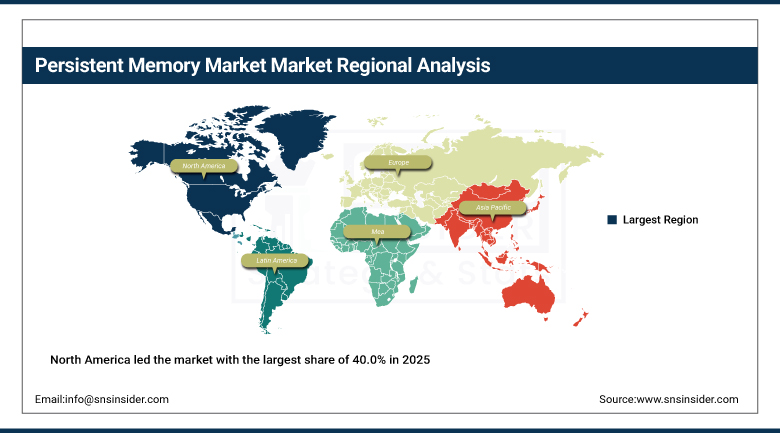
North America led the market with the largest share of 40.0% in 2025. Sustained hyperscale data center investment in in-memory database acceleration, a deep concentration of leading memory and storage technology developers, and growing enterprise adoption of low-latency persistent memory for mission-critical applications continued reinforcing the region’s dominant position. Growing deployment of NVDIMM and emerging MRAM technologies across data center, automotive, and aerospace applications further strengthened North America’s standing as both the largest and one of the most innovation-driven markets tracked in this report, with continued hyperscaler capital expenditure expected to sustain regional demand through the forecast period.
The United States anchored by its deep concentration of leading memory and storage technology developers and substantial hyperscale data center investment. Canada added further regional demand through its own growing cloud infrastructure investment, and that combined strength kept the continent the largest addressable market for persistent memory vendors through the forecast period, with continued in-memory computing adoption expected to sustain regional demand well into the next decade.
Get Customized Report as per Your Business Requirement - Enquiry Now
Europe Persistent Memory Market Insights
Europe held a meaningful share of global revenue, supported by growing automotive and industrial semiconductor demand and continued expansion of enterprise data center capability across the region’s major economies. Regulatory momentum around European Chips Act-backed semiconductor investment continued shaping regional development priorities without meaningfully slowing commercialization across the continent, while sustained automotive electrification investment kept the region among the more resilient persistent memory markets tracked in this report.
Germany led demand of European revenue, supported by its substantial automotive and industrial semiconductor demand base. The UK and France contributed substantial additional demand, and continued European investment in automotive electrification and enterprise data center capacity should keep regional demand for persistent memory technology climbing steadily through the forecast period.
Asia Pacific Persistent Memory Market Insights
Asia Pacific is advancing at the fastest pace among all regions tracked in this report, registering a CAGR of 22.0% from 2026 to 2035, driven by rapidly expanding data center construction, growing domestic memory manufacturing capability, and sustained government-backed investment in advanced memory technology across the region’s largest economies. That combination of manufacturing scale and genuine downstream data center demand across densely populated metropolitan centers kept the region’s growth trajectory well ahead of every other region tracked in this report, with hyperscale cloud infrastructure investment adding a further, sustained layer of demand.
China led the pack, supported by its substantial domestic memory manufacturing base and rapid data center and cloud infrastructure expansion. Taiwan and South Korea contributed meaningful additional demand, with China’s expanding data center construction and South Korea’s advanced memory manufacturing capability both reinforcing the region’s position as the fastest-growing persistent memory market tracked in this report, while Japan and India added further steady regional contribution.
MEA and Latin America Persistent Memory Market Insights
The Middle East and Africa and Latin America both showed steady growth, driven by expanding data center infrastructure investment, growing government focus on digital transformation initiatives, and rising enterprise demand for high-performance computing capability across both regions. As these markets continued building out modern data center infrastructure, persistent memory technology proved a genuinely valuable enabler of increasingly capable, locally hosted enterprise computing environments.
Israel led Middle East and Africa demand, supported by the country’s established semiconductor design presence and substantial multinational research and development investment. Saudi Arabia and the UAE contributed further demand through large-scale data center announcements. In Latin America, Brazil accounted for the largest share of regional revenue, with growing cloud computing and data center investment continuing to anchor regional demand for persistent memory technology.
Market Dynamics
Growth Drivers: Rising In-Memory Computing Adoption and Automotive Compute Expansion
The industry is driven by rising adoption of NVDIMM modules in hyperscale data centers, growing development of MRAM and phase-change memory for edge and automotive applications, expanding use of persistent memory to accelerate in-memory database workloads, and increasing demand for low-latency, high-endurance memory in autonomous vehicle compute platforms. As enterprises and automakers continue prioritizing faster data access and reliable data retention, the need for expanded persistent memory adoption continues driving sustained investment across the industry.
Rising data center capacity expansion continues reinforcing this driver, as cloud providers increasingly deploy persistent memory to accelerate increasingly data-intensive analytics and database workloads. Growing automotive demand for centralized compute domains continues defining a further layer of sustained demand, and that combination of enterprise computing investment and automotive semiconductor content growth is exactly what keeps overall demand climbing at such a steady, sustained pace.
Restraints: High Component Costs and Software Ecosystem Fragmentation
The substantial cost premium of persistent memory relative to conventional DRAM and NAND flash storage continues posing a genuine restraint on faster market-wide expansion, particularly for cost-sensitive enterprise and consumer applications without the budget flexibility that hyperscale data center operators can commit. That cost profile has kept advanced persistent memory adoption concentrated among a comparatively small number of well-resourced customers.
Ongoing fragmentation across persistent memory programming models and software ecosystem support continues posing a further restraint, as application developers face genuine integration hurdles when adapting existing software to leverage byte-addressable, non-volatile memory architectures. Limited standardization across competing technology approaches in certain deployment scenarios keeps some persistent memory integration projects more administratively complicated than conventional memory upgrades ever required.
Opportunities: Edge Computing Expansion and Automotive Autonomous Driving Platforms
Rising edge computing and industrial IoT deployment represents a genuinely significant opportunity, as device manufacturers increasingly require compact, reliable, non-volatile memory for space and power-constrained applications. Vendors positioned early in embedded persistent memory technology stand to capture meaningful share as this capability continues expanding from traditional data center applications into broader edge and industrial deployment scenarios.
Expanding autonomous vehicle compute platform adoption offers a second substantial opportunity, as automakers increasingly integrate centralized compute domains requiring reliable, low-latency data retention for safety-critical autonomous driving functions. Vendors with proven, automotive-qualified persistent memory technology stand to capture meaningful share as global autonomous vehicle development continues scaling across established and emerging automotive markets alike.
Recent Developments:
-
2026: Research into CXL-based persistent memory pooling advanced with a proposed Persistent CXL Switch architecture designed to reduce persist latency while maintaining crash consistency, demonstrating up to 33% average speedup in simulations.
-
2026: CXL adoption expanded for persistent and disaggregated memory, with industry demonstrations highlighting memory expansion and pooling for AI and data-center workloads, including Micron’s 40TB CXL-based shared memory pool.
-
2024: Kioxia and Western Digital jointly advanced development of next-generation storage class memory architectures, targeting reduced latency gaps between DRAM and NAND flash for enterprise storage systems.
Persistent Memory Companies are:
-
Intel Corporation
-
Samsung Electronics Co., Ltd.
-
SK Hynix Inc.
-
Kioxia Holdings Corporation
-
Hewlett Packard Enterprise Company (HPE)
-
International Business Machines Corporation (IBM)
-
Microsoft Corporation
-
Everspin Technologies, Inc.
-
Fujitsu Limited
-
Renesas Electronics Corporation
-
Crossbar, Inc.
-
Weebit Nano Ltd.
-
GigaDevice Semiconductor Inc.
-
Infineon Technologies AG
-
Lenovo Group Limited
-
NEC Corporation
-
Cisco Systems, Inc.
-
Western Digital Corporation
Persistent Memory Market Report Scope:
| Report Attributes | Details |
|---|---|
| Market Size in 2025 | USD 6.20 Billion |
| Market Size by 2035 | USD 36.80 Billion |
| CAGR | CAGR of 19.5% From 2026 to 2035 |
| Base Year | 2025 |
| Forecast Period | 2026-2035 |
| Historical Data | 2022-2024 |
| Report Scope & Coverage | Market Size, Segments Analysis, Competitive Landscape, Regional Analysis, DROC & SWOT Analysis, Forecast Outlook |
| Key Segments | • By Technology (NVDIMM, MRAM/STT-MRAM, PCM (Phase-Change Memory), ReRAM, FeRAM) • By Application (Data Center & Enterprise Storage, Consumer Electronics, Automotive, Industrial, Aerospace & Defense, Healthcare) • By End-User (Data Centers & Cloud Service Providers, Enterprise IT, Consumer Electronics OEMs, Automotive OEMs) • By Form Factor (DIMM, SSD/Add-in Card, Embedded) |
| Regional Analysis/Coverage | North America (US, Canada), Europe (Germany, UK, France, Italy, Spain, Russia, Poland, Rest of Europe), Asia Pacific (China, India, Japan, South Korea, Australia, ASEAN Countries, Rest of Asia Pacific), Middle East & Africa (UAE, Saudi Arabia, Qatar, South Africa, Rest of Middle East & Africa), Latin America (Brazil, Argentina, Mexico, Colombia, Rest of Latin America). |
| Company Profiles | Intel Corporation, Micron Technology, Inc., Samsung Electronics Co., Ltd., SK Hynix Inc., Kioxia Holdings Corporation, Hewlett Packard Enterprise Company (HPE), Dell Technologies Inc., International Business Machines Corporation (IBM), Microsoft Corporation, Everspin Technologies, Inc., Fujitsu Limited, Renesas Electronics Corporation, Crossbar, Inc., Weebit Nano Ltd., GigaDevice Semiconductor Inc., Infineon Technologies AG, Lenovo Group Limited, NEC Corporation, Cisco Systems, Inc., Western Digital Corporation |

Frequently Asked Questions
The major growth factor is rising adoption of NVDIMM modules in hyperscale data centers, growing MRAM development, and expanding automotive compute platform demand.
The NVDIMM segment dominated the Persistent Memory Market by technology, representing the largest share of revenue in 2025.
North America dominated the Persistent Memory Market in 2025, holding an estimated 40.0% share of total global market revenue.
Key opportunities include AI data centers, CXL-based memory expansion, automotive computing, edge devices, and high-performance enterprise storage.
