
CXL Memory Expansion Market Report Scope and Overview:
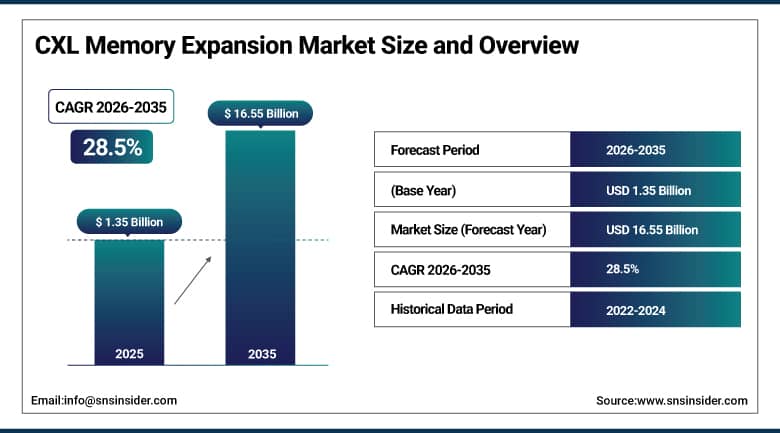
The CXL Memory Expansion Market size was valued at USD 1.35 Billion in 2025 and is projected to reach USD 16.55 Billion by 2035, registering a CAGR of 28.5% from 2026 to 2035.
The CXL Memory Expansion Market is redefining data center memory architecture by enabling memory capacity to be expanded, pooled, and dynamically allocated across compute resources over the Compute Express Link interconnect standard. The market is characterized by rising adoption of CXL memory modules in hyperscale AI server deployments, growing demand for memory disaggregation to overcome DRAM capacity limitations in large language model training and inference, and expanding integration of CXL controllers and switches supporting composable infrastructure designs. Significant growth is being witnessed in AI inference serving, in-memory database acceleration, and high-performance scientific computing, considering that hyperscalers and enterprise data center operators are investing heavily in memory expansion technology capable of decoupling memory capacity from fixed CPU socket limitations.
Astera Labs began volume shipments of its Leo CXL memory controller platform throughout 2025, enabling memory expansion and pooling capability for hyperscale AI server deployments requiring expanded memory capacity.
To Get More Information On CXL Memory Expansion Market - Request Free Sample Report
CXL Memory Expansion Market Trends
-
Growing adoption of CXL memory modules in hyperscale AI server deployments continues addressing DRAM capacity limitations in large language model workloads.
-
Rising integration of CXL controllers and switches continues enabling composable, disaggregated memory infrastructure designs across data centers.
-
Increasing demand for memory pooling architectures continues supporting dynamic memory allocation across multiple compute nodes.
-
Expanding PCIe Gen 5 and Gen 6 adoption continues improving CXL interconnect bandwidth for memory expansion applications.
-
Growing enterprise interest in memory disaggregation continues broadening CXL adoption beyond hyperscale cloud deployments alone.
U.S. CXL Memory Expansion Market Size Outlook
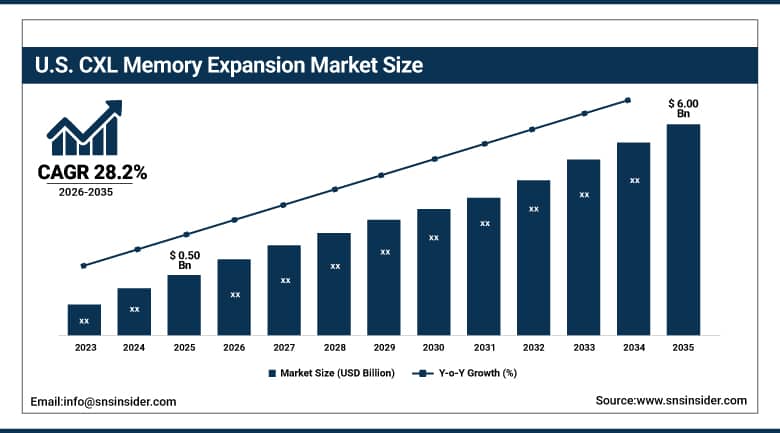
The U.S. CXL Memory Expansion Market was valued at approximately USD 0.50 Billion in 2025 and is projected to reach approximately USD 6.00 Billion by 2035, registering a CAGR of approximately 28.2% from 2026 to 2035.
In the United States demand continued to be shaped by aggressive hyperscale cloud provider investment in AI infrastructure, sustained CHIPS and Science Act support for domestic semiconductor fabrication capacity, and the strong presence of AI research institutions and national laboratories driving early CXL adoption. Rising deployment of CXL memory modules and controllers by domestic hyperscale data center operators continued reinforcing the country's position as both the largest and most innovation-driven market tracked in this report. Growing adoption across AI inference serving, in-memory database acceleration, and defense-related high-performance computing programs added further layers of sustained domestic demand well beyond the technology's original data center memory expansion use case.
Samsung Electronics expanded its CXL memory module portfolio throughout 2025 with new higher-capacity CMM-D devices, targeting AI inference and in-memory database workloads across U.S.-based hyperscale data center customers.
CXL Memory Expansion Market Segment Analysis
-
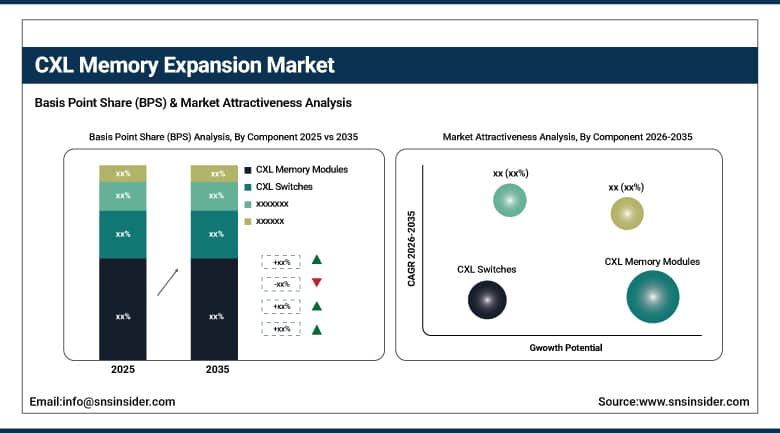
By Component, CXL Memory Modules dominated the CXL Memory Expansion Market with a 41.00% share in 2025, while CXL Switches is the fastest-growing segment with a CAGR of 31.20% from 2026–2035.
-
By Deployment Architecture, Memory Expansion dominated the market with a 56.00% share in 2025, while Memory Pooling is the fastest-growing segment with a CAGR of 32.40% from 2026–2035.
-
By Application, AI & Machine Learning Inference dominated the market with a 39.00% share in 2025, while AI Data Preparation & Vector Databases is the fastest-growing segment with a CAGR of 34.10% from 2026–2035.
-
By End-User, Hyperscale Cloud Providers dominated the market with a 54.00% share in 2025, while Enterprise Data Centers is the fastest-growing segment with a CAGR of 30.60% from 2026–2035.
By Component, CXL Memory Modules Lead While CXL Switches Grow Fastest
The CXL Memory Modules segment dominated the CXL Memory Expansion Market in 2025 owing to its status as the foundational hardware component required for any CXL-based memory expansion deployment across hyperscale and enterprise data centers. System integrators continue prioritizing memory module procurement given their direct role in delivering the additional memory capacity that drives CXL adoption. Continued volume ramp among leading memory suppliers has kept CXL memory modules the largest single revenue contributor within the component landscape tracked in this report.
The CXL Switches segment is the fastest growing in the CXL Memory Expansion Market owing to accelerating adoption of memory pooling architectures that require switch fabric to connect multiple hosts to shared memory resources across composable infrastructure designs. Data center architects increasingly deploy CXL switches to enable dynamic memory allocation across compute nodes rather than static point-to-point memory expansion. Growing hyperscaler investment in composable infrastructure continues accelerating demand for CXL switch fabric technology across the industry.
By Deployment Architecture, Memory Expansion Dominates While Memory Pooling Records Fastest Growth
The Memory Expansion segment dominated the CXL Memory Expansion Market in 2025 due to its status as the simplest, most mature CXL deployment model requiring only point-to-point connection between a host processor and additional memory capacity. Data center operators continue favoring memory expansion as the initial entry point into CXL adoption given its straightforward integration into existing server architectures. Sustained early-stage CXL deployment has kept memory expansion the largest overall contributor to market revenue.
The Memory Pooling segment is the fastest growing in the CXL Memory Expansion Market owing to rising hyperscaler interest in composable infrastructure architectures that dynamically allocate shared memory resources across multiple compute nodes to improve utilization efficiency. Data center architects increasingly favor pooling architectures to reduce stranded memory capacity across server fleets. Growing hyperscaler investment in composable data center design continues accelerating demand for memory pooling deployment architectures.
By Application, AI & ML Inference Leads While AI Data Preparation Grows Fastest
The AI & Machine Learning Inference segment dominated the CXL Memory Expansion Market in 2025 due to persistent key-value cache memory pressure created by continuous AI model serving across hyperscale GPU clusters. Cloud providers continue prioritizing CXL memory expansion given the segment’s scale and unpredictable memory growth patterns during production inference workloads. Sustained global AI inference deployment growth has kept this application the largest overall revenue contributor across the market.
The AI Data Preparation & Vector Databases segment is the fastest growing in the CXL Memory Expansion Market owing to rising demand for expanded memory capacity to support large-scale data preprocessing and vector embedding storage ahead of AI model training and retrieval-augmented generation workloads. Data engineering teams increasingly require CXL-based memory expansion to handle growing vector database indices. Accelerating global generative AI infrastructure investment continues driving sustained growth in this application segment.
By End-User, Hyperscale Cloud Providers Lead While Enterprise Data Centers Grow Fastest
The Hyperscale Cloud Providers segment dominated the CXL Memory Expansion Market in 2025 due to sustained early adoption of CXL memory technology to support massive-scale AI training and inference infrastructure requiring memory capacity beyond native DRAM limitations. Hyperscalers continue driving the majority of CXL memory expansion procurement given their central role in early ecosystem development. Continued hyperscale AI infrastructure investment has kept this end-user segment the largest overall contributor to market revenue.
The Enterprise Data Centers segment is the fastest growing in the CXL Memory Expansion Market owing to rising enterprise interest in memory disaggregation as CXL controller and software ecosystem maturity improves accessibility beyond early hyperscale adopters. Enterprise IT teams increasingly evaluate CXL memory expansion to optimize infrastructure costs and improve resource utilization. Growing OEM platform support for CXL capability continues accelerating enterprise adoption of memory expansion technology.
Regional Analysis
|
Region |
Major Country |
Share within Region, 2025 (%) |
|---|---|---|
|
North America |
United States |
92.00% |
|
Europe |
Germany |
24.00% |
|
Asia Pacific |
Taiwan |
34.00% |
|
Middle East and Africa |
Israel |
27.00% |
|
Latin America |
Brazil |
28.50% |
North America CXL Memory Expansion Market Insights
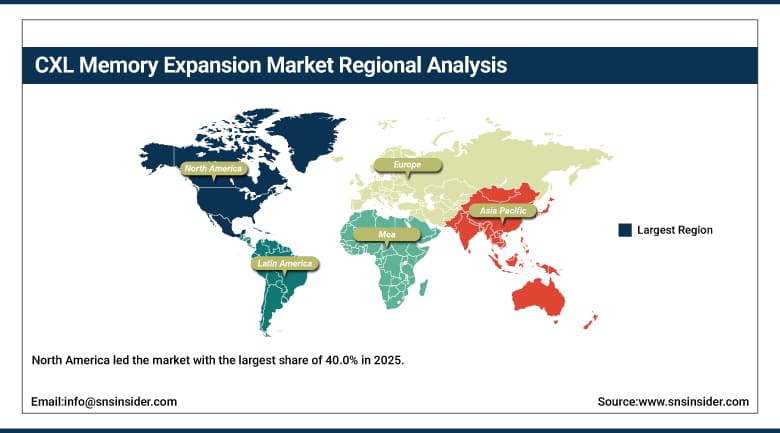
North America led the market with the largest share of 40.0% in 2025. Aggressive hyperscale cloud provider investment in AI infrastructure, sustained CHIPS and Science Act support for domestic semiconductor fabrication capacity, and the strong presence of AI research institutions and national laboratories continued reinforcing the region’s dominant position. Growing deployment of CXL memory modules and controllers across hyperscale, enterprise, and defense-related high-performance computing applications further strengthened North America’s standing as both the largest and most innovation-driven market tracked in this report, with continued hyperscaler capital expenditure expected to sustain regional demand through the forecast period.
The United States anchored by its concentration of leading hyperscale cloud providers and substantial AI infrastructure investment. Canada added further regional demand through its own growing data center investment, and that combined strength kept the continent the largest addressable market for CXL memory expansion vendors through the forecast period, with continued generative AI infrastructure buildout expected to sustain regional demand.
Get Customized Report as Per Your Business Requirement - Enquiry Now
Europe CXL Memory Expansion Market Insights
Europe held a meaningful share of global revenue, supported by growing sovereign AI infrastructure investment and continued expansion of enterprise data center capability across the region’s major economies. Regulatory momentum around data sovereignty requirements continued shaping regional infrastructure investment priorities without meaningfully slowing commercialization across the continent, while sustained enterprise and research computing demand kept the region among the more resilient CXL memory expansion markets tracked in this report.
Germany led demand of European revenue, supported by planned sovereign AI computing investment and its substantial enterprise data center base. The UK and France contributed additional demand, and continued European investment in sovereign AI infrastructure should keep regional demand for CXL memory expansion technology climbing steadily through the forecast period.
Asia Pacific CXL Memory Expansion Market Insights
Asia Pacific is advancing at the fastest pace among all regions, registering a CAGR of 33.0% from 2026 to 2035, driven by expanding hyperscale and enterprise data center construction, growing domestic memory manufacturing capability, and sustained government-backed investment in advanced computing infrastructure across the region’s largest economies. That combination of manufacturing scale and genuine downstream data center demand kept the region’s growth trajectory well ahead of every other region tracked in this report, with hyperscale cloud infrastructure investment adding a further, sustained layer of demand.
Taiwan led the pack, supported by its substantial server ODM manufacturing base and deep integration into global hyperscale supply chains. China and South Korea contributed meaningful additional demand, with South Korea’s advanced memory manufacturing capability and China’s expanding data center construction both reinforcing the region’s position as the fastest-growing CXL memory expansion market tracked in this report.
MEA and Latin America CXL Memory Expansion Market Insights
The Middle East and Africa and Latin America both showed steady growth, driven by expanding data center infrastructure investment, growing government focus on digital transformation initiatives, and rising enterprise demand for high-performance computing capability across both regions. As these markets continued building out modern data center infrastructure, CXL memory expansion technology proved a genuinely valuable enabler of increasingly capable, locally hosted AI and enterprise computing environments.
Israel led Middle East and Africa demand, supported by the country’s established semiconductor design presence and substantial multinational research and development investment. Saudi Arabia and the UAE contributed further demand through large-scale AI data center announcements. In Latin America, Brazil accounted for the largest share of regional revenue, with growing cloud computing and data center investment continuing to anchor regional demand for CXL memory expansion technology.
Market Dynamics
Growth Drivers: Rising AI Memory Demand and Composable Infrastructure Adoption
The industry is driven by rising adoption of CXL memory modules in hyperscale AI server deployments, growing demand for memory disaggregation to overcome DRAM capacity limitations, expanding integration of CXL controllers and switches supporting composable infrastructure, and increasing key-value cache memory pressure from large language model inference workloads. As hyperscalers and enterprises continue prioritizing memory capacity beyond fixed CPU socket limitations, the need for expanded CXL memory technology continues driving sustained investment across the industry.
Rising generative AI infrastructure buildout continues reinforcing this driver, as large-context inference and model serving workloads require memory capacity far exceeding what native DRAM configurations can economically provide. Growing PCIe Gen 5 and Gen 6 adoption continues defining a further layer of sustained demand, and that combination of AI infrastructure investment and interconnect bandwidth improvement is exactly what keeps overall demand climbing at such a steady, sustained pace.
Restraints: Ecosystem Immaturity and Software Compatibility Challenges
The relative immaturity of the CXL software ecosystem continues posing a genuine restraint on faster market-wide expansion, as operating system and hypervisor support for memory pooling and disaggregation architectures remains under active development across major platform vendors. That immaturity has kept advanced CXL deployment scenarios concentrated among early-adopter hyperscalers with dedicated engineering resources.
Ongoing latency overhead associated with CXL memory access relative to native DRAM continues posing a further restraint, as certain latency-sensitive workloads remain better served by traditional memory architectures despite CXL’s capacity advantages. Interoperability testing requirements across competing CPU, memory, and controller vendors in certain deployment scenarios keep some qualification timelines more administratively complicated than traditional memory upgrades ever required.
Opportunities: Memory Pooling Expansion and Enterprise Ecosystem Maturation
Rising memory pooling and disaggregation adoption represents a genuinely significant opportunity, as hyperscalers and enterprises increasingly seek to improve memory utilization efficiency across server fleets rather than provisioning fixed memory capacity per server. Vendors positioned early in composable memory infrastructure technology stand to capture meaningful share as this capability continues expanding from simple memory expansion into broader pooling and sharing architectures.
Expanding enterprise CXL ecosystem maturity offers a second substantial opportunity, as growing OEM platform support and improving software compatibility continue lowering adoption barriers beyond early hyperscale customers. Vendors with proven, enterprise-ready CXL memory technology stand to capture meaningful share as global enterprise AI adoption continues scaling across established and emerging data center markets alike.
Recent Developments:
-
2026: Marvell launched the Structera S 30260, a 260-lane CXL switch designed for rack-level memory pooling, enabling data centers to access disaggregated memory resources outside individual servers.
-
2026: Montage Technology announced industry-first trial production of its CXL 3.2 Memory eXpander Controller, supporting PCIe 6.x, CXL 3.2, and DDR5 memory for AI and data-center memory expansion.
-
2024: Marvell Technology introduced its Structera CXL memory expansion and pooling platform, designed to enable composable memory architectures for next-generation AI and high-performance computing server designs.
CXL Memory Expansion Companies are:
-
Samsung Electronics Co., Ltd.
-
SK Hynix Inc.
-
Astera Labs, Inc.
-
Intel Corporation
-
Advanced Micro Devices, Inc. (AMD)
-
Rambus Inc.
-
Montage Technology Co., Ltd.
-
Microchip Technology Incorporated
-
MaxLinear, Inc.
-
Xconn Technologies, Inc.
-
Panmnesia, Inc.
-
ScaleFlux, Inc.
-
Elastics.cloud, Inc.
-
GigaIO Networks, Inc.
-
H3 Platform Inc.
-
Liqid Inc.
-
Dell Technologies Inc.
-
Hewlett Packard Enterprise Company (HPE)
CXL Memory Expansion Market Report Scope:
| Report Attributes | Details |
|---|---|
| Market Size in 2025 | USD 1.35 Billion |
| Market Size by 2035 | USD 16.55 Billion |
| CAGR | CAGR of 28.5% From 2026 to 2035 |
| Base Year | 2025 |
| Forecast Period | 2026-2035 |
| Historical Data | 2022-2024 |
| Report Scope & Coverage | Market Size, Segments Analysis, Competitive Landscape, Regional Analysis, DROC & SWOT Analysis, Forecast Outlook |
| Key Segments | • By Component (CXL Memory Modules, CXL Controllers, CXL Switches, Software & Orchestration) • By Deployment Architecture (Memory Expansion, Memory Pooling, Memory Sharing/Disaggregation) • By Application (AI & Machine Learning Inference, AI Data Preparation & Vector Databases, High-Performance Computing & Scientific Computing, In-Memory Databases, Cloud & Hyperscale Data Centers) • By End-User (Hyperscale Cloud Providers, Enterprise Data Centers, Research Institutions & National Laboratories, Others) |
| Regional Analysis/Coverage | North America (US, Canada), Europe (Germany, UK, France, Italy, Spain, Russia, Poland, Rest of Europe), Asia Pacific (China, India, Japan, South Korea, Australia, ASEAN Countries, Rest of Asia Pacific), Middle East & Africa (UAE, Saudi Arabia, Qatar, South Africa, Rest of Middle East & Africa), Latin America (Brazil, Argentina, Mexico, Colombia, Rest of Latin America). |
| Company Profiles | Samsung Electronics Co., Ltd., Micron Technology, Inc., SK Hynix Inc., Astera Labs, Inc., Intel Corporation, Advanced Micro Devices, Inc. (AMD), Marvell Technology, Inc., Rambus Inc., Montage Technology Co., Ltd., Microchip Technology Incorporated, MaxLinear, Inc., Xconn Technologies, Inc., Panmnesia, Inc., ScaleFlux, Inc., Elastics.cloud, Inc., GigaIO Networks, Inc., H3 Platform Inc., Liqid Inc., Dell Technologies Inc., Hewlett Packard Enterprise Company (HPE). |

Frequently Asked Questions
The major growth factor is rising AI infrastructure memory demand, growing memory disaggregation adoption, and expanding composable data center infrastructure investment.
The CXL Memory Modules segment dominated the CXL Memory Expansion Market by component, representing the largest share of revenue in 2025.
North America dominated the CXL Memory Expansion Market in 2025, holding an estimated 40.0% share of total global market revenue.
